Feeds:
Posts
Comments

After a rewarding but hands-on week of guests from breakfast to dinner time, we awoke this morning in an empty house.

The only sounds were familiar ones: Beau’s bells and his pleading cries for food–poor starving mite!

The golden Orioles flew hither and thither warbling bonjour. Good to have them back–heralds of the beginning of something–though these days the weather is so changeable you cannot be sure what season it’s trying to be.

The Hoopoes spotted up the road would confirm it’s summer that approaches.

(How amazing that this pair of eccentric-looking birds [or their offspring] return to the same spot each year–how discerning of them to pick our neck of the woods!)

Our neighbor, Serge, called by at 9am with a box of his hens’ very brown and very large eggs–as he had promised to do a couple of weeks back, even before Meredith presented a pot of honey  to him on her diplomatic honey run.

They are extraordinarily brown and made deeply yellow and satisfying omelets for lunch under the greening fig.

The tree’s first fruit crop is fattening fast after so much rain.

These early figs always promise more than they deliver. We have to wait ’til  August for the second crop.

A whiff of donkey dung challenged the senses at lunch under the fig tree and reminded us of the party on Saturday in the courtyard.

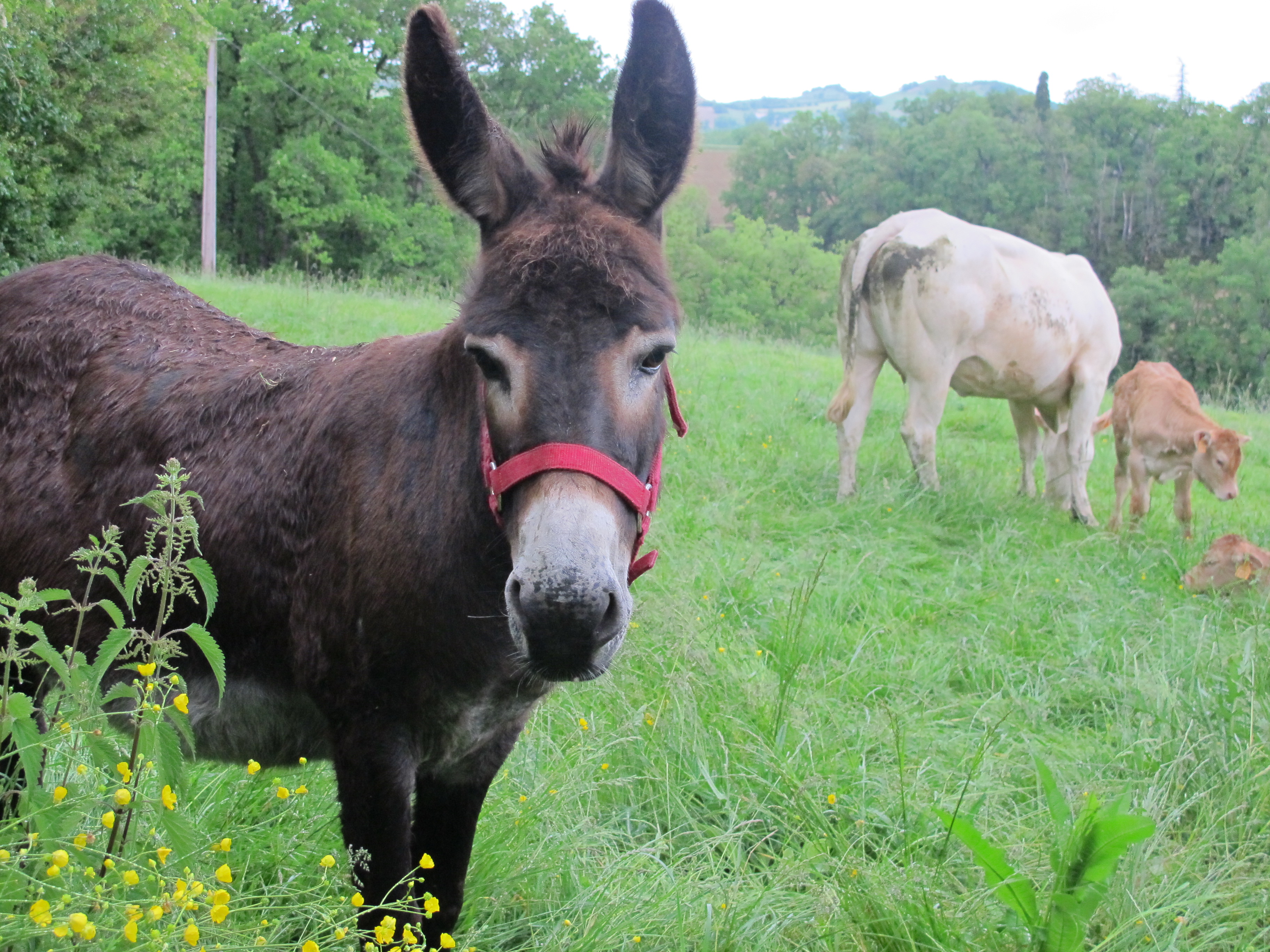
It was graced by Sybil, who demonstrated her initial doubts about attending by marking her patch with a pile, almost green as the figs above!

Later, after all the attention lavished upon her, she startled everyone with an enormous HEE–HAW of appreciation, which won her even more pats and plaudits.

The weather has been difficult–either too cold or too wet–for  local growers the last couple of months, reducing  the availability of seasonal vegetables.

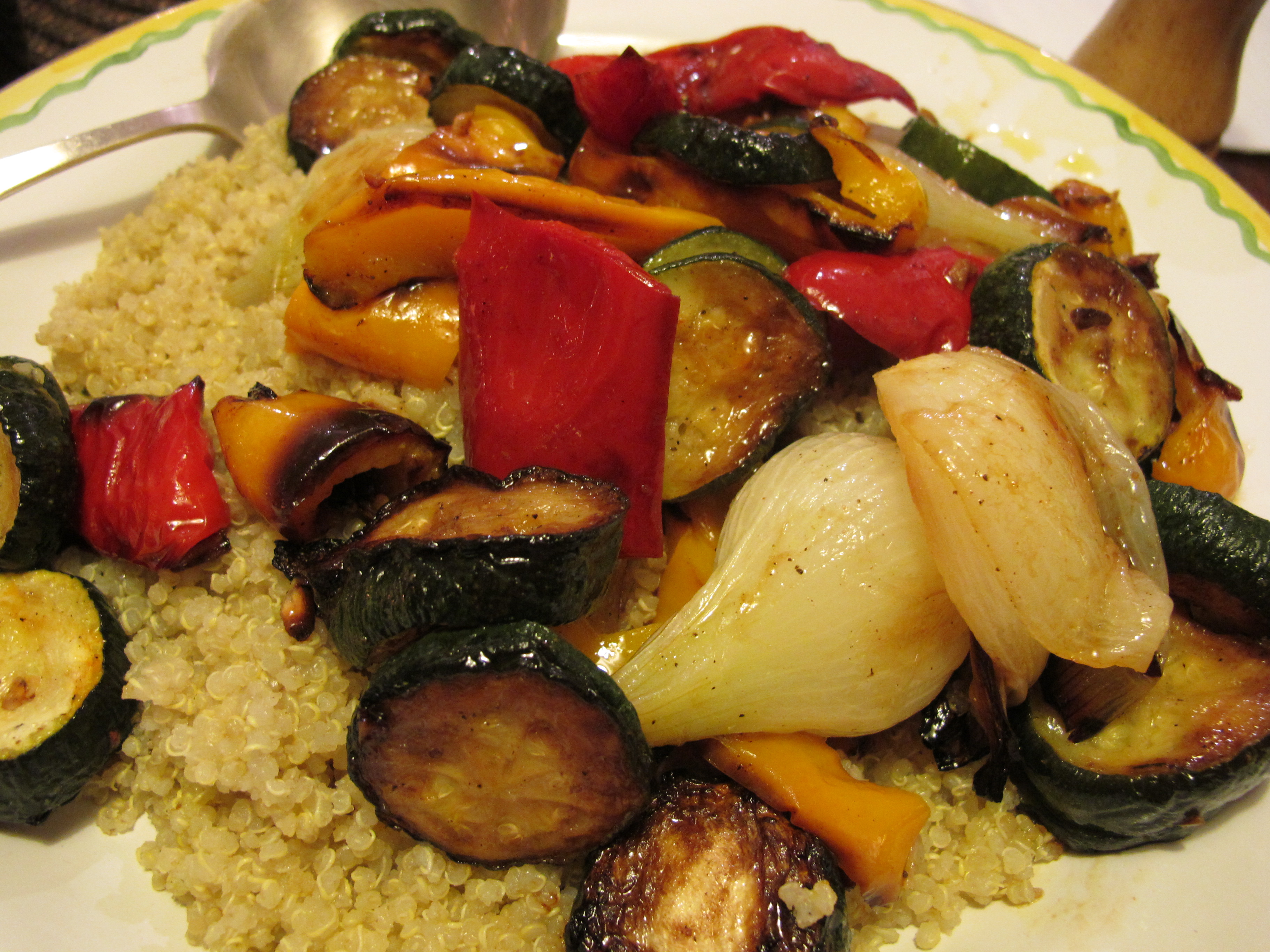
Looking for something to cook a couple of nights ago I found some courgettes and peppers from a trip to the supermarket and remembered a recipe inspired by Delia Smith and featured in my cookbook, Delicious Dishes for Diabetics.

Delia calls it Roast Ratatouille and includes cherry tomatoes and aubergines [eggplant]–but a simpler version is worth a go, I thought….

It was a tasty and healthy supper–served it on a bed of quinoa with a yogurt sauce.

for four

3 courgettes

3 red peppers

3 sweet/red onions–quartered

2 garlic cloves–chopped

2 tablespoons olive oil

salt and pepper

set the oven to 240C/460F

  • cut up the vegetables in largish chunks.
  • Put them in a bowl, add the oil and sprinkle  over the garlic.
  • Turn everything over carefully to coat the vegetables with the oil.
  • Line a shallow oven tray with foil.
  • Brush the foil with olive oil.
  • Empty the bowl onto the tray and spread the vegetables evenly over it.

  • Put the tray on the top level of the oven.
  • Roast for 20minutes or until the vegetables are nicely charred–(not burnt!)

Last scene of all that ends this strange eventful history

Is second childishness… (Shakespeare: As You Like It

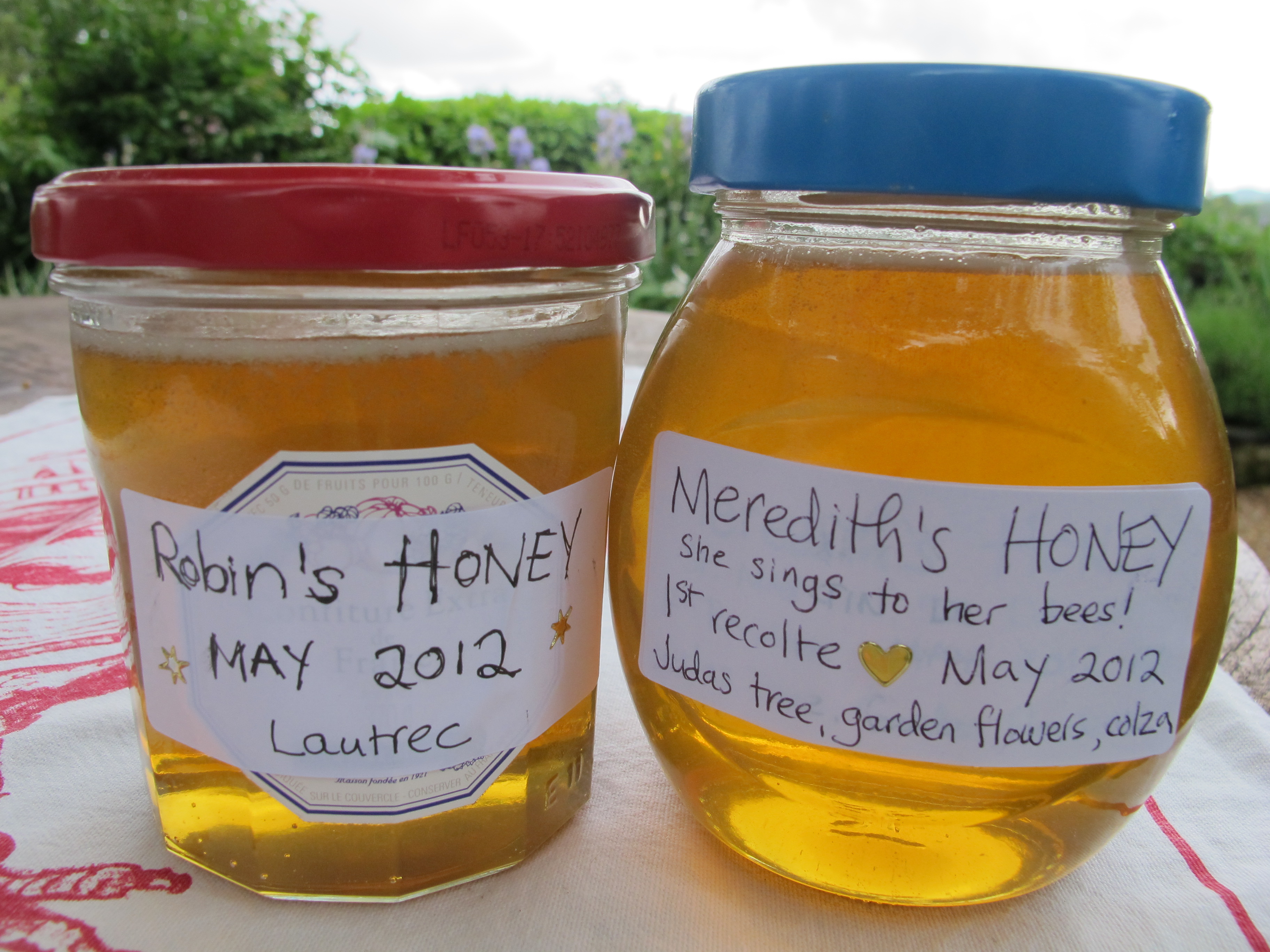
from mere DELIGHT to see this GOLDEN TREASURE potted–(not Shakespeare)!

obviously meant for each other!

Meredith set off yesterday evening to make the rounds of our neighbors with a basket of pots.

She calls it Honey Diplomacy or HD  (HD is in our minds as we’ve just bought our first high definition TV after 12 years).

She returned an hour later light on honey but weighed down with compliments and the promise of the loan of Sybil, our young farming neighbors’ pretty donkey, for an event here Saturday afternoon.

Sybil pricked up her ears on hearing about the party this Saturday!

…from the local Amazon service in the UK, France, Italy, Germany  and Spain!

The postage and packaging charges should be significantly cheaper than when ordering it from the US.

The revision is 9000 words longer and tells the sad story of the how the promising third series of Poldark failed to materialise– plus further stories of life after Poldark, including our move to France and how a passion for cooking and a diagnosis of Type Two diabetes had very positive consequences…

There are many more photos, some from Winston Graham’s private collection, taken when he and his wife Jean joined us on location in Cornwall during the filming of the second series.

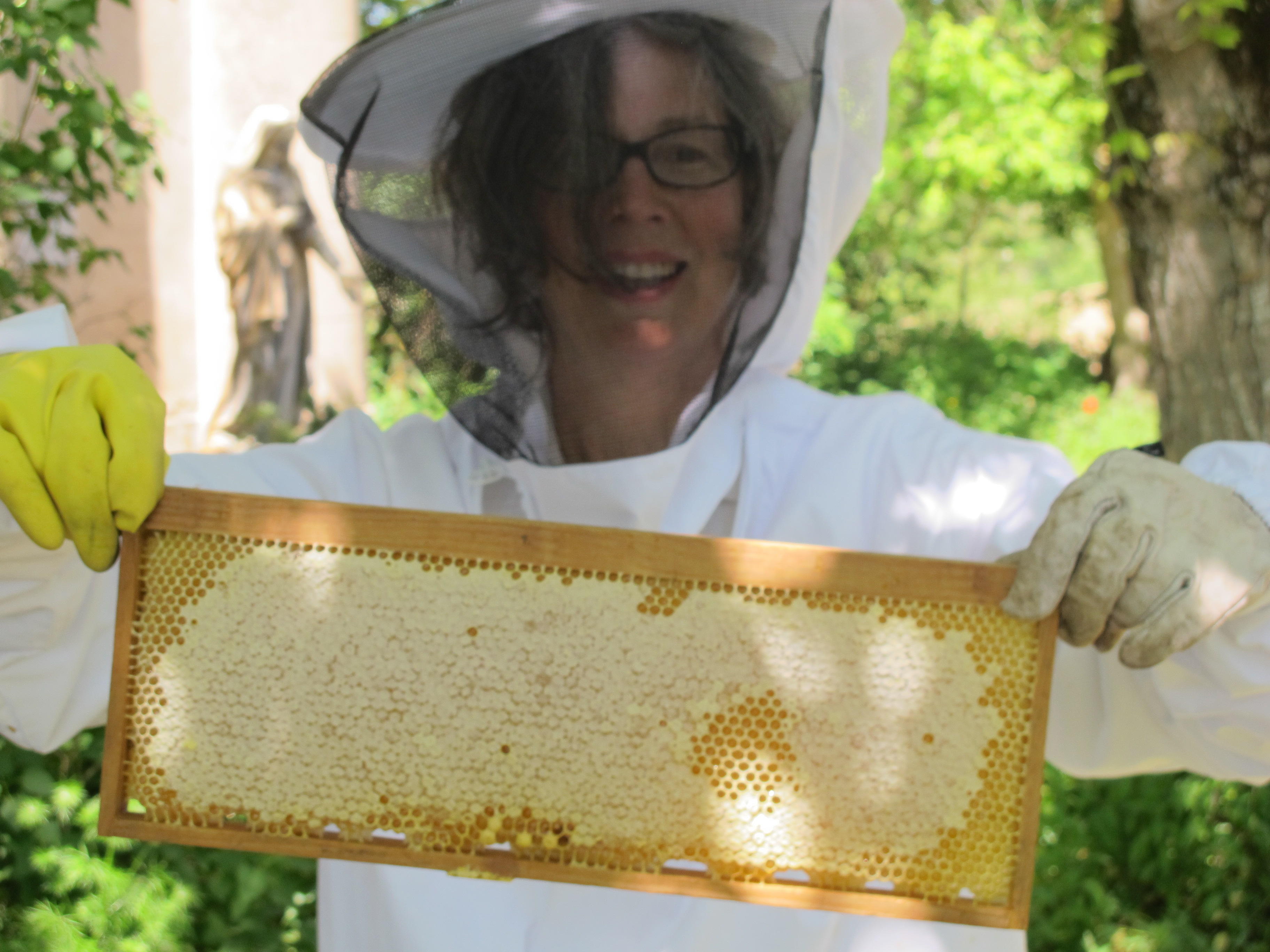
We were as busy as our bees have been–yesterday.

Well Meredith and Alice were–my role was to snap the event as best I could, in the buzzing zone.

I did get to wear the same protective clothing this time.

It may look silly but it gets you to the coal face or rather the hive side.

Alice had promised to bring the costume for me, so there was no escape.

After enduring peels of unkind laughter from the two campaign veterans as I struggled–without breaking my  glasses–to pull the slightly-too-small hood over my head;

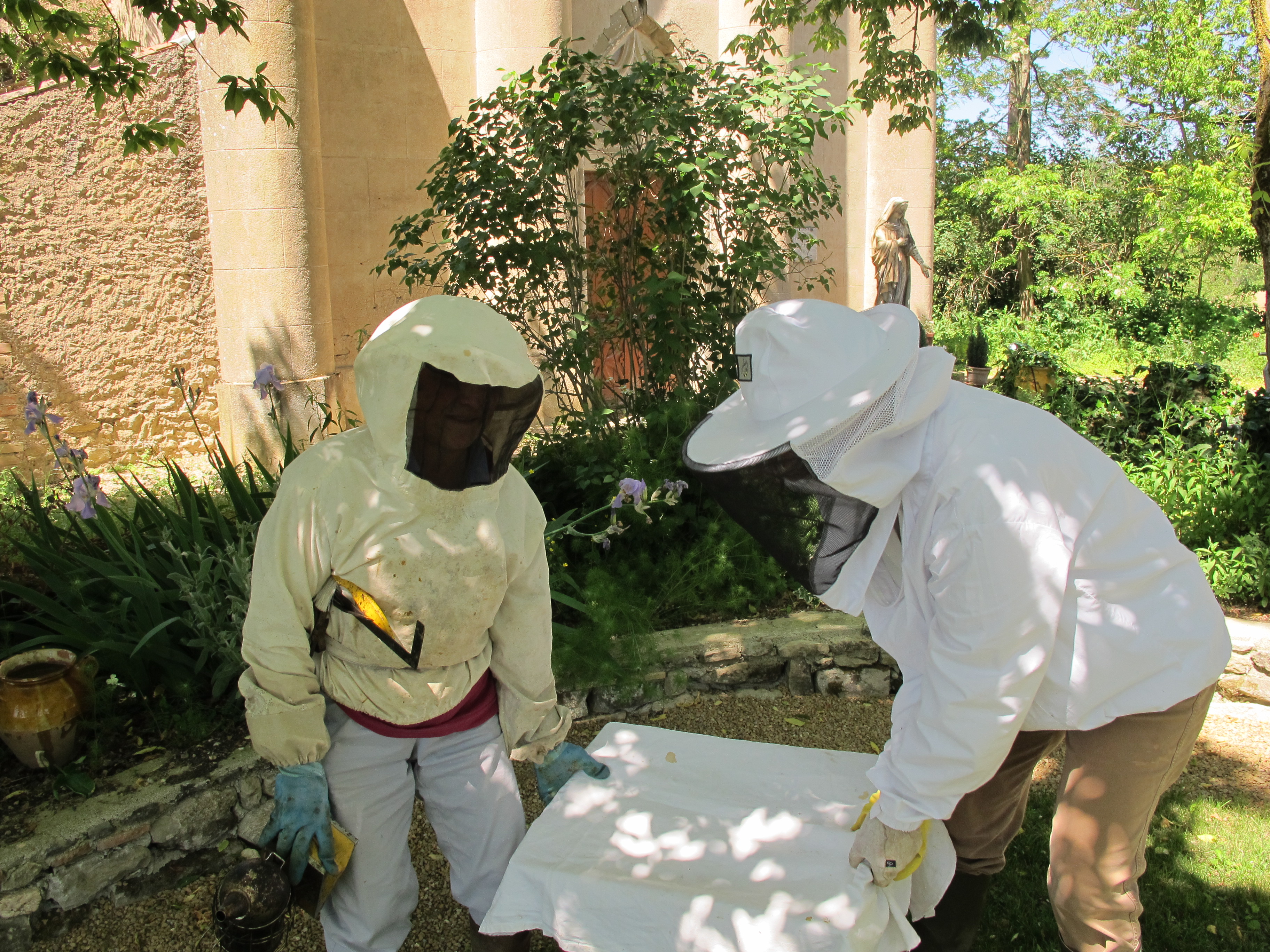
we all made our way to the hive at the end of the garden.

The bees were hard at it–an impressive sight–milling round the hive entrance, anxious to make their deliveries.

Bees just visible–top centre

The smoke gun was smoking and the two intrepids–brushes at the ready–were quickly at work.

The third intrepid–camera at the ready–found being in the danger zone quite exhilarating, now that the astronaut-like look gave him license to roam!

No need to swat or duck and dive this time, just smile benignly from the safe side of the veil.

Click-click-click-buzz-buzz-buzzzzzzzz-swooosh-swooosh-swooosh (smoke gun noise)–a hive of activity in fact!

“Rich pickins!”

Soon Alice and Meredith were taking the “rich pickins” off up the garden away from the aggrieved bees

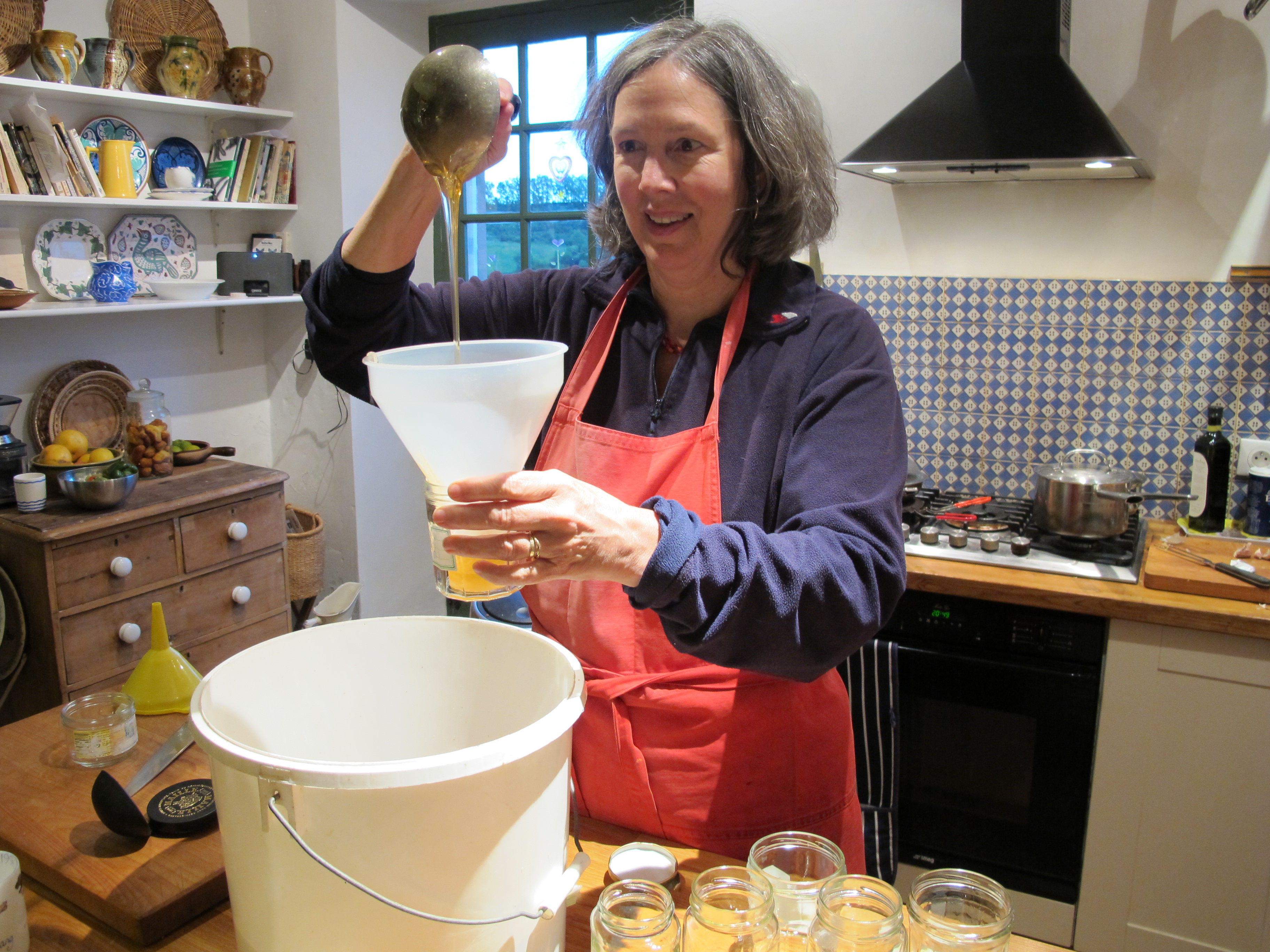
and after de-robing themselves, to Alice’s work place chez elle, to scrape off the honey and admire the recolte (harvest).

Meredith came into the kitchen about an hour later a broad smile on her face saying:

Home is the hunter home from the sea and the bee-keeper home from the hive–

and carrying, with some effort, a large white tub containing seven and a half litres of honey!

And then there’s the matter of the three new chicks…

Frances Ashcroft

The word Diabetes focused my interest.

Yesterday morning I was listening with half an ear to a radio trailer for a programme coming on in an hour.

BBC’s Radio 4 is running a series profiling scientists and their work in various fields called The Life Scientific.

Frances Ashcroft was the subject for this episode.Who is she?

The search for a cure for diabetes goes on in medical research centers all over the world and nearly every day newspaper headlines announce that somewhere a team of scientists has made a major breakthrough.

Usually these often sensational pronouncements hover around the ether for a week or so and then get filed in the memory bank and the teams of scientists return to their work benches and microscopes to continue their quest for a cure.

Until yesterday morning Frances Ashcroft was one such anonymous boffin to me.

Now, thanks to the BBC’s ever inquiring spirit she has come into three dimensions–and hers is a good story.

To quote from Wikipedia, her work “with Professor Andrew Hattersley has helped enable children born with a rare form of diabetes–neonatal–to switch from insulin injections to tablet therapythus making the condition infinitely easier to cope with for thousands of very young sufferers and their parents.

Prof. Ashcroft with some of the youngsters helped by her discoveries.

Her enthusiasm and passionate commitment to the cause make it a compelling listen.

 Listen here to the BBC radio piece.

It encourages me to believe that one fine day–with people like Professor Ashcroft on the case–a cure to Type 2 diabetes will be found.

The ultimate goal-according to her Oxford University Dept’s websiteis to elucidate how a rise in the blood glucose concentration stimulates the release of insulin from the pancreatic beta-cells, what goes wrong with this process in type 2 diabetes, and how drugs used to treat this condition exert their beneficial effects.

In other words : to discover what causes Diabetes.

This is a short film on her now available on YouTube.


I’m planning a cooking workshop in Lautrec the first weekend in October, based on my cookbook, Delicious Dishes for Diabetics and healthy, simple recipes in the Mediterranean tradition.

Lautrec

What’s on the menu?

  • A three-and-a-half day workshop in Lautrec (department of the Tarn in southwest France), in a charming small hotel with a magnificent garden and lovely views.
  • We’ll make our meals and eat them together.
  • All meals and wine are included.
  • Group size limited to about six people (non-cooking partners or traveling companions are welcome to come along and enjoy the meals we prepare for a supplement).
  • Excursions to local markets.
  • All participants have their own private room with en-suite bathrooms.
The focus:
Preparing (and enjoying) healthy recipes based on the Mediterranean way of eating.
My cookbook and blog will be the springboard for the recipes–depending on what is in season.
Dates:
Starting Thursday afternoon, Oct. 4th and finishing Sunday night, Oct. 7th with the farewell meal;
Departure the following morning, Monday, Oct. 8th 2012–i.e. four nights, three full days and a half-day on arrival.
Who might come:
Anyone interested in developing a wider repertoire of healthy recipes that can be enjoyed by the whole family.

What’s the venue?
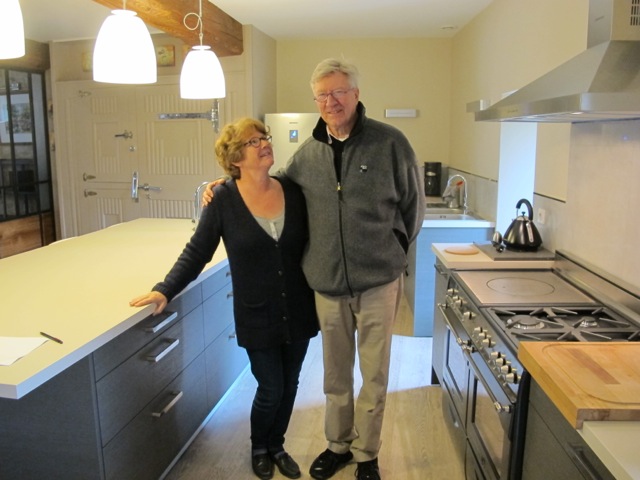
A beautiful new demonstration kitchen in a charming small hotel in the centre of Lautrec:

With Dominique, the owner of La Terrasse de Lautrec in the special workshop kitchen.

La Terrasse de Lautrec

Many more photos of La Terrasse and Lautrec here: http://tinyurl.com/LautrecWorkshop

Lautrec is a medieval bastide–a fortified hilltop village with a population of about 1000 people.
It enjoys the official recognition as Un des plus beaux villages de France [one of the most beautiful villages in France].

Lautrec

It is famous for it’s pink garlic (l‘ail rose)–one of the staples of Mediterranean cooking.
The nearest airports are Toulouse Blagnac (about 1 hour 20 minutes drive) served by BA, Air France and Easy Jet amongst others.
Carcassonne Airport (served by RyanAir) is about the same distance.
Castres also has a small airport with a limited service from Paris.
The nearest train station is Castres, about 15 minutes drive.
Cost: 1000 euros
(as of today’s currency rates, in dollars that is $1288 (US) or in Sterling,  £800)
Transportation from airport to Lautrec can be arranged for an extra fee.
Note: the venue is not suitable for people with mobility problems–i.e. there are stairs to the first floor and no elevator.
To book or for further info, contact Meredith:
meredithwheeler1@gmail.com

Our neighbor Alice came round yesterday afternoon with a small plastic bag of mushrooms–a present for me, she said.

Mousserons she called them–I asked her to write it down, I had never heard of them.

They were delicate looking–white on top and underneath.

If I’d seen them in a field I would have avoided them; I’m wary of wild mushrooms.

Merci beaucoup, Alice–on les cuisine comment? [How do you cook them?]

With a bechamel sauce or a sauce made from veal bones.

“Ah,” I said,  thinking, “Not quite my style!”

Then sprinkled with parmesan and browned in the oven.

“Ah–oui?” I was surprised that Alice–French countrywoman that she is– would think of using Italian cheese in her cooking.

Mousserons have a short season, Alice said, and grow in (fairy) circles.

She knows where to look for mushrooms. Last year she brought us some delicious morels–pretty, brown and conically shaped.

We had the mousserons last night, cooked less ambitiously: sautéed in olive oil and served on a piece of toast brushed with garlic.

Alice then suggested to Meredith it was time to check on the bees.

The colza crop in the fields nearby is coming to an end and the acacia trees are about to bloom.

The honeycombs are full in our hive and need clearing to make room for the new harvest.

Alice had brought her togs and the two of them got ready to go to work.

Meredith asked me to take photos of the scene.

Untogged so to speak, I followed them out to the edge of the garden where our single hive sits.

The worker bees were busy coming and going with their gatherings.

Meredith  pumped the smoke gun to calm them and Alice lifted the first comb.

I was standing with the camera at a safe distance–I thought. (In any case, I’m not scared of bees, wasps or even hornets–ho hum!)

As I leant towards the hive, struggling to get a better angle on what was happening, I suddenly sensed one of the worker bees buzzing round my head.

“Get away! get away!” I spluttered–trying to shoo it off with my free hand while the camera-holding hand graphically recorded the moment of panic.

Unlike a fly or mosquito or any other self-respecting insect that would have taken the hint, this bee was clearly on a mission and having none of it. It continued to harass  me.

Inelegantly climbing over the just-bloomed iris, I whipped off my glasses, bending down to put them and the camera on the ground, while trying to fend off  the determined bee.

On your fleece!–on your fleece!” cried Alice.

Expecting to feel a sharp pain at any moment I pulled the blue fleece over my head, catching sight of the bee clinging to the collar.

I ignominiously exited the garden on the run, pursued by a bee not a bear,

Triumphant bee!

as the much quoted stage direction in Shakespeare’s A Winters Tale has it!

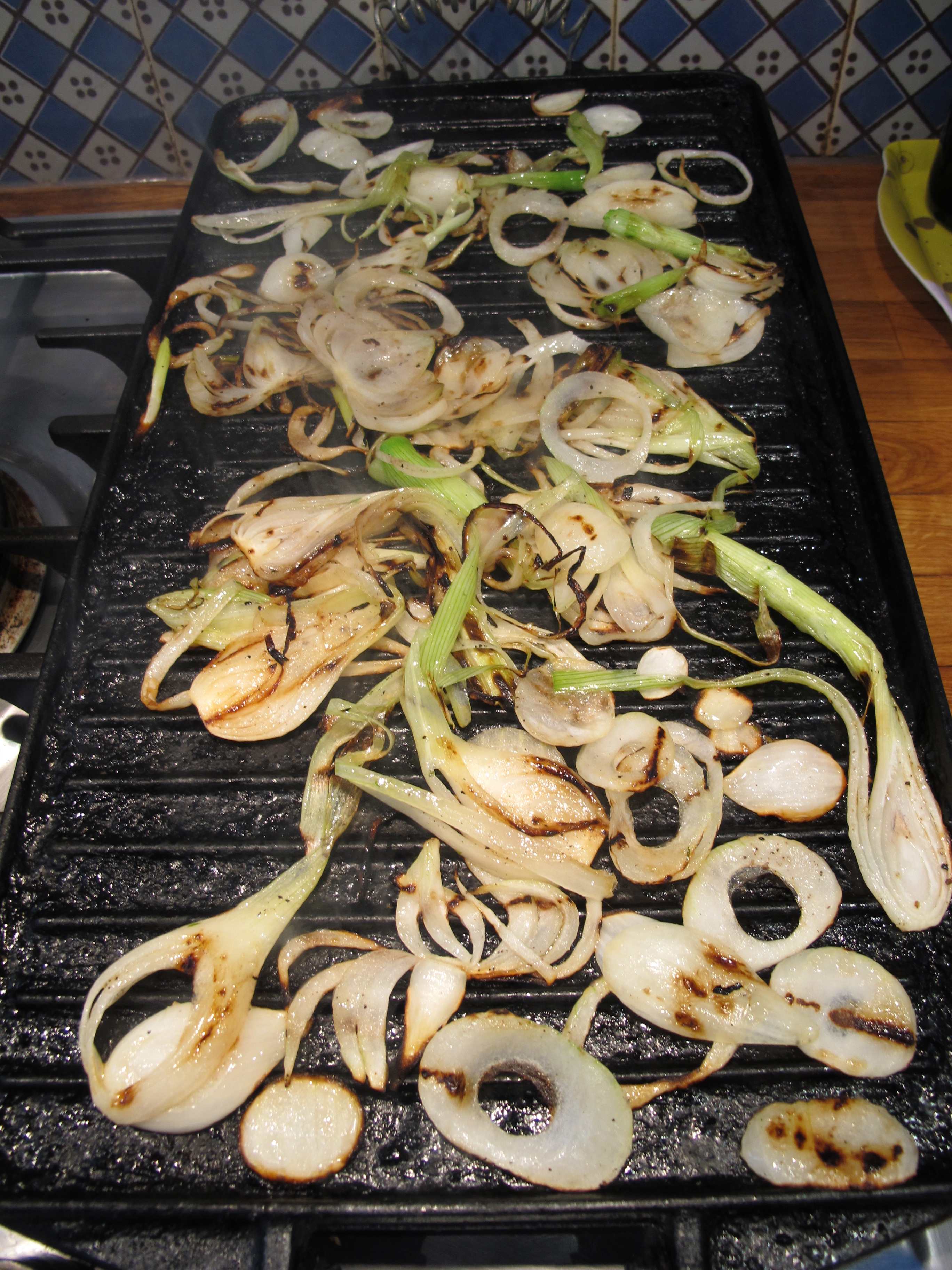
Food writer Hugh Fearnley-Whittingstall wrote about this  simple and delicious idea a couple of weeks back.

Not easy to use up all the spring onions/scallions in a bunch and this makes handy use of the stragglers in the fridge.

How many you do depends on the size of your grill–a bunch at a time on an average grill perhaps.

A warning though–once you start eating them it’s hard to stop picking at the pile on the serving plate.

for 2

a couple of bunches of spring onions/scallions

1 tblsp olive oil

salt

a squeeze of lemon juice

a sprinkling of olive oil

salt and pepper

  • Heat an iron grill pad gently to hot.
  • Slice the onions lengthwise fairly thinly–taking care not to include a finger in the process.
  • Put them in a bowl and add the tablespoon of olive oil.
  • Turn the onions over in the oil to coat them nicely.
  • Add a pinch of salt.
  • When the pad is hot, tip the onions over it and spread them out evenly so they all get a chance to char a little.
  • Turn them and rearrange them as they color up and soften.
  • About five to seven minutes should do it but it depends on the grill and how many onions you are cooking at one go.
  • Transfer the onions back to the bowl, sprinkle with salt and pepper, a little more olive oil and the squeeze of lemon juice.

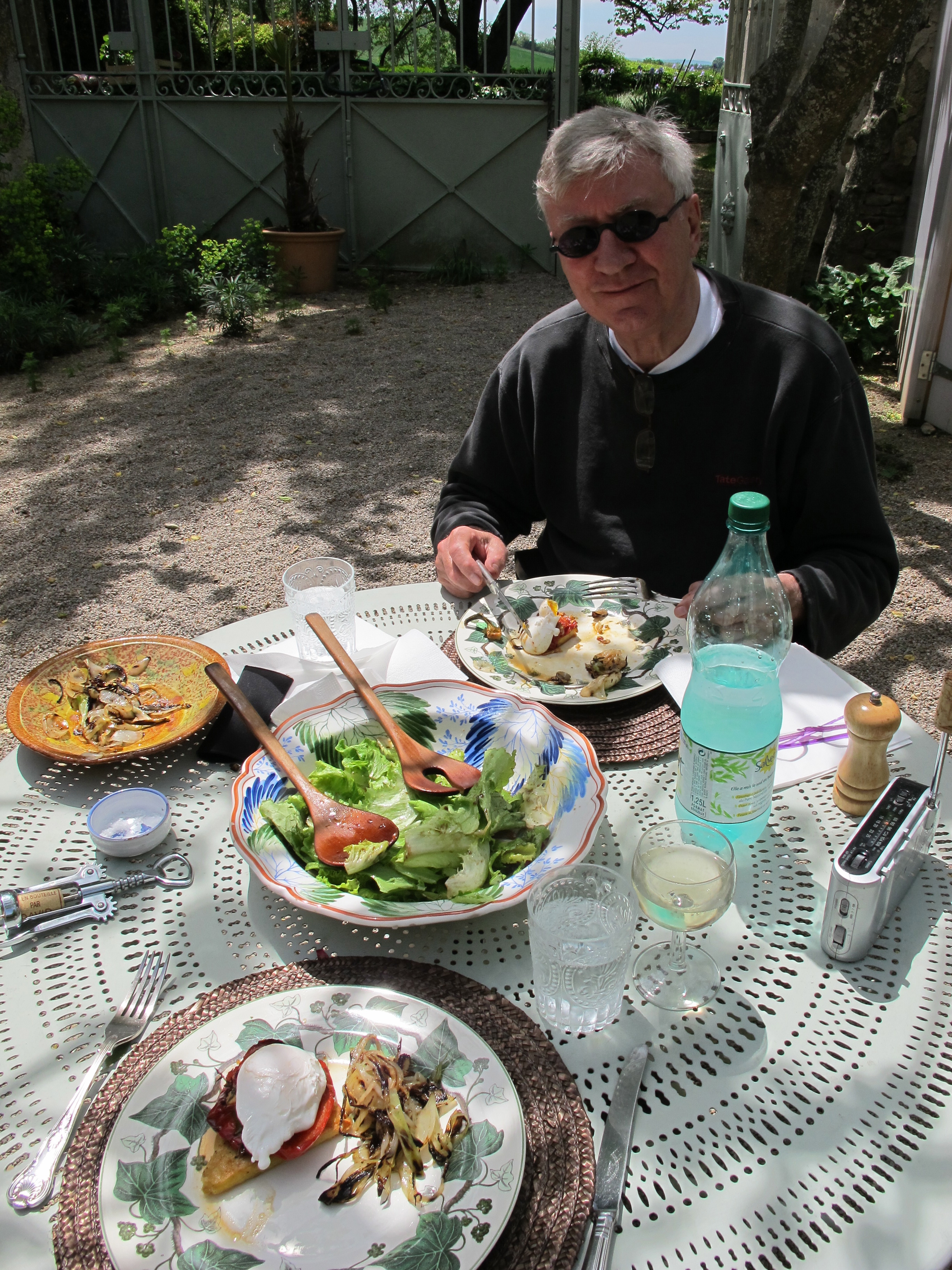
A tasty addition to a lunch plate of left-over roasted red pepper with a poached egg on top…

Happy timing…

As a kid growing up in the fifties, my ear glued to the radio, I often heard Stanley Holloway (who created the role of Alfred Doolittle in the musical,  My Fair Lady)

A face to make you feel better!

reciting and singing one of his song/monologues called My word you do look queer (which dates it somewhat!)–about a man who gets up in the morning feeling better after an illness.

Making his way to the pub he meets friends who tell him how ill he looks–close to death’s door in fact.

He starts to believe them, but just before he expires he bumps into his old mate Jenkins, who says how bonny he looks–and he realizes he’s not really ill anymore.

I’m having trouble shaking off the aftermath of my cold and woke up with a long face and feeling chesty again. “My word I do feel queer,” I thought.

By happy chance and proving that sometimes  a little outside input can put the spring back in your step, our friend Katherine Talmadge, renowned Washington dietitianwhose  single-minded commitment and energy made the event in Georgetown happen a few weeks back, emailed me a recent post this morning.

She’s in California helping her mother recover from an operation with her healthy cure.

I made my usual breakfast which includes some of the elements recommended by Katherine–yogurt, strawberries, oats, oat milk, a prune, cinnamon–and began to feel better, my face regaining its normal shape.

Thanks Katherine!