Feeds:
Posts
Comments

I was later to the market than usual on Saturday and my favorite chicken stall had sold out of medium sized birds. There remained very large ones to feed a family or these neat little numbers she called coquelets. 

coquelet is a small chicken, aka a poussin–(though I read that an American poussin is larger*).

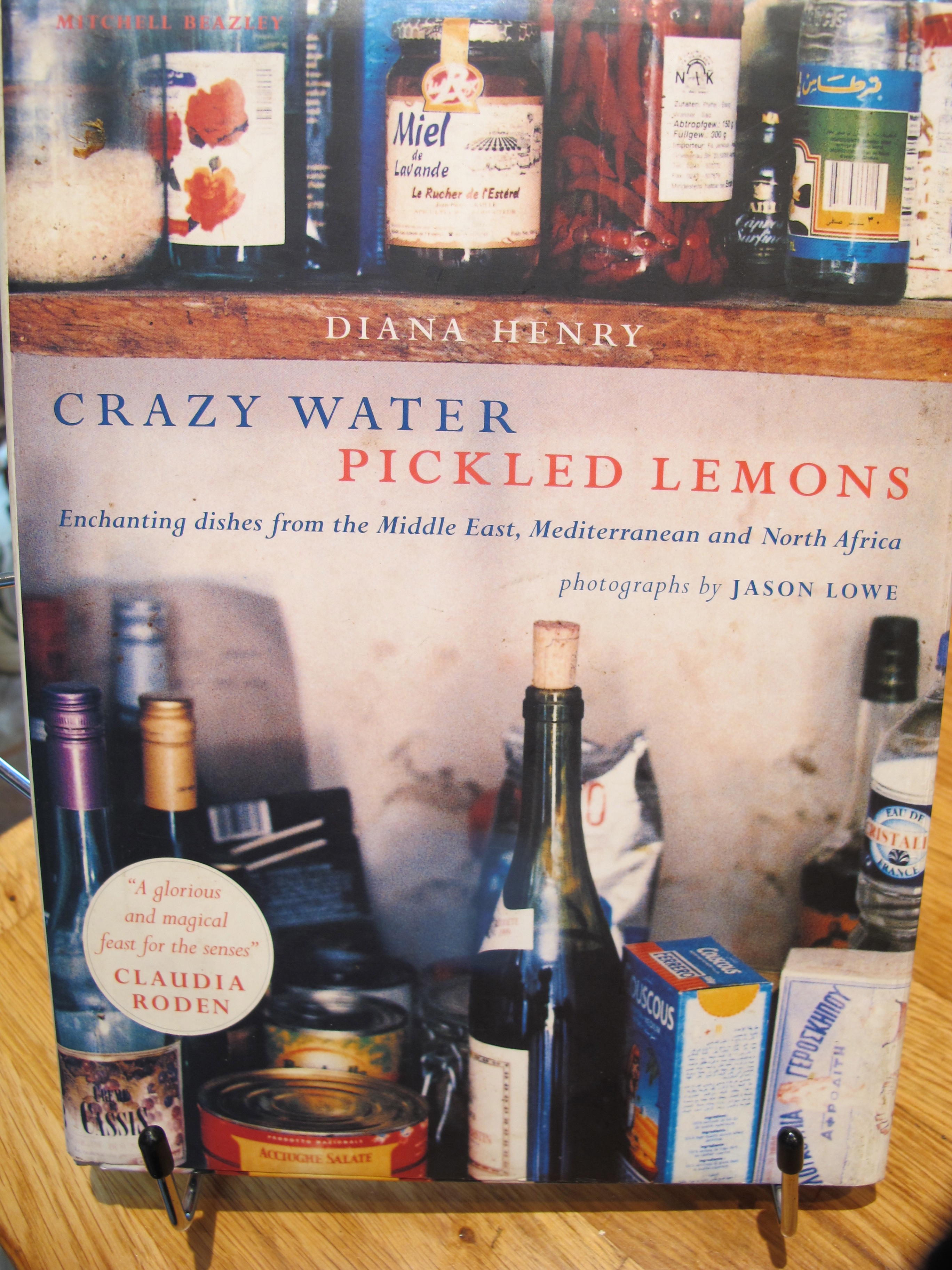
The one I bought on Saturday morning weighed two pounds, perfect for the recipe I remembered in Diana Henry’s lovely and unusual book Crazy Water and Pickled Lemons.
A simple marinade and a quick roast made this an agreeable and easy supper for the two of us–a treat in fact, with the oranges and lemon/lime twist in the marinade.

for 2

*1 small chickencoquelet-poussin–(if you can’t find a small chicken, a larger one could be spatchcocked to cut the cooking time)

2 oranges–quartered and then each quarter, halved

1 sweet potato--sliced in rounds (optional)

the marinade:

juice of 2 oranges + the rind of one**

juice of a lemon or lime + the rind

2 tblsps balsamic vinegar

2 garlic cloves–peeled and crushed

2 tblsps olive oil

2 tblsps dried oregano

a few thyme sprigs

salt and pepper

Mix the marinade ingredients together in a bowl.

Put in the chicken, breast side down and let it rest in the mixture, for 3 or 4 hours in our case–overnight if you can.
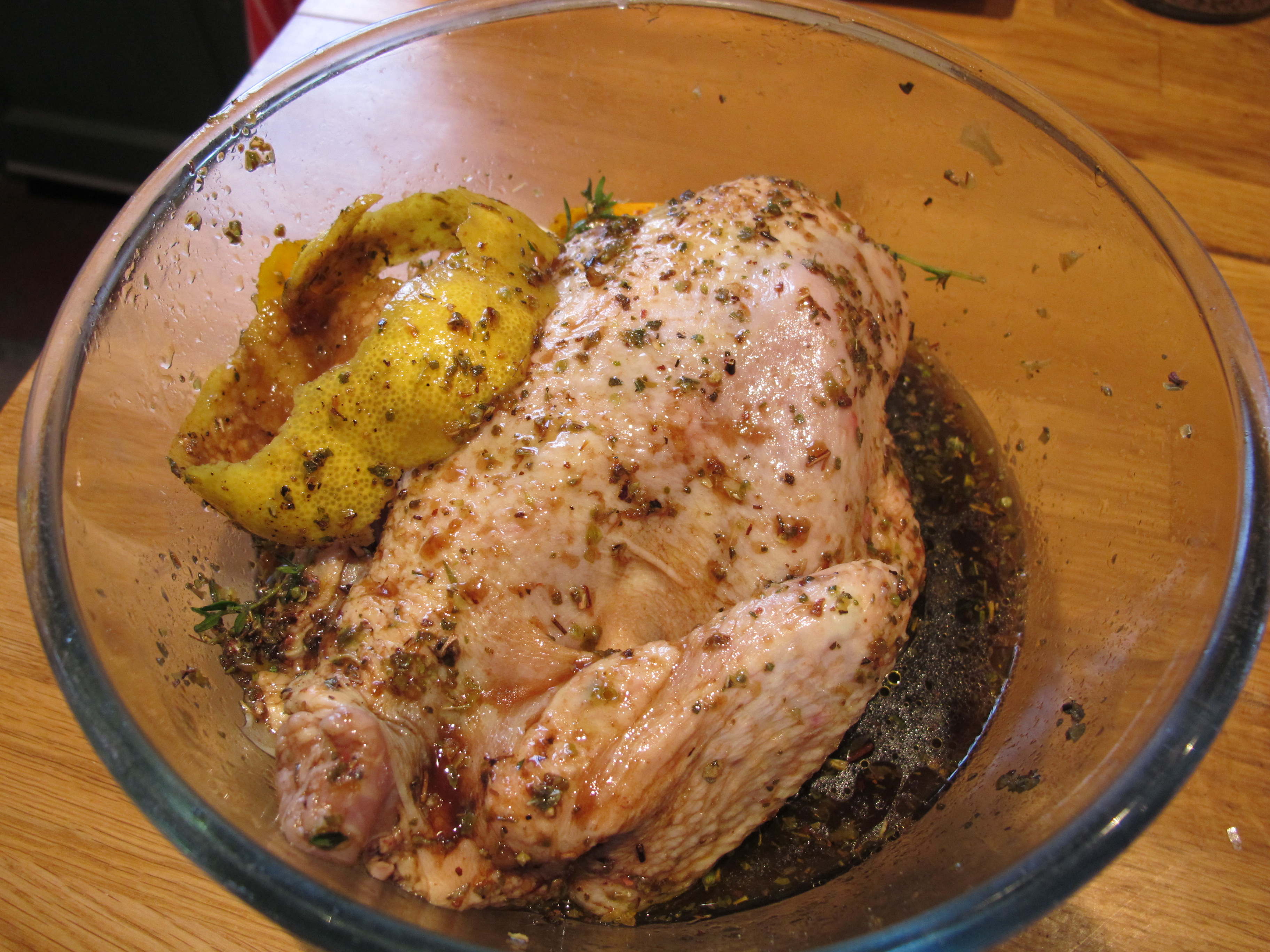
set the oven to 180C/350F

  • Put the chicken in a roasting tin surrounded snugly by the orange pieces and sweet potato slices (if using).
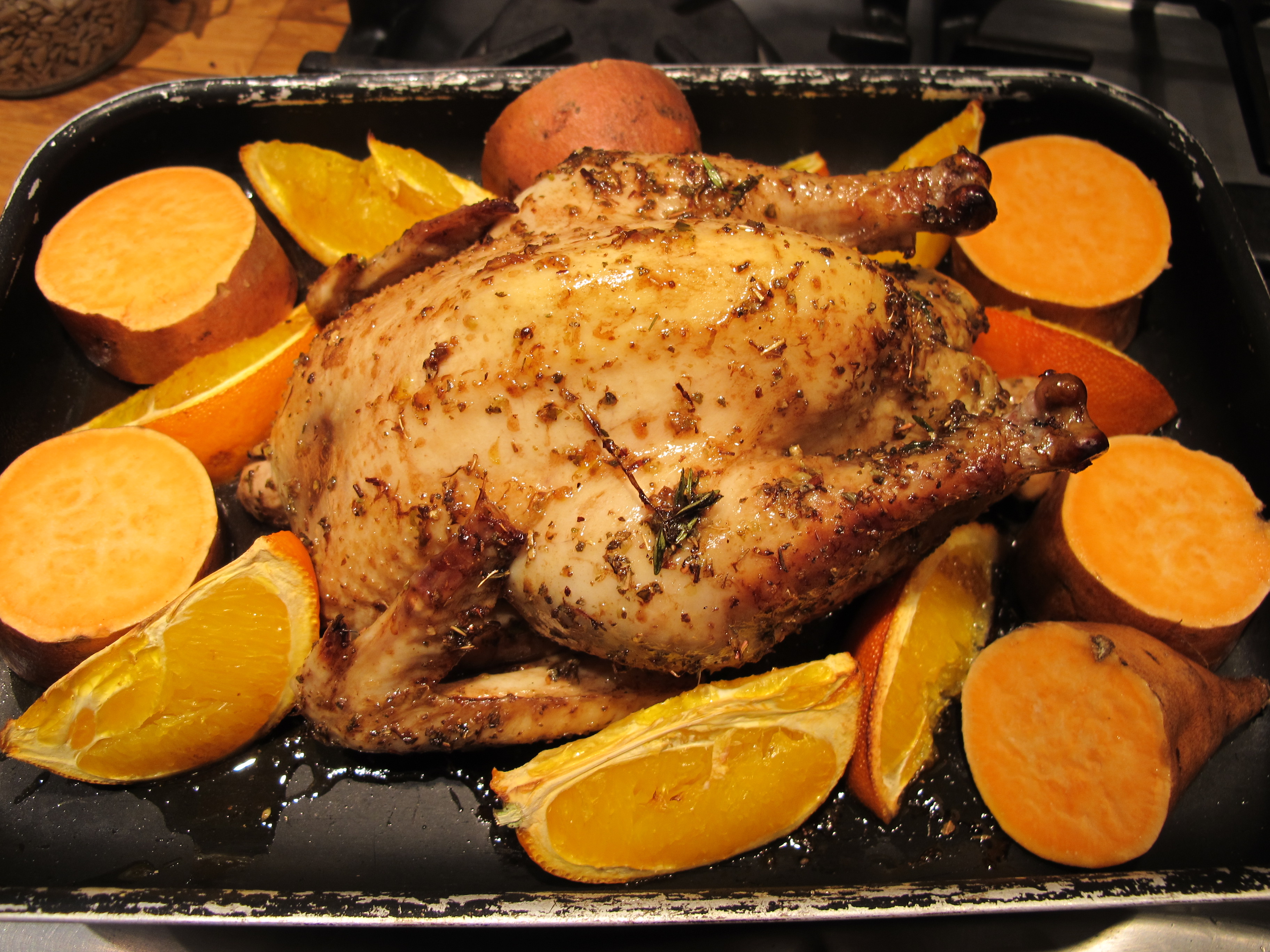
  • Pour a little of the marinade over the chicken.
  • Roast in the oven for an hour or more–depending on the size of the chicken.
  • Baste with the marinade two or three times.
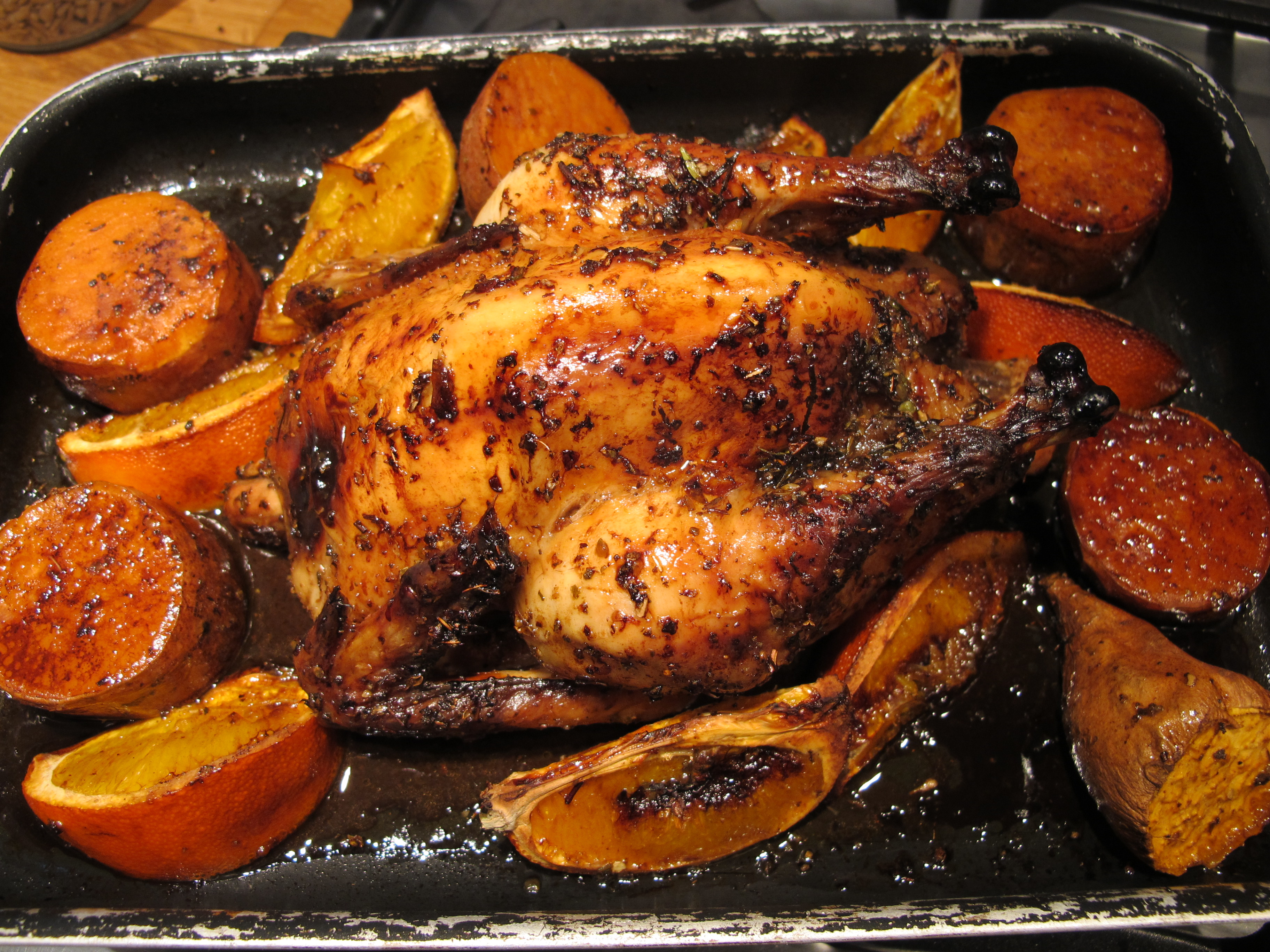
  • Let the chicken rest a little, keeping it warm under a sheet of foil.
  • Halve the bird from front to back, along the breast bone and the back bone–best done with kitchen sheers.
  • Remove the orange slices and the sweet potato slices to a warm dish.
  • Deglaze the pan with a couple of tablespoons of water, scraping off the sticky bits to dissolve them in the liquid.
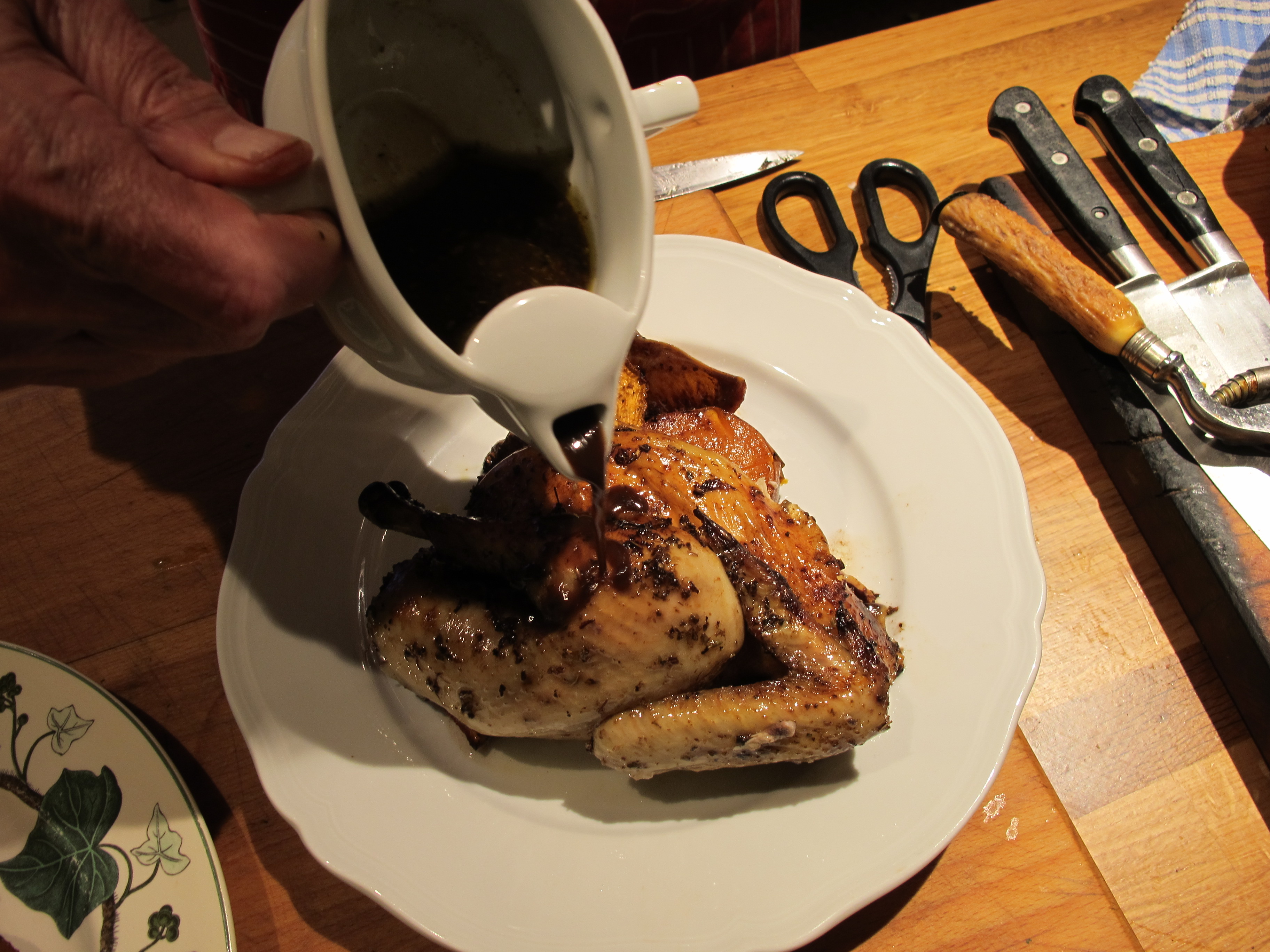
  • Heat the gravy through gently, while stirring.
  • Pour over the plated half-a-chicken and sweet potatoes.
**(Meredith wasn’t sure what the rind is and how it differs from the pith.  Same thing but the first is solid and obtained by carefully running a knife under the skin/rind, lifting it from the orange with as little of the white as you can. The second (pith) is scraped from the orange with a scraper/pither or a  call- it- what-you-willer!)

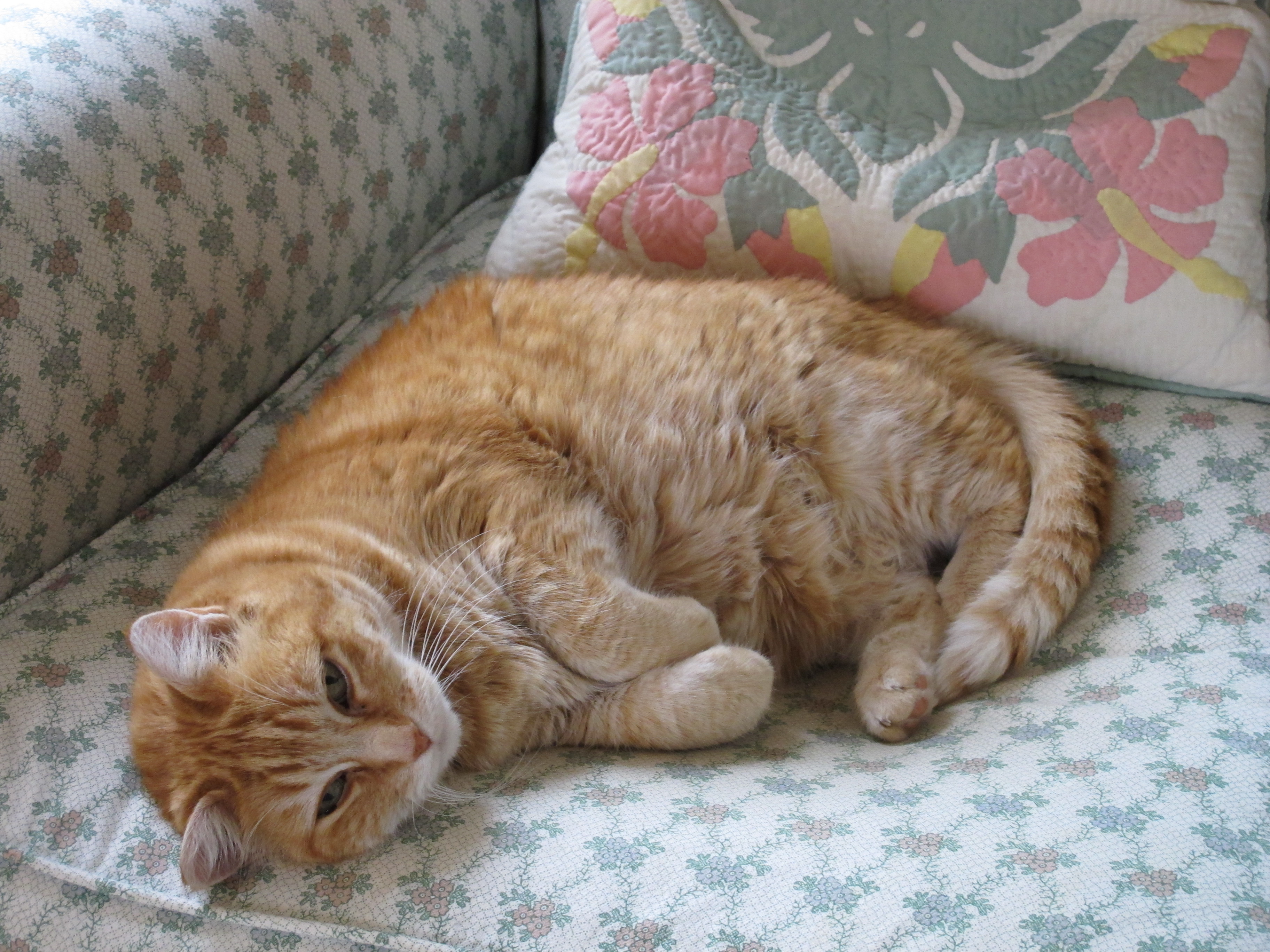
Getting back from an event in Toulouse on the late side last night, tired and hungry, we were welcomed as usual by the cats, pleased to see us no doubt, but like us–in need of a snack.

I had a plan to do a quick stir fry with some chicken breast that had been marinating in an interesting mix of soy, olive oil, orange and lemon juice and various spices—of which more in a later post—and got down to work.

Meredith came into the kitchen looking worried.

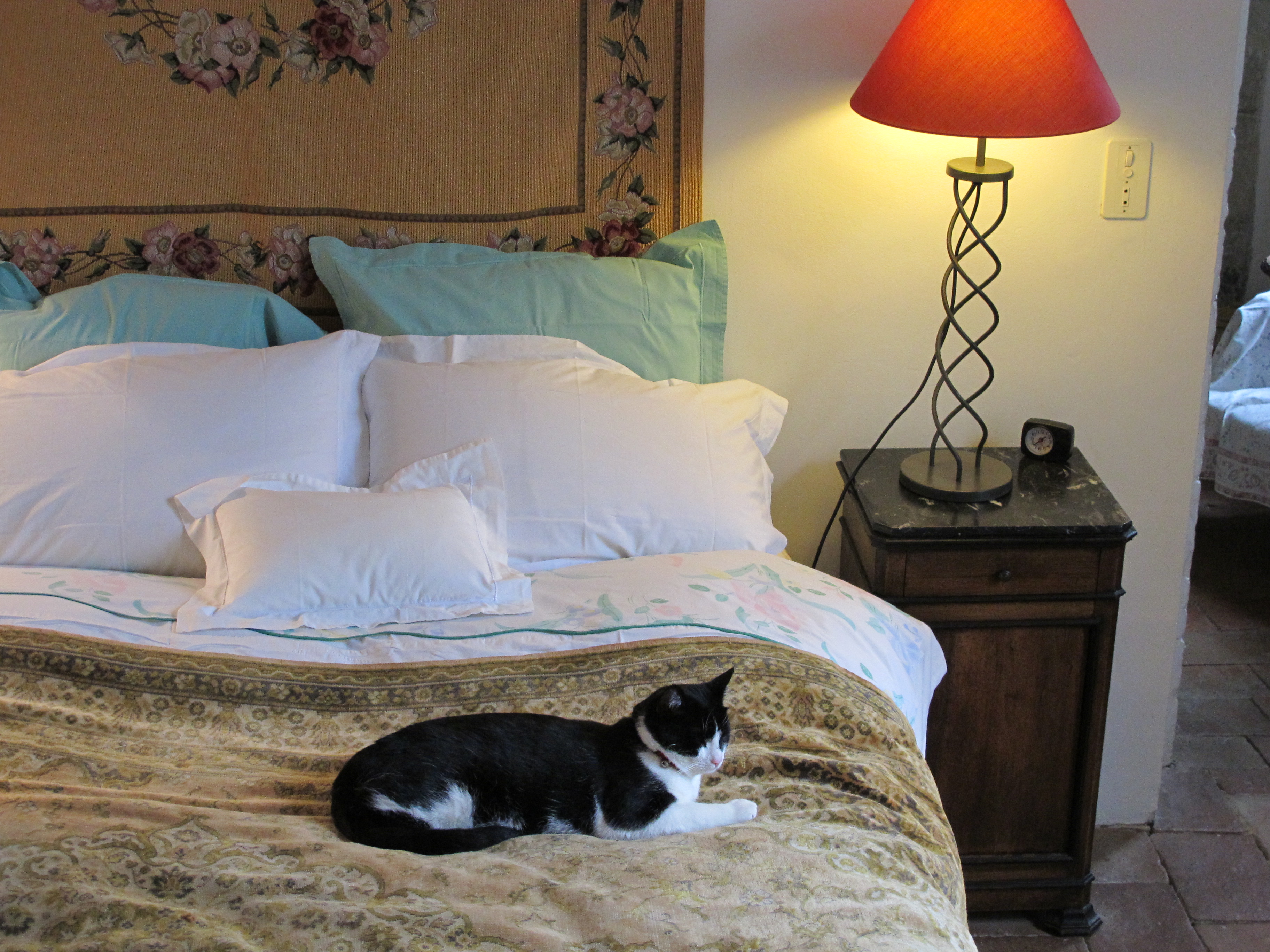
“Have you seen Beau [our young black & white cat]?”

I hadn’t.

Usually he’s the first in line when the tins start popping.

Maybe he’d got locked in the dependence when we hit the road after lunch.

He hadn’t.

I was hungry and needed to eat—so continued to cook.

A now very concerned Meredith went into the garden with a torch.

A few moments later, I heard her exclaim:

“There you are—Beau! what are you doing up there!?”

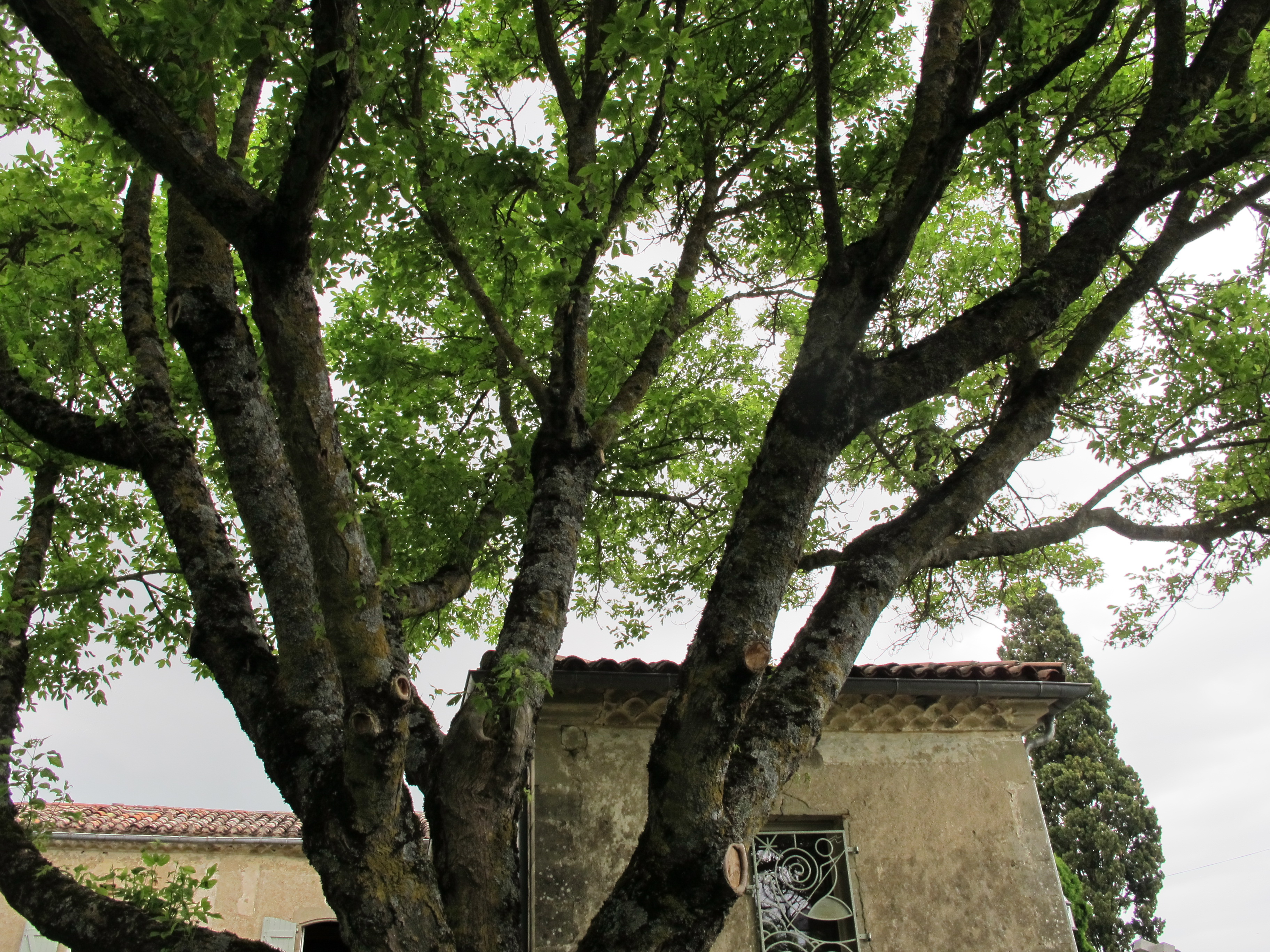
I went out into the garden and saw a marooned Beau, stuck—way up in one of the box elders.

Meredith had heard nothing at first in the garden but sensibly had taken out Beau’s toy squirrel with her.

He heard the irritating squeaky noise it makes when I step on it by mistake.

The familiar sound, usually associated in his mind with fun, unfroze the frightened young cat’s state of mind and he started mewing—

“I’m here—help!!”

He was well beyond our reach, in a tree that was easy to climb but a devil to descend from—even for an experienced cat.

It was 10.30 at night, in the middle of the French countryside and most of our neighbours–the ones with long ladders, for instance–would be tucked up in bed.

What to do?

“Here I am—help…!”

“Well I have to eat!” I heard myself saying—ruthlessly.

We sat down without enthusiasm and discussed the options.

Our friend Thierry might have a ladder long enough—our friend Mitch certainly had one but lives fifteen kilometers away.

Call the fire brigade?

All these seemed ridiculous at that time in the evening—and the last, expensive.

What price our beloved Beau?

We chewed on disconsolately.

After ten minutes and fortified by the food and a glass of wine, Meredith opened the front door and went out into the courtyard.

After the briefest pause, I heard her cry for the second time in half an hour…

“There you are!”

Moments later in walked Beau…

“Here I am!” and sprawled himself on the floor under the kitchen table–as though nonchalance was his second name.

Following him Pippa came in—head cat, the “mother of all cats”—who’d stayed outside while we were eating and–we like to believe—talked the youngster down from the tree!

Pippa–our heroine!

There followed a popping of tins!

And a period of reflection…

Our neighbor Richard, at the market this morning, enthused about the sound of swifts round the barn and the big blue sky.

On the drive home a hare peeked out to sniff the air–checking on Spring and whether it was safe to cross the road.

The bees are buzzing and beginning to busy themselves around the Judas tree.

The donkey up at the farm just eee-awed.

The walnut trees are leafing out at last.

Something is happening here (and you don’t know what  it is–do you Mr Jones!*)–and it’s about time!

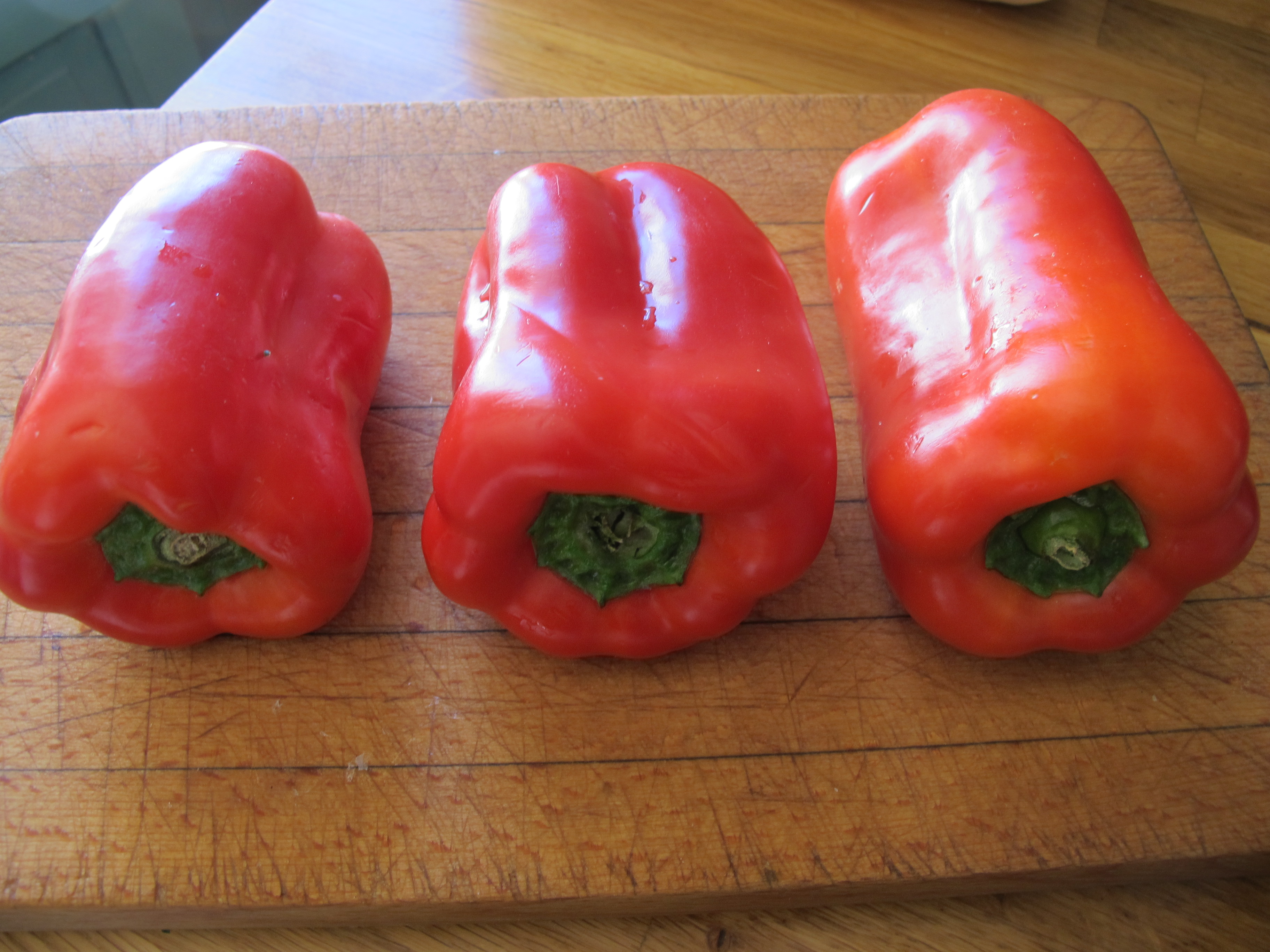
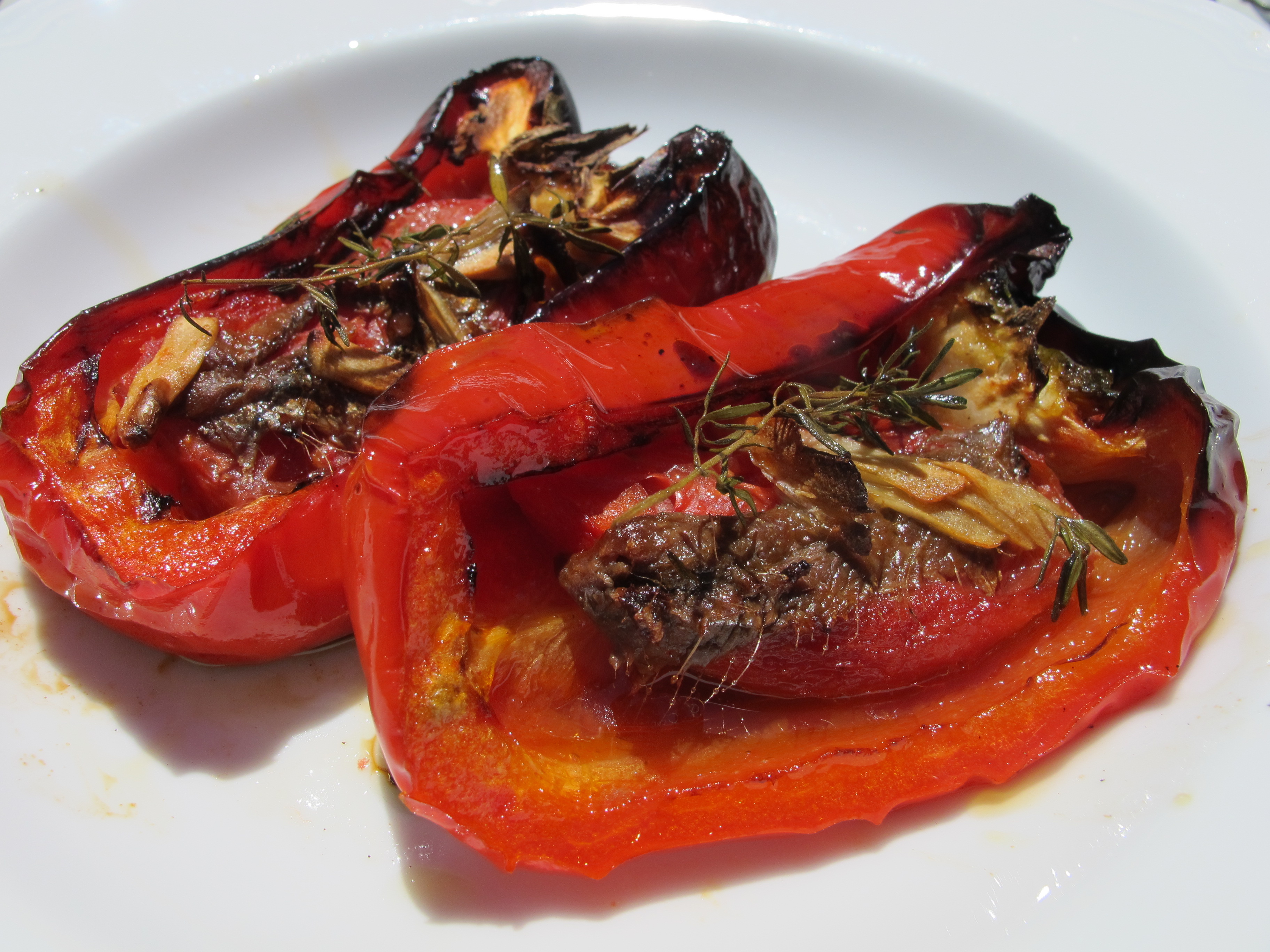
A good day–perhaps–to tempt fate with an early summer lunch dish–roast red pepper halves.

I see they featured just over a year ago with chèvre(goat’s cheese); todays’ will be with the thinnest slivers (easier to do than say fast!) of garlic and anchovies, melting into the tomato juices.

for 2

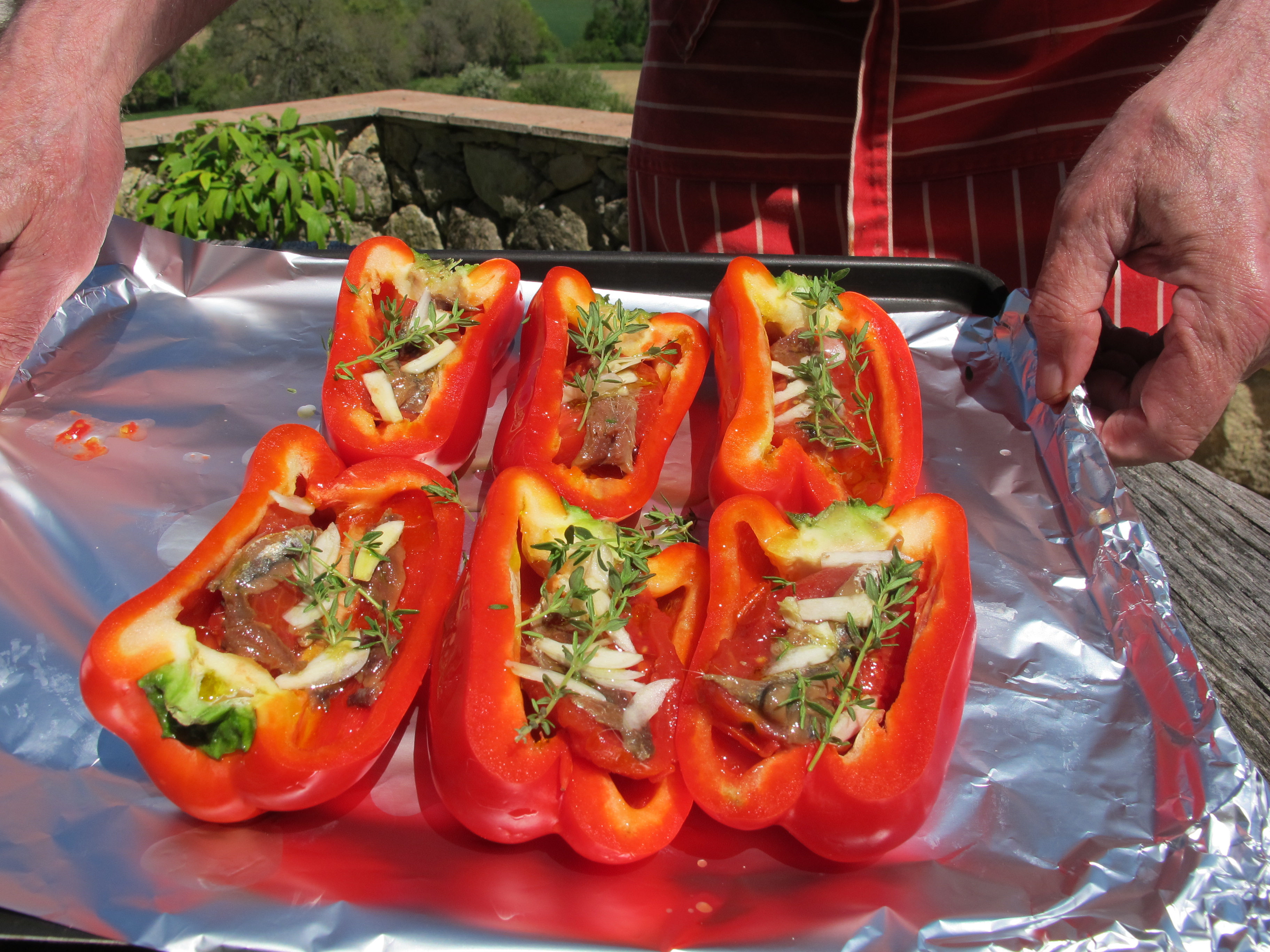
2/3 red peppers–carefully halved so they sit level on the baking tray

6 tinned (canned) tomatoes–halved

2 garlic cloves–sliced as thin as can be

4 anchovy fillets

olive oil

salt and pepper

a few thyme stems

set oven to 200C/400F

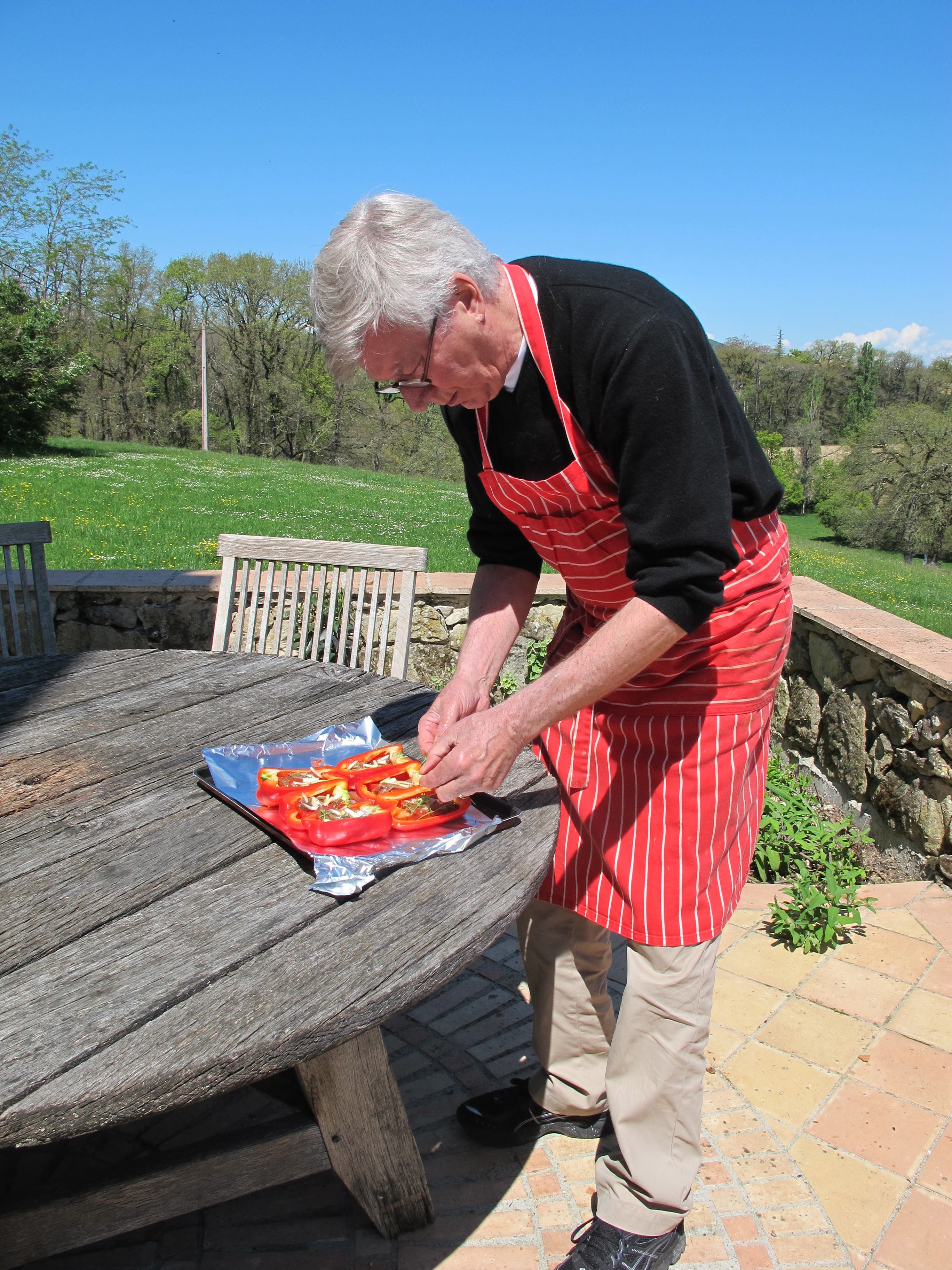
  • Cover a baking tray with foil–(saves time scraping after the tray has been in a hot oven).
  • Brush with olive oil to avoid the peppers sticking.
  • Place the peppers side by side on the tray.
  • Fill each half with tomato pieces, three or four slithers of garlic and an anchovy fillet on each.
  • Season well with salt and pepper.
  • Drizzle a tablespoon of olive oil over each half.
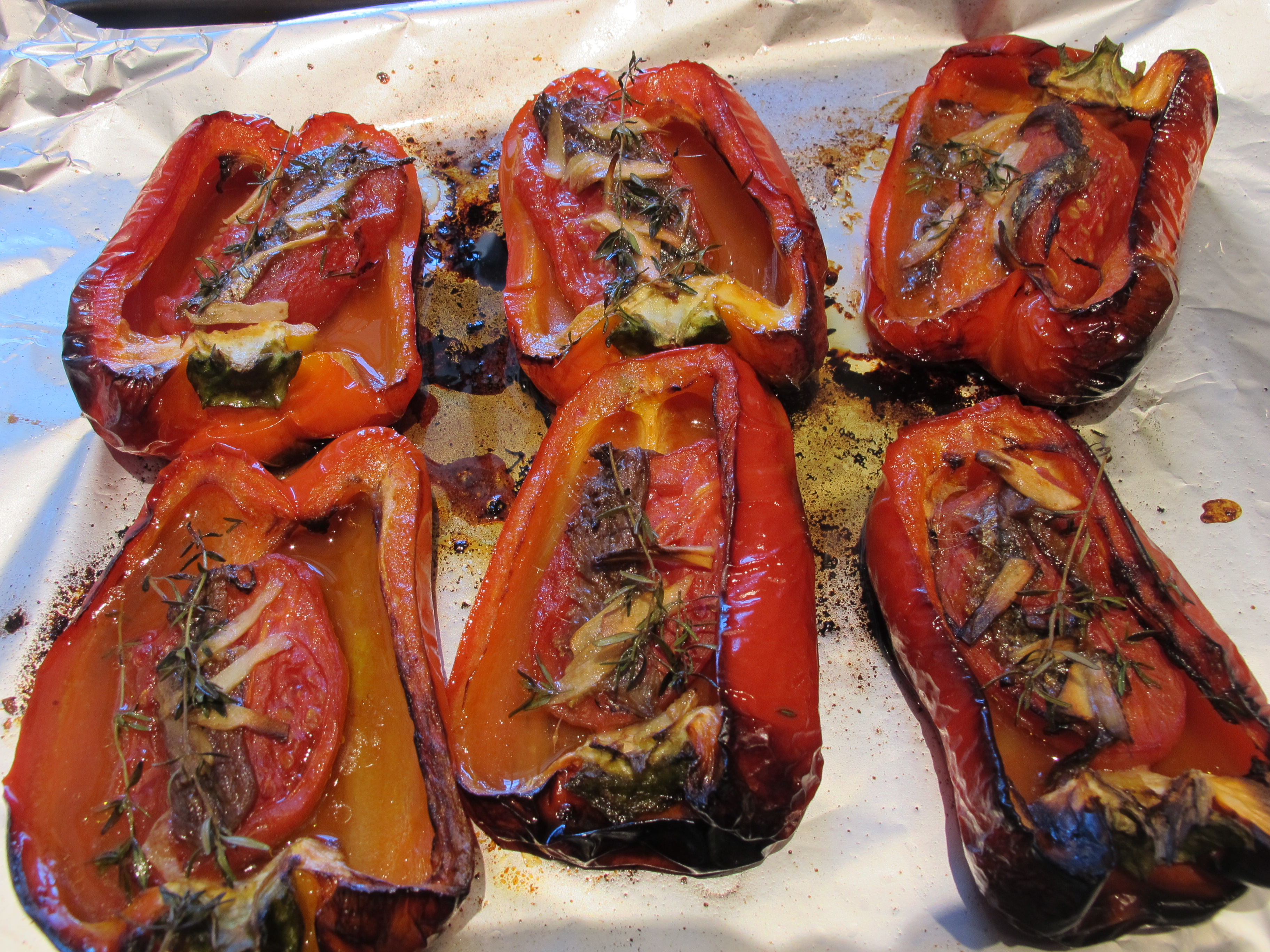
  • Bake in the hot oven for 3/4 hour–checking after half an hour–but they need to be thoroughly tender to be delicious.
And a simple green salad to serve.

from Ballad of a Thin Man by Bob Dylan-lyrics

I like radishes–the fresher the better and we had them coming out of our ears after everyone bought them at the market on Saturday–about five bunches of munchies.

However there is a limit to how many sharp little explosions in the mouth one can take–even if, as it’s said, they are good for the digestion.

Our guests took a fortifying bunch with them on their travels on Sunday morning, but there was still a pile left in the fridge yesterday.

What to do with them..?

I consulted  Nancy Harmon Jenkins’ book–The Mediterranean Diet Cookbook (a gift from our friend Helen in Tuscany, after we’d helped with the olive harvest last November )

and found the perfect lunch for a sunny Bank Holiday (May 1st):

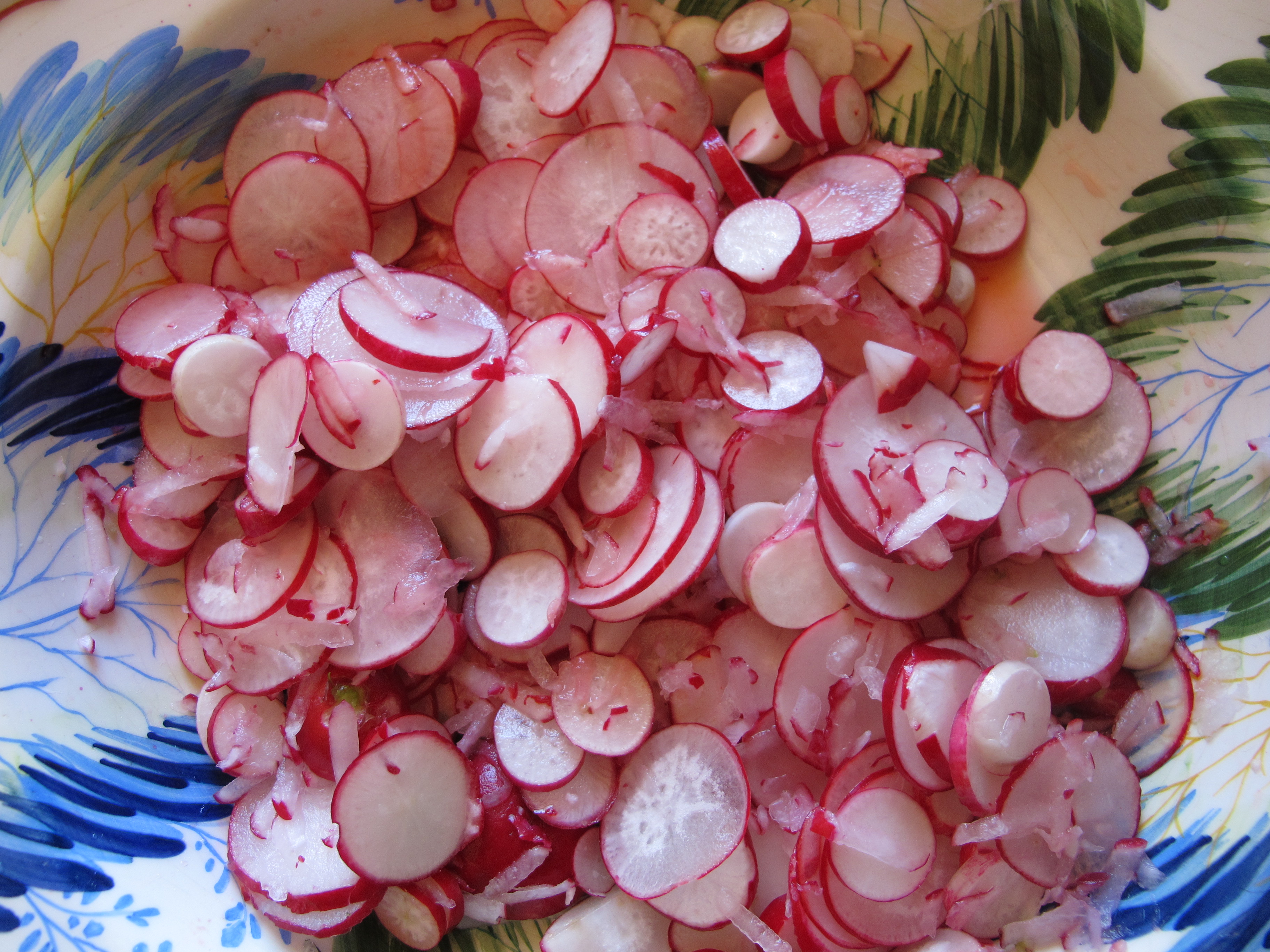
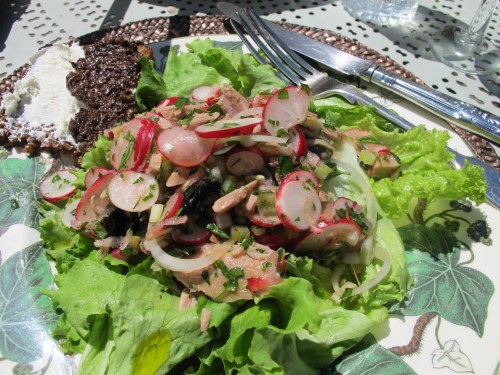
Radish, spring onion and tuna salad

1lb of radishes–washed, trimmed and sliced any-which-way that suits (grating some into the bowl makes for a pretty picture)

juice of 1/2 a lemon 

1 teaspoon of salt

2/3 tablespoons parsley–chopped fine

2 sticks of celery–diced fine

2/3 spring onions/scallions, mainly the white part–chopped fine

4oz jar of good tuna in olive oil–forked into flakes

10/12 juicy black olives–stoned and halved

3 tablespoons of the best olive oil you have

salt

  • Mix the radishes with the lemon juice and salt in a bowl.
  • Add the parsley, diced celery and spring onions.
  • Add the tuna flakes.
  • Sprinkle over the olives and the olive oil.
  • Admire it’s beauty for a moment-
  • before turning it over carefully but thoroughly.

A  green salad,  some soft local goats cheese and a spoonful of the tapinade I’d made on Saturday, went well with it at lunch.

The numbers of undiagnosed diabetes in western countries is astonishingly high. Even when people get the right diagnosis (often YEARS after they’ve developed the disease) there’s often little support for how to make appropriate changes to lifestyle and way of eating.
I stumbled on this inspiring Type 2 diabetic story today from a newspaper in West Virginia, the Charleston Gazette.
It has a happy ending….

Recognize diabetes before it’s too late!

By Kate Long
28/4/20212
(edited)

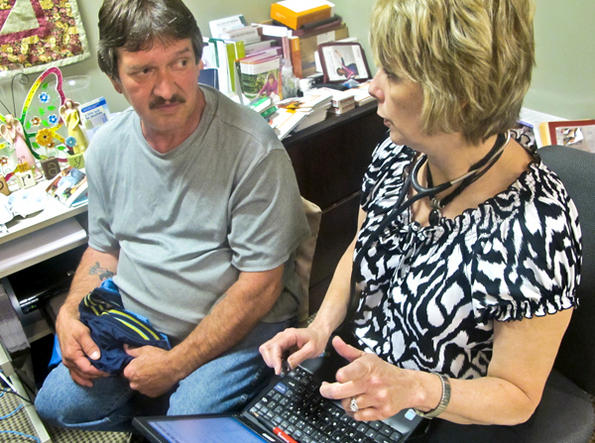
Everette Roberts in October, 2011 (left) and six months later in April, 2012. 
Quitting soda pop, eating right and staying active has made a world of difference, I don’t get sweats and blurry vision any more, I’ve got a lot more energy, and my outlook is better.
WILLIAMSON, W.Va. — The winter of 2010-11, it snowed a lot in Mingo County. Fifty-four-year-old Everette Ray Roberts was shut in for days, me and my dogin a small trailer perched on a steep hillside near Matewan.

A rugged bachelor, Roberts has three ruptured discs in his back from heavy lifting. 

 “I was constantly dizzy and thirsty, with all the snow, I wasn’t getting out and walking around, doing stuff. I’d gained a lot of weight. My eyes got blurry. I’d get so shaky, sitting on the couch watching TV, and I was pouring down the 24-ounce bottles of pop, five or six of them a day. It was like adding gasoline to the fire, all that sugar, but I didn’t know it.

All I knew was, I was terrible thirsty. I kept a gallon of water sitting beside me for when I ran out of pop. I couldn’t sleep. I’d get real, real sweaty;  kept running to the bathroom. I thought maybe it was high blood pressure or something.  I had no idea what danger I was in.”

He was one of an estimated 69,000 West Virginians who have diabetes, but don’t know it.

“Going to the doctor in the snow is not exactly easy, and it’s expensive.”

When he finally did go,  the doctor told him he had all the symptoms of diabetes: blood sugar was up the high 400s and A1C [the three-month blood sugar levels] was 12.5.

His doctor referred him to diabetes educator and nurse practitioner Vicki Lynn Hatfield.

Hatfield and her partner help about 500 of the area’s estimated 3,500 diabetics figure out how to control the condition from day to day, despite sometimes harsh realities of life: shortage of cash, two jobs, kids, and so on.

“I lucked out, if it hadn’t been for Vicki, I’d probably be in kidney failure now,” Everette said.

He and Hatfield went over what he ate, how often he ate, his schedule, his physical activity.

To get rid of his dizziness, shakiness and blurry vision, they planned specific ways he could change what he ate or when he ate and increase physical activity every day. They also got his medicine adjusted.

Everette went to Hatfield’s group Diabetes Self-Management Classes at Williamson Memorial Hospital.

He learned how to shop for food that wouldn’t set off his blood sugar, how to read his own blood sugar levels, how to cope with periods of depression.

“Everette is somebody who, once he found out how to control his diabetes, he took the reins,” says Vicki Hatfield.

A year later, his blood sugar was in normal range. He requires less medicine to keep it there.

“He doesn’t have a lot of money and he doesn’t have a lot of education, but he learned very quickly how to do it. And, just as important, he did it!” 

Hatfield dished it out to him in small steps, he said. He learned what foods would keep him stable and how to lower his blood sugar by taking a walk, how to buy healthy foods on a budget.

“There’s a whole lot more to it than what I thought….

I stay on the move now, 24/7 , I cook for myself. I take the skin off my chicken, and bake it instead of fry it. I make myself a lot of salads. I like salad and I put all kinds of stuff in them, vegetables, meat.

Vicki Hatfield adds,

“People are not born knowing the symptoms of diabetes, and they aren’t born knowing how to control it, and it takes more than a 15-minute doctor visit to help them get a handle on all they need to know.
I have found that if I can get people the information, most will apply it, with whatever means they have. We’ve got plenty of patients who don’t have a lot of education and income, but that doesn’t have to stop them!”

She keeps trying new ways to stamp out diabetes .

Two years ago, she helped start a Mingo County Diabetes Coalition. Now they have a five-year grant for $50,000 a year through Marshall University to spread diabetes awareness and prevention through the county.

Hatfield now offers diabetes prevention classes.

“People tell their neighbors what they learned. So it’s spreading.”

The coalition plans to post symptoms of diabetes in store windows and telephone poles all over the county.

“We want people to know they can catch it early. If we can get people to go after it like Everette has, our diabetes rate should drop.”

Last word to Everette:

“I would tell anybody, the bottom line of it is, if you don’t set it in your mind that you’re going to get it under control, then it’s not going to get better.

It’s up to you whether you do or you don’t.”

(If you or someone close to you has been diagnosed with diabetes, feel free to share your experience of post-diagnosis support in the comments.)


Originally written and published by a small Cornish publisher in 1978–Making Poldark was updated in 1987 when the BBC aired the series again.

When I heard that Acorn Media were going to make Poldark available in a double DVD set for the first time in the United States, it seemed like a good opportunity to take another look at the book to see if it was worth updating again.

This extended version is the result. With many more photographs, some from Winston’s own album of photos he took while with us on location for the second series (published with the kind permission of his son, Andrew Graham).

It covers both the professional and the personal.

The original was a light-hearted memoir of the making of the series.

The new edition includes an account of how and why the plan to make a third series ended so badly–a sad and disappointing tale–enlivened towards the end by The Poldark Appreciation Society’s valiant and colorful protest campaign.

It sketches in the intervening years which have seen our move to France, my diagnosis with Type Two diabetes and the publication of Delicious Dishes for Diabetics.

There are  two versions of the new edition. One is a color-enhanced Collectors Edition, the other is a standard black & white version.

They are available via the website, CreateSpace: 

 The Black and White version $14.99

Colour version $24.99

or http://www.Amazon.com/.

Under the weather

Under the weather–perfect English euphemism for the annoying cold that isn’t exactly ‘flu that has confined me to bed, for almost a week now.

Meredith and Pippa have been exemplary carers though–(Meredith up and down stairs with trays and tinctures and Pippa lying there on the bed, willing me better)

Pippa(r) with two student carers.

–and it has given me some reading time.

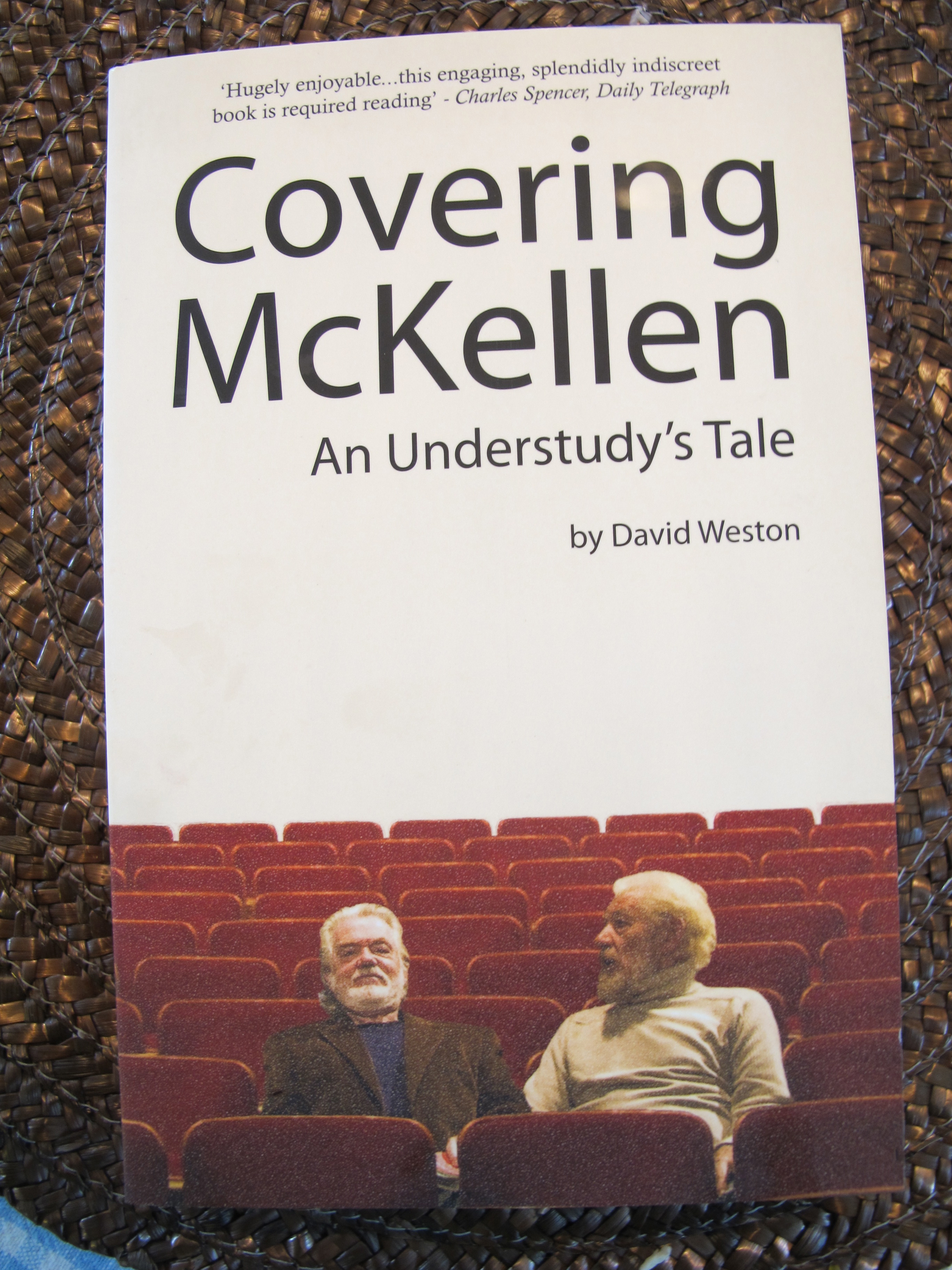
David Weston’s book “Covering McKellen” arrived the day I was struck down.

It relates, in the form of a diary, the troubled but entertaining backstage story of the 2007 Royal Shakespeare Company’s World Tour of Shakespeare’s King Lear–starring Ian McKellen.

David Weston understudied Sir Ian and played the supporting role of “Gentleman” in the production.

He prefers to call the job “covering”–hence the title.

I was in the National Youth Theatre with David in 1960 and The Actors’ Company between 1972 and 1974 with Ian–hence my interest.

The book has proved therapeutic and enjoyable.

It has also reminded me of the danger understudies can pose to a principal–they might be rather good!

Lunch yesterday, for instance, was grilled lamb chops and asparagus–provided by my understudy/cover.

Perfectly cooked–nicely pink without being bloody, seasoned to a “T”with salt and black pepper and with a hint of olive oil, garlic and rosemary from the short marinading–I ate them with relish, not quite understanding the faint feeling of unease I was experiencing with each bite.

Then I remembered David’s book and resolved to get better–asap!

Spicy Cauliflower

When a hero dies (Levon Helm) it’s comforting  to hear of other heroes or in this case heroines, flourishing.

Two such are revered veteran  food writers and cooks  Claudia Roden

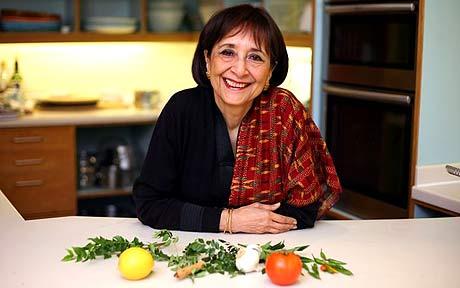
and Madhur Jaffrey

They are both in their  70’s and both have new projects.

Claudia Roden (75) is publishing  The Food of Spain and Madhur Jaffrey (78) is relaunching herself on the Good  Food TV Channel with a new series to accompany her new book, Curry Nation.

Madhur Jaffrey had come to mind when I felt a yen for something with an Indian flavor for supper tonight–but couldn’t find a focus for the fancy, until I spotted a nest of cauliflowers offering themselves on the small table stall of a local grower early this morning.

I was pretty sure Madhur Jaffrey had a good recipe for cauliflower in her book  Indian Cookery; so I bought the middling sized one and headed home for breakfast.

Here it is–adjusted a little:

for 2--as a main course:

1 medium cauliflower–the head separated into small bite size florets

3 tablespoons olive oil

1/2 teaspoon fennel seeds

1 teaspoon black mustard seeds

2 cloves of garlic–chopped fine

1/4 teaspoon turmeric

1/4 teaspoon cayenne pepper

1 teaspoon salt

  • Soak the cauliflower in water for a half hour–then drain the florets.
  • Heat the oil in a pan large enough to hold the florets in a single layer.
  • Add the fennel and mustard seeds and sauté until they start popping.
  • Add the turmeric and the cayenne.
  • Add the garlic to the pan and let it colour lightly.
  • Add the drained florets, salt and 3 tablespoons of water.
  • Cover and cook for 10 minutes–or until the cauliflower is almost tender.

Brown basmati rice, red lentil dhal and yogurt sauce accompanied it–my yen was satisfied!

Levon Helm the drummer of The Band–(in the middle here):

He died a few days before his 72nd birthday, after a long battle with cancer of the throat.

His soaring voice on the Band’s  The Night They Drove Old Dixie Down always makes my hair stand on end.

I saw them live two nights running at the Albert Hall in London, in the mid-seventies.

The group had not played in the UK since being booed off stage when they backed Bob Dylan at the Isle of Wight Festival at the end of the sixties.

Dylan fans were objecting to him “going electric”.

As I approached my entrance door I passed the artists’ Stage Door, where a large black Austin Princess limo had just parked and THEY were getting out–an unexpected thrill!

A moment after finding my seat they walked onto the stage and started the set without a word.

After giving a stunning performance and being rapturously received–Robbie Robertson, the Canadian lead guitarist, spoke quietly into the mic saying: “Thank you and good night,“–the only direct address to the audience that night. Then he, Garth Hudson, Rick Danko, Richard Manuel and Levon Helm left the stage. Clearly the memory of the Isle of Wight still lingered.

As I walked round the building heading for home, a black Austin Princess glided silently passed me gathering speed.

I went back the following night.

Birthday week, in a double significant Birthday year.

Today Meredith continues the celebrations with a small lunch for four after her weekly chi-gong class.

She has engaged a caterer, because naturally she can’t be expected to cook and chi-gong in the same morning.

The caterer was asked to prepare an italian torte from a relatively new cookbook provided by Meredith.

She’s confident, she told the caterer, that if they stick to the instructions in the book, all will be well; there’ll be enough for four even after a hungry making chi-gong class and her friends will be delighted by the delicious dish presented to them.

(The caterer, not without a soupçon of pride, would like it to be known that there’s a small hint in the previous sentence as to the identity of said caterer–just in case any reader might consider the book for purchase*.)

Rice and Spinach Torte

Serves 4 as lunch or more as a starter

Based on Marcella Hazan’s version of a classic, this is very useful as there is no pastry.

You can cook the spinach, rice and onions well in advance, the night before even; then it turns into an assembly job and as such is therapeutic!

1 kg/21⁄4 lb spinach – washed carefully

200 g/7 oz basmati long-grain rice
1 medium onion – chopped
25 g/1 oz butter

4 tbsp olive oil

1⁄4 tsp grated nutmeg
50 g/2 oz grated Parmesan cheese
salt and pepper
4 eggs
25 g/1 oz breadcrumbs – rye or 100 per cent wholewheat

Heat the oven at 230°C/450°F/Gas Mark 8.

  • Cook the spinach in the water clinging to it after washing, covered, over a gentle heat – until it has wilted completely –about 10 minutes.
  • When it’s cool enough, gently squeeze as much water out of it as you can and roughly chop it.
  • Cook the rice in a saucepan, in 570 ml/1 pint/21/2 cups ofwater, covered and over a low heat – it will take about 25 minutes.
  • Test it for tenderness; drain and leave to cool.
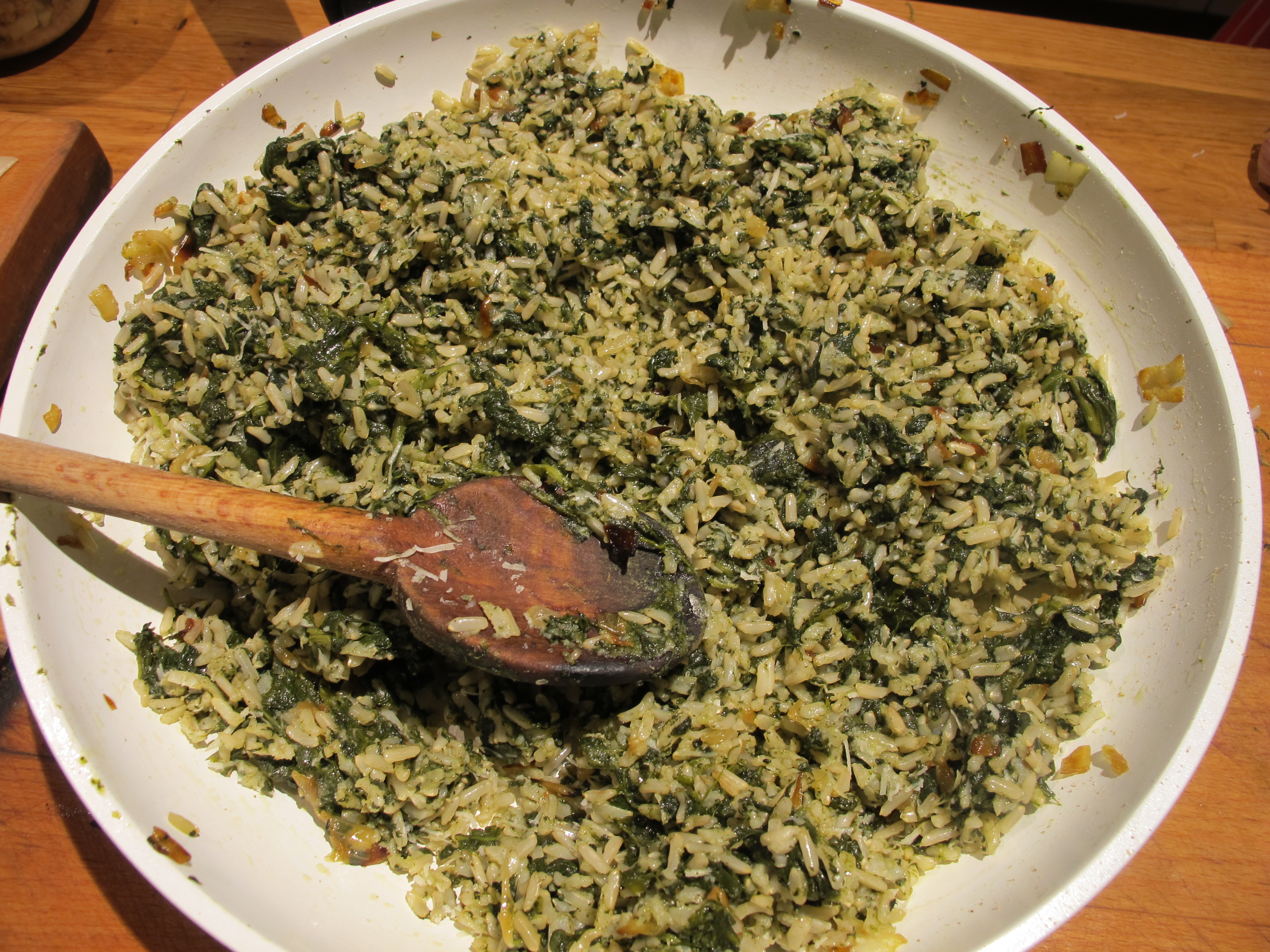
  • Cook the onion in the butter and oil in a large sauté pan overa medium heat until it is a lively brown.
  • Add the cooled spinach and rice to the onion and cook on low heat for about 4 minutes, turning to mix and coat well with the oil and butter. Leave to cool.
  • Add the nutmeg and half the cheese.
  • Season this mix carefully with salt and pepper – tasting and turning as you go – the salt should just come through.
  • Turn in the eggs singly.
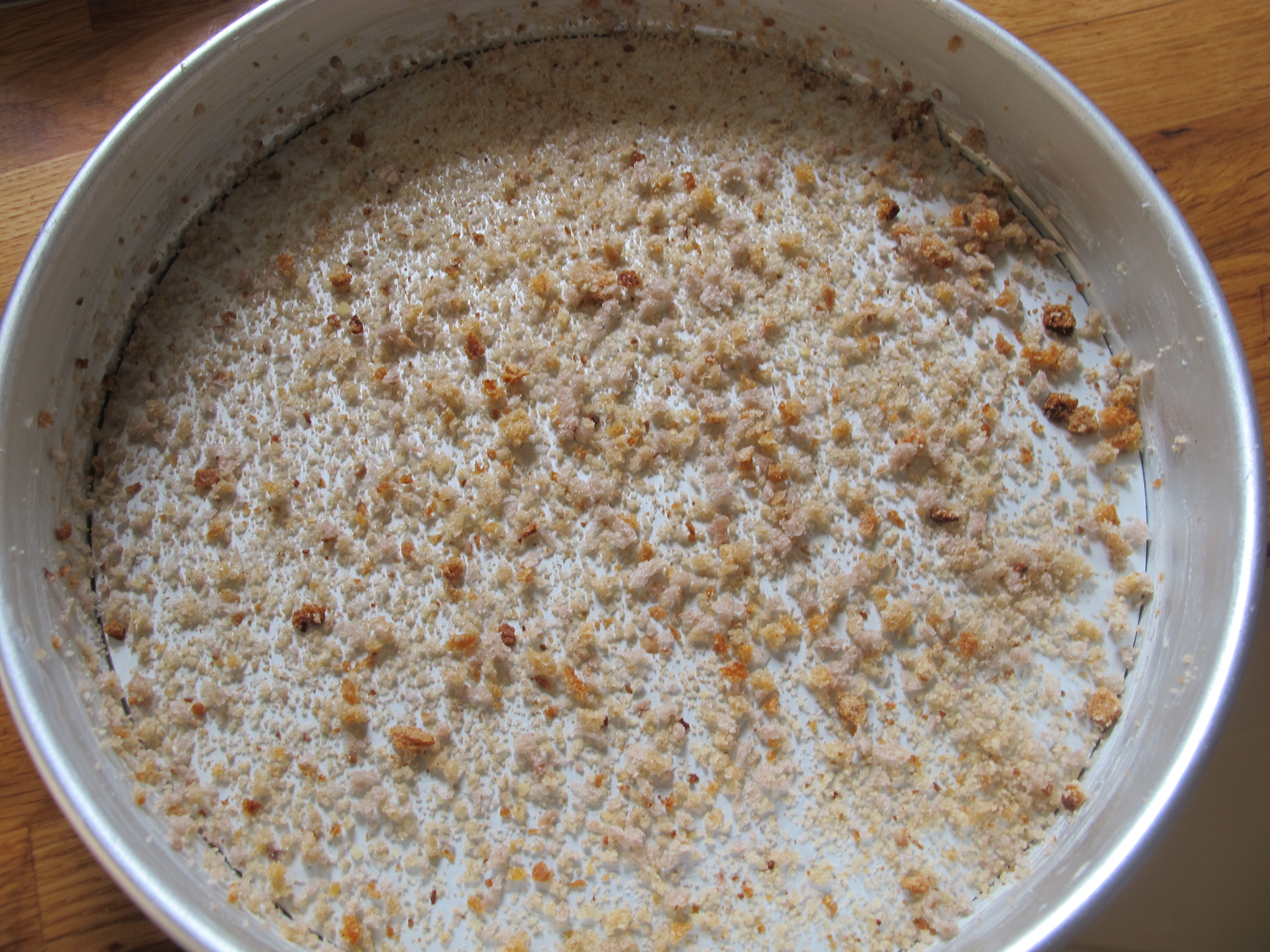
  • Butter or oil the torte tin and sprinkle half the breadcrumbs in the base.
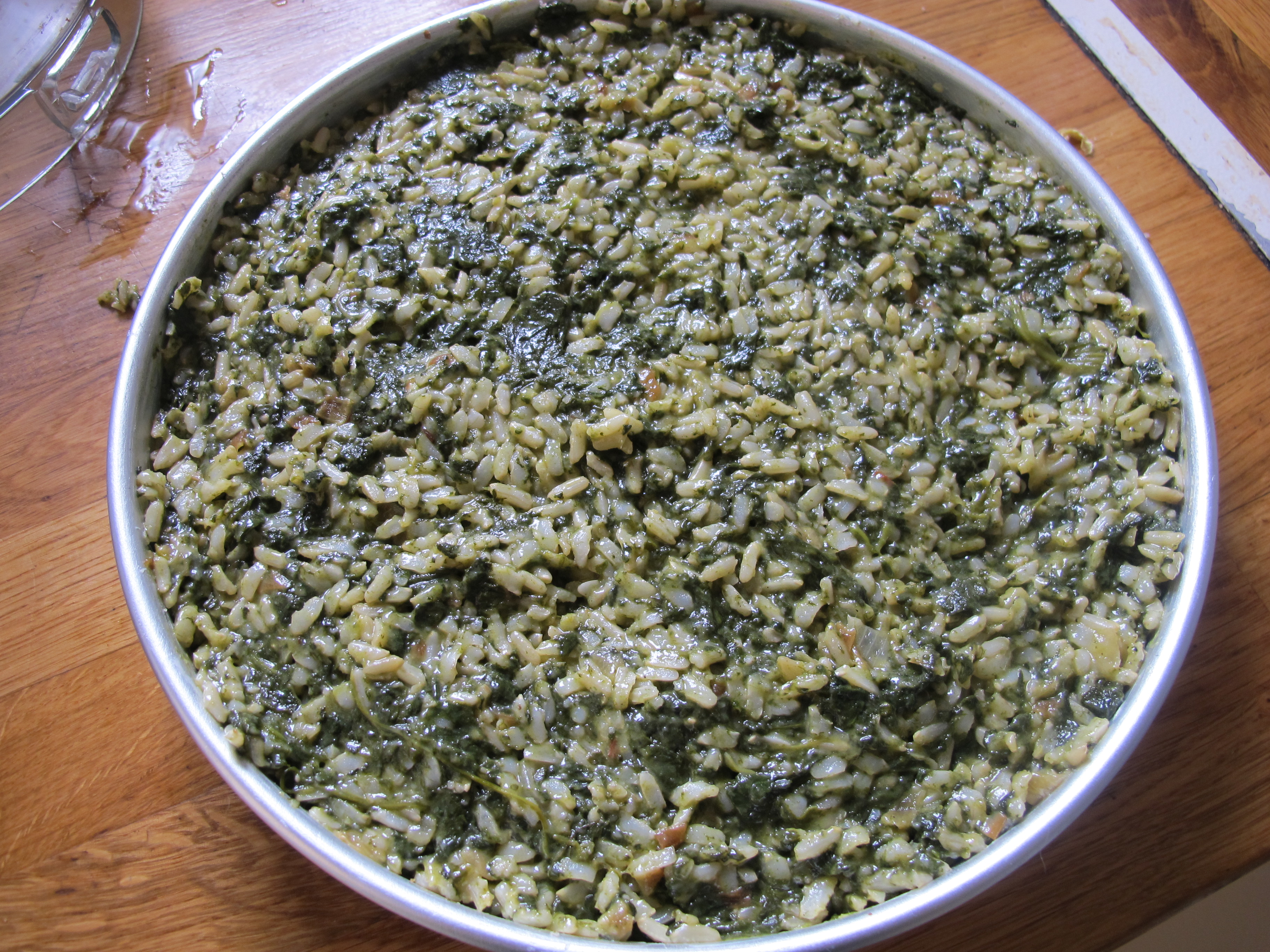
  • Now turn the mix into it and smooth over the surface.
  • Mix the remaining crumbs and cheese and sprinkle them over the surface.
  • Dribble olive oil over this.
  • Bake in the top of the oven for 15 minutes.
  • Serve tepid–with perhaps a green salad.

(*Delicious Dishes for Diabetics–to save possible confusion!)

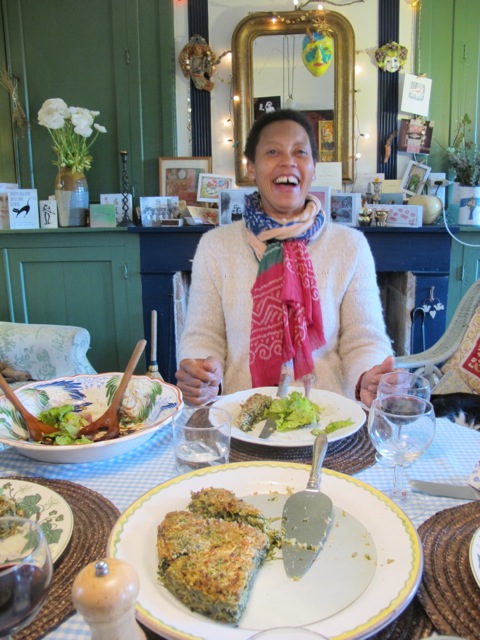
Sonia & the torte, going, going....

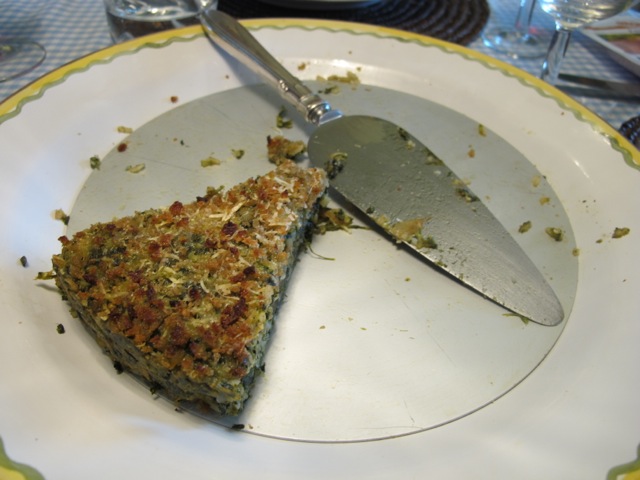
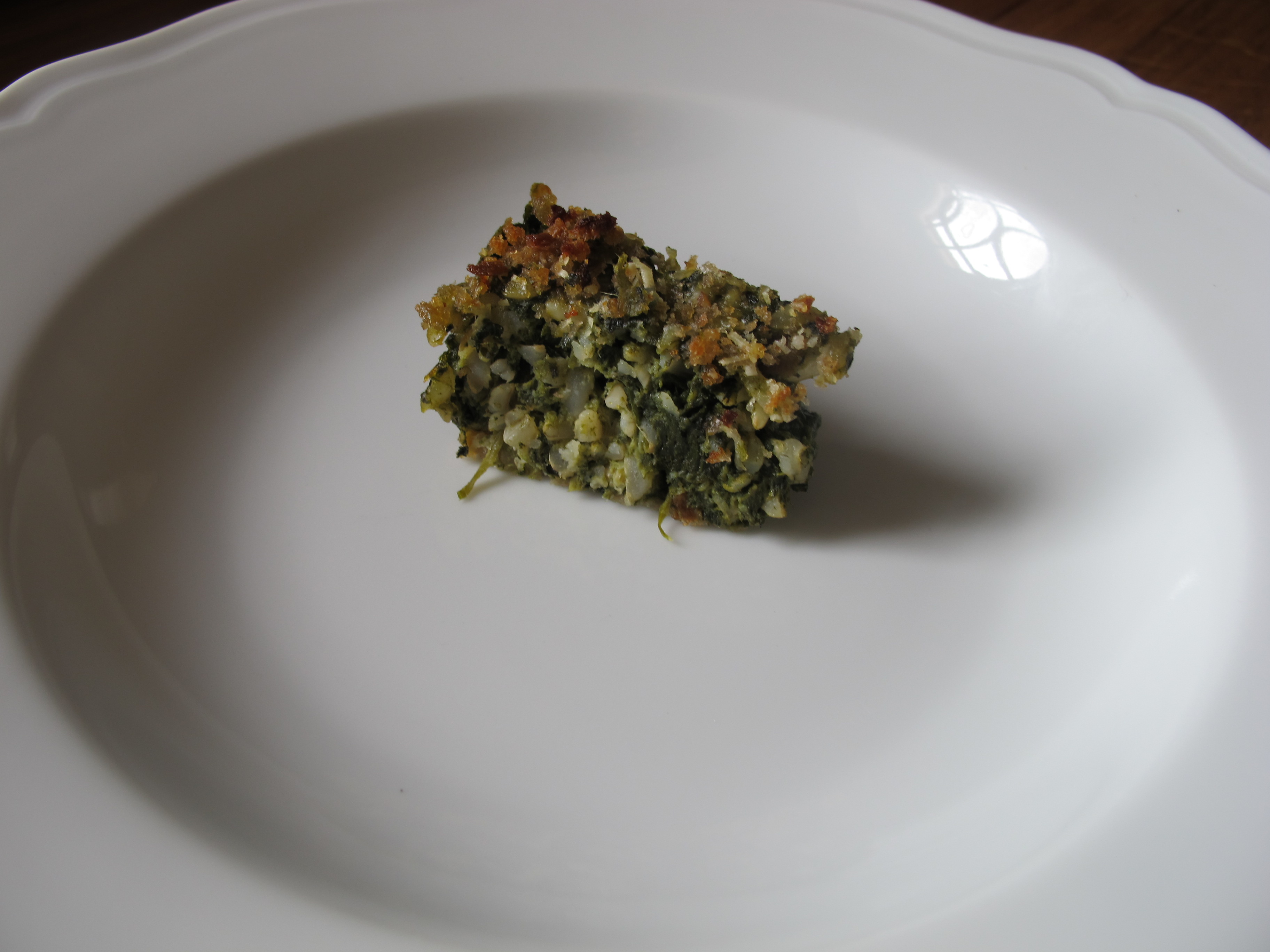
What was left!

together with a restored chi-gong class and a happy caterer!