Feeds:
Posts
Comments

Testing time

Sophie arrived at 8.15 this morning to give me a blood test (prise de sang). She is one of the 5 nurses working from Lautrec. I’d rung yesterday afternoon to arrange the home visit–such is the convenience of living under the French system and in the countryside. I was the last stop on her morning round, which began in darkness at 6.45am.

She’ll return to the office in time to catch the 10am dispatch from the pharmarcie to the laboratory in Castres who analyse the sample later this morning. I will receive the result tomorrow by post–or at the latest on Friday.

Sophie didn’t charge for the visit this morning–usually about 9 euros. She said, with a smile, “Non, non, you gave me a bottle of olive oil last time–that’ll cover a second visit.”

It’s true that I’d given her a small bottle from our November trip to Tuscany to help harvest olives at a friend’s farm (more on that later).  It was only a quarter litre–pas grandes choses–but that’s Sophie!

Today it was the quarterly test for glycemie, which indicates the average level of sugar in the blood over a three month period–giving an overview of how successful I have been in controlling it.

When I was diagnosed 12 years ago, I went out and bought a testing unit–but never used it–nor the second one purchased a few years later!

Michel Woitiez, our doctor, who from the start impressed on me the importance of taking the condition seriously, has never asked me if I test daily. He never mentions it.

My book, Delicious Dishes for Diabetics, attempts to illustrate how a person with Type Two Diabetes, while changing some habits of a lifetime, can still cook and eat enjoyably, without feeling deprived.
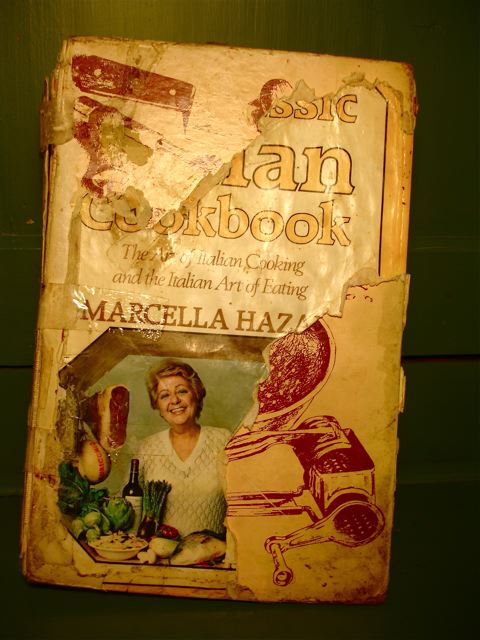
This recipe is from one of Marcella Hazan’s inspirational cookbooks.

my culinary Bible

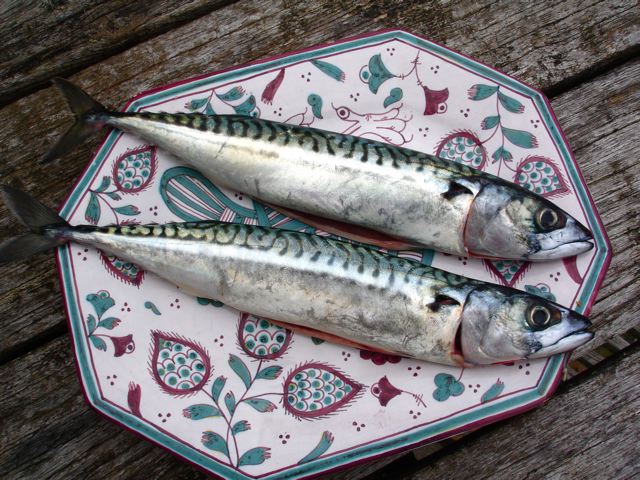
To be worthwhile mackerel has to be fresh—nice clear eyes and firm to the touch.

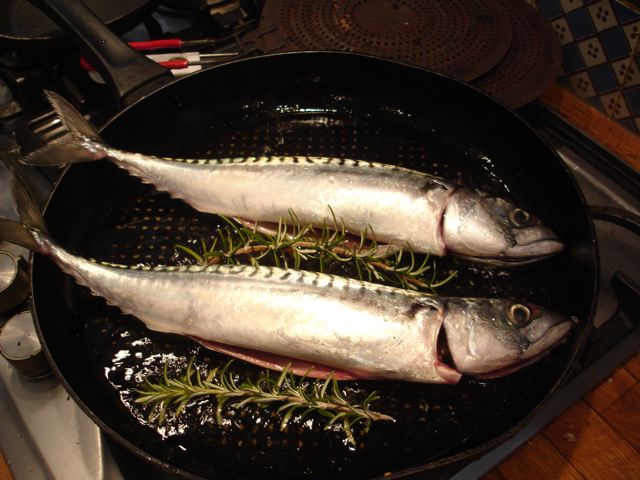
These fitted the bill at the market this morning– and were only four euros for the pair! I cooked them whole in olive oil flavoured with rosemary and garlic—good strong tasting elements to match the richness of the fish.

For 2

2 medium sized mackerel— gutted and cleaned

4 garlic cloves—peeled

6 tablespoons olive oil

Juice of half a lemon

2 sprigs of rosemary

1. Wash and dry the fish.

2. Heat the oil in a large sauté pan and fry the garlic cloves until they begin to colour.

3. Add the fish with the rosemary and brown gently on both sides.

4. Cover and cook for about 15 minutes—checking for doneness by carefully  lifting the flap of the cleaned belly–if it looks pink continue cooking a couple of minutes more.

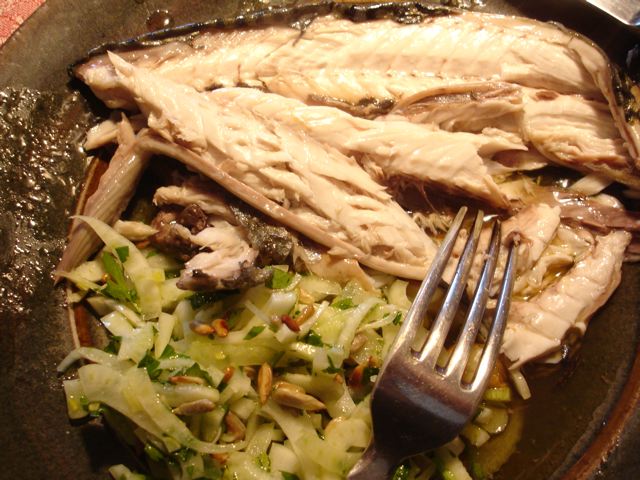
5. Carefully lift the mackerel out of the pan and lay them on the waiting plates.

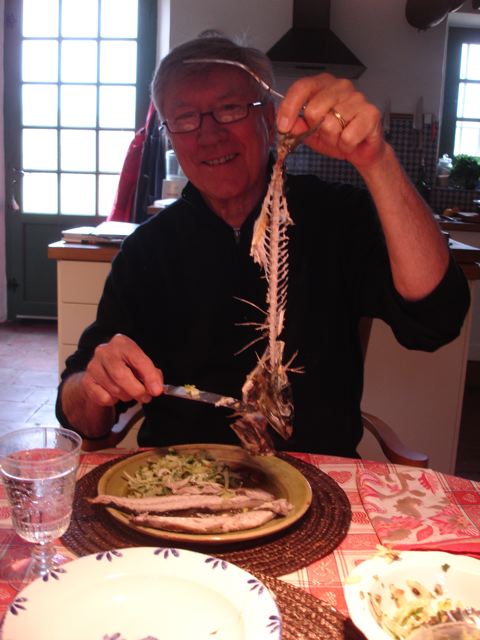
6. Spoon over the juices and watch out for the bones!

Cauliflowers (Choux-fleur in french ) look so appealing –their pure white faces peeking through the outer leafing, daring you not to buy them.

cauliflower

This is the third time in as many weeks that I’ve succumbed.

They usually have to wait awhile to get cooked; often because their green cousin–broccoli–is an easier option.

Steamed, seasoned, olive oil and a little lemon juice poured over, broccoli is quick to do and adds a fresh colour to the plate.

Tonight though–it’s pasta with the patient cauliflower as the basis of a piquant sauce.

This is adapted from a Marcella Hazan recipe.

for 4

1 cauliflower–released from its casing, washed and broken into large florets

8 tablespoons olive oil

2 garlic cloves– finely chopped

6 anchovy fillets–mashed

1 or 2 small red chillies–depending on your taste–chopped (discard the seeds)

salt

2 tablespoons parsley–chopped

3 tablespoons of toasted breadcrumbs

300g/12oz wholewheat penne or fafalle

Cook the cauliflower florets in salted boiling water until they are tender.

Remove the cauliflower from the pan, saving the water to cook the pasta in later.

Set the cauliflower aside.

Heat the oil in a saucepan and add the chopped garlic.

Sauté it until it turns colour, then take the pan off the heat and add the anchovy mash and the chillies.

Stir this into a sauce.

Mix in the cooked cauliflower, breaking it up into small pieces and  mashing some of it.

Cook it in the sauce for a couple of minutes, then set aside.

You are going to gently reheat the mixture just before the pasta is ready.

Bring the cauliflower water back to the boil and cook the penne or fafalle to your taste.

Drain and add it to sauce in the pan, turning it over carefully but thoroughly.

Sprinkle over the breadcrumbs and parsley and serve from a heated bowl.

Cauliflower is a super food

I bought a couple of chicken breasts for lunch in Castres market this morning.

The recipe below is adapted from the late Ismail Merchant’s excellent book, Indian Cuisine.

Ismail Merchant

Ismail, who died too soon six years ago aged 68, was the producer half of the enormously successful film production team Merchant Ivory. I filmed The Europeans with them in New England in the autumn of 1978, with lovely Lee Remick.

Food played an important part in the ebullient Ismail’s modus operandi.

In earlier days he would do the rounds of the established film companies looking for backing, with a homemade apple pie in his bag.  Slices would be produced in exchange for the use of the telephone!

Money was never NOT a problem for them in those days and it was clear, deep into the filming in New Hampshire, that things were tight. Anxious creditors hovered and it was uncertain whether we’d be able to complete the filming.

About five o’clock one Saturday afternoon, I spotted Ismail coming in from the car park laden down with several grocery bags. “What’s up, Ismail?”

“Curry for dinner–everyone’s invited!”

He disappeared into the hotel’s kitchen which he had commandeered for the night.

At eight that evening, the whole company (at least 80 people) plus a few unfamiliar faces entered the dining room where  a wonderful Indian feast was laid out–a fantastic sight!

We finished the film on time, with no further rumours of money worries.

His simple recipe makes the rather bland chicken breasts more interesting with chili and cinnamon.

Chicken breasts sautéed with cinnamon, onions, and parsley

for 4

4 boned chicken breasts (without the skin)– sliced in half, lengthwise

4 tblsps olive oil

1 cinnamon stick– broken up

1 largish onion– chopped

2 to 3 small red chillies

juice of two lemons

Cook the onions gently in the oil with the cinnamon until soft.

Add the chicken breasts with the lemon juice.

Season with salt and pepper.

Turn them over after three minutes and cook for a further three minutes; then add the parsley and chillies.

Turn the breasts in the sauce and continue cooking for a further 5 minutes–the exact cooking time depends on the thickness of the chicken breasts.

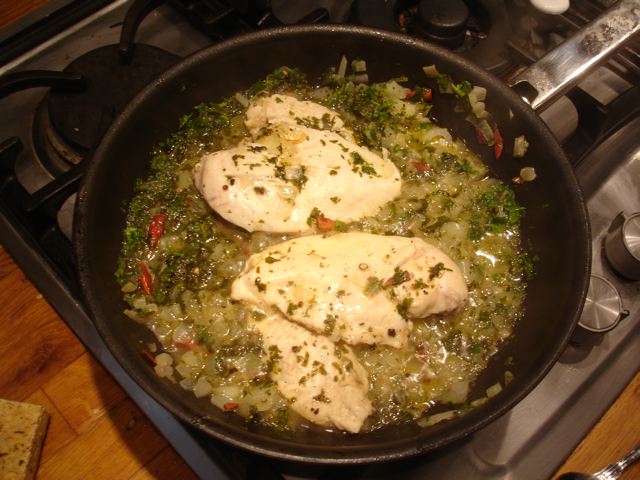
In the pan...

(I just cooked two today.)

Cut into the thickest part of one to check. If it is still very pink, continue to cook another couple of minutes.

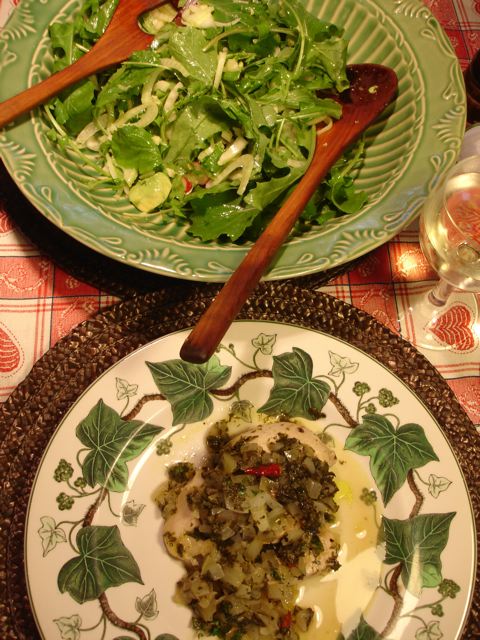
I served it with a salad of  raw fennel, radish, avocado and rocket  dressed with 3 tablespoons of extra virgin olive oil, a tablespoon of freshly-squeezed lemon juice, half a teaspoon of Dijon mustard,  salt and pepper,  whisked together.

On the plate....

A healthy & delicious dish for diabetics–and everyone else….

Extractor fan woes….

Ever since the new kitchen hob and the extractor fan went in over two years ago the fan hasn’t worked.

So grilling and frying on top of the stove has been a smelly business, to be avoided if we’re eating in the kitchen.

I only discovered it wasn’t working when a friend informed me. I just thought it wasn’t very efficient.

Gilbert Caminade, our carpenter, said he’d had one fitted that worked too well; it threatened to suck up everything in his new kitchen and the adjacent living room as well!  I didn’t have that problem.

I put up with it–as one does–for far too long, until this morning, when Jean Louis, the electrician, arrived to fix a few things and to investigate why the wretched fan was en panne (broken down).

He turned it on, scratched his head and went outside to check the outlet. I left him to it. A little while later he came back into the kitchen with a rolled up piece of plastic in his right hand. “Ca marche maintenant?” I asked. (Does it work?)

Ooh–c’était une grande panne!” he replied, with a broad smile, implying it had been a difficult job and held up the piece of plastic.

The person fitting the fan on Christmas Eve two years ago, in his hurry to get the job done for us, had left a wad of  plastic wrapping wedged in the outlet, which had blocked the extraction of air ever since.

I put my hand under the fan and nothing seemed different– “Ooh ça marche” said Jean-Louis reassuringly, “mais pas assez d’enlever une perruque!” (Not enough to lift a wig!)

The offending wad!

Walking and Walnutting

From the mid-September to the middle of November I combine my walks with a quest for walnuts.

I call it walnutting, and I’m nutty about it. It has become a little obsessional.

I know every walnut tree within 5 kilometres, and roughly when the nuts will mature and drop.

A night of high winds and torrential rain during this period can bring unexpected blessings, because there could be rich pickin’s, as they say in Cornwall, in the morning. You have to tread carefully or you’ll crush them, but a slight roll under your foot can mean treasure beneath!

When they fall on public paths or on the  roadside verges, anyone can harvest them.

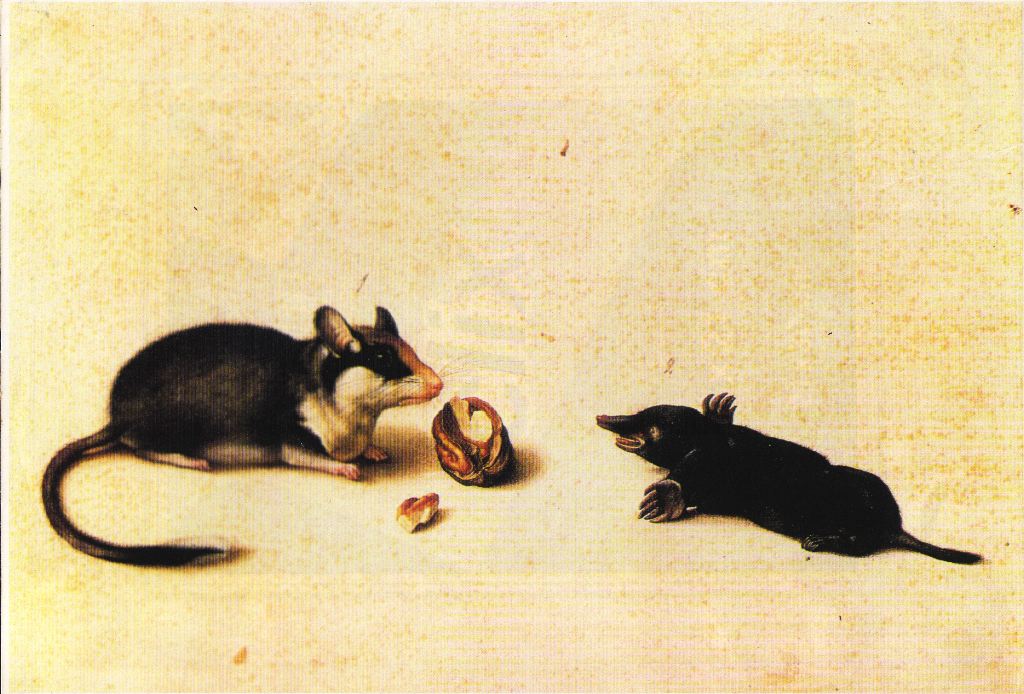
Walnuts are a super food— even the two little critters pictured below, painted over four hundred years ago, knew they were worth fighting for.


Dormouse & Mole with walnut

(By Jacopo Ligozzi in the Uffizzi Gallery, Florence)

Walnuts are full of omega 3’s–the good fats–and rich in proteins, potassium (good for the heart), zinc and iron.

They are delicious in salads and in sauces.

Dry roast them in a small pan and they taste even better.

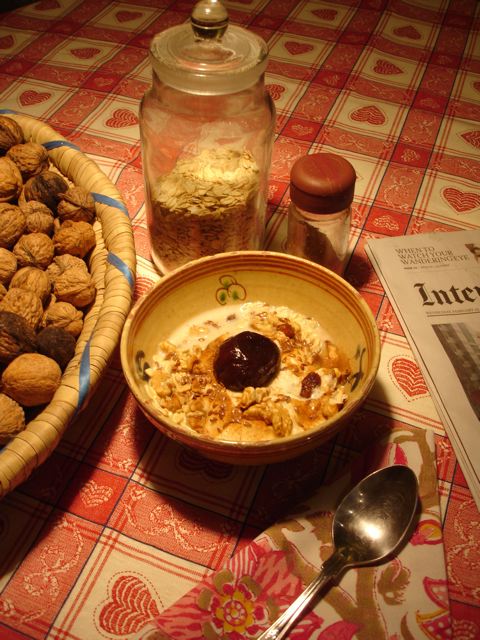
I crack five of them every morning onto my oats as part of the fresh breakfast mix pictured below, which consists of:

Three tablespoons of large oat flakes, an untreated dried apricot–chopped, a teaspoon of linseeds, an Agen prune, half a tub of no- fat organic yoghurt, a sprinkling of cinnamon and unsweetened oat milk.

Breakfast with walnuts and oat flakes

This cherished treasure of the far west of England has achieved special status.

The European commission ruled yesterday that the Cornish Pasty has won Protected Geographical Status or PGS; in other words, it’s officially  Pretty Good Stuff!

The EU ruling states that a genuine Cornish pasty has to have a distinctive “D” shape, and be crimped on one side, not on the top.

“The texture of the filling is chunky, made up of uncooked minced or roughly cut chunks of beef (not less than 12.5%), swede, potato, and onion with a light seasoning.” Not good for type two-ers!

I know something about this great local delicacy. I spent an entire morning’s filming inside the coach that completed Ross Poldark’s return from the American War, the first scene of the series, having the intricacies of pasty making explained to me, between takes, by a delightful lady extra called Elizabeth Coad.

I also learned from a former miner the reason these beauties have an indented ridge over the top. Apparently during a day’s work at the tin or copper face, often two to three thousand feet below the surface, a miner’s fingers would become impregnated with poison from the metal and the ridge of pastry was what he held  the pasty by, to be discarded afterwards. The pasties often contained a two course meal–the meat and potato in one half and apple in the other! Miners used to leave a small portion of their pasties down the mine after their shift for the ghosts of old miners, the Knockers they called them.

Real Cornish miners having a pasty break.

"Miners" in costume.

a crunchy winter salad

The lettuce in Castres market this morning were small and expensive, but I found two good-looking fennel bulbs to act as a salad base for lunch.

Having removed the tough outer layers and the tops of the bulbs, I halved them and laid the cut sides down flat, sliced them finely and put them in a bowl.

I added a finely-sliced stick of  celery, half a small red onion, finely sliced (of course it’s a matter of taste how finely or otherwise you like your raw vegetables sliced!),

and the chopped flesh of a ripe avocado. Over this, I sprinkled a generous tablespoon of dry roasted  sunflower seeds.

(If I’d had radishes, they’d have gone in for taste and colour.)

I added some flat parsley leaves for a deeper green colour.

Shavings of Parmesan cheese over the top finished it off.

I dressed it with 3 tablespoons of olive oil, a tablespoon of freshly-squeezed lemon juice, half a teaspoon of Dijon mustard,  salt and pepper, whisked together.

It passed muster with The Taster in Chief (aka Meredith), which is more than can be said for the very fresh herring that I had rather messily filleted and fried.

I thought they were delicious–  still too bony for Meredith, which I understand.

I’ll try again, though, because herring are healthy and sustainable.

This recipe is from my book–Delicious Dishes for Diabetics– to be published in August.

It is adapted from a favourite recipe of Quentin Blake, the illustrator of children’s books.

It’s very simple but a bit scary because the fish is cooked at such a high temperature it doesn’t seem possible it will survive the heat, but the scales protect it.

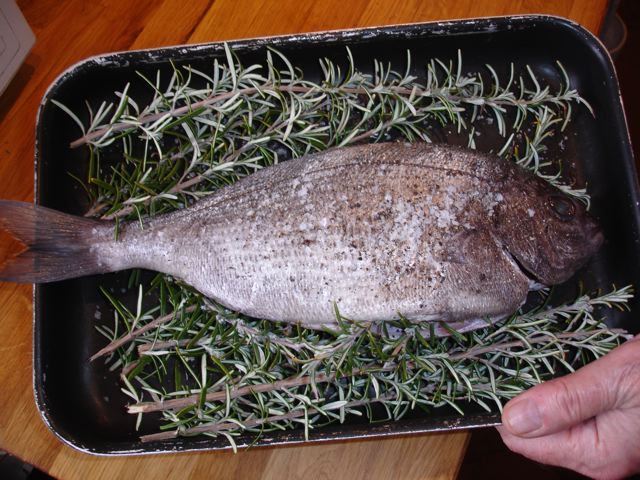
This fish looked good on the stall in Castres market on Saturday morning. It weighed in at 1.25lb–perfect for 2.

M. Gayraud, the fishmonger, gutted it but left the scales on. He pulled back the head to show me the brilliant freshness of the gills.

I collected a large bunch of rosemary from the overgrown bush in the driveway;

Back in the kitchen, I set the oven to 240C/450F

and arranged the rosemary in a small roasting tray;

I washed the fish, being careful not to wipe off the scales, and dried it thoroughly;

salted the cavity and stuffed it with two or three sprigs of rosemary.

Then I laid the fish on top of the rosemary and seasoned it with salt and pepper.

It went into the middle of the oven and cooked for 15 to 20 minutes, the time depends on the size of the fish.

It’s worth checking.

Peel back the skin a little –the flesh should be white and succulent.

When you are satisfied, peel off the skin and carefully separate the fillets.

Serve with this simple sauce.

3 tablespoons of olive oil.

1 tablespoon of lemon juice.

Salt and pepper.

Put the juice in a bowl and add the seasoning.

whisk in the olive oil.

The Glycemic Index measures how carbohydrate rich foods affect blood sugar levels in the body.

It is an important tool for diabetics, whose ability to process glucose (sugar) is impaired.

The Glycemic Load (or density of carbohydrate )is a useful extension of the Glycemic Index.

The Glycemic Foundation explains:

The glycemic load (GL) of a specific food portion is an expression of how much impact (“oomph”)  the food will have in affecting blood glucose levels.

Here’s an example:

The G.I.of watermelon is high (G.I. = 72), but its glycemic load, the oomph factor, is relatively low  (G.L. = 7), because the quantity of carbohydrate in a serving of watermelon (150 g or a 5 mm thick slice) is minimal since it’s mainly water.

The G.I. of a potato is also high (GI=80), but unlike the watery melon, it has a high density of carbohydrates, a high Glycemic Load, so even a small portion will have a high impact  or  “oomph”.


The more carbohydrate density that there is in a food, the higher its G.L. or oomph factor.

The Glycemic Load of a food is the glycemic index of a portion or serving of that food.

The G.I. per serving of the watermelon is much lower than the potato.

Phew–it’s enough to give you indigestion!