Feeds:
Posts
Comments

Meredith has been out with with our neighbour Alice, in search of a beehive that Alice had promised to lend her.

As they come into the kitchen, Meredith says “Look , Robin, Alice has brought you something really special”.

Alice then comes into the kitchen clutching a paper bag. She handles it with such care that I’m convinced there’s a puppy dog inside it.

Thoughts tumble round my head:

We have seven cats inside and out;

Where will we keep it? Do I want a dog after all these years of doglessness!

Alice carefully puts the paperbag in my arms and I quickly realise it’s not a dog.

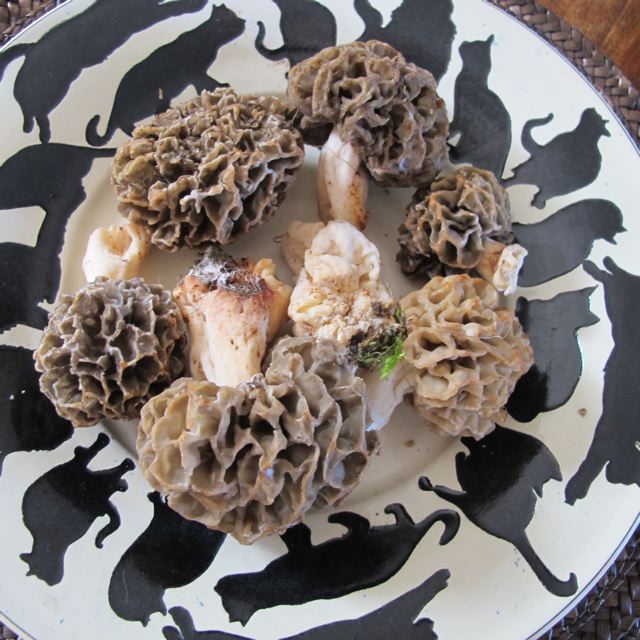
It is some wonderfully strange shaped mushrooms.

They look like dirty sponges on small white feet.

Alice says reverentially–“Ils sont des morilles”
“Ah oui?–Merci beaucoup Alice, c’est trés gentille.”


“Where did you find them” I ask her (in French).

“C’est un secret,” she replies, with a broad grin on her face.

She then tells me how she cooks them:

Sauté very gently in butter with chopped onions perhaps, then fold in some creme fraiche.

I ask about garlic.

“No garlic”–then, after a moment’s thought, she says you could add a little with some parsley in a persillade.

Morels along with cepes are the most sought after mushrooms she tells us, and are usually the first of the season.

Then she  says, rather surprisingly, that they don’t have a lot of taste–which accounts for the butter, cream and onions I suppose.

Anyway, it is a great honour to be given something so prized and we will have them tonight, on a piece of rye toast.

The Pyrénées just visible this morning from the ramparts of Lautrec.

The name is not attractive–sounds a bit like what afflicted Michael Gambon in a Dennis Potter film some years ago.

It actually means fish cooked with a lot of garlic.

This is a classic Greek village dish–traditionally taken to the local  bakery’s oven in the morning, to be ready by lunchtime.

Rena Salaman, in her book Greek Food, says the fish you chose was determined by the importance of the occasion.

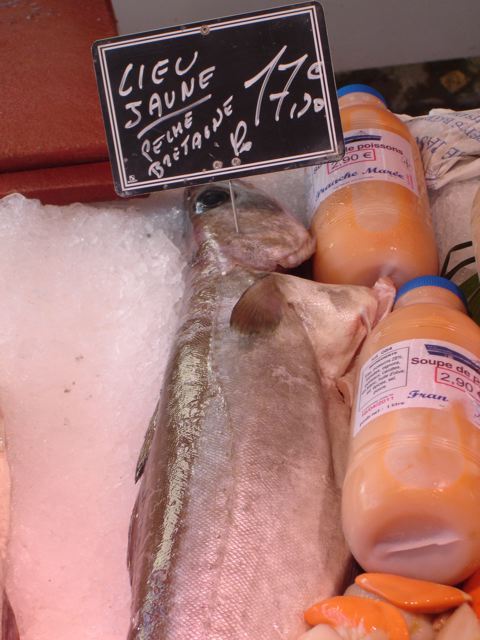
It’s just the two of us tonight, so when I saw that the Friday fishmonger in Lautrec was selling pollacklieu jaune–for 11 euros a kilo, I figured this was the moment to try this eco-friendly fish.

The fish stall in Lautrec this morning

I asked him to fillet it, which he did in a trice.

I complimented him: “Vous avez le savoir -faire, Monsieur!”  He has the proper knife too.

(You can cook the fish whole, of course.)

A whole pollack on the stall

This is adapted from Rena Salamon’s excellent book.

The fillets weigh just over 8oz/250gms each.

for 2

2 pollack fillets– about half a pound each. You could choose haddock, cod, monkfish, red or grey mullet or other firm-fleshed white fish

juice of a lemon

3 tablespoons olive oil

2 medium onions–finely sliced

1 stick of celery–finely sliced

4 cloves of garlic–finely sliced

1lb/450gms tin of tomatoes–drained of juice and broken up

2 tablespoons parsley–finely chopped

1 small wine glass of white wine

salt and freshly milled black pepper

2 tablespoons wholewheat/rye breadcrumbs

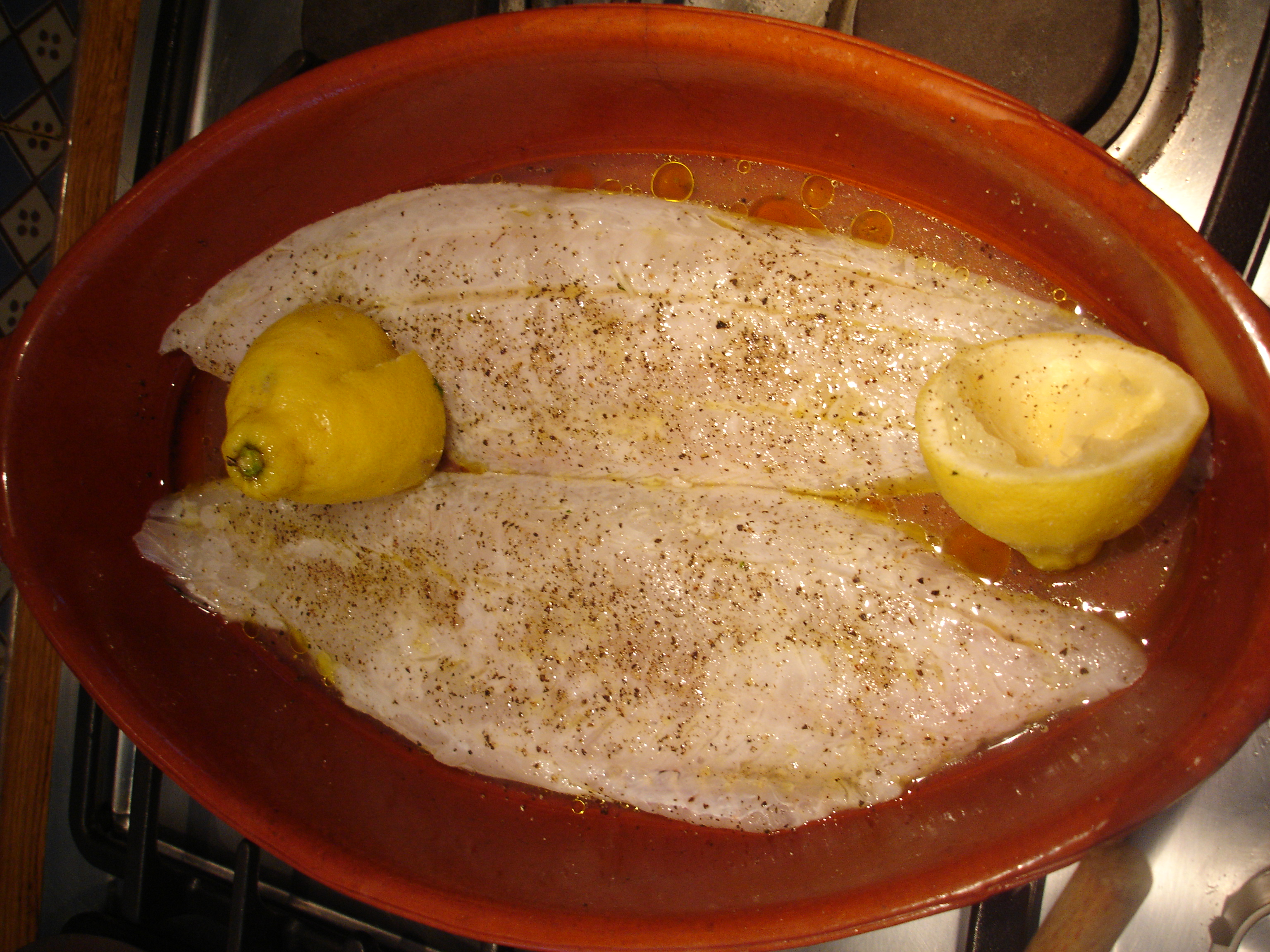
Oil a baking dish that will hold the fillets with a tablespoon of the oil.


Lay the fillets–cut into pieces or whole–in the dish.

Pour over the lemon juice and season with salt and pepper.

Leave to marinate for about an hour.

Heat the oven to 180C/350F.

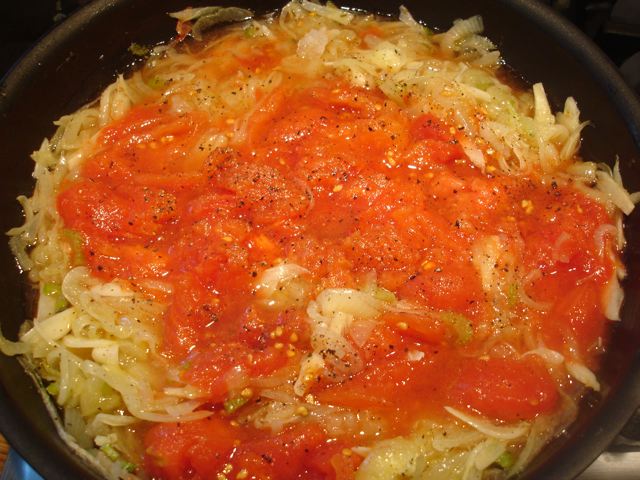
Gently sauté the onions, garlic and celery  until they collapse–being careful not to brown them.

Add the tomatoes and the wine to the onions, garlic and celery.

Mix and season well.

Cook this gently for 15-20 minutes.

Add the parsley and cook for a further few minutes.

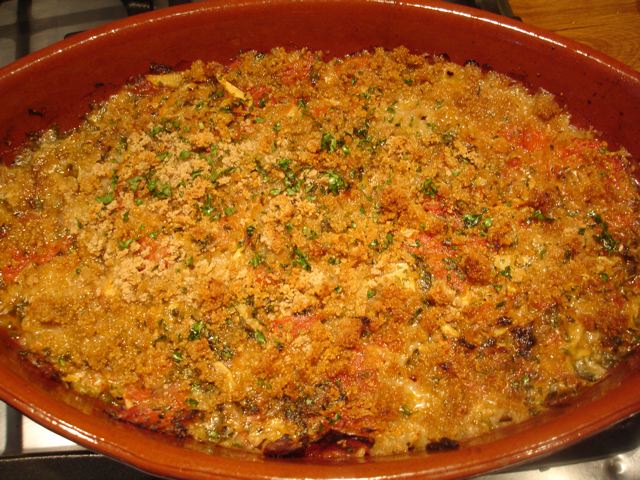
Spoon this mixture over the fish and sprinkle with breadcrumbs.

Bake in the centre of the oven for 30-40 minutes.

This is my 50th post and it’s dedicated to my mother Molly [Weakford] Ellis–whose cooking on a small budget in the late forties and fifties was resourceful and inventive. From her I learned that it was worth spending a little time in the kitchen–not least because I got to lick the bowls!

The Ellis Family under the flowering cherry 1955

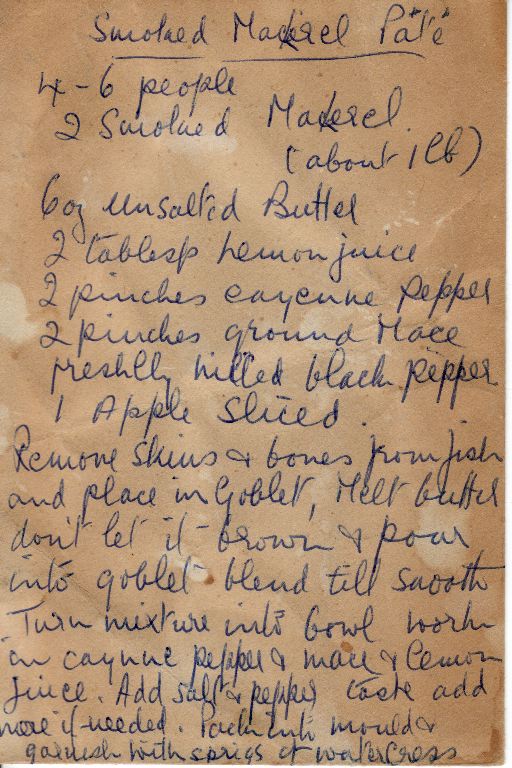
Her smoked mackerel paté has a fair amount of melted butter in it, but the oily mackerel is a healthy counter to it.

I like it best served on toasted rye bread.

She wrote the recipe out for me on the back of an envelope and miraculously I still have it.

Her flowing round hand is unmistakeable to me. Few of her written recipes survive, so I treasure this one.

It is very simple.

I made it this morning with the 8oz/250gms of mackerel bought last Saturday at the London Farmers’ market and reduced the other ingredient quantities accordingly….

(Tasting it for balance is a legitimate perk of the cook!)

The apple slices cut the richness of the paté.

Watch out though–it is more-ish!

Serve with lemon wedges.

It’s Mother’s Day this weekend–so “Thanks Ma!”

Home again in France and happy to be so.

In spite of being bleary-eyed from the journey  yesterday, I don’t miss another sign of the change of seasons: an asparagus stall at the Realmont market this morning.

At the bigger Castres market on Saturday there’ll be several, piled high with the new green and white  asparagus spears. I much prefer the green–a matter of taste and habit.

It may be a little early for this superfood, but I buy 500 grams/1ib, a generous serving for two–about 7 spears each, plus a few for testing.

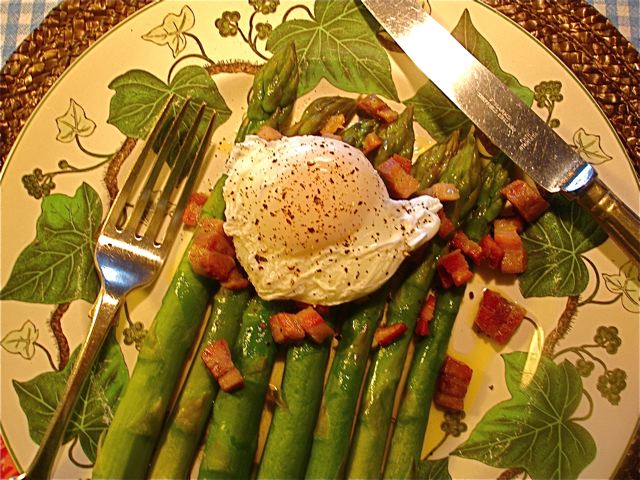
I know there’s a piece of bacon in the fridge–about 4oz/100gms– which I will dice small, gently sauté to a crispy finish.

I’ll dress the asparagus with 3 tablespoons olive oil, 1/2 teaspoon Dijon mustard, 1 tablespoon of lemon juice and a pinch of salt–whisked together; sprinkle over the bacon bits and top it off with a carefully placed poached egg.

An easy lunch for two weary people.

For the asparagus:

Trim the rough base of the spears, making them all about the same length.

Choose a saucepan or sauté pan that will take them all lying horizontally, and that’s wide enough to take a steamer basket/tray.

Fill the pan with water to the depth of the basket.

Place the asparagus horizontally in the basket and cover the pan.

It’s handy to cook an extra spear that you can use to test for doneness.

6–8 minutes should do it, depending on the thickness of the spears.

Pierce a spear with the tip of a knife to test for doneness–or better still, use your teeth!

When they are tender, divide them between two plates.

Spoon over a little dressing and share out the bacon dice.

Carefully place a poached egg on top.

Wrapping the ends of the asparagus in a damp paper or cloth towel, helps preserve the freshness of the  asparagus in the refrigerator. Best to eat asparagus within 48 hours of purchase–but why wait anyway!

Market envy…

I went to a market on Saturday morning.

Nothing untoward about that.

This market was in Parliament Hill Fields in London, in the grounds of William Ellis school at the bottom of West Hill–old stomping grounds for me–I went to school in Highgate–just up the hill.

It happens every Saturday and is beloved by the residents of this densely populated area of north London.

A barking chorus of what look like adorable dogs–large and small, hairy and smooth, tethered to the wire mesh fence–greets you on arrival.

“Don’t forget the bones!” is obviously the anxious  message.

You can bank on bumping into friends, everyone shopping for the social occasions of the weekend.

The marketeers come from far and wide. There are breadmakers, cheesemakers, cakemakers, butchers, fishmongers and numerous vegetables stalls. There’s even one dedicated to tomatoes–tomatoes in March?

I ask the stallholder about that, after he gave me one to try which was wonderfully sweet. He says he grows them under cover on the Isle of Wight. There’s no answer to that!

Another stall sells a variety of game with ready-to-cook pheasants, partridge, wild ducks and pigeons. Venison too.

These last two stalls reminded me of what I miss in France, where I glory in the market culture and its emphasis on the seasonal, but where it’s often difficult to find “the out of the ordinary”.

Pheasants and partridge are hunted wild but not farmed–I rarely see them in the markets or supermarkets.

Farmers markets in the UK usually offer this variety of produce, plus a helping of home cooked fare in an atmosphere of village fetes in summer.

I found myself feeling a touch of envy for this Saturday crowd of Londoners, out in the spring sunshine and planning their tasty weekend meals.

I’m discovering that blogging can become addictive.

We are in London for a week and I’m not cooking–so my source material is limited and I’m finding it difficult and frustrating.

I’m having blog withdrawal symptoms!

This is not reasonable I know.

London is coming out of winter fast and looks beautiful.

A willow tree close to the river in Chiswick was a cascade of bright fresh green and a large grey heron was sunning himself on the river bank.

Every morning there are new blossoms out.

We were driving north on Devonshire Place towards Regent’s Park just now when Meredith started singing–

“I’ve often walked down this street before;
But the pavement always stayed beneath my feet before.”

It was the emerging cherry blossom  both sides of the street that evoked the feeling of Freddie Eynseford-Hill’s joy filled ode to Eliza Doolittle in My Fair Lady!

Primrose Hill was covered with lunchtime picnickers and it’s not the end of March yet, though the clocks go forward tomorrow.

Nevertheless reasonableness doesn’t come into it and in spite of being spoiled with some good theatre and meals with friends, I still felt a dish of cold turkey was all there’d be for lunch!

I eased the pain by enquiring about pollack, in the well run fish shop on Gloucester Avenue.

The friendly French owner gave me the french name–lieu jaune, which I remember seeing on the stalls back home.

It’s a member of the cod family and a sustainable alternative to other white fish. Its resurfacing, so to speak, is not uncontroversial though.

They were out of it, but he recommended coley instead.

Tonight I shall cook FISH.

Phew–withdrawal of symptoms!

This seed is a useful alternative to rice. It is grown high up in the Andes–and no one seems to agree on how to pronounce it!

It serves as a plain canvas on which you can paint what you like.

It takes less time to cook than rice and is delicious in its own right or, as below, mixed with  sautéed vegetables.

It takes well to steamed  green vegetables, like broccoli dressed with good olive oil or sprinkled with crunchy nuts such as dry-roasted walnuts.

Crumbled feta or goats cheese is good too.

Here you can learn more about the benefits of Quinoa–perhaps more than you want to know!

Quinoa with sautéed vegetables

for 4

8oz/250gms quinoa

1 pint/2 cups/16floz of vegetable stock–I use organic stock cubes.

Cook this gently, covered, until you can fluff it up with a big fork–about 15-20 minutes.

quinoa cooking in stock

Meanwhile…

Gently sauté together:

4 tblsp olive oil

1 medium onion (red or yellow)–chopped fine

1 clove garlic–chopped

small red pepper–seeded and chopped into small dice

1 small chilli–chopped

1 small courgette–chopped into small dice

1 medium ripe tomato–peeled, seeded and chopped into small dice

Sauté them until soft.

vegetables gently sautéed

Add this mix to the cooked quinoa.

Add salt and pepper to taste–though be careful with salt, as the stock may be salty.

Allow the flavours meld.

cooked quinoa with veg mixed in

If you have some, sprinkle with a tablespoon of chopped parsley.

Mix all together carefully and eat it hot or tepid.

(You can steam the quinoa for a couple of minutes to re-heat.)

Michel Montignac

Michel Montignac
Michel Montignac in the kitchen of La Tour d’Argent restaurant in Paris (1993)
Photograph: Ian Cook/Getty Images

Shortly after being diagnosed with Type 2 diabetes, my friend David Clifford recommended Michel Montignac’s book, Dine Out and Lose Weight, now retitled  Eat Yourself  Slim and Stay Slim!

I read it and  found it helpful. Montignac emphasises the importance of changing one’s “way of eating” rather than dieting.

His theory is that it’s high sugar content in some carbohydrate foods that encourages the body to store unwanted fat that increases weight, rather than a high calorie intake.

He was a pioneer in using the glycemic index of foods–which measures the effect of carbohydrates on blood sugar levels (how quickly carbohydrates turn into glucose in the blood) to help people lose weight. Controlling excess weight is important for people with diabetes.

One day last September I read that Michel Montignac had died at the relatively young age of 65.

I emailed The Guardian newspaper to ask if they were planning an obituary. They replied, asking if I knew him. Though he came from southwestern France, I didn’t know him personally but  explained that I knew his work. The Guardian obit editor then invited me to write Montignac’s obituary.

It was an offer I couldn’t refuse.

Still no oven!

(En principene competez pas vos poules avant qu’elles sont éclorés–on ne sait jamais!–there’s someone coming to fix it on Monday)

So a chance to see how this dish, a regular favorite and so easy to do, does when cooked on top of the stove– on a very diffused heat.

Normally it cooks slowly in a low oven for two hours and comes out sweet and tender.

A minor experiment.

It features in my first cookbook–Delicious Dishes for Diabetics.

Adapted  from the talented Frances Bissel’s book The Pleasures of Cookery–it uses spare rib chops–which stay succulent during the long cooking.

(Not to be confused with spare ribs from the belly of the pig; spare rib chops come from the neck end of the pig and are sweeter. They are also reasonably priced.)

for 4

4 spare rib chops/echine in France

2 400gms/16oz  tins/bottles of white beans

1 onion— sliced

1 stick celery — sliced

2 juicy oranges

1 teaspoon of coriander seeds

1/4 pint/150ml stock–I use organic vegetable stock cubes, but it’s a question of taste.

salt and pepper

A handful of chopped fresh coriander or parsley.

Set the oven to 160C/320F–if you are lucky enough to have an oven that works!

Spread the beans over the bottom of the oven proof dish in which you will serve the finished dish.

Brown the chops in a non-stick pan (to avoid using any fats) and lay them on top of the beans.

Lightly brown the onion and celery in the same pan.

Spread them over the chops.

Cut some strips of rind from an orange, avoiding the white pith.

Bury these among the chops and beans.

Squeeze the juice from  two oranges and pour it over the chops.

Pound the coriander seeds and sprinkle them over.

Add the stock.

Cook in the middle of the oven for 2 hours–(or as I am doing tonight, on a very low heat on top of the stove for the same period).

Check after an hour to ensure that there is enough liquid–but be careful not to add too much or the concentrated taste of the sauce will weaken.

Season when it’s cooked.

A green vegetable–steamed broccoli with olive oil–looks good with this on the plate.

Sprinkle with chopped coriander or parsley.

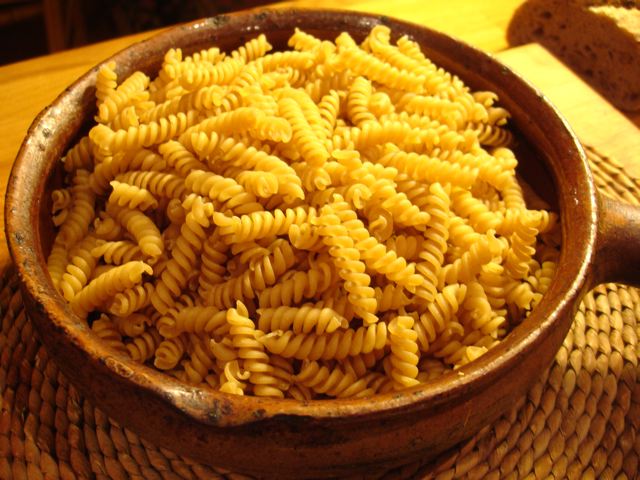
wholewheat spirrals

Our friend Rosemary Beau*, has pointed out in a comment, that I had not specified whether I use whole wheat pasta in the post for Penne in a tomato, rosemary and balsamic vinegar sauce.

She was right to mention it.

After my diagnosis of Type 2 Diabetes, we changed from eating white to whole wheat pasta. Although of course we noticed the difference in texture, we quickly came to prefer whole wheat pasta. We like the taste.

It favours strong sauces, like the one mentioned above.
Many supermarkets stock it these days–I just bought some at  the Holloway Road branch of Waitrose in London–but the shapes available in whole wheat are more limited than for regular pasta–so far.
From a health perspective, I feel more comfortable eating the whole wheat variety.
Research shows that the Glycemic Index [GI] of unrefined pasta is lower than refined–which is no surprise . What is surprising is that the difference is not as great as one might imagine.
Anyway, a moderate helping of pasta a week is a delight that I’m not giving up–for the moment at least!

How “al dente” it’s cooked is a matter of taste.

In Italy you’d think it an arrestable offence to overcook pasta–they cook it very al dente.  It does make for agreeably slower eating and as it takes longer to digest, it’s considered healthier.

Dishes made with the whole wheat variety are still a rarity in restaurants–though I was brought out of a jet lag daze last year when I spotted one at the end of the pasta offerings on a menu in New York City.

*We got to know Rosemary many years ago when we stayed at her warmly elegant B&B in the La Sologne area, south of Orleans in central France.