Feeds:
Posts
Comments

Archive for the ‘Food’ Category

I finally got round to looking at August’s newsletter of GI News–a useful and lively healthy eating outlet from the University of Sydney and based around the principles of the Glycaemic Index and Glycaemic Load.

There’s a short piece by dietician Nicole Senior in which she discusses the pros and cons  of eating red meat from the perspectives of health and the environment.

It’s far from bad news for red meat fanciers.

She quotes recent research:

A model healthy diet according to Australia’s National Health & Medical Research Council, contains 65g a day of red meat (455g/1lb per week) and the American Institute of Cancer Research: World Cancer Research Fund says to limit red meat to no more than 500g (1lb 2oz a week) to reduce the risk of cancer.

To reduce greenhouse gas emissions, Professor Tony McMichael and colleagues from the Australian National University have suggested we limit red meat to no more than 90g (3oz) a day (630g/1lb 5oz a week), based on the idea people in developed countries currently eat more than double this.

Restricting red meat to a quarter of the Plate, she says, will help as a guide to achieving this.

I then took another peek at Michael Pollen’s excellent and amusing Food Rules (Penguin) in which he says that when buying meat, it’s worth looking for animals that have been fed in pastures.

Monsieur Fraisse, our butcher in Lautrec, knows where each animal he butchers has been raised and what they’ve been fed on. A luxury I know and not so easy when shopping in supermarkets.

Worth asking though?–if there’s a working butcher’s counter at the supermarket?

I’d be interested to hear any feed back–(so to speak!).

Michael Pollen writes:

The food from these animals will contain much healthier types of fat as well as higher levels of vitamins and antioxidents.

You will pay more but if you are buying and consuming less–the cost won’t be much higher.

The meat will taste better too!

Michael Pollen’s mantra on how to eat:

Eat food. Not too much. Mainly plants.

You could also check out the piece by Professor Jennie Brand-Miller–GI expert–on the protein values to be got from plants, in the same August newsletter.
Read Full Post »

Our friend, Sonia, called by with husband John yesterday to buy an extra cook book autographed for a friend.

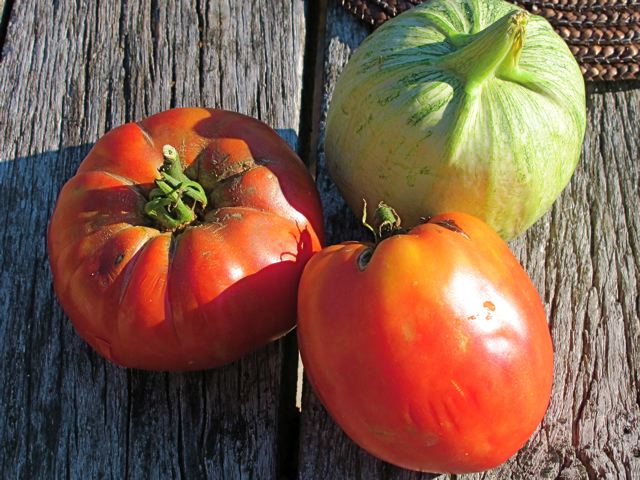
She’s a green-fingered gardener and a generous spirit–seldom arriving without something seasonal from her vegetable patch. Yesterday she brought us two HUGE tomatoes, and a round courgette.

How on earth did she know about our new resolve!?

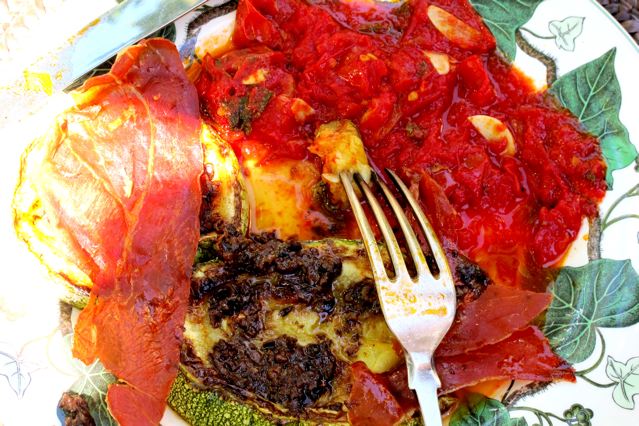
She also brought enough basil to make pesto (recipe from the cook book)–a favorite with Meredith–which was delicious, drizzled lightly over the grilled aubergine and courgettes for supper:

No wine! We kept the pledge--but it was hard.

Now–what to do with the two red beauties…?

One weighed in at a pound and a half (700 grams)! A sauce, perhaps…?

A sliced tomato salad and pesto again, with the other (a puny pound or 450gms)?

Some of the left-over Parma ham, lightly grilled, and Sonia’s courgette–cut into thick rounds, lightly salted and left to drain for half an hour, dried and brushed with olive oil, then roasted for 20 minutes at a high heat (turn them over after 10 minutes) with a spoonful of tapinade spread over it this time–will see us through to supper.

A merry mess!

Post lunch, I notice that there’s enough tomato sauce left over to make a small courgette tian for supper.

We’ll be not be wanting courgettes for a couple of days!

But there are plenty of other summer choices and I’ll never tire of red ripe tomatoes….must go check the tomato patch!

Read Full Post »

…of the cook book!

"Salade Niçoise"--prét à manger!

Can we have a week of eating lightly and no wine?

The guests have flown, the book is launched, the sun has come out–seems a perfect time.

We’ll start today.

Lunch: A modest Salade Niçoise for two….

Cherry tomatoes–halved; a couple of anchovy fillets–halved; a hard boiled egg–halved; sprinkling of green beans–cooked to tender; black olives (niçoise if possible); half a cucumber seeded and diced; a spring onion thinly sliced and a tin of good tuna packed in olive oil–drained–all arranged on a small bed of salad leaves (heresy to some natives of Nice, who claim the authentic version has no salad leaves!)

Salade niçoise--lunch today.

Dressing: a few torn basil leaves and a couple of fat cloves of garlic, crushed to a pulp with a pinch of salt and whisked into three tablespoons of good olive oil. 

Dinner: a salmon fillet each–cooked in a pan on the lowest heat, skin side down and with no oil.

When they start to change  colour at the base, sprinkle with a little salt and pepper and cover the pan.

They are done when little beads of white juice emerges from the top.

A simply cooked seasonal vegetable (Green beans? Grilled/roast halved tomatoes? Grilled courgettes/zucchini?) would go well plus a quartered lemon.

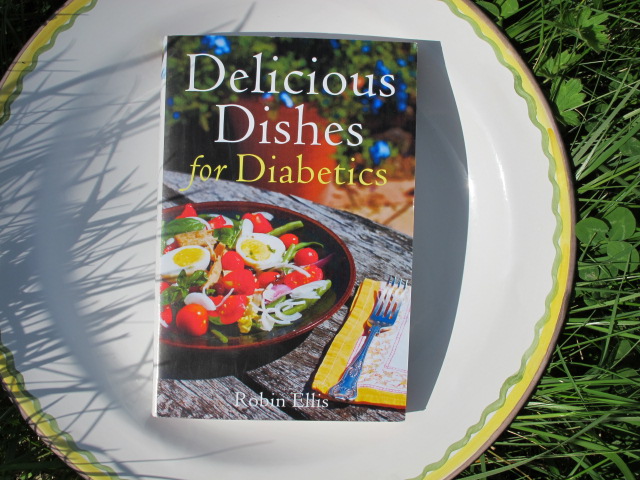
(Both these recipes from Delicious Dishes for Diabetics–a Mediterranean Way Eating.)

Bon appetit!

Read Full Post »

Yotam Ottolenghian Israeli born in Jerusalemowns five restaurants in London and contributes flavoursome recipes to the Guardian on Saturdays, with unusual Middle Eastern taste twists.

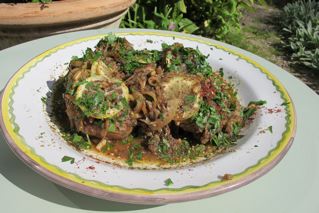
Not a great looker--but the taste...!

Ottolenghi’s Chicken is his version of the traditional Palestinian dish, M’sakhan. It is delicately flavoured with soft spices like cinnamon, allspice, and sharpened a little with sumac [dark red and lemony], enhanced with thin slices of  lemon and onion–delicious to bite into–and finished off with za’atar–which is sesame seeds in a mix with oregano, thyme and other herbs.

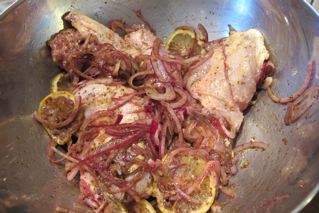
The chicken pieces are marinaded overnight in these gentle flavours, then roasted for 40 minutes.

Garlicky yogurt sauce & Moroccan bread went well with it at the book launch. For diabetics, better to substitute whole-wheat brown pita bread or brown Basmati rice.

1 chicken–cut up into 8/10 pieces

1 lemon–sliced very thin

2 red onions–sliced very thin

2 cloves of garlic–mashed to a pulp in a pinch of salt

4 tablespoons olive oil

1 teaspoon allspice

1 teaspoon cinnamon

1 tablespoons sumac

200 ml stock

1 teaspoon salt 

1 teaspoon pepper

2 tablespoons za’atar

50 gms/2 oz pine nuts

for 4/5

Combine the first 11 ingredients in a bowl and mix well together.

  • Let this marinade, covered, in the fridge–preferably overnight.
  • Heat the oven to 200C/400F.
  • Lay the chicken pieces, skin side up, in a roasting pan and cover them with the lemon and onion marinade.
  • Sprinkle over the za’atar.
  • Roast in the oven for 35 to 40 minutes–the juices should run clear when you pierce a leg piece.
  • In a small frying pan gently dry roast the pine nuts.
  • Sprinkle them over the chicken and present the dish to the “table” before serving and enjoy the “oohs!” and “aahs!”.
  • Scatter over some chopped parsley to finish, for colour, if you have some on hand.
Yogurt sauce
 2 125gm pots of no-fat yogurt–whisked to smooth
1 fat clove of garlic–pulped in a pinch of salt
1 tablespoon of olive oil
Whisk all ingredients together into a smooth sauce.
As so much of this dish can be prepared beforehand it is a useful dish for company.
Two chickens roasted together will give you enough to feed 10 people.

Read Full Post »

First “post-launch” post–we’ve been busy!

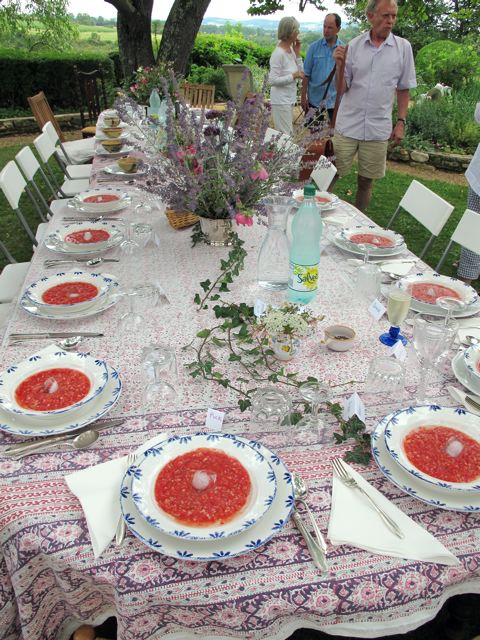
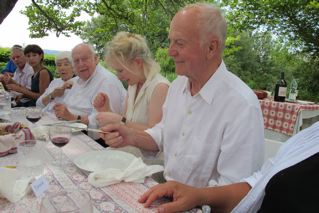
Twenty-two friends (many of whom, in one way or another, had helped with the book) sat down for lunch on Friday at tables set end on end under the trees–

Ma's Gazpaccio waiting patiently

–nicely protected from the sun but rain could be a problem and it has been uncharacteristically wet this year.

The skies were scoured for signs, forecasts checked hourly and finally a prayer went up to the heavens.

We were blessed–not a drop fell the entire afternoon.

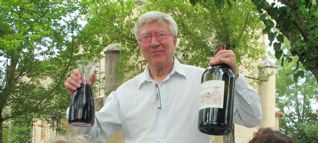
A friendly sounding hum rose early from the throng–Ma’s Gazpacho was hitting the spot; as was the mellow Tuscan red poured from a 3 litre magnum–a gift from our friends Keith and Helen.

It–“the book”–was launched.

Hope James–the book’s illustrator–was there and I read this out from our friend Eva Marie’s email, received that morning:–

“Her beautiful sketches brought me right back to your cozy home and the French countryside. I am suddenly missing you and Meredith!”

That’s what they do–they bring the book to life.

Chicken was next, with unfamiliar spices–sumac and za’atar–[see part two–tomorrow– for the recipe]

An Ottolenghi special that lends itself well  to large parties.

Marinaded overnight on Wednesday, cooked in three batches Thursday afternoon and gently reheated–stacked in its juices–an hour before we ate it.

Served with plain green beans, a garlicky yogurt sauce and toasted Moroccan bread.

Then followed two lovely surprises–for me.

Fellow Poldark actor Donald Douglas [his chilled cucumber soup features in the book] tapping a glass and rising during the cheese course, meant only  one thing–he was going to speak.

He not only spoke–he sang!

“There is nothing like a Dame” from South Pacific–adapted for the occasion.

“He played Ross the brave and bold

Now here he is grey haired and old”.

Now another surprise.

My old friend George–one of three distinguished judges present–touched me and everyone with his words on long lasting friendship.

What a day!

[A second helping promised for tomorrow…!]

Read Full Post »

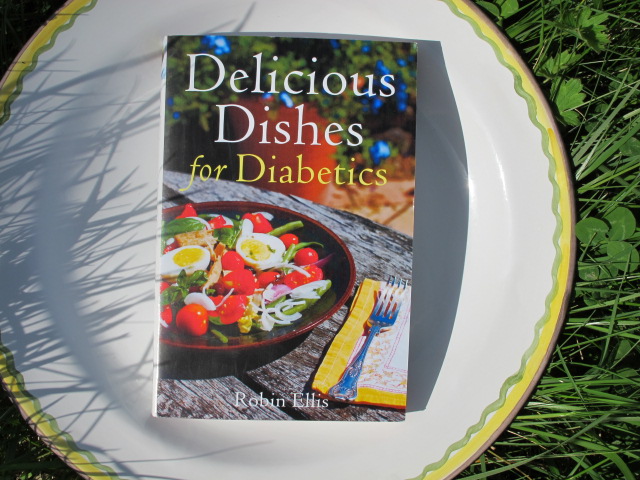
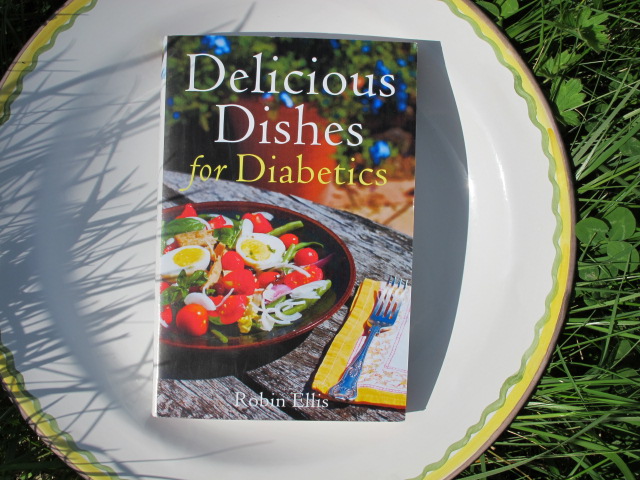
It’s publication day–August 4th–for Delicious Dishes for Diabetics!

In February 2010, Meredith and I popped into publishers Constable and Robinson in London for a meeting.

Eighteen months later and the book goes on sale–TODAY!

What can I SAY but–

HOORAY!

And a big THANK YOU to Francia, Paula, Judith, Hope, Paige, Alex,Holly, of course Meredith, and all those who have helped it along the WAY.

Thanks too to all for supporting the blog–which I’m enjoying writing hugely.

Read Full Post »

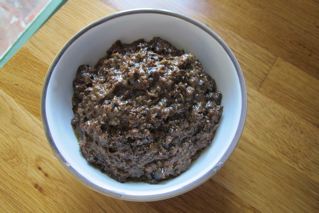
Tapenade

This is in Delicious Dishes for Diabetics–to be published in TWO DAYS TIME!!–4th August

Based on Mireille Johnston’s recipe – she got the mix just right – this is a traditional savoury spread.

The word tapenade originates from the Provençal for ‘caper’.

It’s a great standby to have in the fridge and is simplicity itself to make.

Serve it as a summer lunch on toast brushed with olive oil and a slice of the ripest tomato on top, or on grilled slices of

courgettes or aubergines, or on savoury biscuits or small pieces of toast as an appetizer, or whatever!

It is a favourite at St. Martin–and would even persuade Cal McRae to come to lunch!

Serves 4 or more

200 g/7 oz black olives–the oily fleshy Greek ones are best, carefully stoned; it’s important to use the plumpest tastiest olives

6 anchovy fillets – chopped

2 tbsp capers

2 cloves garlic – crushed

1 tsp fresh thyme

1 tbsp Dijon mustard

juice of a lemon

black pepper

120 ml/4 fl oz/½ cup olive oil

  • Put all the ingredients, except the oil, in a processor.
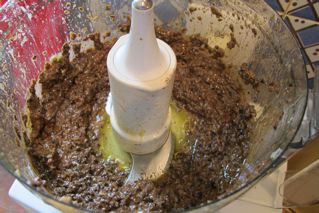
  • Using the surge button, gradually pour in the oil, bringing it to a nice nobbly sludge, i.e. not too smooth.
  • Taste for balance; you may need a little more lemon juice.
  • Pour into a bowl or plastic box, and dribble a little more olive oil over to form a preserving film.
  • Store in the fridge.

Read Full Post »

I was searching through an old blue large-format scrapbook for the recipe I planned to post today.

No luck–but I found this from Jenny Baker’s Simple French Cuisine–which has been an old friend for years.

It qualifies nicely for the “what to do with the courgettes/zucchini season” list!

for 4

2 lbs/1 kilo courgettes/zucchini–[a mix of green and yellow if you like]-sliced thin. [A food processor helps here.]

2 tablespoons olive oil

2 oz/50gms anchovy fillets–mashed to a pulp

1 teaspoon olive oil [to melt the anchovies in]

2 cloves of garlic–chopped fine

2/3  tablespoons of parsley–chopped

3/4 tablespoons wholewheat/rye breadcrumbs

black pepper and a pinch of salt

for 4

Heat the oven to 200C/400F

  • Heat the oil in the largest sauté/frying pan you have.
  • Add the courgettes and turn them in the oil.
  • Cook them for 15 minutes–turning occasionally over a medium heat–taking care not to brown them.
  • When they are cooked through mix in the pinch of salt–the anchovies in the topping will provide enough additional saltiness.
  • Heat the teaspoon of oil in a small pan and melt the anchovies in it.
  • Turn off the heat and add the garlic, parsley and breadcrumbs.
  • Season with pepper and mix thoroughly–you have the topping.
  • Fold the courgettes into a medium gratin dish and spoon over the topping.
  • Crisscross some olive oil over the topping and round the circumference.
  • Cook in the oven for about 15 minutes–[it should be nicely browned and come out sizzling a little!].

We had it for lunch.
The juices from the tomato salad melded well with the anchovy breadcrumb topping.

Read Full Post »

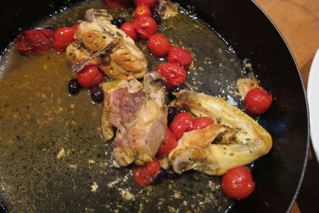
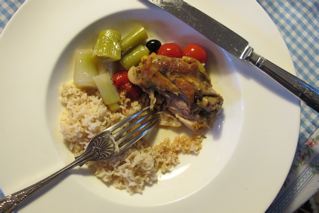
A bowl of cherry tomatoes waiting their turn, reminded me of this delicious Marcella Hazan recipe–a different summer way with chicken.

The sweetness of the cherry toms is cut by the little black olives from Nice. Meredith bought some last week.

And rosemary is cascading in the garden.

for 4

a free range chicken–cut up in 8/10 pieces

1 tablespoon of olive oil

5 cloves of garlic–peeled and left whole

2 teaspoons of rosemary needles–chopped fine

salt and pepper

4fl oz/100ml white wine

20+ cherry tomatoes

a handful of black nicoise olives 

Trim the excess fat and some of the loose skin from the chicken–tidying it up.

Heat the oil in a large sauté pan with a lid.

Add the rosemary and garlic.

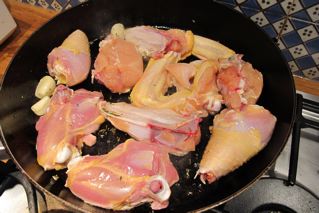
Put in the chicken pieces skin side down and sauté them over a medium high heat.

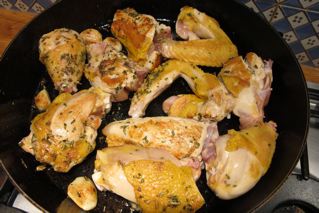
Nudge them with a spoon after 2 to 3 of minutes–when they move easily without sticking to the pan look to see if they’ve nicely browned. At that point, turn them over and repeat on the reverse side.

When you have a pan of golden chicken pieces season them generously and add the wine.

Let it bubble a little–then cover the pan and cook the chicken for about 30 minutes on a low heat–turning the pieces from time to time to keep them moist. Add a tablespoon or two of water if needed.

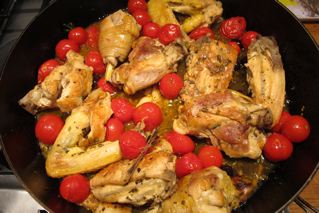
Add the tomatoes and olives and cover the pan again.

Cook until the skin of the tomatoes show signs of splitting.

Read Full Post »

It’s  “summer“–though it felt more like March this weekend.

(“We had our summer in May,” said my egg supplier in the market early Saturday morning.)

It’s the busy season of guests–and the unexpected.

It was brighter Sunday morning and we took our visitors from Washington D.C., Irv and Iris, to Lautrec for lunch with two other friends.

Café Plum  (charming bookstore/café, a touch of the Left Bank in Lautrec) was finding it a challenge being popular.

A table of twelve had just ordered when we arrived.

We waited twenty minutes, and then were told, politely, it would be another twenty if we wanted to eat!

The six of us decided a salad in the courtyard chez nous might be a better bet–though we might be chasing the sun.

Iris and I got back first.

“Shall I make a tomato salad?”

“Good idea,” I said.

Iris and Meredith had picked some of our tomatoes Saturday evening–five varieties–for  a taste test.

Plenty were ripe, despite the weather. (Do they get tired of waiting for the sun and say to themselves: “time to go red?“.)

They cut them up in bite-size chunks and arranged them on a pretty plate with salt & olive oil for the sampling.

Delicious!”– though some were sweeter than others.

Certainly good enough for a quickly improvised salad.

To go with the sweet tomatoes, Iris found black olives and buffalo mozzarella in the fridge, added some torn basil, thinly sliced red onion and sunflower seeds (dry roasted).

She dressed this good-looking mix with Tuscan olive oil (Liquid Gold) made by our friends, Keith & Helen.

We had it with tuna salad (A saucy tuna lunch for two), slices of melon and Parma ham, followed by local cheese.

We poured out more of our favourite everyday red– Gaillac’s Clément Termes and continued the animated chat.

Next time we go Café Plum we’ll make sure we pip “the party of twelve” to the post!

Read Full Post »

« Newer Posts - Older Posts »