Feeds:
Posts
Comments

Caponata has as many versions as there are towns in Sicily, no doubt!

Everyone has their way of cooking this traditional peasant dish.

The English cook Jamie Oliver calls it Incredible Sicilian Aubergine Stew.

It’s a good description; this is adapted from his version.

(There are echoes of the French ratatouille, of course.)

This recipe is in my cookbook, Delicious Dishes for Diabetics,  which is published in August in the UK, November in the USA.

for 4

2 large aubergines (aka eggplant)–cut in chunks, salted and left to drain–overnight if you can, but an hour or two anyway (They soak up less oil this way, when cooked.) Dry them thoroughly with kitchen paper.

1 tsp dried oregano

s&p

1 small red onion–chopped fine

2 garlic cloves–sliced fine

1 small bunch parsley– stalks chopped separately very finely–(chop the leaves finely too to scatter over the finished dish)

2 tablespoons of capers–drained and squeezed free of liquid

A handful of green olives–stoned, if you’ve time

2/3 tablespoons herb vinegar (I use tarragon vinegar)–not more or it dominates

5 ripe tomatoes (tinned, if it’s not the season)–roughly chopped

Heat 2 tablespoons of olive oil in a large pan.

Add the aubergine chunks and oregano (do this in two lots if your pan isn’t big enough)

Cook on a highish heat to brown the chunks, turning them as they colour.

(This is the longest part of the cooking.)

When the aubergines are nicely coloured, add the onion, garlic and the parsley stalks.

Cook for a couple of minutes.

Add more olive oil if you feel it needs it.

Add the olives, capers, and herb vinegar.

When vinegar has evaporated, add the tomatoes.

Bring up to a simmer and cook on a gentle heat for 15 to 20 mins, covered for the first 10 minutes, until the aubergines are really melting.

Season with pepper and salt–bearing in mind that you salted the aubergines earlier.

Sprinkle over the parsley.

Serve with extra olive oil on hand.

Tonight we have a vegetarian among the six, so I am serving this as a vegetable with our slow roast shoulder of lamb and as the main dish for the vegetarian.

caponata–tastes better than it looks!

Be not afeard. The isle is full of noises,
Sounds and sweet airs that give delight and hurt not.
Sometimes a thousand twangling instruments
Will hum about mine ears, and sometime voices
That, if I then had waked after long sleep,
Will make me sleep again; and then, in dreaming,
The clouds methought would open, and show riches
Ready to drop upon me, that when I waked,
I cried to dream again.”

We are a couple of hours from the Mediterrenean here, so this is no island paradise; but Caliban’s friendly welcome to Ferdinand in Shakespeare’s Tempest flooded into my mind as I set  off on my walk at 7.30 this morning.

The birds had been up betimes–taking over from the cicadas we heard last night.

Cicadas in April..?, we asked ourselves.

The golden oriole scolded me for being late, but the rest were happy talking among themselves, sounding like:

“a thousand twangling instruments–hum{ing} about mine ears!”.

Things get going early here–a few neighbours had dropped by already.

Early callers!

They seemed a little nervous when I appeared and moved on to a quieter part of the meadow.

The pheasant hopped into the undergrowth when he spotted me–his squawk sounding like an steam train on its last journey to the breakers’ yard.

I played Ferdinand  in 1965 at Salisbury Repertory Theatre–my first professional Shakespeare.

I’d been Prospero too, the exiled Duke of Milan, in a school production a few years earlier and seen John Gielgud play it at the Theatre Royal, Drury Lane. The play is an old friend.

Ferdinand is hardly one of the great parts in the repertoire–his main job being to look convincingly awed throughout. Awed by the island, awed by Prospero’s daughter, Miranda–well and truly AWED!

As I descended into the little valley, surrounded by these magical sounds, I felt a touch of Ferdinand’s awe rising unashamedly in me!

A dish to see off the winter chill.
This is adapted from a recipe by Australian cookery writer Jody Vassallo and is a relatively quick all-in-one dish for small company.
It took me about 50 minutes from arriving back from the market to turning off the gas under the casserole.
Chorizo–sausage of the moment–to be eaten in moderation of course!

If made earlier in the day, you may need extra water when reheating it, as the lentils will continue to absorb the liquid–but it shouldn’t be swamped.

2 chorizo sausages–I prefer spicy ones–sliced into round chunks

2 tablespoons of olive oil

1 onion–chopped fine

1 carrot–chopped fine

1 stick of celery–chopped fine

1 small fennel bulb–outer casing and core  removed–chopped into small chunks

50 gms/2 oz pancetta or bacon–chopped

1 teaspoon of smoked paprika

120 ml/4 fl oz white wine

2 garlic cloves–peeled but left whole

a couple of bay leaves

250 gms/ 8oz green or puy lentils–the small grey-green ones–washed and drained

1 litre of water–with extra to hand

salt and pepper

a small bunch of parsley–chopped

Heat the oil in a medium casserole and fry the sausage and pancetta/ bacon until lightly coloured.

Remove and set aside on kitchen paper.

Add the onion, carrot, celery and fennel and cook these in the same sausage-informed oil for about seven minutes–until they too have lightly coloured.

Return the sausage and bacon to the casserole, sprinkle over the smoked paprika, add the wine, the garlic and the bay leaves.

When the wine has evaporated, add the lentils and  the litre of water.

Bring up to the simmer, cover and cook until the lentils are tender, about 20–30 minutes.

Season well and serve in warm bowls with the parsley sprinkled over and a swirl of olive oil perhaps.

steaming bowl of lentils and chorizo!

I came across this comment today from Gerald Bernstein, MD, director of the diabetes management program at the Diabetes Institute at Beth Israel Medical Center in New York City, explaining why”belly fat” is bad:
“When those fat cells around the belly swamp the organs that play a key role in regulating blood sugar, that fat works to block the action of insulin, which is necessary to lower the blood sugar.
Insulin normally triggers the liver to take up extra blood glucose and store the energy for future use.
But when the liver is submerged in this fat tissue, insulin can’t get it to respond. As a result, blood sugar can accumulate in the bloodstream, where it can damage organs all over your body.”
It reminded me of what Jill Littrell, in a comment a few days ago, said–in scientific terms– about the link between this visceral fat that lies deep inside the abdomen, surrounding the abdominal organs– the liver, kidneys, the pancreas– and the development of Type Two diabetes.
I’m beginning to understand this better.
Whether you are young, middle or–more middle aged (!)–no fat is your friend.

Walk with a Warbler

Walking Country by Hope James

I hear a sound  as I set out for my walk at 7.30, I haven’t heard in months—the warble of a golden oriole–(always an early riser).

Watching the walker...

Keen to let me know he’s back, he tracks me as I go–at least that’s how it seems; it’s good to hear him again.

There’s a pheasant in the meadow that we think is courting Madame Arkarti, our eccentric looking hen.

lurking pheasant...

She seems–as yet– oblivious of this. He circles the house, always at a safe distance, squawking his squawk–why else would he do this?

Two hares in a field bound away into the nearest cover when I stop to look–as far as they know, I might have a gun I suppose.

A farmer goes by on a tractor with spraying equipment on the back–off to work a nearby field. The smell as I follow reminds me of lavatory cleaner. It’s a miracle we have as much wild life as we do.

The garlic is growing fast encouraged by the recent rain.

Garlic grows apace

They’ll start to lift it towards the end of June ready for the garlic festival in Lautrec on the first Friday of August. Ten thousand people mill through the narrow streets and there’s free garlic soup at noon.

Homemade MINT SAUCE with apple and onion (goes well with roast lamb or lamb chops):

Meredith and I both grew up in houses in the fifties with mint in the garden.

Chicago and London–little did we know…!

The homemade mint sauce that went with the lamb roast at our house was tasty–my mother was a good cook!

Made with the traditional ingredients, as I remember–fresh mint, sugar and malt vinegar.

In this version an apple (not sugar) provides the sweetness in the sweet-and-sour sauce, which cuts the richness of the lamb.

This is included in my book Delicious Dishes for Diabetics, to be published in the UK in August and the US in November.

Leaves from a large bunch of mint

An apple–peeled, cored and roughly chopped

A small onion–quartered

Mix these ingredients in a food processor–not too finely; it should have  texture.

Then add salt and a good splash cider vinegar.

Taste it for balance before leaving it in the fridge to marinade for an hour.

Bring it back to room temperature and taste again before serving.

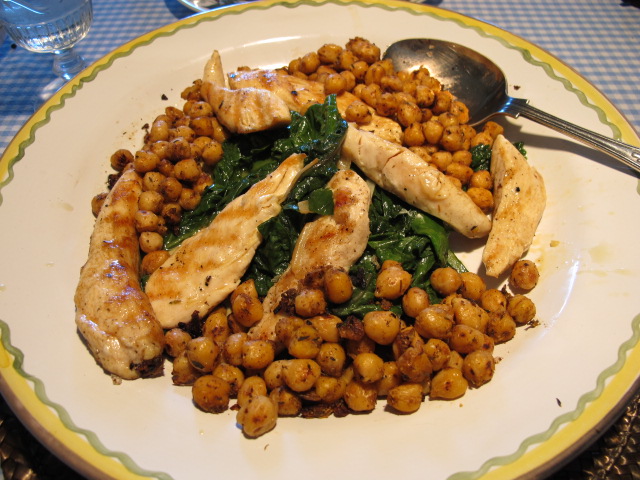
We had these spicy little numbers yesterday for lunch–with grilled strips of marinaded chicken breasts and swiss chard leaves sautéed with garlic and olive oil.

This is adapted from a lovely book of recipes by Australian cookery writer Jody Vassallo, which I found at Café Plum in Lautrec in French (it sells books as well as coffee, and feels Parisien!).

1 16 oz/450 gm  tin or bottle of cooked chickpeas–drained, rinsed and dried (it’s important to dry them well– kitchen paper comes in handy here).

1 clove of garlic-crushed to a paste, with a little salt

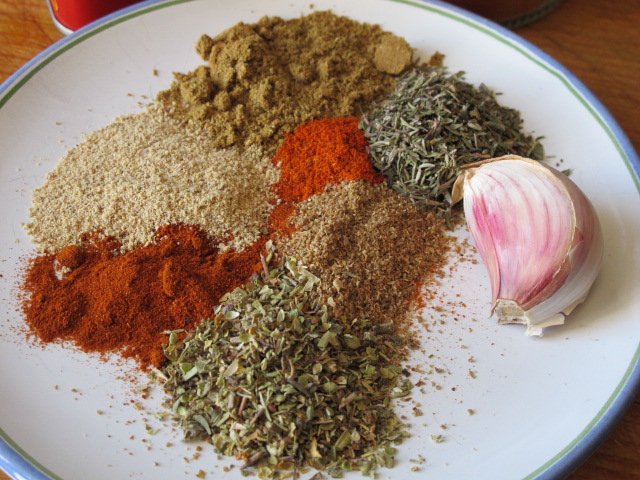
1 tsp each of smoked paprika, cumin powder, white pepper powder, coriander powder, cayenne powder, dried thyme, dried oregano and salt–(or as many of these as you can muster!)

2 tablespoons olive oil

Put the garlic, spices and dried herbs in a bowl and add the salt.

Mix these together thoroughly with a fork.

Add the chickpeas to the bowl and turn them over to coat them in the mixture.

Heat the olive oil in a large frying pan.

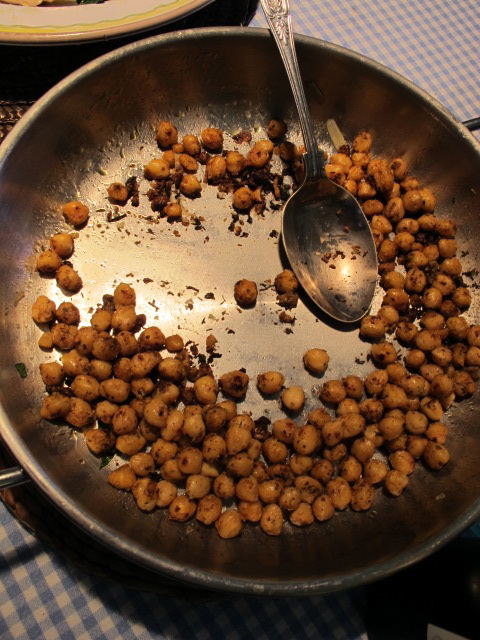
When the oil is hot add the chickpeas and roll them about in the oil–they should ideally lie in one layer.

Cook them over a gentle heat for 10 minutes, until they colour and crisp up.

They were delicious with:

A chicken breast each–cut into thin strips, seasoned and marinaded in olive oil for an hour.

Then cooked on a hot grill plate for a couple of minutes each side.

and

A large handful of swiss chard leaves (or spinach) washed and most of the water shaken off it, then sautéed in 2 tablespoons of olive oil with 1 clove of  garlic sliced very fine.

Heat the oil in a pan you can cover.

Fry the garlic until it starts to colour.

Carefully add the chard, a little salt and turn it in the oil.

Cover the pan and let the chard reduce until it is tender.

The excess water makes a little sauce, but if there’s too much just drain it off.

I arranged it all on a single plate and we fought for the last chickpea!

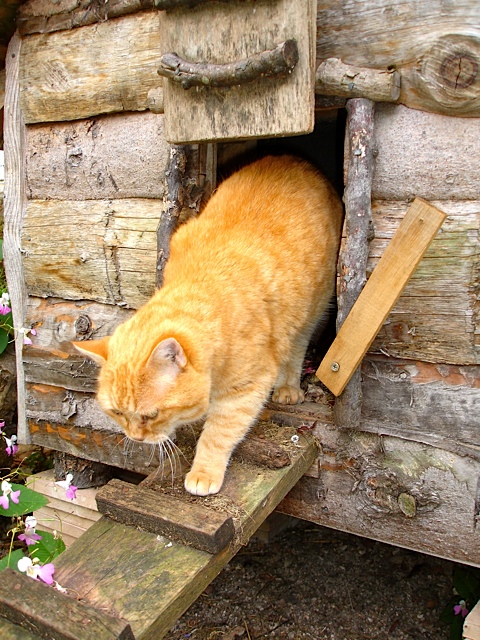
She’s “the cat in the hen coop” from the previous post…

The guilty party exits the scene.

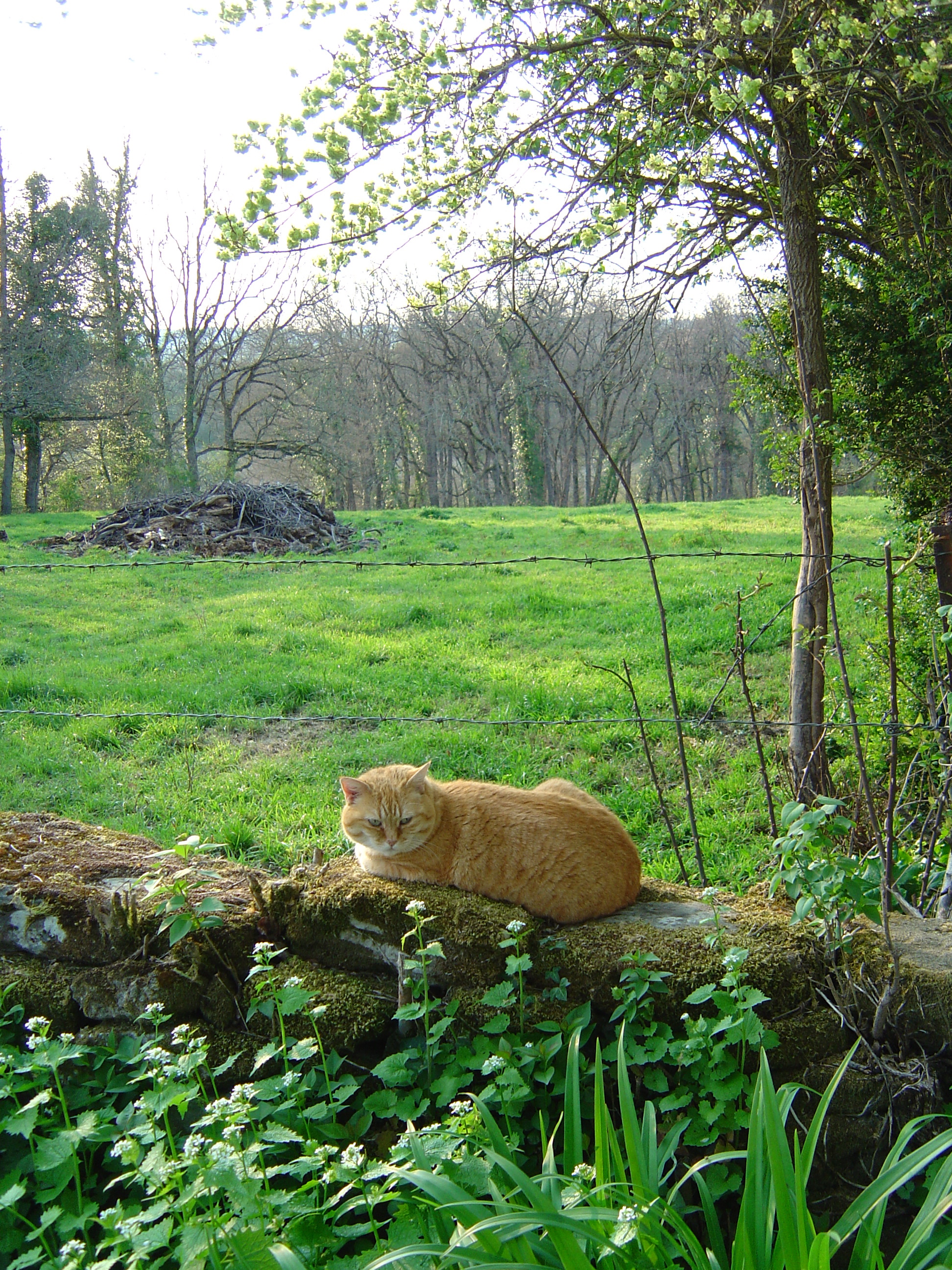
…and sister of Marmalade–both “gingers” of course, and never been separated; also known as “little Mother” because she had a litter at 11 months.

She’s fearless and is sometimes found in the meadow behind the house sitting in the centre of a circle of cows.

“I called you all here today….”.

She loves to drink from a source of running water and will balance on the rim of a sink, leaning in to drink from the swan-neck tap.

Once when we were having a new septic tank dug, the man with the digger sliced through the water mains and the back was flooded.

As we stood calculating the damage, a face peeked round the corner of the back door….

“I hear there’s been a bit of an accident!”

There’s always a silver lining …

She can be a solitary soul–expert at finding a quiet corner to curl up in.

"I want to be alone..."

She loves a clean-smelling cardboard box, a woolly pullover just back from the cleaners or a cherished bowl.

Most of her 12 years she’s been a plump pussy–too plump we’ve often worried–always keen to do a celebratory roll for you.

On an evening stroll up to the farm she’ll join with a headlong dash.

But lately the tail is down and she’s light to lift.

“She’s not well”, the vet said yesterday and prescribed her a course of antibiotics.

…Meredith says, as she comes into the kitchen from the courtyard, clutching a plastic flower pot with 4 eggs nestling at the bottom.

“Omelettes!”.

“Where did you find them?”

“In the pigeonnier!”

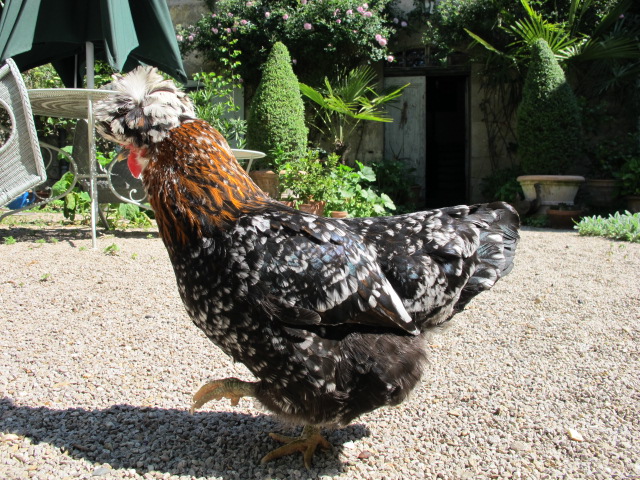
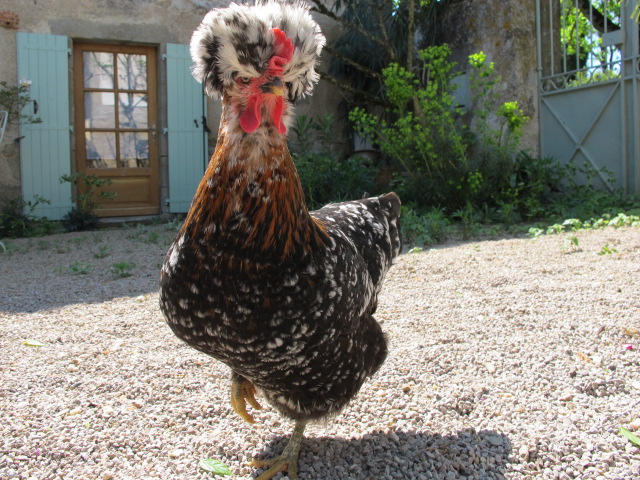
Madame Arcarti*, our eccentric-looking hen,

has been keeping her ‘laying’ spot a secret since she ended her brooding marathon a couple of weeks ago. She’d sat on potentially fertile eggs brought over by our neighbour Flo for well over a month–to no avail.

This instinct to hatch out the young chicks is impressive, but borders on the obsessive. In the end–fearing for her well being (she barely took time out to eat)–Meredith gradually reduced the number of eggs available until there were none and our hen resumed her other instinct–which is indiscriminate weeding in the garden.

We began to wonder where she was laying, since there was no sign of an egg in the little hen house, one of her usual dropping zones!

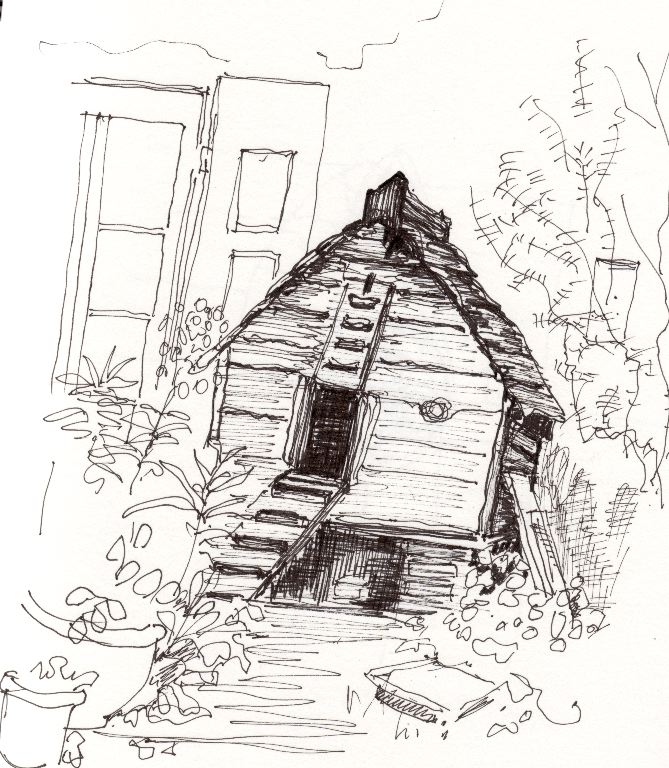
Sketch by Hope James, illustrator of my cookbook

The pigeonnier, on the corner of the courtyard, is where three visiting hens, parked with us over the winter, had done their laying.

They are now happily relocated a few miles up the road, but Madame Arcati hadn’t forgotten!

Omelette with cheese and herbs

( from my book Delicious Dishes for Diabetics)

for 1

2 free range eggs

a little olive oil or butter if you prefer

1 tablespoon freshly grated parmesan

a pinch of fresh herbs–chopped fine; parsley, sage, rosemary, thyme, mint, tarragon, chives–any one of these or a mixture

salt & pepper to taste

Heat your omelette pan gently before adding the oil or butter.

It should be hot when you add the eggs.

Whisk the eggs lightly in a bowl.

Add a little salt and pepper and a pinch of the herbs.

When you are ready to make the omelette add the oil or butter to the hot pan. (I always use olive oil.)

Add the egg mix and cook over a high heat.

With a wooden spoon tack round the circumference of the egg mix, releasing a little of the liquid each time to build a quilt-like texture to the cooking omelette.

Sprinkle on the cheese

Take the pan off the heat when you have a creamy and scrummy looking item that looks just cooked.

Fold it over as you like, sprinkle extra parmesan over it and serve immediately.

A green salad is all you need with it.

* Madame Arcarti is named after the meddling medium from Noel Coward’s play Blithe Spirit–played so memorably in the film by Margaret Rutherford.

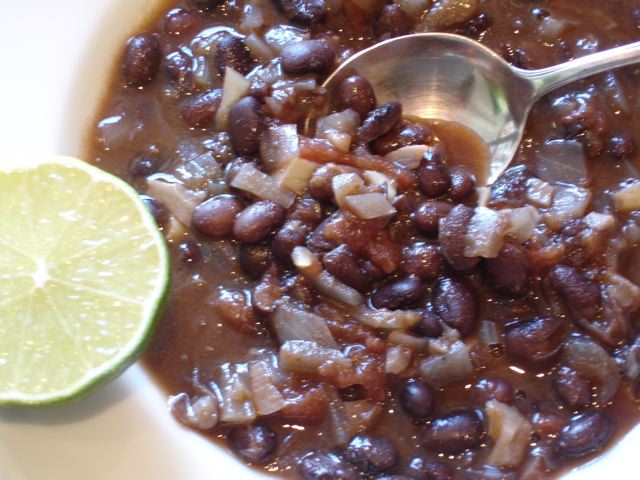
Black Bean Soup

I ate my first bowl of black bean soup here in February 1974.

Joe Allen restaurant, 326 West 46th St. NYC

The Actors Company (http://www.mckellen.com/stage/index6.htmwas performing at the Brooklyn Academy of Music (BAM) for five glorious but freezing weeks. After the performance each night we would get on the subway at Flatbush Avenue and ride back into Manhattan to eat late.

Joe Allen in the theatre district was a favourite stop. It was reasonably priced and at that time of night packed with fellow actors, noisily “coming down” from “the show”. It was heaven!

Their french fries and the black bean soup were favourites; they were cheap and helped restore the energy level after a three hour performance.

 The version below of this classic soup is adapted from one presented by the British food writer, campaigner and cook, Hugh Fearnley-Whittingstall.

1/2 lb black beans–soaked for 8 hours (discard water afterwards)

(Soaking the dry beans doubles their weight–so if you’re using tinned beans, you need 1 lb/400 gm.)

If you have time it’s worth using dried beans; the water they cook in makes a tasty base for the soup stock.

serves 6

1 tablespoon olive oil

2 onions–chopped small

4 garlic cloves–peeled and chopped

1 small fresh red chili–seeds removed and chopped

1 teaspoon cumin powder

1 teaspoon coriander powder

16 oz/4oo gm tin of tomatoes–chopped with their juice

1 pint/500 ml of the bean water, to which you add an organic vegetable stock cube dissolved in 4 floz/100 ml of water or 600 ml organic vegetable stock

salt and pepper

Juice of a lime–if you have one

Drain and rinse the beans.

Put them in a saucepan with enough water to cover by a couple of inches.

Bring to the boil and cook at a simmer until tender–about 30 minutes.

Meanwhile, heat the oil in a saucepan and sweat the onions for about 10 minutes until they are soft.

Drain the beans (saving the water for later).

Add the beans, garlic, chilli and the spices to the onions and cook on for a couple of minutes.

Mix in the tomatoes and the stock.

Bring the soup to the boil and let it simmer gently, covered (it can become too thick if left uncovered), for 30 minutes.

Season well with salt and freshly ground black pepper.

I’m going to leave it unliquidised this time –but you can liquidise it all to a smooth finish or liquidise just half of it.

Add a squeeze of lime instead of the more traditional sour cream or yogurt to finish.