Feeds:
Posts
Comments

A few days off…

A Hundred and Fifty Two posts and…

…I’m going to have a few days off.

Partly to finish the update of a book I wrote years ago called Making Poldarkand partly to have a few days off!

Back in 1978 I was commissioned by Bossiney Books (a small publisher in Cornwall)  to write an account of the filming of the two series. I updated it in 1987 and it had a life with the issue of the videos and the DVDs (only recently released in the United States).

Acorn Media are issuing a box set of both series in the USA soon and are including, as a special “extra”, the first chapter of my original memoir. That inspired me to begin work on a further update.

Here’s a “sneak preview” of the draft of the new chapter:

Making PoldarkPART 3

Twenty five years on and I’m living in a Presbytère—(priest’s house– the last priest moved out 90 years ago)—deep in the countryside of SW France with an American wife, Meredith, six cats and a hen.

I shop in the local markets and cook for the two of us twice a day. I’ve written a cookbook for Type Two diabetics and blog most days about that, cooking and the life here.

 What happened to the actor who for years feared the day he discovered he didn’t need to act anymore?

What happened to the townie who found the countryside beautiful–but dull–and couldn’t wait to get back to the city on a Sunday night?

 Well—“life moves on” is the easy answer, but that won’t do.

 When we reissued Making Poldark in the late 80s, Meredith and I were living in a Victorian house in north London, not far from where I grew up around Hampstead.

London is blessed with large parks and Hampstead Heath was a brisk walk away—you can lose yourself in the woods there and make believe you are in the countryside and still be a 15 minute walk from the local movie house.

 I had never thought of owning a second home in the sticks—let alone in France. (I knew Italy better and went to Florence regularly—I love the Italian kitchen.)

It was a shock then to hear myself asking the friends of Hughes Rudd—Meredith’s colleague and friend from ABC News in New York, who had retired down here–if they knew of anyone selling a house. 

More shocking still—having visited the house Hughes’ friends came up with—to find myself offering the owner the asking price five hours later! Not exactly businesslike, but the truth was I’d fallen in love (coup de foudre)—again.

 Meredith, coup de foudre no. 1 (lightning strike) in 1986, and I were getting married in the summer and though she thought the house was a gem—she must have been asking herself : “Do I need this and a wedding to see to?”

 We were married at the Rosslyn Hill Chapel in Hampstead in August and had our reception at the London Zoo.

We honeymooned at the empty house in the Tarn—empty apart from a couple of large beds a friend had made and some cardboard furniture.

The year was 1990.

To be continued…!

Thanks everyone for your continuing support–I am getting a big kick from doing it–and from reading your comments.

A trés bientôt…

rxx

It was 32C/90F at noon yesterday–HOT!

I made a salad for lunch, involving grilled courgettes, cannellini beans, rocket and cherry tomatoes.

A bit of a business and maybe on the heavy side considering the heat, but I’d been wanting to make it for some time and it would make a good post I thought.

I convinced myself.

We’d had it before--Meredith even wrote “GREAT!” on the recipe page–I thought I was on safe ground.

After she’d dutifully eaten half a plateful of the salad, she got up  made a piece of toast–with the organic rye I eat–sliced a large wedge of very ripe tomato, placed it on the toast with a pinch of salt and drizzled some of our tuscan olive oil on it.

She found the ball of mozzarella I’d bought earlier, sliced a piece similar in size to the slice of tomato and placed it on top.

She bit into it and at that moment I knew I’d made the wrong choice for lunch.

"The right choice"

[ps: recipe for the salad to follow in a later post!]

Eating a painting…

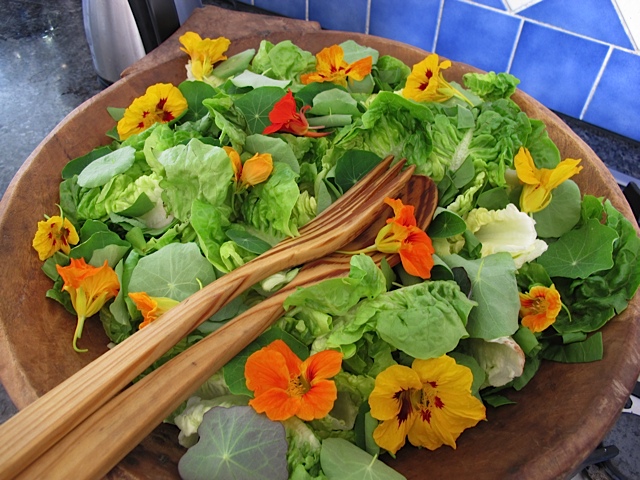
Still life--salad bowl

We were invited for lunch at our friends Donald and Emma’s yesterday.

Donald Douglas of that ilk!

He who gave up chasing me over the Cornish cliffs dressed as Captain McNeil years ago (sensible fellow) and settled down a few miles from us here in France.

I’m always slightly wary of visits to Donald–never sure he hasn’t a troop of redcoats hidden in the stable–just kidding!

Donald, apart from being a fine actor, is a talented gardener and an artist–happy experimenting in any medium.

Even food.

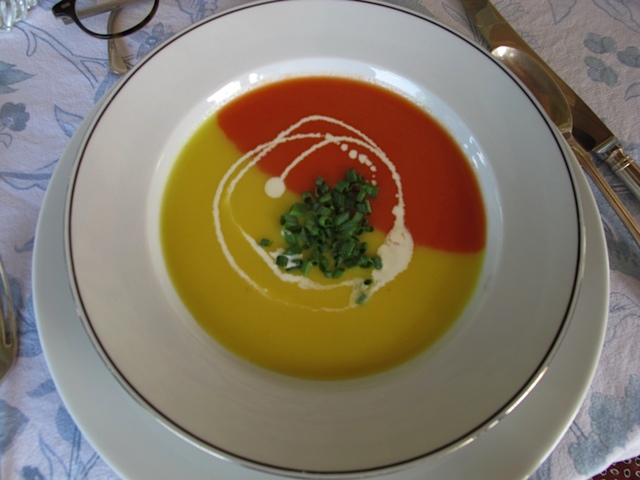
This is chilled Red and Yellow Pepper Soup with chives.

Or is it a painting?

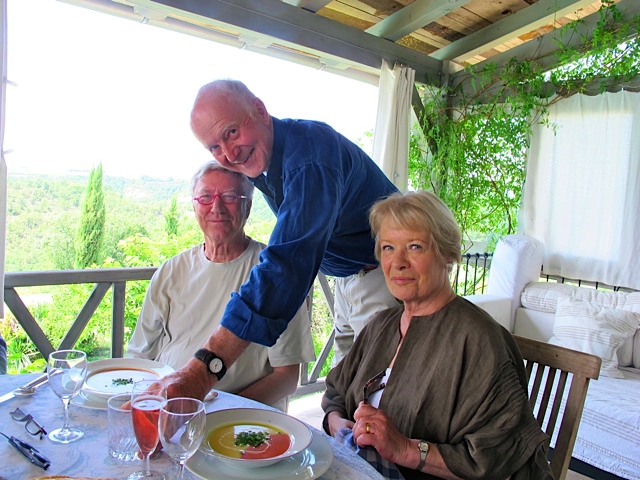
Three (Robin, Donald, and friend Miranda) about to eat the painting...

No–it’s lunch.

In fact–it’s an edible action painting.

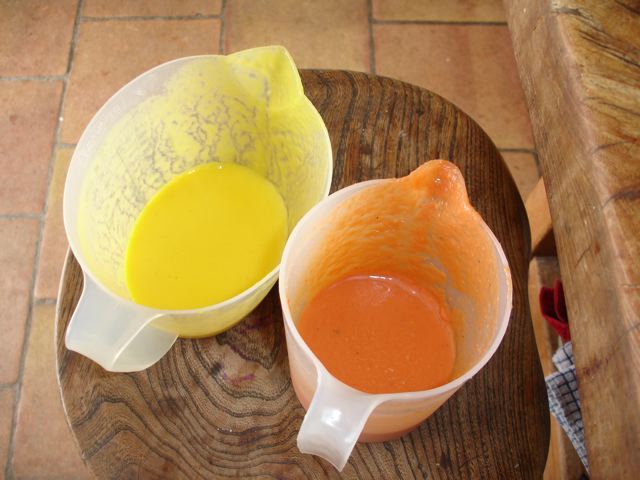
He makes the two soups–being careful they are of the same consistency–and fills two jugs.

He chills them and when the guests are seated he starts to “paint”–pouring from both jugs at the same time.

He adds a swirl of cream and a large pinch of chives to each bowl and hey presto–

ART you could EAT!!

Submitted on 2011/08/12 

We used buy a good meat at Mercato di S. Lorenzo (as you best known) were we can found the best steak of Florence. Cooked “al sangue” (at blood); salt and pepper after cooked, in the plate… enjoy!!!
beatrice
Submitted on 2011/08/12 
I forget one most important thing: its good eat the steak one a month. Its really true that in Tuscany around 1950 more people has colestherol and diabetic causes by “steak cooked on the fire”. Fat around the meat causes this problems and the medical study of Careggi’s Hospital in Florence discovered this new and confirmed!!!
beatrice
Submitted on 2011/08/13 

Robin, I have to admit that I do enjoy a good piece of beef, and a nice piece of steak. I do buy my meat from a butcher who knows where his meat has come from. I do pay that bit extra, but I would rather do that & know that the meat is edible and tasty. I have in the past bought meat from supermarkets, but find there is no taste at all in it. I try to keep our intake of red meat (which includes lamb chops) to twice in a week, three times if a make a casserole.  I have to think about Jimmy’s insulin. Now this is where your invaluable book comes into it own – it has been used already.
Best wishes, Elaine

Sometimes I am surprised how cheap meat from the supermarket is compared to other food. At least in Germany it is so because here the competition between the supermarket chains is very hard. Meat has become a mass product and the quality suffers. Cheap prices support factory farming. Meat has no time to ripen. I think many farmers feed too much silage and concentrate. This all has effects on the quality of meat and milk.

I have seen meat packs with origin data only in Austrian supermarkets or in German organic markets. In Tyrol there are still many small mountain farmers who produce good quality.

We should make it like the Southerners and eat meat as a side dish and not as a main course.

Martina

Submitted on 2011/08/12 

I do think it is folly (from both an economic and resource standpoint) to cycle our protein through an animal before we consume it. I do enjoy bacon and sausage now and then, but otherwise my diet is (as Pollan recommends) mainly plant-based. I initially turned to plants out of concern over e.coli (I now know that plants are not safe from e.coli contamination) but I have stayed away from meat because of concerns over the quality of commercially raised meats (added hormones, antibiotics, unnatural diets). I do live in a rural area where many “know” their meat, and that is an exception – whether free range chicken/eggs, grass fed beef, or wild deer.

Debra Wade

Submitted on 2011/08/15 

Since the mad cow disease scare meat in our local butcher’s and supermarkets has to show the provenance, even down to the individual animal. At least it used to; I haven’t checked recently. Certainly the origin of fruit and veggies are regularly shown, i.e., Italy, Chile, Israel whatever.

Argentinian beef is a good bet too, because the animals are ‘free range’ in that they walk to their water, eat grass and don’t get pumped up with undesirable chemicals and additives. It is natural meat (which I have eaten with a spoon, it was that tender!), which is mainy why Argentinians don’t have a cholesterol problem.Since the mad cow disease scare, meat in our local butcher’s and supermarkets has to show the provenance, even down to the individual animal. At least it used to; I haven’t checked recently. Certainly the origin of fruit and veggies are regularly shown, i.e., Italy, Chile, Israel whatever.

a presto, Keith

Submitted on 2011/08/12
Hello Robin,
We used to visit our local farmer and choose the animal we wanted whilst it was still grazing!! Then a couple of weeks later collect the cuts we had ordered. Not so today – so few local abatoirs left. However, there is an excellent farm nearby which sells all its own meat, poultry and even venison. I know how lucky we are, but several supermarkets in UK now print the name of the farm and farmer on meat packs which is very useful.

Sophie-Jane
Submitted on 2011/08/12 
Hello Robin, Leaving aside the question of excessive animal fat intake and disease, I think you could mention too that many of the guidelines on eating meat are written with U.S. beef in mind. It is forbidden to add hormones in France whereas U.S. beef is full of these, as well as a lot more antibiotics than are permitted in France. Consequently, guides on healthy eating from America (including such good reads as Michael Pollen) will advise greatly restricting intake. And for the same reason… we have a lot fewer advice-givers on the topic in France! Although the best beef in France may be from local independent butchers, even the “ordinary” cuts from the regular supermarkets are of decent quality. And a typical serving is much smaller, at home or in a restaurant, than what you’d get elsewhere.
x Susan
Thanks everyone--Robin.

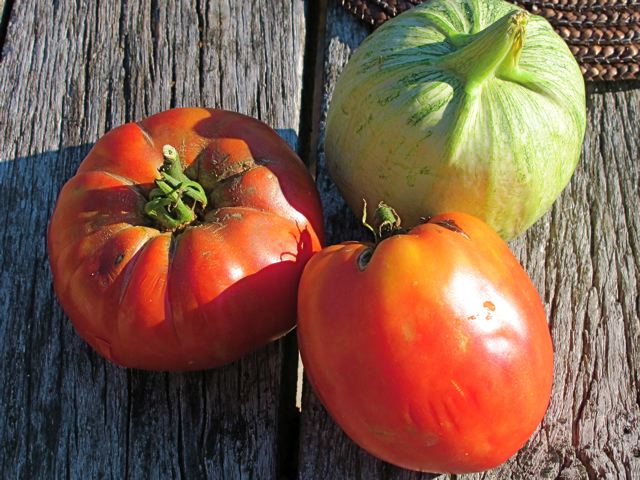
This guy weighed in at 750gms/1lb 10oz!

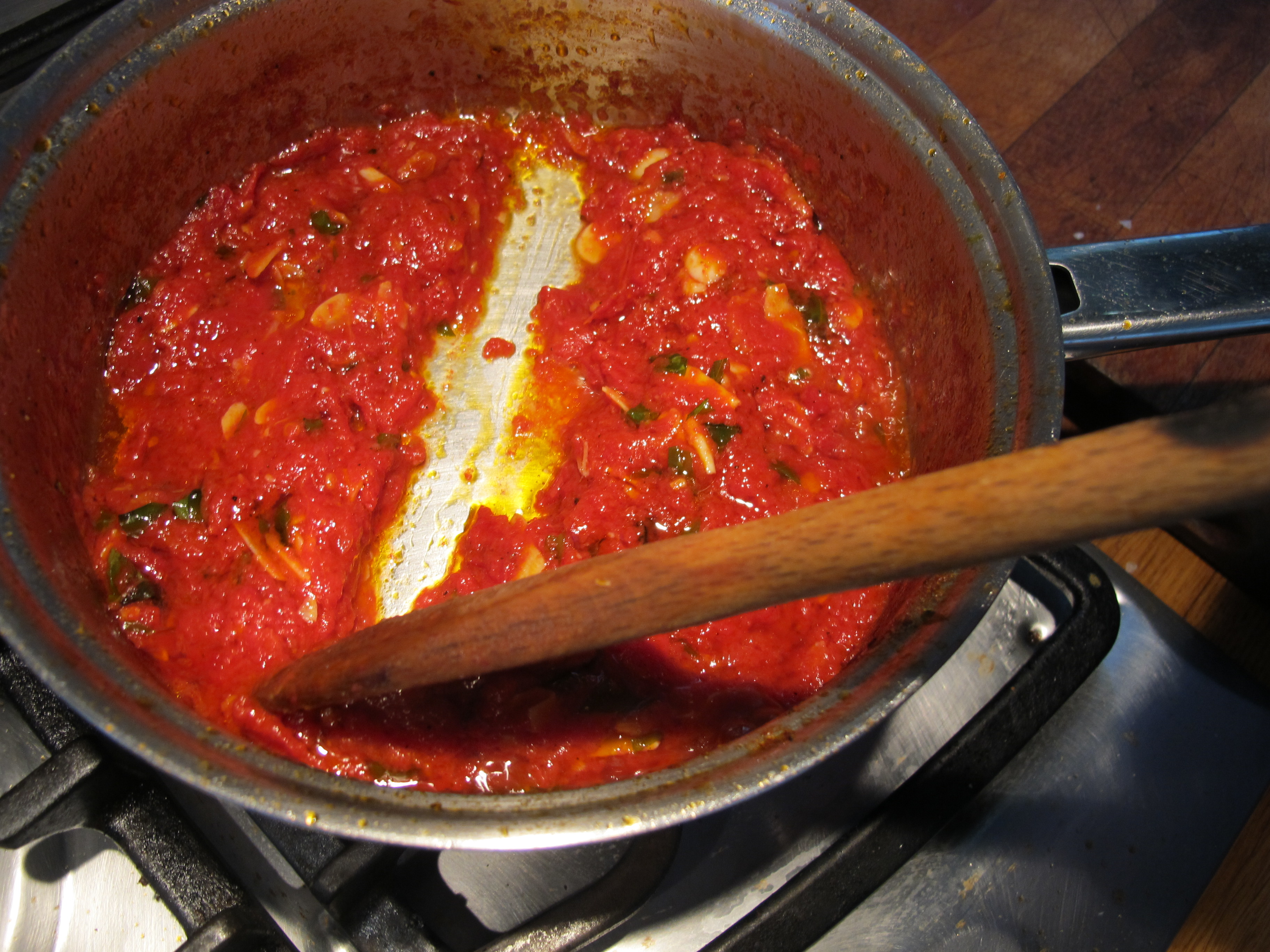
I’m making a simple fresh tomato sauce with garlic and basil

First we go to La Fête du Pain, [the Bread Festival] in Lautrec. I find a convenient parking place–not easy.

Kids welcome you with an entrance sticker and a little sack of Lautrec flour (the village has one of the oldest working windmills in the South West!)…

and wish you “Bonne Journée ” with eager faces.

Charming.

A percussion group climb up to the village in front of us.

Baritone and crisp side drums keep a good rhythm, making it sound like Sienna on Palio day.

We reach the square and “BANG”–du monde–too many people–too much noise!

I’m not grumpy–just not geared up for the crowd.

I leave Meredith there with her camera and drive home (losing the parking place).

Starting the sauce

I start the sauce* and feel better.

Meredith rings and says there’s a stall grilling lamb and sausages.

I rally and make my way back to Lautrec (retrieving the parking place).

After waiting in line for an age, we sit down with two plates of meat in the upper village square.

I buy two small glasses of red–1 euro each–and break the pledge a day early. We feel no guilt.

It’s definitely a “Jour de Fête“–happy crowds “milling” [jour du pain!] and “teeming” .

Plenty for the kids to do too–like learning to make pizza….

Eager students...

and “Guessing the Grain”…

"Older children"--guessing which grain is which!

and I’ve cheered up too!

Felicitations, LAUTREC!!

Simple fresh Tomato sauce

1 1/2lb/700gms–ripe tomatoes

4 tablespoons olive oil

3/4 fat cloves of garlic–sliced finely

a few basil leaves–chopped

s&p

Heat the oil in a pan.

Sauté the garlic gently in the oil until it starts to colour.

Chop the tomatoes–scooping out and leaving aside much of the seedy liquid.

Add them to the pan.

Cook them over a medium heat, stirring from time to time, for about 20 minutes.

When you can divide the red sea with a spoon and little pock marks appear in the sauce is done.

Season and serve as you like.

Jours de fête

Last week it was La Fête d’Ail (the Garlic festival) in Lautrec; Tomorrow–La Fête du Pain (the Bread festival).

The French fill their summers with fêtes.

In 1954 Dad took me to the Everyman Cinema in Hampstead to see Jacques Tati’s Jour de Fete (viewable here free).

In pre-Monsieur Hulot mode, Tati plays the good-hearted but accident-prone village postman.

Two bits stayed with me: the flag pole sequence (which starts about 12 mins in) and the bicycle race–when he gets tangled up in a mini Tour de France and ends up in a river (about 1hr 10min in).

Now maybe not quite so hilarious but at the time I nearly choked, I laughed so much–(and bonded with Dad)!

Still seeing the funny side–years later!

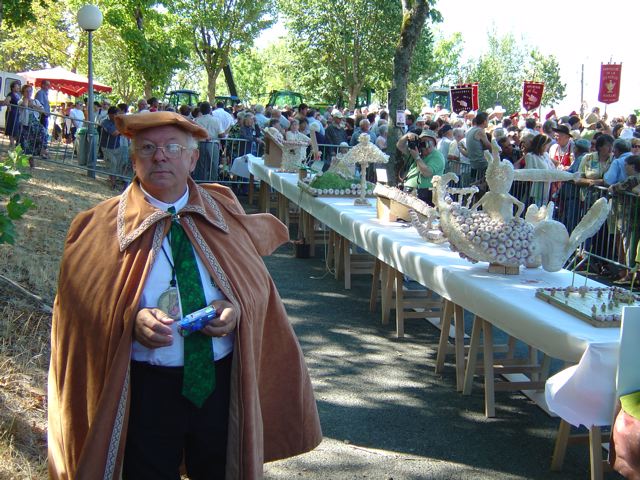
Last week (it’s always held on the first Friday in August) ten thousand people teemed–albeit slowly–through the narrow streets of Lautrec, buying local produce and aiming for the central square where la soupe à l’ail (garlic soup) is dispensed free at noon–with a glass of warm rosé.

This is after the much anticipated announcement of the winners of the best tress

Tress Parade!

and the most imaginative object made of garlic.

“Snail” on its journey to…

…the Viaduct of Millau

The pink garlic–l’ail rose de Lautrec–is specially good and long lasting.

It has protected status and a lovely pinkish hue on the outside skin.

Not long after buying our house here, we took some to California where Meredith’s brother–in-law planted some cloves and ended up winning first prize in the Marin County Fair!

We told the story to the farmer in the next hamlet, thinking he might be amused.

After a long pause and looking like thunder, he growled—“c’est interdit!” (that’s forbidden!).

He needn’t have worried–the different soil composition in California–turned the garlic white!

Meaty thoughts…

I finally got round to looking at August’s newsletter of GI News–a useful and lively healthy eating outlet from the University of Sydney and based around the principles of the Glycaemic Index and Glycaemic Load.

There’s a short piece by dietician Nicole Senior in which she discusses the pros and cons  of eating red meat from the perspectives of health and the environment.

It’s far from bad news for red meat fanciers.

She quotes recent research:

A model healthy diet according to Australia’s National Health & Medical Research Council, contains 65g a day of red meat (455g/1lb per week) and the American Institute of Cancer Research: World Cancer Research Fund says to limit red meat to no more than 500g (1lb 2oz a week) to reduce the risk of cancer.

To reduce greenhouse gas emissions, Professor Tony McMichael and colleagues from the Australian National University have suggested we limit red meat to no more than 90g (3oz) a day (630g/1lb 5oz a week), based on the idea people in developed countries currently eat more than double this.

Restricting red meat to a quarter of the Plate, she says, will help as a guide to achieving this.

I then took another peek at Michael Pollen’s excellent and amusing Food Rules (Penguin) in which he says that when buying meat, it’s worth looking for animals that have been fed in pastures.

Monsieur Fraisse, our butcher in Lautrec, knows where each animal he butchers has been raised and what they’ve been fed on. A luxury I know and not so easy when shopping in supermarkets.

Worth asking though?–if there’s a working butcher’s counter at the supermarket?

I’d be interested to hear any feed back–(so to speak!).

Michael Pollen writes:

The food from these animals will contain much healthier types of fat as well as higher levels of vitamins and antioxidents.

You will pay more but if you are buying and consuming less–the cost won’t be much higher.

The meat will taste better too!

Michael Pollen’s mantra on how to eat:

Eat food. Not too much. Mainly plants.

You could also check out the piece by Professor Jennie Brand-Miller–GI expert–on the protein values to be got from plants, in the same August newsletter.

Our friend, Sonia, called by with husband John yesterday to buy an extra cook book autographed for a friend.

She’s a green-fingered gardener and a generous spirit–seldom arriving without something seasonal from her vegetable patch. Yesterday she brought us two HUGE tomatoes, and a round courgette.

How on earth did she know about our new resolve!?

She also brought enough basil to make pesto (recipe from the cook book)–a favorite with Meredith–which was delicious, drizzled lightly over the grilled aubergine and courgettes for supper:

No wine! We kept the pledge--but it was hard.

Now–what to do with the two red beauties…?

One weighed in at a pound and a half (700 grams)! A sauce, perhaps…?

A sliced tomato salad and pesto again, with the other (a puny pound or 450gms)?

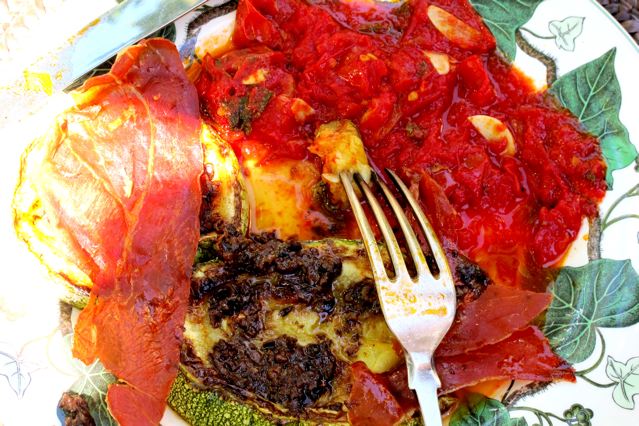
Some of the left-over Parma ham, lightly grilled, and Sonia’s courgette–cut into thick rounds, lightly salted and left to drain for half an hour, dried and brushed with olive oil, then roasted for 20 minutes at a high heat (turn them over after 10 minutes) with a spoonful of tapinade spread over it this time–will see us through to supper.

A merry mess!

Post lunch, I notice that there’s enough tomato sauce left over to make a small courgette tian for supper.

We’ll be not be wanting courgettes for a couple of days!

But there are plenty of other summer choices and I’ll never tire of red ripe tomatoes….must go check the tomato patch!

…of the cook book!

"Salade Niçoise"--prét à manger!

Can we have a week of eating lightly and no wine?

The guests have flown, the book is launched, the sun has come out–seems a perfect time.

We’ll start today.

Lunch: A modest Salade Niçoise for two….

Cherry tomatoes–halved; a couple of anchovy fillets–halved; a hard boiled egg–halved; sprinkling of green beans–cooked to tender; black olives (niçoise if possible); half a cucumber seeded and diced; a spring onion thinly sliced and a tin of good tuna packed in olive oil–drained–all arranged on a small bed of salad leaves (heresy to some natives of Nice, who claim the authentic version has no salad leaves!)

Salade niçoise--lunch today.

Dressing: a few torn basil leaves and a couple of fat cloves of garlic, crushed to a pulp with a pinch of salt and whisked into three tablespoons of good olive oil. 

Dinner: a salmon fillet each–cooked in a pan on the lowest heat, skin side down and with no oil.

When they start to change  colour at the base, sprinkle with a little salt and pepper and cover the pan.

They are done when little beads of white juice emerges from the top.

A simply cooked seasonal vegetable (Green beans? Grilled/roast halved tomatoes? Grilled courgettes/zucchini?) would go well plus a quartered lemon.

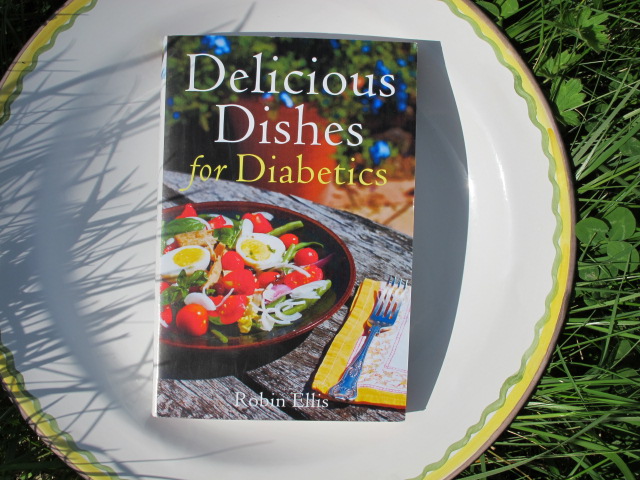
(Both these recipes from Delicious Dishes for Diabetics–a Mediterranean Way Eating.)

Bon appetit!

Yotam Ottolenghian Israeli born in Jerusalemowns five restaurants in London and contributes flavoursome recipes to the Guardian on Saturdays, with unusual Middle Eastern taste twists.

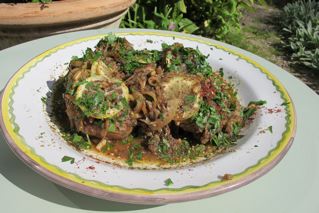
Not a great looker--but the taste...!

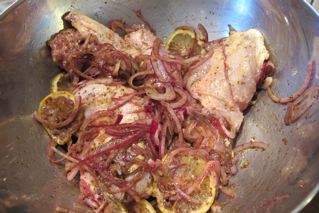
Ottolenghi’s Chicken is his version of the traditional Palestinian dish, M’sakhan. It is delicately flavoured with soft spices like cinnamon, allspice, and sharpened a little with sumac [dark red and lemony], enhanced with thin slices of  lemon and onion–delicious to bite into–and finished off with za’atar–which is sesame seeds in a mix with oregano, thyme and other herbs.

The chicken pieces are marinaded overnight in these gentle flavours, then roasted for 40 minutes.

Garlicky yogurt sauce & Moroccan bread went well with it at the book launch. For diabetics, better to substitute whole-wheat brown pita bread or brown Basmati rice.

1 chicken–cut up into 8/10 pieces

1 lemon–sliced very thin

2 red onions–sliced very thin

2 cloves of garlic–mashed to a pulp in a pinch of salt

4 tablespoons olive oil

1 teaspoon allspice

1 teaspoon cinnamon

1 tablespoons sumac

200 ml stock

1 teaspoon salt 

1 teaspoon pepper

2 tablespoons za’atar

50 gms/2 oz pine nuts

for 4/5

Combine the first 11 ingredients in a bowl and mix well together.

  • Let this marinade, covered, in the fridge–preferably overnight.
  • Heat the oven to 200C/400F.
  • Lay the chicken pieces, skin side up, in a roasting pan and cover them with the lemon and onion marinade.
  • Sprinkle over the za’atar.
  • Roast in the oven for 35 to 40 minutes–the juices should run clear when you pierce a leg piece.
  • In a small frying pan gently dry roast the pine nuts.
  • Sprinkle them over the chicken and present the dish to the “table” before serving and enjoy the “oohs!” and “aahs!”.
  • Scatter over some chopped parsley to finish, for colour, if you have some on hand.
Yogurt sauce
 2 125gm pots of no-fat yogurt–whisked to smooth
1 fat clove of garlic–pulped in a pinch of salt
1 tablespoon of olive oil
Whisk all ingredients together into a smooth sauce.
As so much of this dish can be prepared beforehand it is a useful dish for company.
Two chickens roasted together will give you enough to feed 10 people.