Feeds:
Posts
Comments

Archive for the ‘Food’ Category

Penne in a sauce of tomatoes, rosemary and balsamic vinegar.
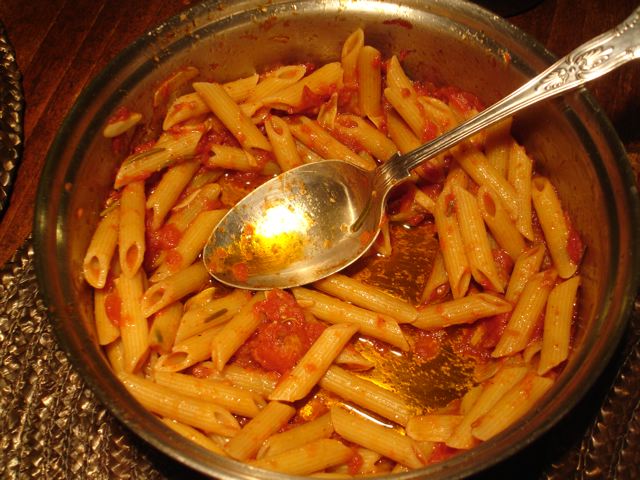
This is adapted from a recipe in  Marcella’s Kitchen by Marcella Hazan.

It is included in my recipe book Delicious Dishes for Diabetics (to be published in August this year in the UK, November in the USA).

Quick and simple to do, it has a distinctive earthy flavour, thanks to the rosemary.

It’s worth taking care to slice the garlic real thin.

for 4

8 tablespoons of olive oil

4 cloves garlic–very thinly sliced

2 sprigs rosemary or 2.5 tsps dried rosemary

A large tin [800gms/2lb] of tinned tomatoes- -drained of  their juice

s&p

1lb/400gms [100gms/4oz each person] wholewheat penne, farfalle or any short pasta

2 tsps balsamic vinegar

Sauté the garlic gently in the oil with the rosemary (if using fresh) until the garlic sizzles–a couple of minutes.

Add the tomatoes, salt and plenty of pepper—(if using dried rosemary add it with tomatoes).

Cook for 10-15 minutes.

Cook the pasta in salted water.

Drain well and add to the sauce.

Turn the pasta in the sauce and cook for a minute or two longer.

Turn off heat and make a well in middle of the pasta and add the balsamic vinegar.

Turn over the pasta again in the sauce.

Serve on heated plates with freshly grated parmesan cheese.
Read Full Post »

Peckishness can present problems for people with diabetes.

To snack or not to snack–that is the question!

One reason to eat a good breakfast is not to feel that nagging hunger mid-morning.

I have a bowl of oats, with walnuts, a teaspoon of linseeds, a prune, a dried apricot chopped, half a tub of low/no fat yoghurt, cinnamon sprinkled over and oatmilk, every morning and it’s sometimes my favourite meal of the day!

That and the two pieces of rye bread toasted and a cup of coffee take me happily through to lunch.

For me it is in the gap between lunch and dinner that peckishness kicks in–usually between 5pm-6pm.

What to do about it?

Ideally nothing–but then when dinner time comes the temptation to scoff is hard to resist.

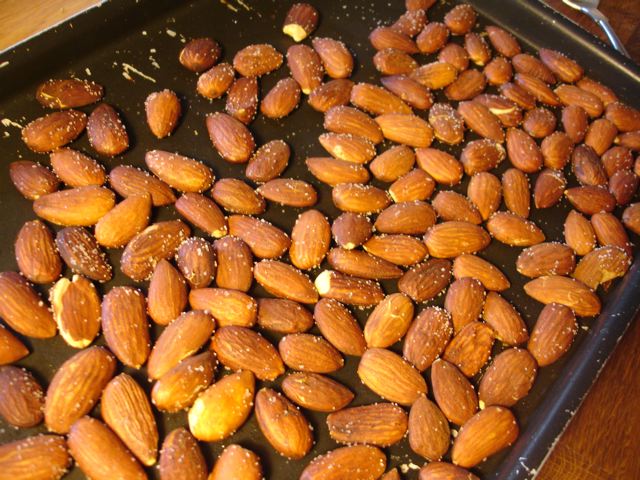
I ease the pain with nuts. Almonds are my prefered nut at the moment–roasted with a little salt. Pistachios preceded them until my nails started to split with opening them. Both have good health properties. Eaten in moderation, one doesn’t have to feel guilty about snacking.


Home-roasted almonds


8oz/250gm almonds

1 teaspoon olive oil

fine salt

heat the oven to 180c/375f

Put the almonds in a bowl and tip the teaspoon of oil over them.

Turn them over in the oil until they are well covered.

Add a couple of sprinkling of salt and flip them over and over until the salt is well distributed.

Spread  the nuts on a shallow baking tray and roast in the middle of the oven for about 10 minutes.

Read Full Post »

Stuffed red peppers with baked sweet potato and swiss chard

More a summer dish this, with ripe tomatoes–but I had the chevre [goat’s cheese], needed to use it and it’s already the “Ides” of March today.

for the stuffed pepper


1 red pepper–carefully halved through the stem

2/3 tinned tomatoes for each half

1 garlic clove–thinly sliced

1 soft goat’s cheese–halved or quartered, depending on its size (it should fit snugly in the pepper half)

olive oil

salt and pepper

heat the oven to 180C/375F–medium

Place the pepper halves on a shallow oven tray–covered with foil.

Put three tomatoes, slivers of garlic, and half the chevre in each pepper half.

Drizzle over some olive oil and season well with salt and pepper.

for the sweet potato

1 medium sweet potato–pricked to avoid it bursting!

for the swiss chard

8oz/250gm swiss chard–leaves only, separated and washed

see post-Light lunch for one–for how to cook it

Bake both the pepper halves and the sweet potato in the oven for about an hour.

When ready halve the sweet potato–one half for each plate.

A pepper half for each plate (careful not to spill too much of the juice).

Add a serving of the swiss chard.

Divide any  juice left in the pan between the the plates.

Bon Appetit!


Read Full Post »

I found this recipe in Anna del Conte’s Classic Food of Northern Italy. It originates from an Umbrian cook, Zia Lidoria, and though in her version is for rabbit, it works well for chicken. [see below one way to cut up a chicken].

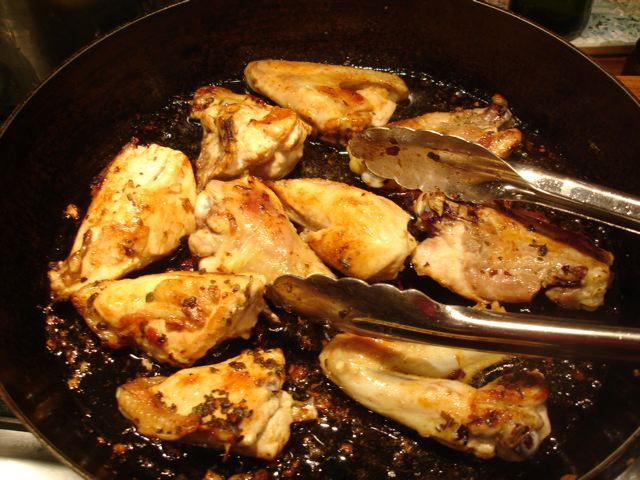
The long initial browning of the chicken is a little scary; the pieces seem to be shrinking alarmingly, but they come back to life when liquid is added.

Browning up

1 chicken–cut up into 8/10 pieces

1 tablespoon sage leaves

3 garlic cloves

6 tablespoons olive oil

5 floz white wine vinegar

5 floz hot water

rind of half a lemon—removed without the white pith

2 tblsps capers—drained and squeezed

4 anchovy fillets

1 tblsp chickpea flour

Salt and pepper

Heat the oil  in a large sauté pan.

Chop the garlic and sage together.

Fry the mixture gently until the garlic begins to colour—a couple of minutes.

Add the chicken pieces to the pan and turn them over well in the garlic, sage and oil mixture.

This is the long bit and will take about 45 minutes!

Keeping the heat low, turn the pieces every few minutes as they begin to take on a good colour.

Hold your nerve and when they are nicely browned add the vinegar and hot water.

Turn the chicken in the liquid, season well with salt and pepper and cover the pan.

Cook on a low heat for a further 40  minutes.

While the chicken cooks on, chop the lemon rind, the capers and the anchovies finely together, then sprinkle in the flour, stirring it in well.

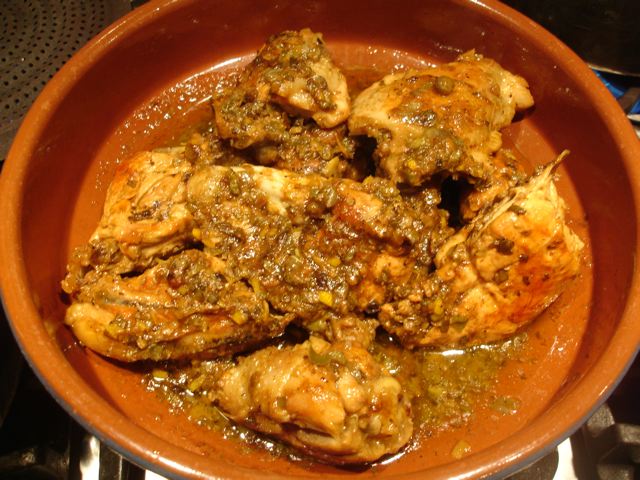
When it’s time, remove the chicken pieces and keep them warm in a heated serving bowl, covered with a lid or foil.

Try the sauce in the pan and if necessary reduce it a little to concentrate the taste.

Stir in the lemon rind mix and cook for a minute.

Pour the sauce over the chicken and serve with brown basmati rice or chickpea mash.

We had some broccoli with it last night.

Mark Bitman of the New York Times bones a chicken in this video and explains clearly how to do it and why there are good reasons to try.

Read Full Post »

Jack posed this question yesterday in a comment and it is not an unreasonable one. It made me think about the new language of the internet, which sometimes seems like webspeak gobbledigook!

I put the above question into Google and found this on one site:

Any user-posted root node is subject to moderation.

Moderation refers to two possible changes in a node’s status:

  1. Approval of a node into the selected section of the site;
  2. Front-Paging a node, i.e. allowing it to be listed on the main page.
  3. Note that a node cannot be “front-paged but unapproved”.

Silly me I should have knowd!

I think I understand what is meant but wouldn’t plain english explain it better?!

Moderation has other meanings and there are  jollier definitions:

“Moderation is a fatal thing. Nothing succeeds like excess.”

Oscar Wilde

“Moderation in temper is always a virtue; but moderation in principle is always a vice”

Thomas Paine

Moderation is the inseparable companion of wisdom, but with it genius has not even a nodding acquaintance”–[Oh dear!]

Charles Caleb Colton: (English sportsman and writer, 1780-1832)

“Throw moderation to the winds, and the greatest pleasures bring the greatest pains”

Democritus

This definition is from wikipedia:

Moderation is a principle of life. In ancient Greece, the temple of Apollo at Delphi bore the inscription Meden Agan (μηδεν ἀγαν) – ‘Nothing in excess’. Doing something “in moderation” means not doing it excessively. For instance, someone who moderates their food consumption, tries to eat all food groups, but limits their intake of those that may cause deleterious effects to harmless levels.

This I can understand!


Read Full Post »

For 2

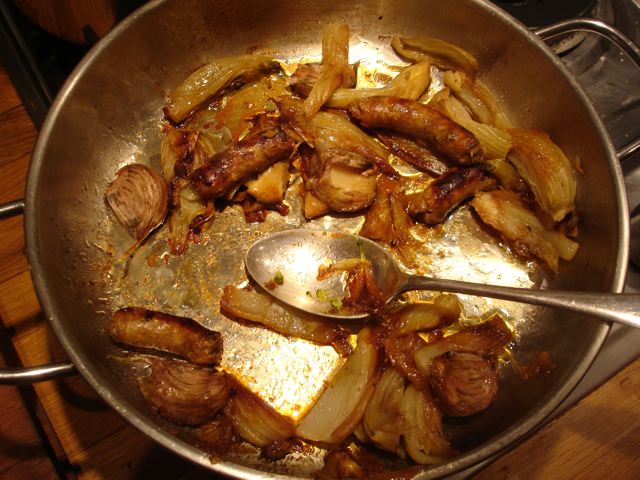
4 fennel bulbs

1 garlic bulb–cloves separated and peeled

1/4 cup/60ml/2floz olive oil

500gm/450oz spicy sausage–cut into wine cork size chunks

salt

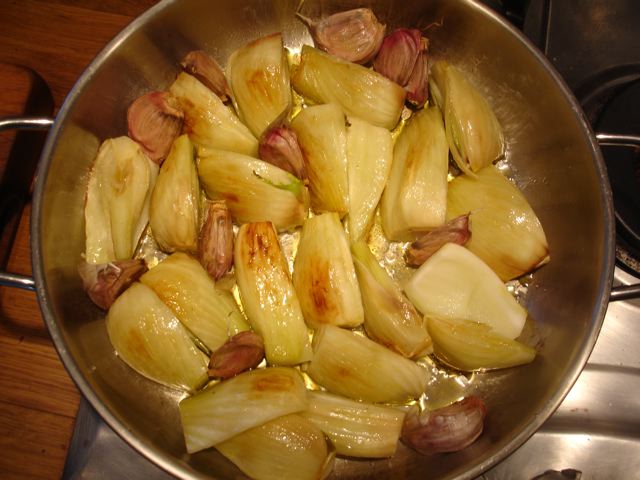
1. Remove the outer casing of the fennel and cut  the bulbs into eighths vertically.

2. Put them in a pan large enough to take them in a single layer.

3. Scatter the whole garlic cloves among them.

4. Pour over the olive oil and add a pinch of salt.

5. Sauté gently, uncovered, for half an hour, turning the fennel as it colours.

6. Add 1/4 cup/60ml/2floz of water, cover the pan and continue cooking for about another half hour, adding more water as needed.

7. The fennel should end up meltingly tender. The water makes a light sauce.

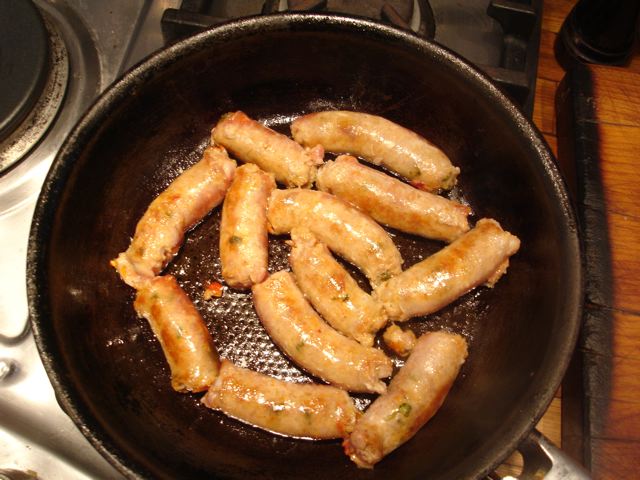
8. While the fennel cooks its second half hour, sauté the sausages gently in a separate pan, turning them as they colour.

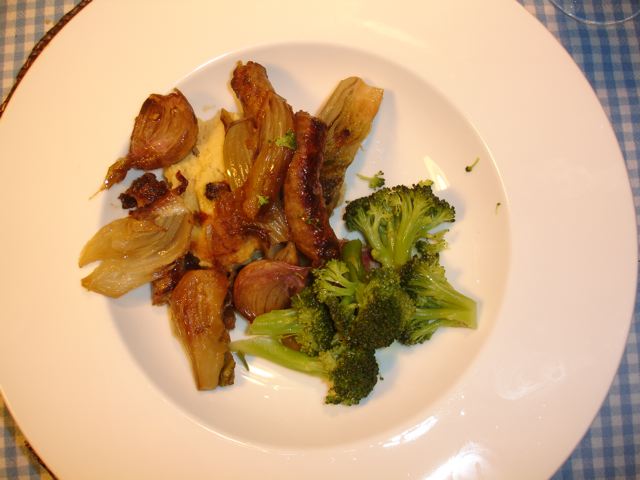
9. Add them to the fennel and cook it all together for 5 minutes.

10. Adjust the seasoning and serve over Chickpea mash or what you will.

Read Full Post »

Spring is in the air at Realmont market this morning. People are very chatty; the terrace of the cafe is packed–seven round one of the small tables, relishing the sunshine.

Winter is still on the stalls though–no change yet from the root vegetables, cabbages, broccoli, sprouts, and cauliflowers that have dominated for months. A few stalls are selling plants for early bedding. Frost still threatens, limiting the choices.

At a pork butcher’s stall I have yet to shop at–mainly because there’s always a long queue–I spot a different looking sausage. It’s marked : Saucisse fraiche Basque.

I ask the stallholder what’s in it: “Piment d’Espelette et poivre”, she says.

The chili pepper of Espelette is a speciality of the Basque country that borders Spain and the Atlantic coast four hours to the west of us. It is harvested in late summer and appears on the stalls here in September. As chilis go it is not very hot–but it’s colourful.

“I’ll take some–thank you” and she cuts off about a pound from a nestling wheel of fresh sausage. I also buy a kilo of pork shoulder.

I already have four or five fennel bulbs in my basket and dinner slowly dawns on me!

The sweetness of the slowly braised fennel will, I hope, contrast well with the lightly spiced sausage.

This a new dish–so we”ll see.

Braised Fennel with Spicy Sausage.

to be continued later today…..

Read Full Post »

Lunch in a UFO today.

It’s sitting in a French field,  looking spectacularly out of place–as any self-respecting UFO would.

The owner tells us it’s coming up to two years now since they landed.

He built it himself, from packs–“like Ikea! he says. Packs or no packs, it’s a piece of work and it revolves 360 degrees–as any self-respecting UFO would.

It’s beautiful inside with many  features that are familiar to us: a high-tech kitchen, a dining area and toilets.

It has living quarters too and there are children’s toys lying around. This is obviously both a home and a work place.

The owners call it Dôme de Montmiral.


It is a couple of miles from the Castelnau of that name, though there’s about a thousand years of history separating them. We ask if there were any problems getting permission to build it there–sorry, to land it? “No, everyone was for it–but we had to go to the highest level.” Well, you would for a UFO…..

Enough of that!

The Dôme is an unusual restaurant, set in the middle of  beautiful countryside in the north Tarn, here in southwestern France. Its shape resembles a flying saucer and it serves vegetarian food. A bioclimatic house, made from wood–it is self-sufficient in many ways.

This is the fantastic project of Valérie and Raymond Moncan. She is the cook and she’s passionate about it; quite a change, as she used to be a professor of  Latin and Greek!

She serves a fixed menu–though you  can have input when booking and she is sensitive to special needs.

I notice the shelves are full of cookbooks which I can’t resist investigating. The first one I pull out is titled: “Mal de Sucre” [the evil/curse of sugar]. I feel I’m in good hands!

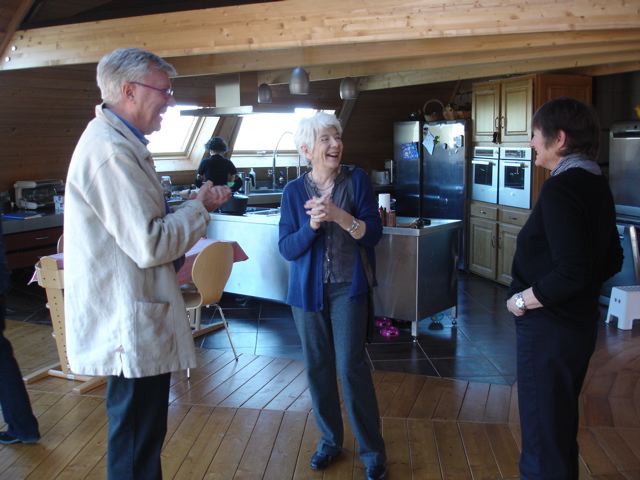
Today we’re having lunch with Donald Douglas –aka “Captain McNeil”–my old enemy in Poldark.                      

Old rivals call it a day!

It’s his birthday and we are celebrating with his partner and other friends.

There are three courses for 25 euros with wine on top.

The food is different–more delicate than the usual restaurant vegetarian. In fact it is vegan–no dairy products. It’s tasty and lightly-spiced and  perhaps a little other worldly…?

Shredded patés of beetroot, apple and mushroom with seasonings

Kitcheri of basmati rice & red lentils with vegetables

The sort of fare one might imagine being served in a UFO….!

Read Full Post »

Comfort food par excellence, adapted from  Rose Elliott’s The Bean Book.

This and her nicely-titled  Not Just a Load of Lentils have been friends for years.

for 4

1 onion–finely chopped

1 stick of celery–finely sliced

1 tablespoon olive oil

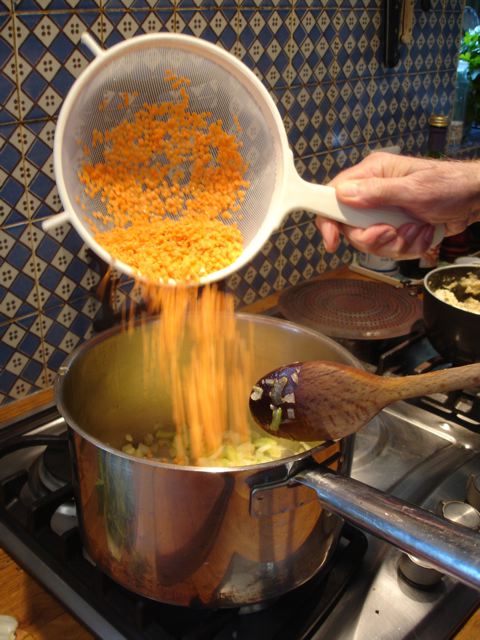
4oz/100gm red lentils–thoroughly rinsed

14oz/400gm tin of  tomatoes with their juice

1 1/2 pints/850 litres vegetable stock (I use organic stock cubes)

juice of half a lemon–more if you like

Salt and pepper

1 tablespoon parsley–chopped

Soften the onion and celery in the oil over a low heat.

Add the lentils and turn them in the mixture.

Add the broken up tomatoes and the stock.

stir everything thoroughly and bring to a simmer.

Partially cover the pan and cook until the lentils have melted.

Remove from the heat and let it cool for 5 minutes.

Liquidise to a smooth finish and season to taste .

Stir in the lemon juice.

Serve hot in bowls that show off the beautiful colour, with a pinch of parsley in the middle of the bowl.

Read Full Post »

A simple but delicious soup this, that cooks for a while– deepening the taste.

The recipe is adapted from Carolyn Mcrum’s wonderful  The Soup Book published in 1978.

She writes: “Soup-making is one of the most pleasurable of culinary processes, but it takes time, and that it why it is so little enjoyed in a hurried age. My hope is to persuade people that the soup you make yourself is infinitely superior to soup from a packet or tin, and that making soup is a comforting activity, surpassed only by the activity of eating it”.

For 4

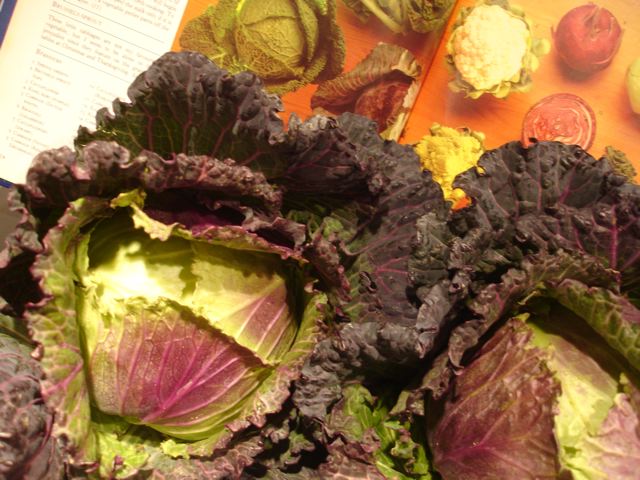
1 cabbage—a Savoy or one of the other “beautiful faced” varieties, rather than the tightly formed White or Green cabbage

Red Drumhead cabbages

2 medium onions—chopped small

1 garlic clove—chopped small

1 rasher (slice) of bacon—chopped small

2 tablespoons olive oil

2 ½ pints/1 ¼ litres—vegetable stock—I use organic stock cubes

Salt and pepper

Grated parmesan cheese to finish

  1. Blanch the cabbage whole for two minutes in lightly salted boiling water—this keeps the cabbage together in the water. Set it aside to cool, before chopping it up.
  2. Soften the onions, garlic and bacon very gently in the oil for at least 10 minutes—this is the taste engine of the soup and needs time for the magic to work.
  3. Add the chopped cabbage and the stock and season well.
  4. Cook at a gentle simmer for at least an hour and a half.
  5. Check the seasoning and serve hot with a sprinkling of parmesan cheese worked in.

The wonderful aroma—though not everyone would call it that—fills the house for hours!

Read Full Post »

« Newer Posts - Older Posts »