Feeds:
Posts
Comments

IMG_1787

Sunrise over Chesapeake Bay–Wednesday morning.

Birds squabble round the bird feeder–many varieties, searching for food while the snow still lies on the ground.

Cardinals, Blue Jays, Grackles, a Red Headed Woodpecker, Sparrows, Finches.

In the bay, close to the house, a pair of Herons and four majestic Tundra Swans in stately procession.

A single gull knocks on the door.

“Any spare scraps ‘dbe welcome,” then circles away when there is no response.

Canada geese called by yesterday–a rare visitation we are told.

A host of black birds swirl in from the side and threaten to sweep the smaller fry off the picture.

Our indignant host gets up and the invaders retreat, to bide their time in the trees a little to the side.

“This is the eighteenth snowfall we’ve had this winter.”

“Is that standard?”

“Normally we have two or three!”

No wonder the bird feeder is popular!

We are in Washington DC and it’s snowing.

_41327968_snow4_ap

It makes a pretty picture but gives us pause about driving to see our friends Ann and Ray on Chesapeake Bay later this afternoon.

Not a major problem because our generous hosts Irv and Iris are happy to have us stay over an extra night.

Which gives me time to post the intro to the Chicken section in Healthy Eating for Life (now available on Amazon.com by the way).

It describes a way of roasting a chicken which was new to me. It was Irv who tipped me the wink!

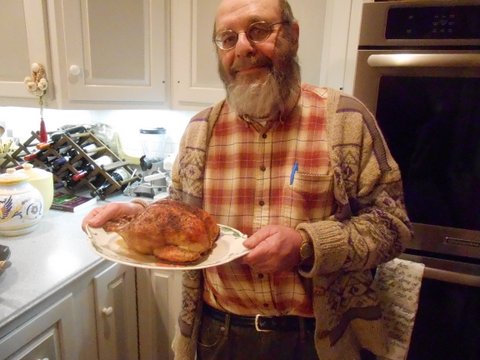
He even demonstrated his method last Friday.

DSCN9071

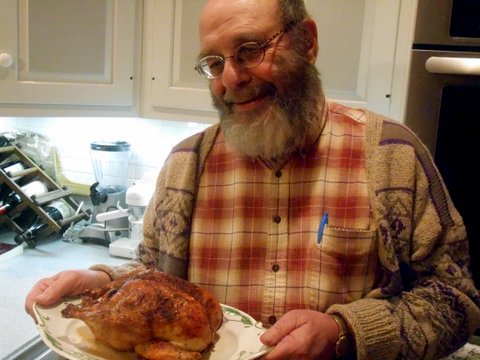
Our friend Irv Molotsky in Washington  put me onto a wonderfully carefree way to roast a chicken, developed by America’s Test Kitchen. Simple and hands-off—well the chicken needs a hand getting into the oven, but that’s about it!

Wash a medium size chicken and pat it dry. Brush it with olive oil and season it well with sea salt and black pepper. Stuff a couple of garlic cloves, a sprig of rosemary and half a lemon in the cavity. Put a roasting tray in the oven. Heat the oven to 230c/450f—yes, you are heating the tray.

Take the tray out, wearing a strong pair of oven gloves, put the chicken in it and pop the tray back in the oven for thirty minutes.

Then, WITHOUT OPENING THE OVEN, turn off the heat and leave the chicken for a second thirty minutes. Take the chicken out of the oven and the pan.

While the bird takes a well-earned rest, covered with foil, for twenty minutes, make a little gravy. Lift all but a spoonful of fat out of the pan and ease the remaining good bits, including the squeezed garlic cloves, into a sauce with half a wine glass of white wine or water. Gently heat this, stirring to amalgamate the gravy.

Hey Presto!

Irv’s Carefree Roast Chicken!

DSCN9072

Forty years on…

and Ross Poldark remounts…

Today the BBC announced the name of the actor who is to play the lead in the re-working of the series  first screened in 1975.

Irish actor Aidan Turner has bagged it.

Aidan-Turner-as-Poldark

Just needs to add the scar and he’s away!

Congratulations to him–I hope he has as much fun as we did filming this wild and wonderful saga written in 12 books over a sixty year period by Winston Graham.

Forty years ago this November I went for the first of three auditions for the part, knowing little about Winston Graham and less of the books.

A brief glance at the first book of the saga, Ross Poldark, was enough–I seriously wanted him to be me or vice versa.

I had to go through two more nail-biting sessions in front of producer and directors before finding myself in the position Aidan is in today….

…Cast to play Ross Poldark.

Ross+Poldark

Now–two generations on–this great piece of storytelling will be enjoyed again by millions on TV and in book form.

The time is right. The wheel of fashion turns and Poldark, an unashamedly romantic tale, can be told again with a straight face.

The new series has the advantage of being adapted from original books written by an exceptionally gifted storyteller–Winston Graham.

The characters develop at their own pace and seem responsible for their own destiny.

No visible puppeteer, no obvious manipulation–just the telling of stories through the characters involved.

Aidan and I share a common debt to Winston, for giving us the chance to play a difficult, contrary, complex man often out of his time.

It’s a roller coaster of a ride!

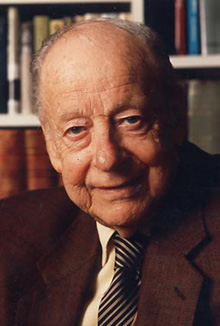
winston-graham-1000338

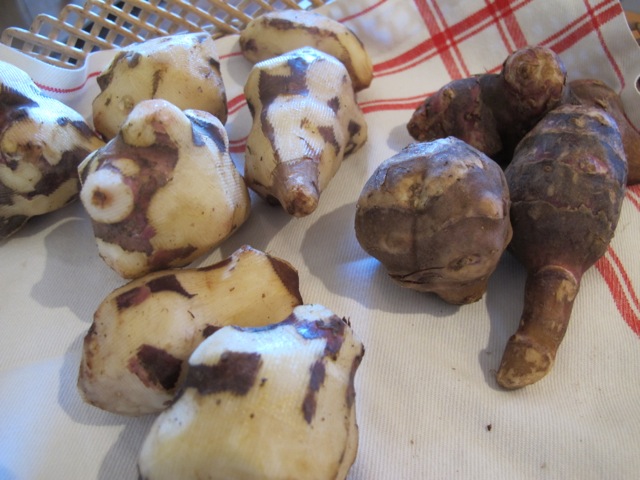
These knobbly numbers are Jerusalem Artichokes.

IMG_1489

They are doubly duplicitous.

The name has nothing to do with Jerusalem the town and even less to do with the noble globe artichoke.

It derives from a corruption of the Italian for sunflower–girosole-which, because of the way it sounds, morphed into Jerusalem.

Also known as sun chokes, sunroots, topinambor and earth apples they are a species of sunflower and originating from the eastern side of North America–their health benefits, especially for diabetics, are explained here.

Duplicitous, yes, but also delicious and especially here when mixed with capers, white wine and pieces of chicken.

Marcella Hazan devised this recipe.

One caveat–they do have a reputation for causing flatulence–but hey!

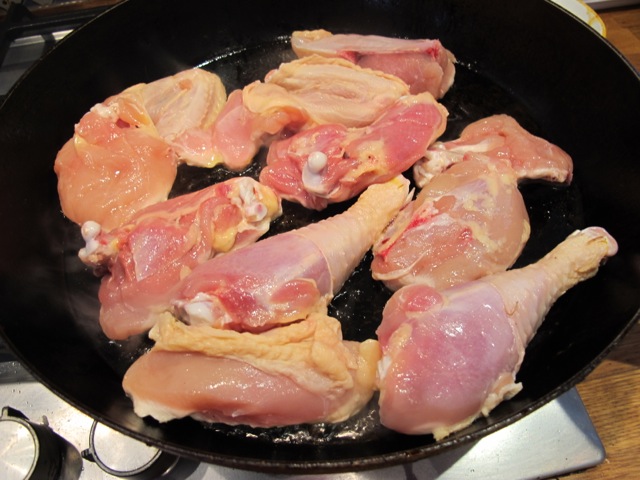
1 chicken–cut into pieces

IMG_1492

2 tbs olive oil

1lb Jerusalem artichokes–peeled and sliced thin in a food processor

2 garlic cloves–chopped

2 tbs capers–drained

2 tbs parsley–chopped

1 glass/6 tbs/4 fl oz white wine

salt and pepper

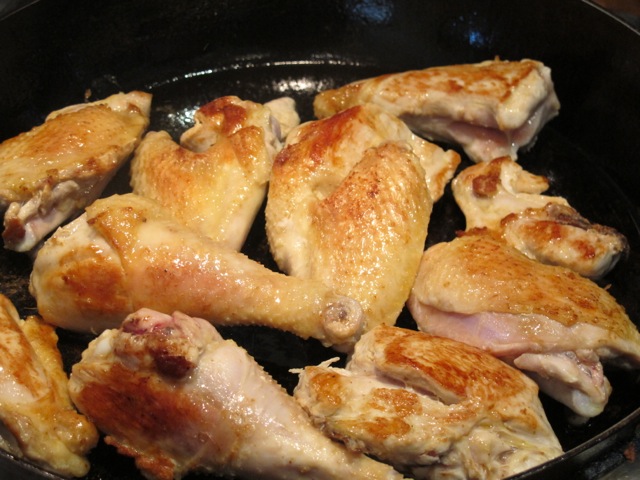
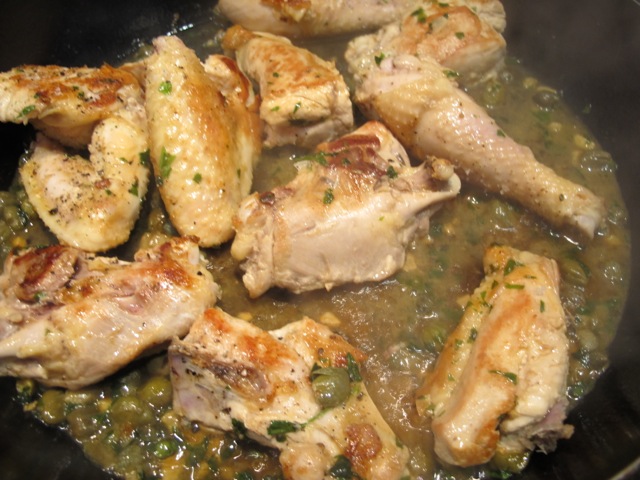
Heat the oil in a casserole with a lid and brown the chicken pieces (five minutes each side)

IMG_1510

Park them in a bowl.

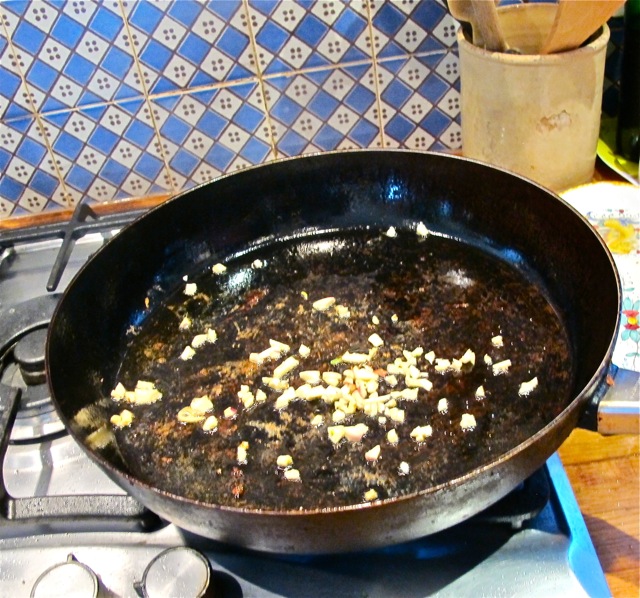
Add the garlic and sauté briefly.

IMG_1513

Mix in the parsley, capers and wine before returning the chicken to the pan.

IMG_1515

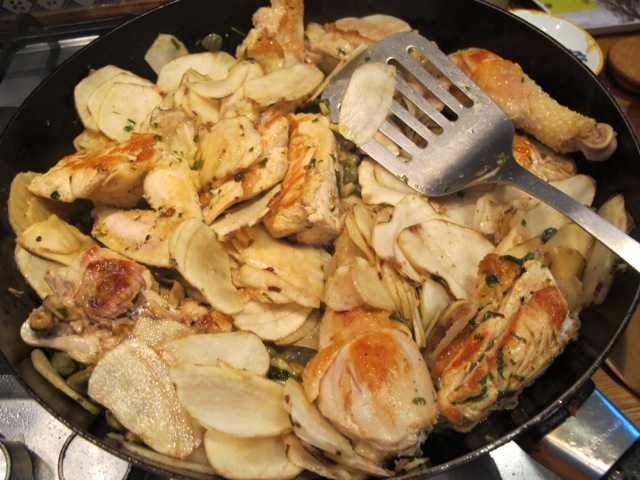
Turn everything again and add the artichoke slices.

IMG_1517

Again turn everything over a couple of times and cover the pan.

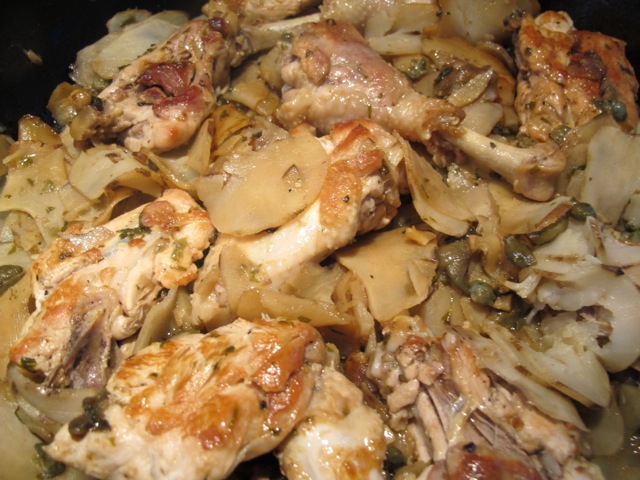
Cook on a very low heat for 30 to 40 minutes.

It’s good to let the condensation moisten and tenderize the artichokes–so resist the temptation to lift the lid too often.

A couple of times is good to check the liquid–add a little water if it is drying out–and turn it all again.

IMG_1519We are seeing a movie tonight with some friends so I made this last night and stored it in the fridge.

I shall reheat it slowly when we get home and before you can say Jack Robinson or Jiminy Cricket, we’ll be sitting down tearing the chicken (and the movie) to pieces!

Still no working oven!

(En principene competez pas vos poules avant qu’elles sont éclorés–on ne sait jamais!–there’s someone coming to fix it on Monday–or so we’re told!)

A chance to see how this dish, a regular favorite (it features in my first cookbook–Delicious Dishes for Diabetics), does when cooked on top of the stove–on a very diffused heat.

Normally it cooks slowly in a low oven for two hours and comes out sweet, tender– so easy to do.

So a minor experiment.

photo

Adapted  from the talented Frances Bissel’s book The Pleasures of Cookery–it uses spare rib chops–which stay succulent during the long cooking.

(Not to be confused with spare ribs from the belly of the pig; spare rib chops come from the neck end of the pig and are sweeter. They are also reasonably priced.)

for 4

4 spare rib chops/echine in France

2 400gms/16oz  tins/bottles of white beans

onion— sliced

1 stick celery — sliced

2 juicy oranges

1 teaspoon of coriander seeds

1/4 pint/150ml stock–I use organic vegetable stock cubes, but it’s a question of taste.

salt and pepper

A handful of chopped fresh coriander or parsley.

Set the oven to 160C/320F–if you are lucky enough to have an oven that works!

Spread the beans over the bottom of the oven proof dish in which you will serve the finished dish.

Brown the chops in a non-stick pan and lay them on top of the beans.

Lightly brown the onion and celery in the same pan.

Spread them over the chops.

Cut some strips of rind from an orange, avoiding the white pith.

Bury these among the chops and beans.

Squeeze the juice from two oranges and pour it over the chops.

Pound the coriander seeds and sprinkle them over.

Add the stock and cover the pan.

photo

Cook in the middle of the oven for 2 hours–(or as I am doing tonight, on a very low heat on top of the stove for the same period).

Check after an hour to ensure that there is enough liquid–but be careful not to add too much or the concentrated taste of the sauce will weaken.

Season with salt and pepper when it’s cooked.

A green vegetable–steamed broccoli with olive oil–is a nice winter accompaniment.

photo

Sprinkle with chopped coriander or parsley.

It worked just as well cooked slowly on top of the stove in a covered dish!

I’m thinking of getting rid of the oven!

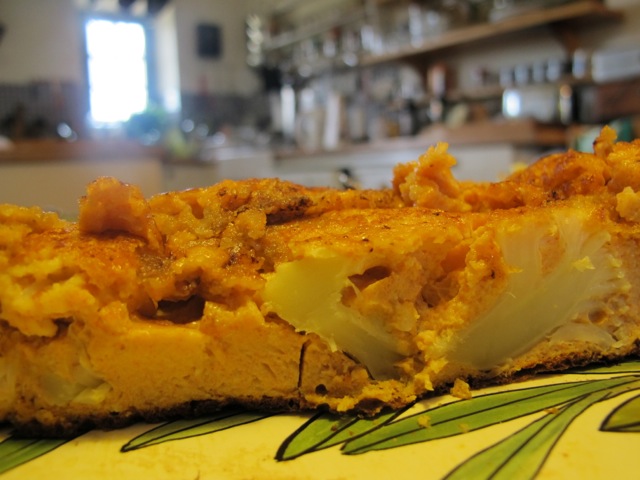
The smokiness here comes from smoked paprika.

IMG_1418

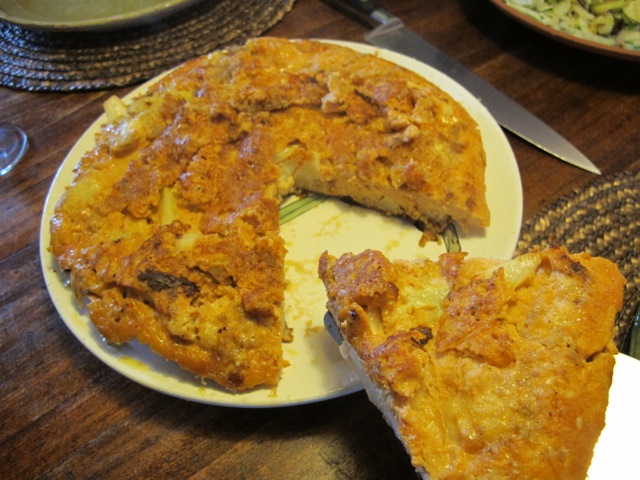
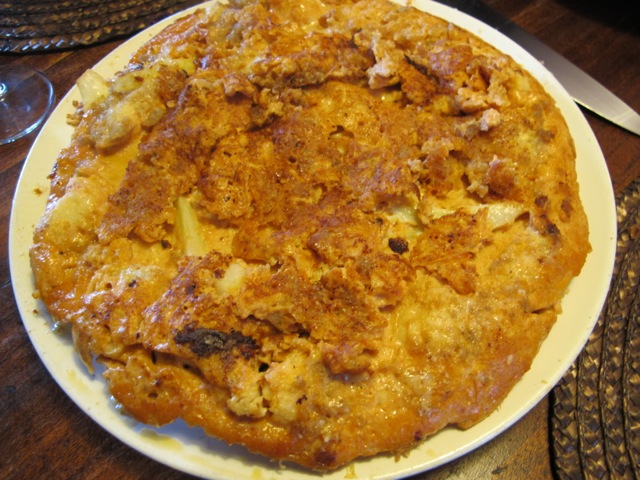
It makes for a delightfully different take on a traditionally Italian way with eggs.

IMG_1427

This is adapted from Yotam Ottolenghi’s richer version. I have substituted coconut milk for the cream and lessened the amount of cheese.

I cooked it long and slow on top of the stove and managed to brown the top with a manoevre described below…still no oven or grill!

1 small cauliflower (or half a big one)

6 eggs

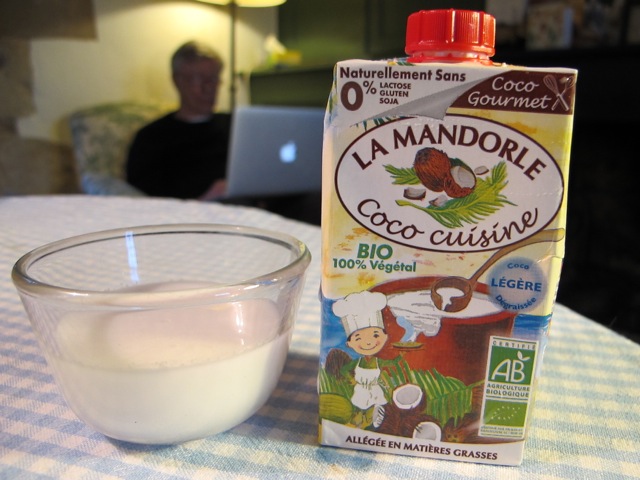
4 tbsp coconut milk*

2 tbsp Dijon mustard

75 gm/2.5 oz grated parmesan +25gm/1oz more for the topping

2 tsp smoked paprika

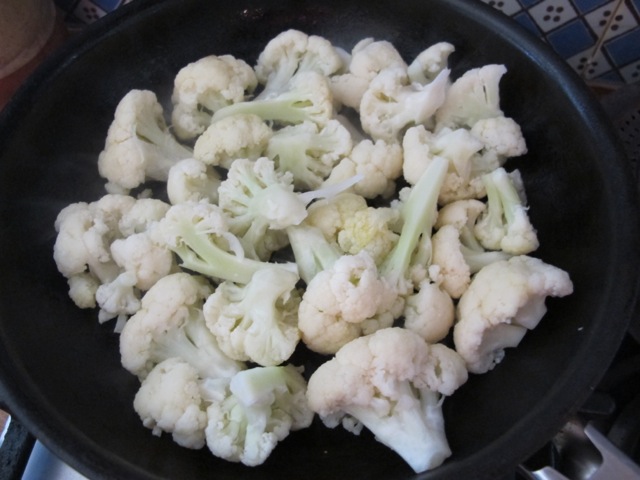
Steam the separated cauliflower florets to just tender and set aside.

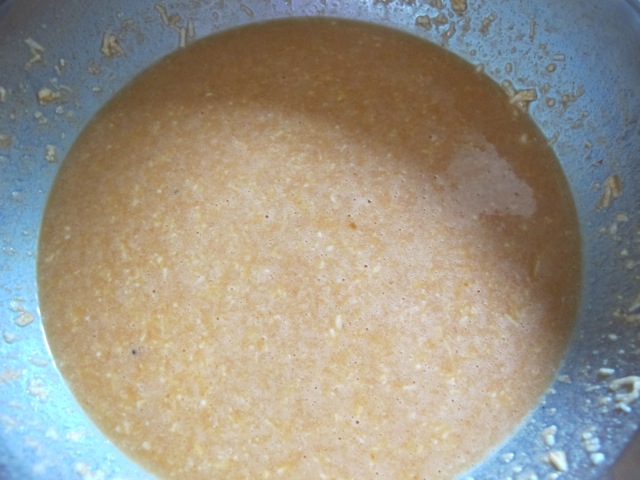
In a bowl whisk together the coconut milk, the paprika and the mustard.

Add the eggs and carefully whisk them in.

Mix in the parmesan and season with salt and pepper.

IMG_1412

Heat the olive oil in a 26 cm (or 10 inch) frying pan.  Brown the cauliflower in one layer on one side for a couple of minutes (no need to turn them to brown them completely).

IMG_1411

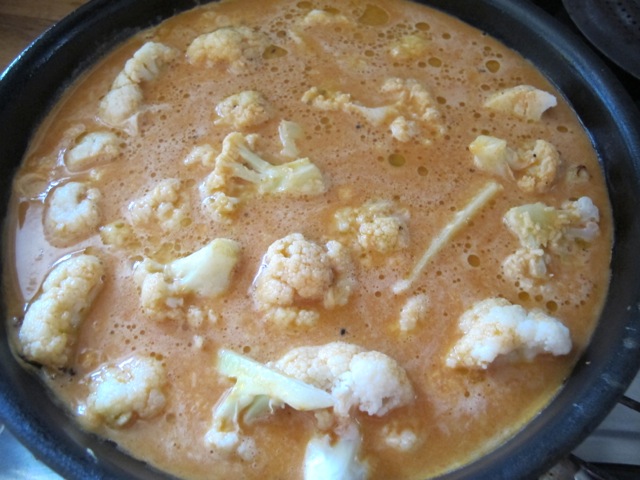
Pour the eggy mix over the cauliflower–shake the pan a little to get an even distribution of cauliflower.

IMG_1413

Cook the frittata on the lowest possible heat, using a heat diffuser if you have one, until there is just a small pool of liquid left on the surface.

To brown, simply slide the pan under the grill for a minute.

With no oven or grill available, I had to be bold!

I laid a flat plate, roughly the circumference of the pan, on top of the frittata then with my left hand on the back of the plate and holding the pan’s handle with my right hand I flipped the whole thing over, then slid the frittata back into the pan to briefly brown the top.

IMG_1414

The challenge made me feel good–but I ran the risk of it all ending up on the floor!

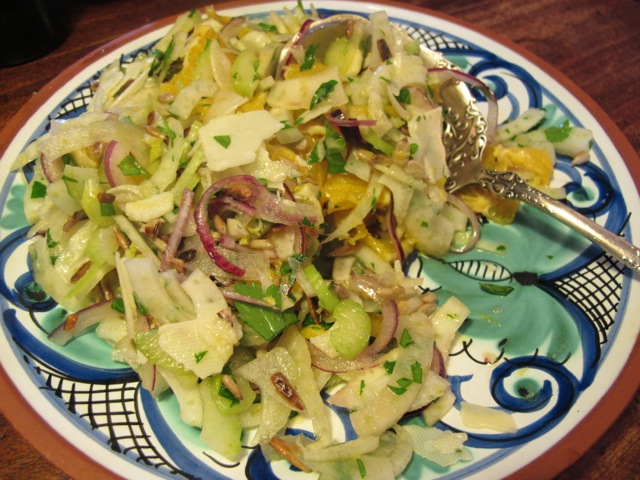
I made the fennel and orange salad from my new cookbook, Healthy Eating for Life, to contrast  the blousy smokiness of the frittata.

IMG_1423

*The difference between coconut milk/cream and cream of coconut is fully explained here: 

http://www.thekitchn.com/whats-the-difference-coconut-m-75446/

IMG_2292

It looks like milk, it is NOT sweetened and it does NOT taste of coconut!

“Troubles come not single spies but in battalions…” (Claudius in Hamlet)

Massalitinov_and_Knipper_in_Hamlet_1911-1

Russian actor Nikolai Massalitinov as Claudius with Olga Knipper as Gertrude, fully braced for “troubles”; in the Moscow Art Theatre production of Hamlet–a few years ago!

First it was the TV–no picture from the UK– satellite dish has to be larger now to receive the BBC; then the temperature control on the oven called it a day and now neither of the keys will open the car doors electronically.

And to cap it all in this catalogue of woes (or self pitying monologue), three recipes I was hoping to write up turned out to be duds!

Not exactly a battalion of troubles compared to this horror the folks in Cornwall have been facing.

But enough to tickle the imagination and set off a search for alternatives.

French TV or a good book/internet stuff by the fire? No contest for much of an evening.

No oven? no matter…

Top o’the stove to ye all me ‘arties!

Last night I remembered the spicy dal in the fridge from a couple of nights back–firm enough to form little patties to fry lightly in olive oil.

I had spotted some locally grown endive yesterday at Castres market–those torpedo shaped lettuce that intrigue, but can flummox too. What to do with them other than add to salad?

This recipe from my new book,  Healthy Eating for Life, suggests cooking them in the oven. But no working oven!

I excavated  one good fennel bulb left in the fridge too.

This recipe for pot-roasted fennel from my first cookbook, Delicious Dishes for Diabetics, sautés them slowly on top o’ the stove.


Solution: cook ’em together–on top!!

Sweet fennel, plus the faint bitterness of the endive, finished with squeeze of lemon.

I halved the prepared endives lengthwise to shorten the cooking; then browned them in two fluid ounces of olive oil on a medium flame, uncovered, with the fennel (sliced top to bottom in 8 pieces) and garlic (unpeeled), for ten minutes.

Added four fluid ounces of water to the pan and cooked the mix–covered–for a further twenty minutes–until the vegetables are tender.

We dined last night reflecting on how lucky we are to live in a rectory between a church and cemetery, on a rise where the rain runs downhill bypassing us.

IMG_4487

We say it often: The ancients knew a thing or two about where to build their sacred spots.

IMG_1279

Lunch is looming and I have it in mind for us to finish the spinach and red onion frittatta left-over from Saturday–with a green salad.

I have some difficulty finding the plastic box it’s stored in among the rest of the left-overs waiting their turn.

A pretty cabbage (red drumhead) is sitting in the fridge too, as cabbages and cauliflowers are wont to do.

One of the legion of left-overs in the fridge was the remains of the red lentils with cabbage and tomato.

I sneaked a taste and changed my mind about lunch–it was too good to let go!

It needed something green to go with it–THE CABBAGE!

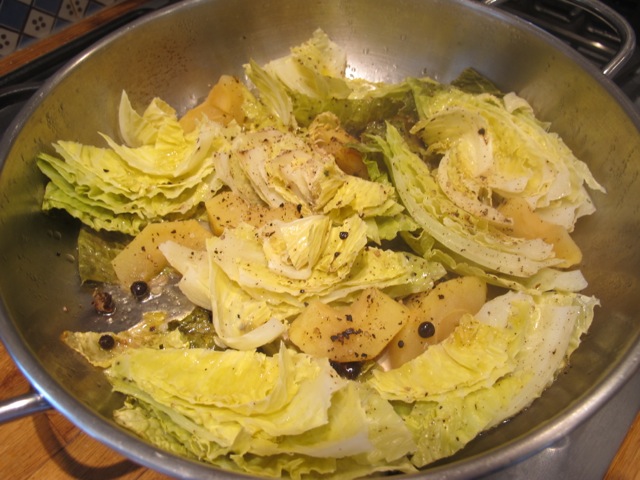
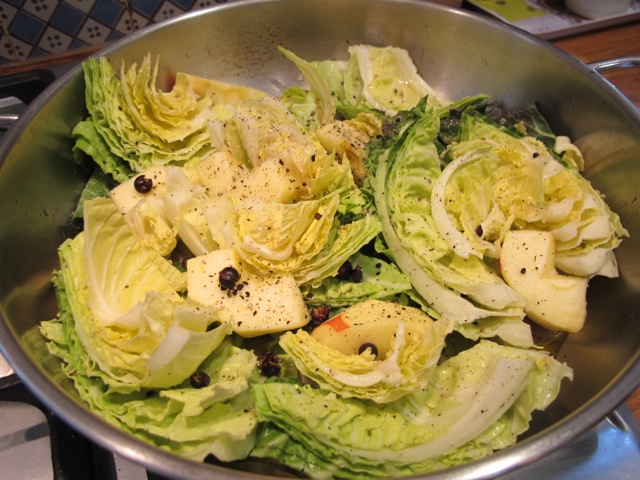
1 medium savoy cabbage (red drumheads are not always easy to find)–outer leaves removed, quartered, cored and halved

2 apples–peeled, quartered, cored and halved

2 tbs olive oil

10 juniper berries–lightly crushed with the flat of a knife

5 fl oz white wine

salt

plenty of black pepper

  • Pour the oil into a shallow pan (with a lid) and arrange the cabbage and apple “eighths” prettily.
  • Squash the juniper berries with the flat of a knife and sprinkle them over and in between.
  • Sprinkle the wine over, a good grinding of the pepper mill and some salt.

IMG_1276

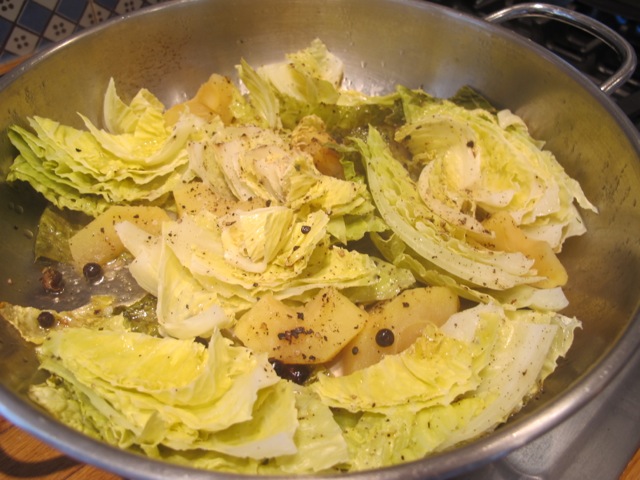
  • Cover the pan and cook for about 30 minutes.

IMG_1280

  • Pick a leaf of cabbage from the pan and test for doneness.
  • Serve hot.
  • The fridge is looking tidier–should be no problem finding the frittatta tomorrow…
  • Left-overs rule, OK?

Back in the days before enlightenment–BE or rather BMbefore Meredithdespairing black moods regularly followed perceived failure, chez-moi.

“Buck up”–my mother used to say—“failure is character building”!

“Don’t make it worse, Ma!”

The first night of the RSC’s  production of King Lear in the 1976 Stratford season was one such occasion.

Donald Sinden (Lear) and Judi Dench (Regan) among the cast.

I was playing Edmund, the bastard son of Gloucester.

The famous speech/soliliquy which ends–“Now God–stand up for bastards!” had gone over well during the three weeks (too long) of previews, with some morale-boosting laughs.

Come press night, the first 7 or 8 rows of critics sit stony-faced–they’d seen King Lear countless times.

Not a squeak, not a giggle and no visible smiles–just an aggressive (as I heard it) silence.

I am unnerved and later fluff a line.

The result is–Black Dog!

Poor proud parents have to endure a post-play drink with an inconsolable zombie son.

They do get to meet Judi Dench–ebullient as ever; though I was never sure she enjoyed playing Regan!

Scroll down the years to last night.

I tried out a new dish involving butternut squash and green split peas.

Failure!

The peas wouldn’t soften and the squash was tough.

The spicy sauce wasn’t bad, but the time it had all taken to cook was demoralizing.

Was I downhearted? Of course not! It’s PM now, I’m forty years older–that would be silly!

I awoke this morning, though, in need for something completely different: lamb chops? Sausages?

I drove to Lautrec’s Friday market.

Sausages–fait mason [made by the butcher]–won the day and here is the result:
IMG_1219

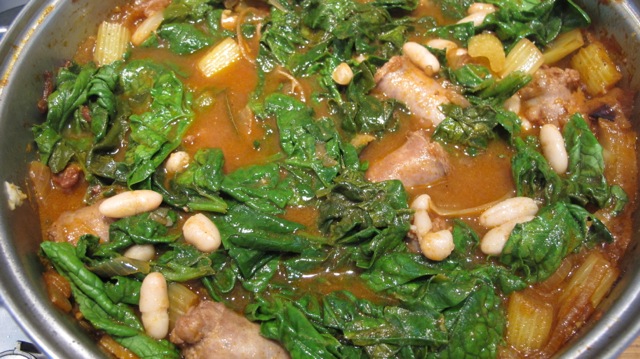
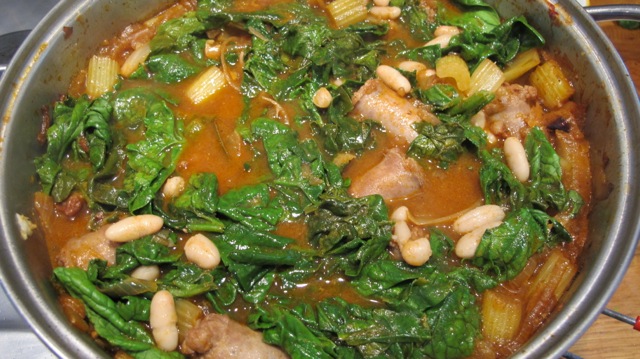
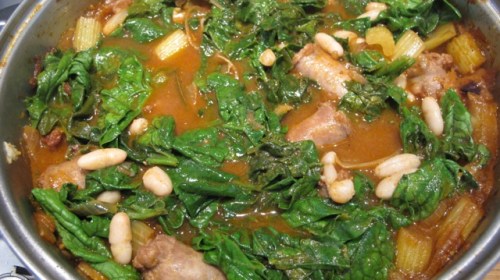
A one pot dish inspired by a recipe in the second Riverford Farm cookbook.

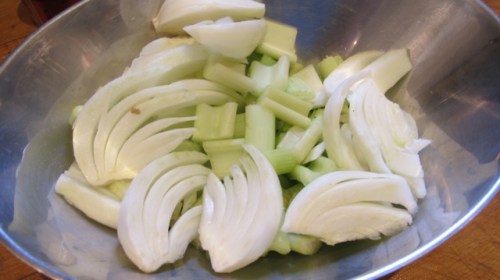
Celery and fennel make for good companions with the modest amount of sausage.
IMG_1211

Kale or Swiss chard can substitute for the spinach–or you can just  omit the greens.

for 3/4

1 tbsp olive oil

450gm/1 lb good quality pork sausages

50 gm/2oz bacon–diced

2 medium onions–sliced

2 garlic cloves–pulped in a little salt

8oz celery–cut into inch-size chunks

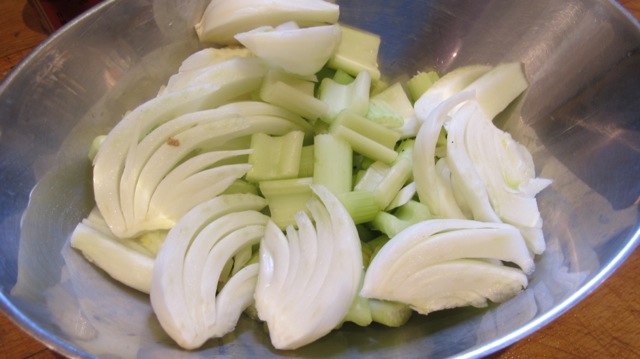
1 large fennel bulb–outer leaves removed, halved vertically and then each half carefully divided into eight pieces. (This helps them become tender quicker!)

2 bay leaves 

a good sprig of fresh thyme

1 tbs tomato concentrate

100ml red wine–a small wine glass

600ml stock–I use organic vegetable stock cubes

4 tsp dijon mustard

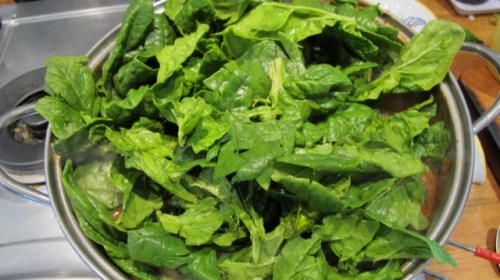
8oz spinach–washed and thick stems removed

400gms cooked white beans from a tin [can] or jar

salt and pepper

  • Sauté the sausages and bacon in the olive oil for 10 minutes in a pan large enough to hold all the ingredients.
  • Remove the sausages to a plate.
  • Sauté the onions and garlic gently in the pan until the onions soften and turn opaque; take care not to let them burn on the bottom of the pan.

IMG_1210

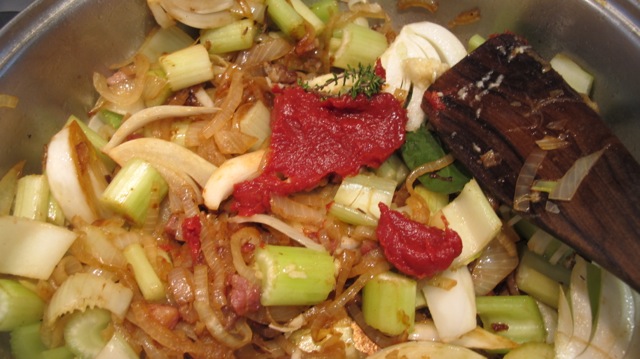
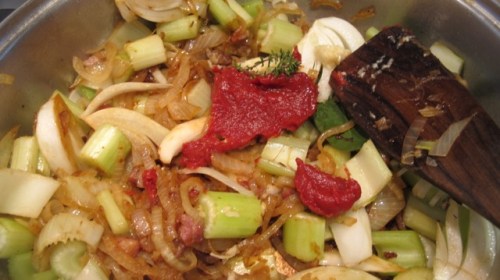
  • Add the fennel, the celery, tomato concentrate and herbs
IMG_1212

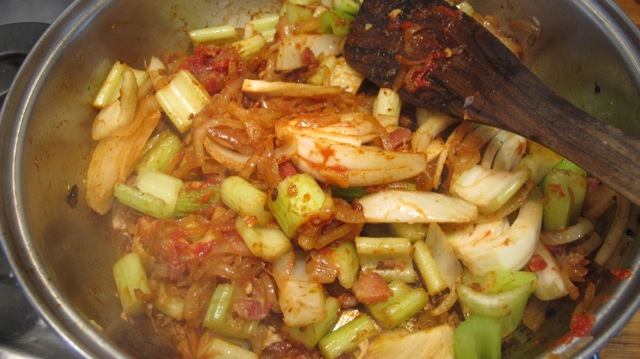
  • Turn everything over thoroughly.

IMG_1213

  • Add the red wine and mix again, scraping up the good bits as you go!
  • Add the stock, the saved sausages and stir in the mustard.
  • Bring the pan to a simmer and leave it to bubble gently for about 20 minutes.

IMG_1214

  • Check the seasoning. I found it didn’t require added salt–the bacon and stock cube were sufficiently salty–but added some freshly-milled black pepper.
  • Spread the greens over the top of the dish and leave them for ten minutes to start dissolving into it. (Cover the pan if you feel the need).IMG_1218
  • Gently stir in the greens and add the beans.
  • Cook for a further few minutes to heat through.

IMG_1220

We had the dish for lunch served over half a baked sweet potato each.

Success!

This recipe is from my new book,  Healthy Eating for Life.

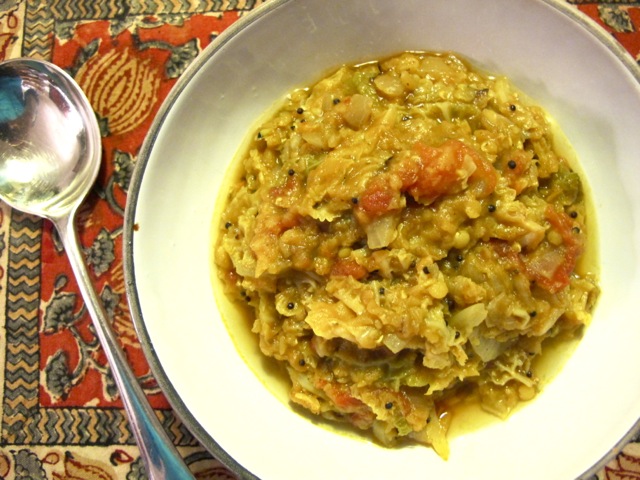
I was going to try out a new dish using the cooked Puy lentils left over from lunch yesterday, but changed my mind–and settled on this soupy supper instead.

I found a small cabbage sitting in the fridge, patiently waiting its turn…

IMG_1186

Red lentils with cabbage and tomatoes

Rose Elliott adapted this from a recipe in Julie Sahni’s Classic Indian Vegetarian Cookery. I have tweaked it a bit more.

for 4

250gms/8oz red lentils

2 1/4 pints/1300ml stock–I use organic vegetable stock cubes

1/3 tsp turmeric

375gms/12oz tinned [canned] tomatoes–chopped

  • Rinse the lentils thoroughly.
  • Put them in a saucepan with the stock and the turmeric and bring up to the boil.
  • Cook at a gentle simmer for 45 minutes.
  • Add the chopped tomatoes then set aside.

1 tbsp olive oil

1 1/2 tsp black mustard seeds

1 tbsp curry powder–(your choice how hot!)

onion–chopped

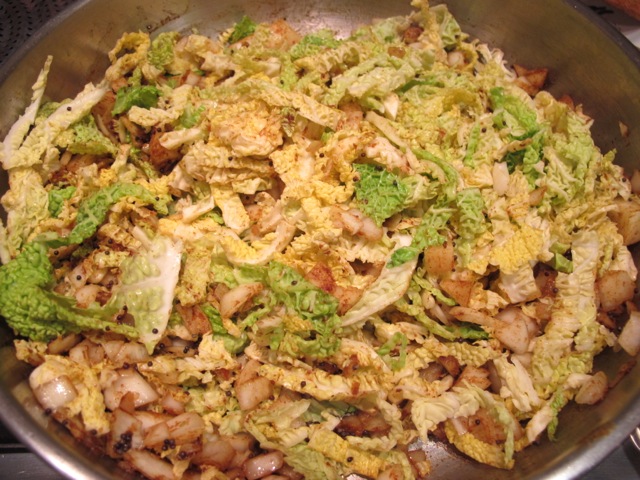
a small cabbage–outer leaves removed, quartered, cored and shredded

IMG_1175

Juice of half a lemon

salt and pepper

Parsley or better still fresh coriander–chopped to sprinkle over

  • Heat the oil in a new pan.
  • Add the mustard seeds and cook them until they start to pop–a couple of minutes.
  • Mix in the curry powder.

IMG_1177

  • Add the onion and the cabbage and mix everything together well.

IMG_1178

  • Cover the pan and cook for 5 minutes.
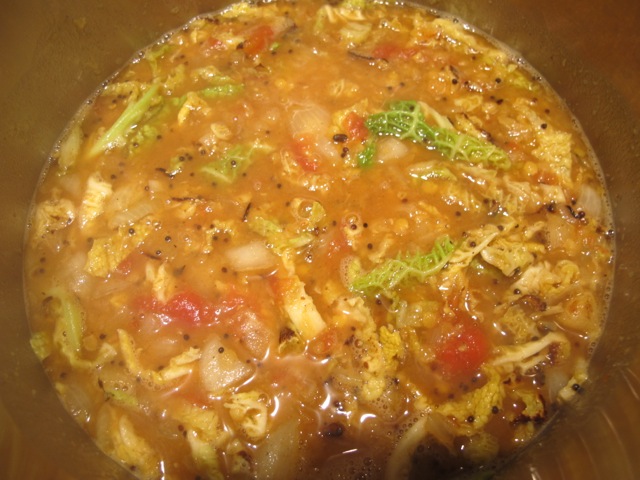
  • Add the wilted cabbage to the lentils.
  • Bring the mixture up to the simmer.
  • Leave it to simmer gently for 20 minutes.
  • Season to taste with salt and pepper.
  • Stir in the lemon juice.

IMG_1181

  • Sprinkle over the parsley or coriander (none available chez nous ce soir!)

It’s best served hot.