Feeds:
Posts
Comments

Archive for the ‘Recipes’ Category

Home again in France and happy to be so.

In spite of being bleary-eyed from the journey  yesterday, I don’t miss another sign of the change of seasons: an asparagus stall at the Realmont market this morning.

At the bigger Castres market on Saturday there’ll be several, piled high with the new green and white  asparagus spears. I much prefer the green–a matter of taste and habit.

It may be a little early for this superfood, but I buy 500 grams/1ib, a generous serving for two–about 7 spears each, plus a few for testing.

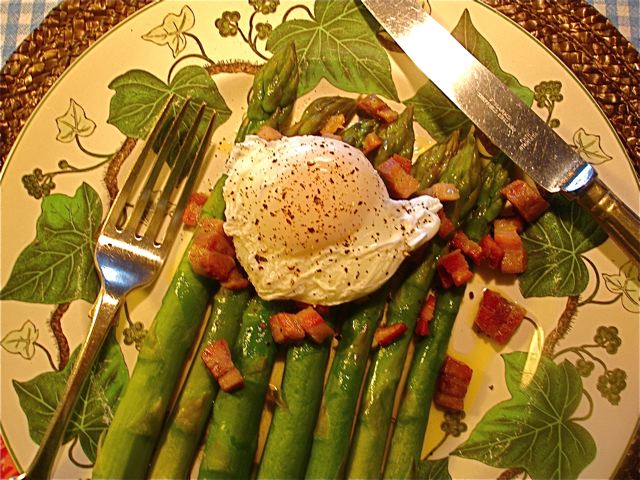
I know there’s a piece of bacon in the fridge–about 4oz/100gms– which I will dice small, gently sauté to a crispy finish.

I’ll dress the asparagus with 3 tablespoons olive oil, 1/2 teaspoon Dijon mustard, 1 tablespoon of lemon juice and a pinch of salt–whisked together; sprinkle over the bacon bits and top it off with a carefully placed poached egg.

An easy lunch for two weary people.
For the asparagus:

Trim the rough base of the spears, making them all about the same length.

Choose a saucepan or sauté pan that will take them all lying horizontally, and that’s wide enough to take a steamer basket/tray.

Fill the pan with water to the depth of the basket.

Place the asparagus horizontally in the basket and cover the pan.

It’s handy to cook an extra spear that you can use to test for doneness.

6–8 minutes should do it, depending on the thickness of the spears.

Pierce a spear with the tip of a knife to test for doneness–or better still, use your teeth!

When they are tender, divide them between two plates.

Spoon over a little dressing and share out the bacon dice.

Carefully place a poached egg on top.

Wrapping the ends of the asparagus in a damp paper or cloth towel, helps preserve the freshness of the  asparagus in the refrigerator. Best to eat asparagus within 48 hours of purchase–but why wait anyway!

Read Full Post »

This seed is a useful alternative to rice. It is grown high up in the Andes–and no one seems to agree on how to pronounce it!

It serves as a plain canvas on which you can paint what you like.

It takes less time to cook than rice and is delicious in its own right or, as below, mixed with  sautéed vegetables.

It takes well to steamed  green vegetables, like broccoli dressed with good olive oil or sprinkled with crunchy nuts such as dry-roasted walnuts.

Crumbled feta or goats cheese is good too.

Here you can learn more about the benefits of Quinoa–perhaps more than you want to know!

Quinoa with sautéed vegetables

for 4

8oz/250gms quinoa

1 pint/2 cups/16floz of vegetable stock–I use organic stock cubes.

Cook this gently, covered, until you can fluff it up with a big fork–about 15-20 minutes.

quinoa cooking in stock

Meanwhile…

Gently sauté together:

4 tblsp olive oil

1 medium onion (red or yellow)–chopped fine

1 clove garlic–chopped

small red pepper–seeded and chopped into small dice

1 small chilli–chopped

1 small courgette–chopped into small dice

1 medium ripe tomato–peeled, seeded and chopped into small dice

Sauté them until soft.

vegetables gently sautéed

Add this mix to the cooked quinoa.

Add salt and pepper to taste–though be careful with salt, as the stock may be salty.

Allow the flavours meld.

cooked quinoa with veg mixed in

If you have some, sprinkle with a tablespoon of chopped parsley.

Mix all together carefully and eat it hot or tepid.

(You can steam the quinoa for a couple of minutes to re-heat.)

Read Full Post »

Still no oven!

(En principene competez pas vos poules avant qu’elles sont éclorés–on ne sait jamais!–there’s someone coming to fix it on Monday)

So a chance to see how this dish, a regular favorite and so easy to do, does when cooked on top of the stove– on a very diffused heat.

Normally it cooks slowly in a low oven for two hours and comes out sweet and tender.

A minor experiment.

It features in my first cookbook–Delicious Dishes for Diabetics.

Adapted  from the talented Frances Bissel’s book The Pleasures of Cookery–it uses spare rib chops–which stay succulent during the long cooking.

(Not to be confused with spare ribs from the belly of the pig; spare rib chops come from the neck end of the pig and are sweeter. They are also reasonably priced.)

for 4

4 spare rib chops/echine in France

2 400gms/16oz  tins/bottles of white beans

1 onion— sliced

1 stick celery — sliced

2 juicy oranges

1 teaspoon of coriander seeds

1/4 pint/150ml stock–I use organic vegetable stock cubes, but it’s a question of taste.

salt and pepper

A handful of chopped fresh coriander or parsley.

Set the oven to 160C/320F–if you are lucky enough to have an oven that works!

Spread the beans over the bottom of the oven proof dish in which you will serve the finished dish.

Brown the chops in a non-stick pan (to avoid using any fats) and lay them on top of the beans.

Lightly brown the onion and celery in the same pan.

Spread them over the chops.

Cut some strips of rind from an orange, avoiding the white pith.

Bury these among the chops and beans.

Squeeze the juice from  two oranges and pour it over the chops.

Pound the coriander seeds and sprinkle them over.

Add the stock.

Cook in the middle of the oven for 2 hours–(or as I am doing tonight, on a very low heat on top of the stove for the same period).

Check after an hour to ensure that there is enough liquid–but be careful not to add too much or the concentrated taste of the sauce will weaken.

Season when it’s cooked.

A green vegetable–steamed broccoli with olive oil–looks good with this on the plate.

Sprinkle with chopped coriander or parsley.

Read Full Post »

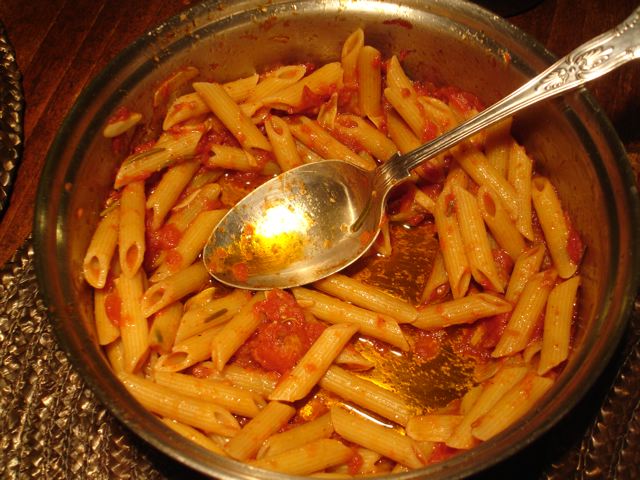
Penne in a sauce of tomatoes, rosemary and balsamic vinegar.

This is adapted from a recipe in  Marcella’s Kitchen by Marcella Hazan.

It is included in my recipe book Delicious Dishes for Diabetics (to be published in August this year in the UK, November in the USA).

Quick and simple to do, it has a distinctive earthy flavour, thanks to the rosemary.

It’s worth taking care to slice the garlic real thin.

for 4

8 tablespoons of olive oil

4 cloves garlic–very thinly sliced

2 sprigs rosemary or 2.5 tsps dried rosemary

A large tin [800gms/2lb] of tinned tomatoes- -drained of  their juice

s&p

1lb/400gms [100gms/4oz each person] wholewheat penne, farfalle or any short pasta

2 tsps balsamic vinegar

Sauté the garlic gently in the oil with the rosemary (if using fresh) until the garlic sizzles–a couple of minutes.

Add the tomatoes, salt and plenty of pepper—(if using dried rosemary add it with tomatoes).

Cook for 10-15 minutes.

Cook the pasta in salted water.

Drain well and add to the sauce.

Turn the pasta in the sauce and cook for a minute or two longer.

Turn off heat and make a well in middle of the pasta and add the balsamic vinegar.

Turn over the pasta again in the sauce.

Serve on heated plates with freshly grated parmesan cheese.

Read Full Post »

Peckishness can present problems for people with diabetes.

To snack or not to snack–that is the question!

One reason to eat a good breakfast is not to feel that nagging hunger mid-morning.

I have a bowl of oats, with walnuts, a teaspoon of linseeds, a prune, a dried apricot chopped, half a tub of low/no fat yoghurt, cinnamon sprinkled over and oatmilk, every morning and it’s sometimes my favourite meal of the day!

That and the two pieces of rye bread toasted and a cup of coffee take me happily through to lunch.

For me it is in the gap between lunch and dinner that peckishness kicks in–usually between 5pm-6pm.

What to do about it?

Ideally nothing–but then when dinner time comes the temptation to scoff is hard to resist.

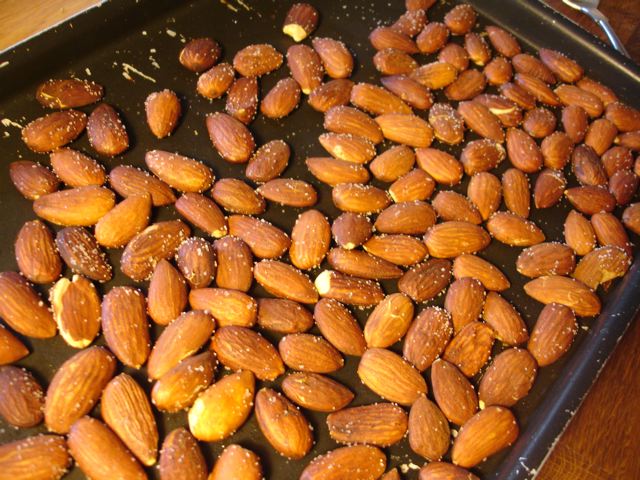
I ease the pain with nuts. Almonds are my prefered nut at the moment–roasted with a little salt. Pistachios preceded them until my nails started to split with opening them. Both have good health properties. Eaten in moderation, one doesn’t have to feel guilty about snacking.


Home-roasted almonds


8oz/250gm almonds

1 teaspoon olive oil

fine salt

heat the oven to 180c/375f

Put the almonds in a bowl and tip the teaspoon of oil over them.

Turn them over in the oil until they are well covered.

Add a couple of sprinkling of salt and flip them over and over until the salt is well distributed.

Spread  the nuts on a shallow baking tray and roast in the middle of the oven for about 10 minutes.

Read Full Post »

Stuffed red peppers with baked sweet potato and swiss chard

More a summer dish this, with ripe tomatoes–but I had the chevre [goat’s cheese], needed to use it and it’s already the “Ides” of March today.

for the stuffed pepper


1 red pepper–carefully halved through the stem

2/3 tinned tomatoes for each half

1 garlic clove–thinly sliced

1 soft goat’s cheese–halved or quartered, depending on its size (it should fit snugly in the pepper half)

olive oil

salt and pepper

heat the oven to 180C/375F–medium

Place the pepper halves on a shallow oven tray–covered with foil.

Put three tomatoes, slivers of garlic, and half the chevre in each pepper half.

Drizzle over some olive oil and season well with salt and pepper.

for the sweet potato

1 medium sweet potato–pricked to avoid it bursting!

for the swiss chard

8oz/250gm swiss chard–leaves only, separated and washed

see post-Light lunch for one–for how to cook it

Bake both the pepper halves and the sweet potato in the oven for about an hour.

When ready halve the sweet potato–one half for each plate.

A pepper half for each plate (careful not to spill too much of the juice).

Add a serving of the swiss chard.

Divide any  juice left in the pan between the the plates.

Bon Appetit!


Read Full Post »

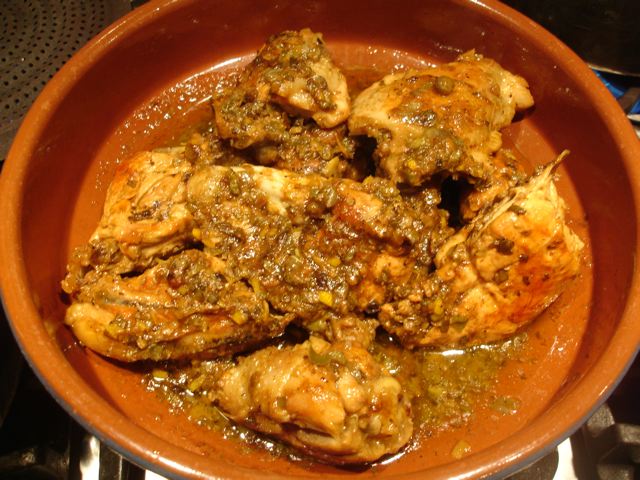
I found this recipe in Anna del Conte’s Classic Food of Northern Italy. It originates from an Umbrian cook, Zia Lidoria, and though in her version is for rabbit, it works well for chicken. [see below one way to cut up a chicken].

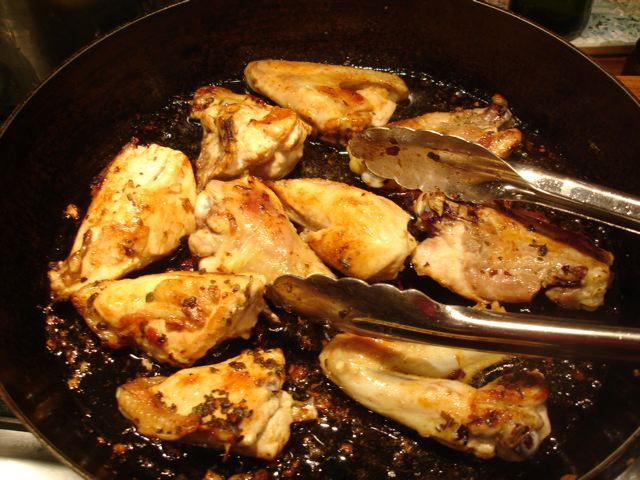
The long initial browning of the chicken is a little scary; the pieces seem to be shrinking alarmingly, but they come back to life when liquid is added.

Browning up

1 chicken–cut up into 8/10 pieces

1 tablespoon sage leaves

3 garlic cloves

6 tablespoons olive oil

5 floz white wine vinegar

5 floz hot water

rind of half a lemon—removed without the white pith

2 tblsps capers—drained and squeezed

4 anchovy fillets

1 tblsp chickpea flour

Salt and pepper

Heat the oil  in a large sauté pan.

Chop the garlic and sage together.

Fry the mixture gently until the garlic begins to colour—a couple of minutes.

Add the chicken pieces to the pan and turn them over well in the garlic, sage and oil mixture.

This is the long bit and will take about 45 minutes!

Keeping the heat low, turn the pieces every few minutes as they begin to take on a good colour.

Hold your nerve and when they are nicely browned add the vinegar and hot water.

Turn the chicken in the liquid, season well with salt and pepper and cover the pan.

Cook on a low heat for a further 40  minutes.

While the chicken cooks on, chop the lemon rind, the capers and the anchovies finely together, then sprinkle in the flour, stirring it in well.

When it’s time, remove the chicken pieces and keep them warm in a heated serving bowl, covered with a lid or foil.

Try the sauce in the pan and if necessary reduce it a little to concentrate the taste.

Stir in the lemon rind mix and cook for a minute.

Pour the sauce over the chicken and serve with brown basmati rice or chickpea mash.

We had some broccoli with it last night.

Mark Bitman of the New York Times bones a chicken in this video and explains clearly how to do it and why there are good reasons to try.

Read Full Post »

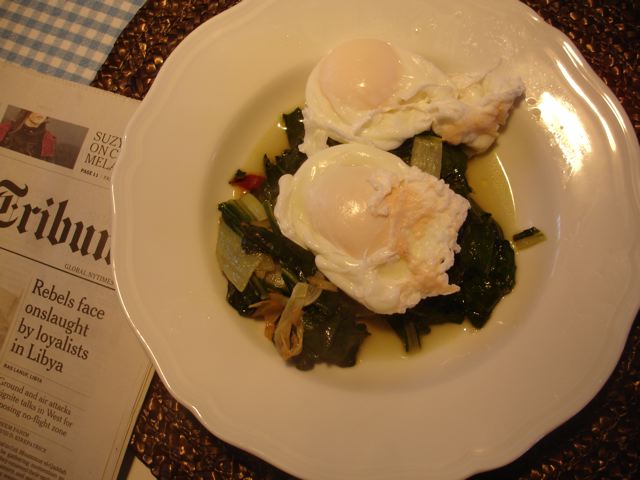
Two poached eggs on Swiss Chard or Spinach

Mid-week Meredith went out to lunch with a friend, so I looked in the fridge and found a handful [4-6oz/100-150gm] of Swiss Chard [see below] and a couple of eggs. This is what I did then:

Peeled a garlic clove, sliced it thin and deseeded a small dried red chili.

Poured two tablespoons of olive oil into a sauté pan, added the garlic and chili and let the garlic colour lightly.

Roughly cut up the chard and added it to the pan with a little salt, turning it in the garlicky oil.

I covered the pan and cooked the chard on a low flame turning it now and then to prevent it burning for about 5 minutes until it was cooked through.

Spooned off the excess liquid before making a nest of the chard on a plate ready to receive the eggs.

I poached the two eggs, drained them well and placed them in the nest and hey presto!–a light lunch.

I could have had a small salad with it but I didn’t.

To prepare the chard or spinach

First separate the leaves from the stalks of the chard or spinach, wash them and shake as much water as possible from them, before chopping and adding them to the pan.

Solo light lunch

Read Full Post »

For 2

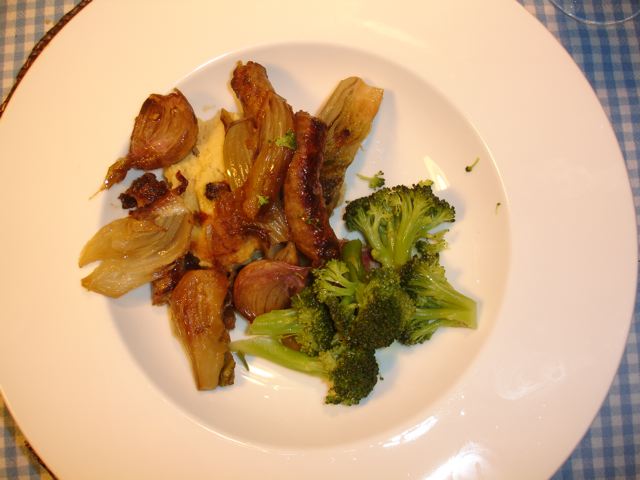
4 fennel bulbs

1 garlic bulb–cloves separated and peeled

1/4 cup/60ml/2floz olive oil

500gm/450oz spicy sausage–cut into wine cork size chunks

salt

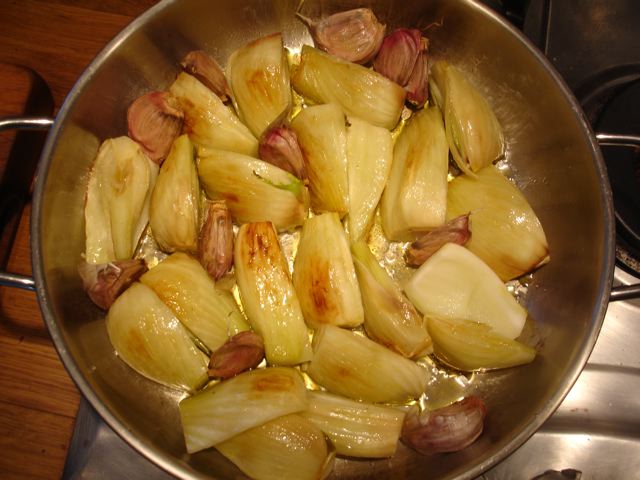
1. Remove the outer casing of the fennel and cut  the bulbs into eighths vertically.

2. Put them in a pan large enough to take them in a single layer.

3. Scatter the whole garlic cloves among them.

4. Pour over the olive oil and add a pinch of salt.

5. Sauté gently, uncovered, for half an hour, turning the fennel as it colours.

6. Add 1/4 cup/60ml/2floz of water, cover the pan and continue cooking for about another half hour, adding more water as needed.

7. The fennel should end up meltingly tender. The water makes a light sauce.

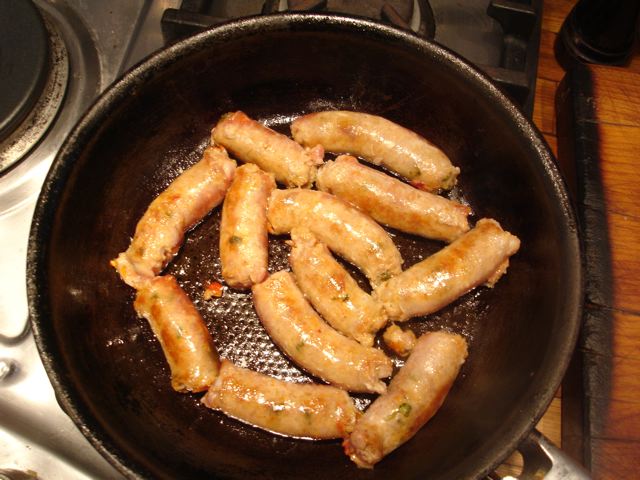
8. While the fennel cooks its second half hour, sauté the sausages gently in a separate pan, turning them as they colour.

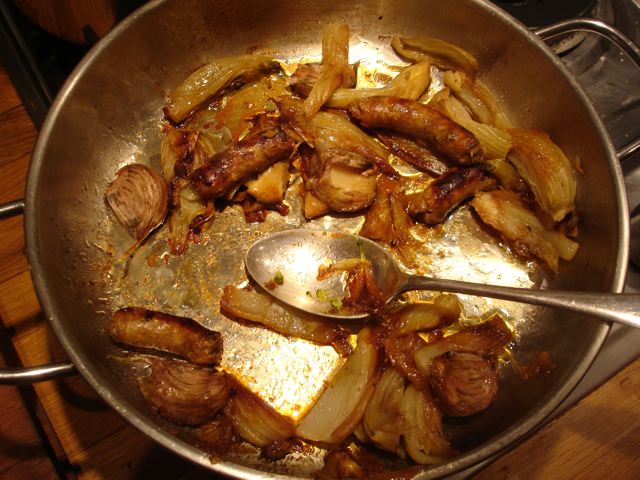
9. Add them to the fennel and cook it all together for 5 minutes.

10. Adjust the seasoning and serve over Chickpea mash or what you will.

Read Full Post »

Spring is in the air at Realmont market this morning. People are very chatty; the terrace of the cafe is packed–seven round one of the small tables, relishing the sunshine.

Winter is still on the stalls though–no change yet from the root vegetables, cabbages, broccoli, sprouts, and cauliflowers that have dominated for months. A few stalls are selling plants for early bedding. Frost still threatens, limiting the choices.

At a pork butcher’s stall I have yet to shop at–mainly because there’s always a long queue–I spot a different looking sausage. It’s marked : Saucisse fraiche Basque.

I ask the stallholder what’s in it: “Piment d’Espelette et poivre”, she says.

The chili pepper of Espelette is a speciality of the Basque country that borders Spain and the Atlantic coast four hours to the west of us. It is harvested in late summer and appears on the stalls here in September. As chilis go it is not very hot–but it’s colourful.

“I’ll take some–thank you” and she cuts off about a pound from a nestling wheel of fresh sausage. I also buy a kilo of pork shoulder.

I already have four or five fennel bulbs in my basket and dinner slowly dawns on me!

The sweetness of the slowly braised fennel will, I hope, contrast well with the lightly spiced sausage.

This a new dish–so we”ll see.

Braised Fennel with Spicy Sausage.

to be continued later today…..

Read Full Post »

« Newer Posts - Older Posts »