Feeds:
Posts
Comments

Archive for the ‘other sides to this life’ Category

…Meredith says, as she comes into the kitchen from the courtyard, clutching a plastic flower pot with 4 eggs nestling at the bottom.

“Omelettes!”.

“Where did you find them?”

“In the pigeonnier!”
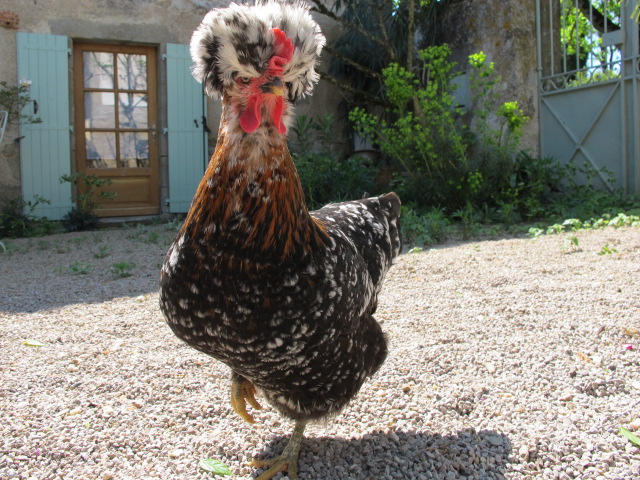
Madame Arcarti*, our eccentric-looking hen,

has been keeping her ‘laying’ spot a secret since she ended her brooding marathon a couple of weeks ago. She’d sat on potentially fertile eggs brought over by our neighbour Flo for well over a month–to no avail.

This instinct to hatch out the young chicks is impressive, but borders on the obsessive. In the end–fearing for her well being (she barely took time out to eat)–Meredith gradually reduced the number of eggs available until there were none and our hen resumed her other instinct–which is indiscriminate weeding in the garden.

We began to wonder where she was laying, since there was no sign of an egg in the little hen house, one of her usual dropping zones!
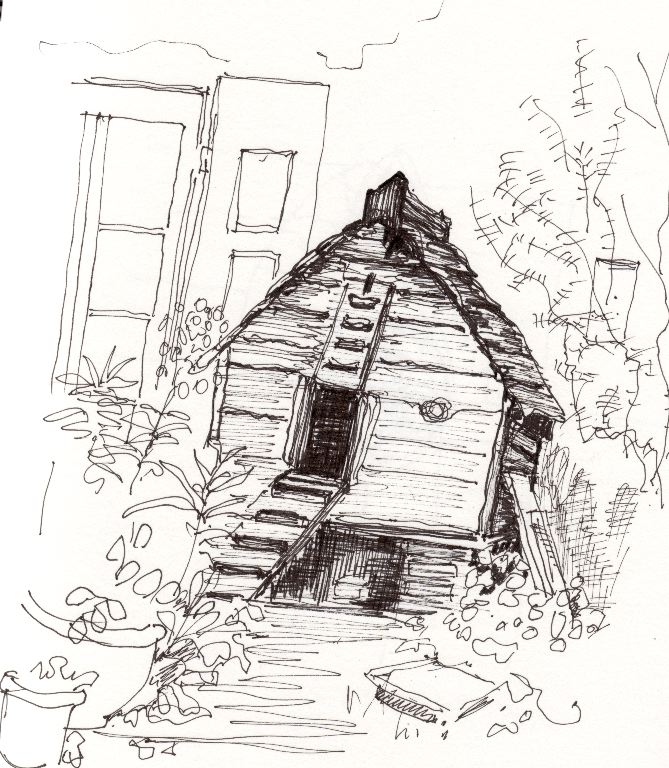
Sketch by Hope James, illustrator of my cookbook

The pigeonnier, on the corner of the courtyard, is where three visiting hens, parked with us over the winter, had done their laying.

They are now happily relocated a few miles up the road, but Madame Arcati hadn’t forgotten!

Omelette with cheese and herbs

( from my book Delicious Dishes for Diabetics)

for 1

2 free range eggs

a little olive oil or butter if you prefer

1 tablespoon freshly grated parmesan

a pinch of fresh herbs–chopped fine; parsley, sage, rosemary, thyme, mint, tarragon, chives–any one of these or a mixture

salt & pepper to taste

Heat your omelette pan gently before adding the oil or butter.

It should be hot when you add the eggs.

Whisk the eggs lightly in a bowl.

Add a little salt and pepper and a pinch of the herbs.

When you are ready to make the omelette add the oil or butter to the hot pan. (I always use olive oil.)

Add the egg mix and cook over a high heat.

With a wooden spoon tack round the circumference of the egg mix, releasing a little of the liquid each time to build a quilt-like texture to the cooking omelette.

Sprinkle on the cheese

Take the pan off the heat when you have a creamy and scrummy looking item that looks just cooked.

Fold it over as you like, sprinkle extra parmesan over it and serve immediately.

A green salad is all you need with it.

* Madame Arcarti is named after the meddling medium from Noel Coward’s play Blithe Spirit–played so memorably in the film by Margaret Rutherford.

Read Full Post »

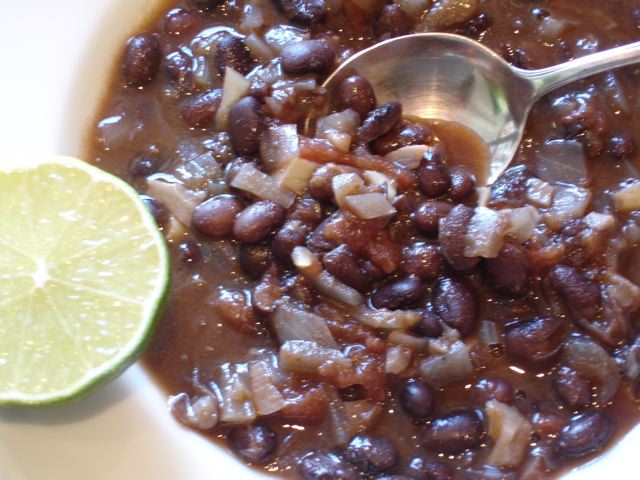
I ate my first bowl of black bean soup here in February 1974.

Joe Allen restaurant, 326 West 46th St. NYC

The Actors Company (http://www.mckellen.com/stage/index6.htmwas performing at the Brooklyn Academy of Music (BAM) for five glorious but freezing weeks. After the performance each night we would get on the subway at Flatbush Avenue and ride back into Manhattan to eat late.

Joe Allen in the theatre district was a favourite stop. It was reasonably priced and at that time of night packed with fellow actors, noisily “coming down” from “the show”. It was heaven!

Their french fries and the black bean soup were favourites; they were cheap and helped restore the energy level after a three hour performance.

 The version below of this classic soup is adapted from one presented by the British food writer, campaigner and cook, Hugh Fearnley-Whittingstall.

1/2 lb black beans–soaked for 8 hours (discard water afterwards)

(Soaking the dry beans doubles their weight–so if you’re using tinned beans, you need 1 lb/400 gm.)

If you have time it’s worth using dried beans; the water they cook in makes a tasty base for the soup stock.

serves 6

1 tablespoon olive oil

2 onions–chopped small

4 garlic cloves–peeled and chopped

1 small fresh red chili–seeds removed and chopped

1 teaspoon cumin powder

1 teaspoon coriander powder

16 oz/4oo gm tin of tomatoes–chopped with their juice

1 pint/500 ml of the bean water, to which you add an organic vegetable stock cube dissolved in 4 floz/100 ml of water or 600 ml organic vegetable stock

salt and pepper

Juice of a lime–if you have one

Drain and rinse the beans.

Put them in a saucepan with enough water to cover by a couple of inches.

Bring to the boil and cook at a simmer until tender–about 30 minutes.

Meanwhile, heat the oil in a saucepan and sweat the onions for about 10 minutes until they are soft.

Drain the beans (saving the water for later).

Add the beans, garlic, chilli and the spices to the onions and cook on for a couple of minutes.

Mix in the tomatoes and the stock.

Bring the soup to the boil and let it simmer gently, covered (it can become too thick if left uncovered), for 30 minutes.

Season well with salt and freshly ground black pepper.

I’m going to leave it unliquidised this time –but you can liquidise it all to a smooth finish or liquidise just half of it.

Add a squeeze of lime instead of the more traditional sour cream or yogurt to finish.

Read Full Post »

An Oak & a Walnut Tree

The oak and and the walnut–two tardy trees–seem to be competing to be the last to go green.

The false acacia is as usual first out in the front garden. We have three of them and their unbashful arrival is a reassuring sign that winter is on its way out. Now the Judas tree is in full bloom and the young Liquid Amber is leafing out.

Curtains up on “Easter Parade”–but these two rivals are still in the dressing room!

They remind me of a scene in a film a few years back when two veteran actors are seated in front of a roaring fire on dueling armchairs. Each attracts attention by gradually lowering his voice, until both are whispering and we, the audience, almost feel the heat as we lean forward to catch what they are saying!

In the cow pasture behind our house the oak is winning this particular duel. They always edge out the walnuts in the greening game. They keep their old and brown leaves well into the new year, last to admit that things must change.

The people round here call the wood of the oak [le chene]un bois noble.

It’s a hard wood–which lasts. There’s a lot of it in this old house–beams bent with the weight of the tiles they support.

oak beams bending

They’ve held for almost three hundred years–a noble wood indeed!

Perhaps it has earned the right to takes its time–and be the last to green.

Read Full Post »

Much of the language of the Internet is still a mystery to me.

But with a little research I discover that a Rich Site Summary (RSS) helps you Easily Stay Informed of the Regularly Changing Content of a web site or blog!

You can save time by not having to visit a particular site each day–anything new gets delivered by email automatically.

Signing up for this service is simple (famous last words!).

On the top right corner of my home page, it says Feeds: Posts and Comments.

To receive the posts, click on the word Posts; this takes you to another page where you click on the button saying “subscribe now” and hey presto!

If you also click on “Comments”, you will receive the remarks of other readers and occasionally my responses. (Same process, you will be taken to another page where you click on a button saying “Subscribe Now”.)

It’s a learning curve–or a nightmare, depending on your mood!

I hope I haven’t ruined your day!

Read Full Post »

…OK, but what flowers can I eat?

Johnny-jump-ups, nasturtiums and I discover today…

…the flowers from our Judas tree (Redbud to Americans).

…which is almost in full bloom here–a magnificent sight.

Legend has it that this was the tree from which Judas Iscariot hung himself. The flowers turned from white to blood-red in shame. It’s more likely that the name derives from the hills of Judaea in the Middle East, where this tree is commonplace.

The flowers have a lemony citric taste–I’m going to try them in a salad tomorrow!

Read Full Post »

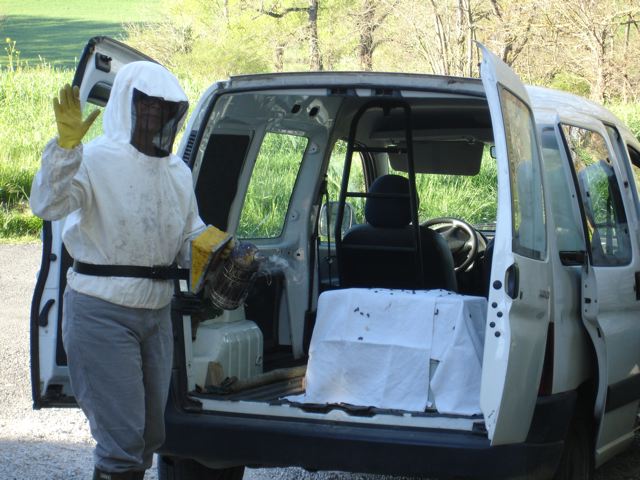
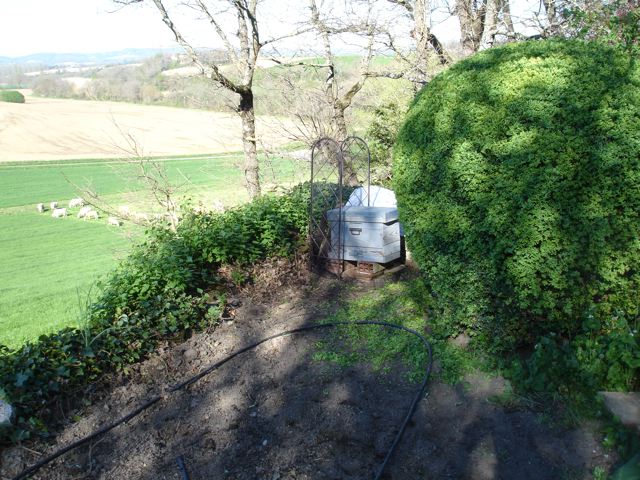
Alice–our mushroom supplier earlier this week–just arrived with a hive full of displaced bees.

“You’d better stay inside, Robin, you might get stung!”

I’m happy to continue having my honey-free breakfast in the kitchen.

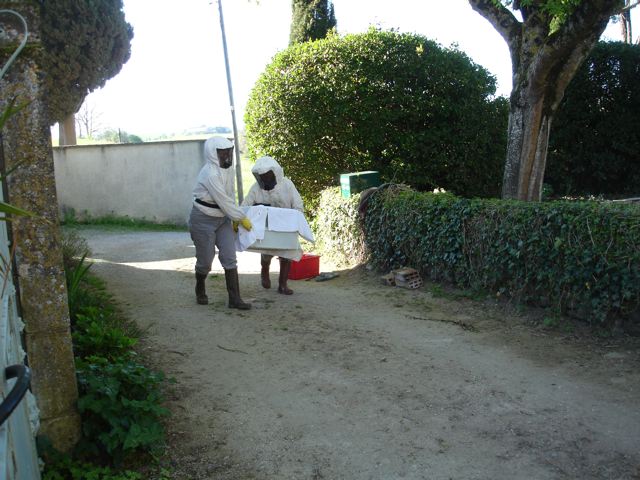
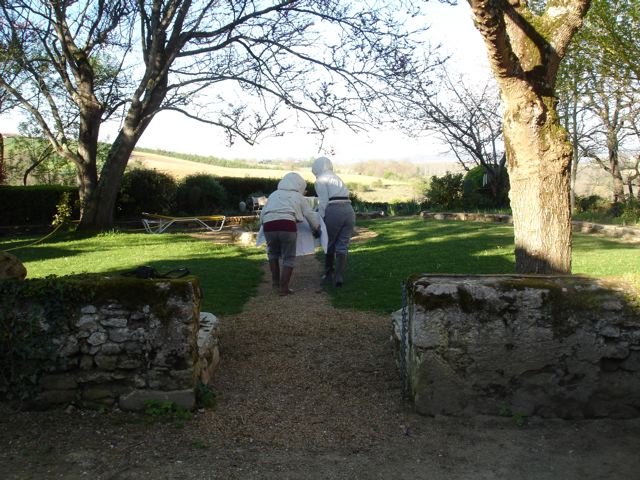
Meredith and Alice, dressed in their protective costumes, carry the box of bees out to the end of the garden.

!

Alice seems confident they will be happy in their new setting–and she is often right about things.

Yesterday she’d brought round another bag of morel mushrooms–‘miffed’ perhaps that I had not followed her advice about using creme fraiche in the cooking of the first lot. (I didn’t have any.)

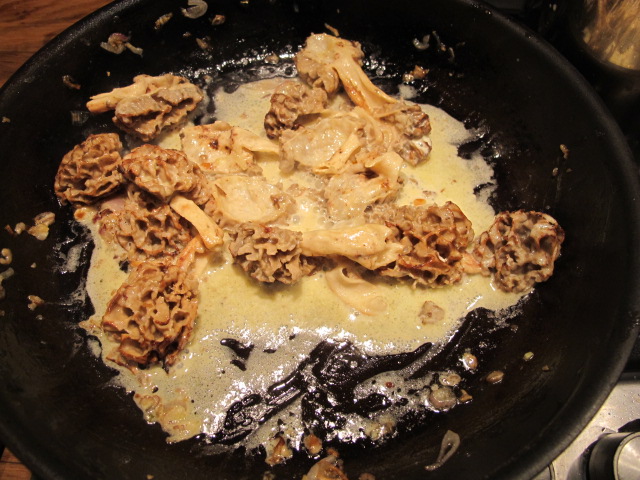
“Has he bought creme fraiche?” she asked. Meredith nodded in the affirmative.”Eh voila!” and left the second bag for supper last night. She was right–they taste good with a tablespoon of cream amd a twist of fresh ground black pepper added to the pan.

morels with cream

She thinks the field across the road will be a rich source of nectar for them this year, with much buzzing contentment.

“The fascinating process of making honey begins when the bees feast on flowers, collecting the flower nectar in their mouths. This nectar then mixes with special enzymes in the bees’ saliva, an alchemical process that turns it into honey. The bees carry the honey back to the hive where they deposit it into the cells of the hive’s walls. The fluttering of their wings provides the necessary ventilation to reduce the moisture’s content making it ready for consumption.”*

Happy bees would be better than discontented bees when I’m working in the tomato patch close by, in a month or two.

The danger zone?

“The vexed question”

Honey promoting web sites are keen to be positive about the vexed question of honey and diabetes, pointing out that it is a better option than sugar and sugar substitutes.

Because honey is generally thought to be health promoting, a little everyday is a good idea–even for people with diabetes, they argue.

* more than you need to know perhaps about HONEY–but useful nonetheless.

Read Full Post »

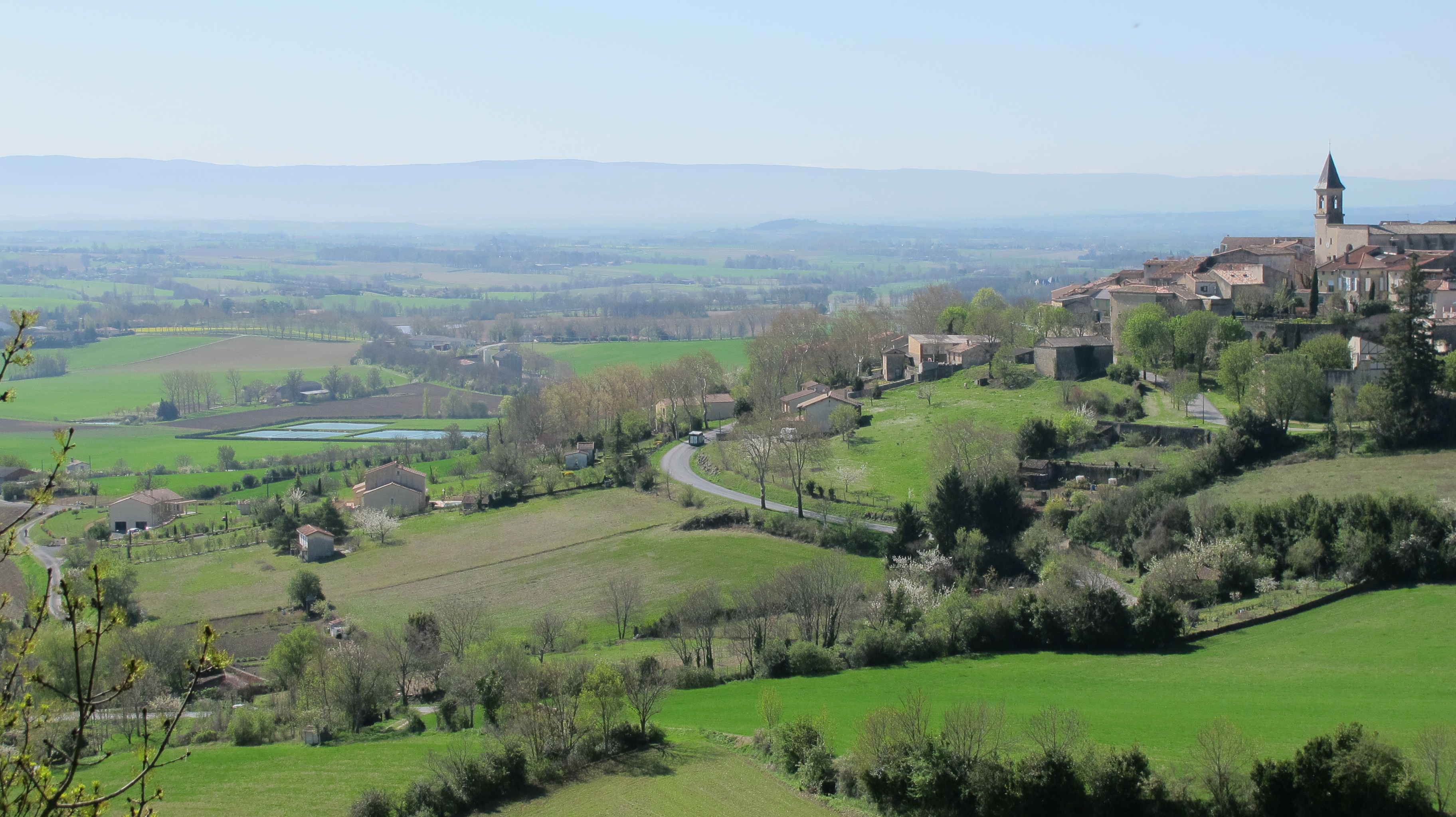
Meredith’s new camera has its first outing and doesn’t disappoint.

The day takes your breath away and so do the photos this camera is capable of.

The bastide village of Lautrec

"I'm here too!" Iris

proud pink tulip

Goddess watching over...

...the garden.


Meanwhile there’s a hand of pork chugging away on the stove with some green split peas for company–more of that in due course.

Enough for now to stand and wonder….

Read Full Post »

Meredith has been out with with our neighbour Alice, in search of a beehive that Alice had promised to lend her.

As they come into the kitchen, Meredith says “Look , Robin, Alice has brought you something really special”.

Alice then comes into the kitchen clutching a paper bag. She handles it with such care that I’m convinced there’s a puppy dog inside it.

Thoughts tumble round my head:

We have seven cats inside and out;

Where will we keep it? Do I want a dog after all these years of doglessness!

Alice carefully puts the paperbag in my arms and I quickly realise it’s not a dog.

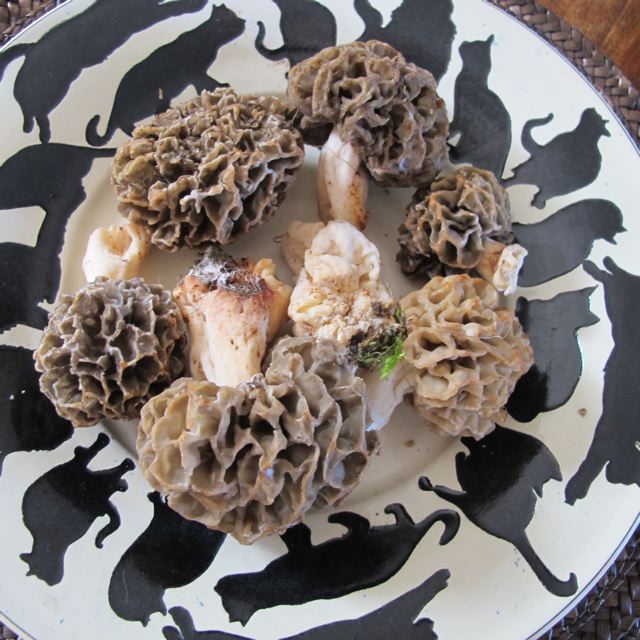
It is some wonderfully strange shaped mushrooms.

They look like dirty sponges on small white feet.

Alice says reverentially–“Ils sont des morilles”

“Ah oui?–Merci beaucoup Alice, c’est trés gentille.”


“Where did you find them” I ask her (in French).

“C’est un secret,” she replies, with a broad grin on her face.

She then tells me how she cooks them:

Sauté very gently in butter with chopped onions perhaps, then fold in some creme fraiche.

I ask about garlic.

“No garlic”–then, after a moment’s thought, she says you could add a little with some parsley in a persillade.

Morels along with cepes are the most sought after mushrooms she tells us, and are usually the first of the season.

Then she  says, rather surprisingly, that they don’t have a lot of taste–which accounts for the butter, cream and onions I suppose.

Anyway, it is a great honour to be given something so prized and we will have them tonight, on a piece of rye toast.

Read Full Post »

The Pyrénées just visible this morning from the ramparts of Lautrec.

The name is not attractive–sounds a bit like what afflicted Michael Gambon in a Dennis Potter film some years ago.

It actually means fish cooked with a lot of garlic.

This is a classic Greek village dish–traditionally taken to the local  bakery’s oven in the morning, to be ready by lunchtime.

Rena Salaman, in her book Greek Food, says the fish you chose was determined by the importance of the occasion.

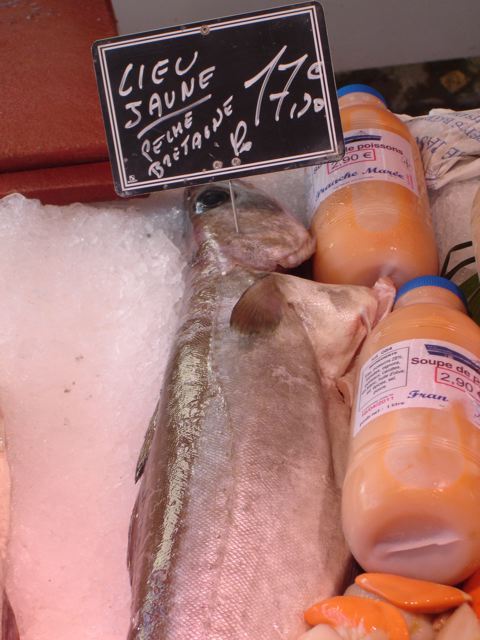
It’s just the two of us tonight, so when I saw that the Friday fishmonger in Lautrec was selling pollacklieu jaune–for 11 euros a kilo, I figured this was the moment to try this eco-friendly fish.

The fish stall in Lautrec this morning

I asked him to fillet it, which he did in a trice.

I complimented him: “Vous avez le savoir -faire, Monsieur!”  He has the proper knife too.

(You can cook the fish whole, of course.)

A whole pollack on the stall

This is adapted from Rena Salamon’s excellent book.

The fillets weigh just over 8oz/250gms each.

for 2

2 pollack fillets– about half a pound each. You could choose haddock, cod, monkfish, red or grey mullet or other firm-fleshed white fish

juice of a lemon

3 tablespoons olive oil

2 medium onions–finely sliced

1 stick of celery–finely sliced

4 cloves of garlic–finely sliced

1lb/450gms tin of tomatoes–drained of juice and broken up

2 tablespoons parsley–finely chopped

1 small wine glass of white wine

salt and freshly milled black pepper

2 tablespoons wholewheat/rye breadcrumbs

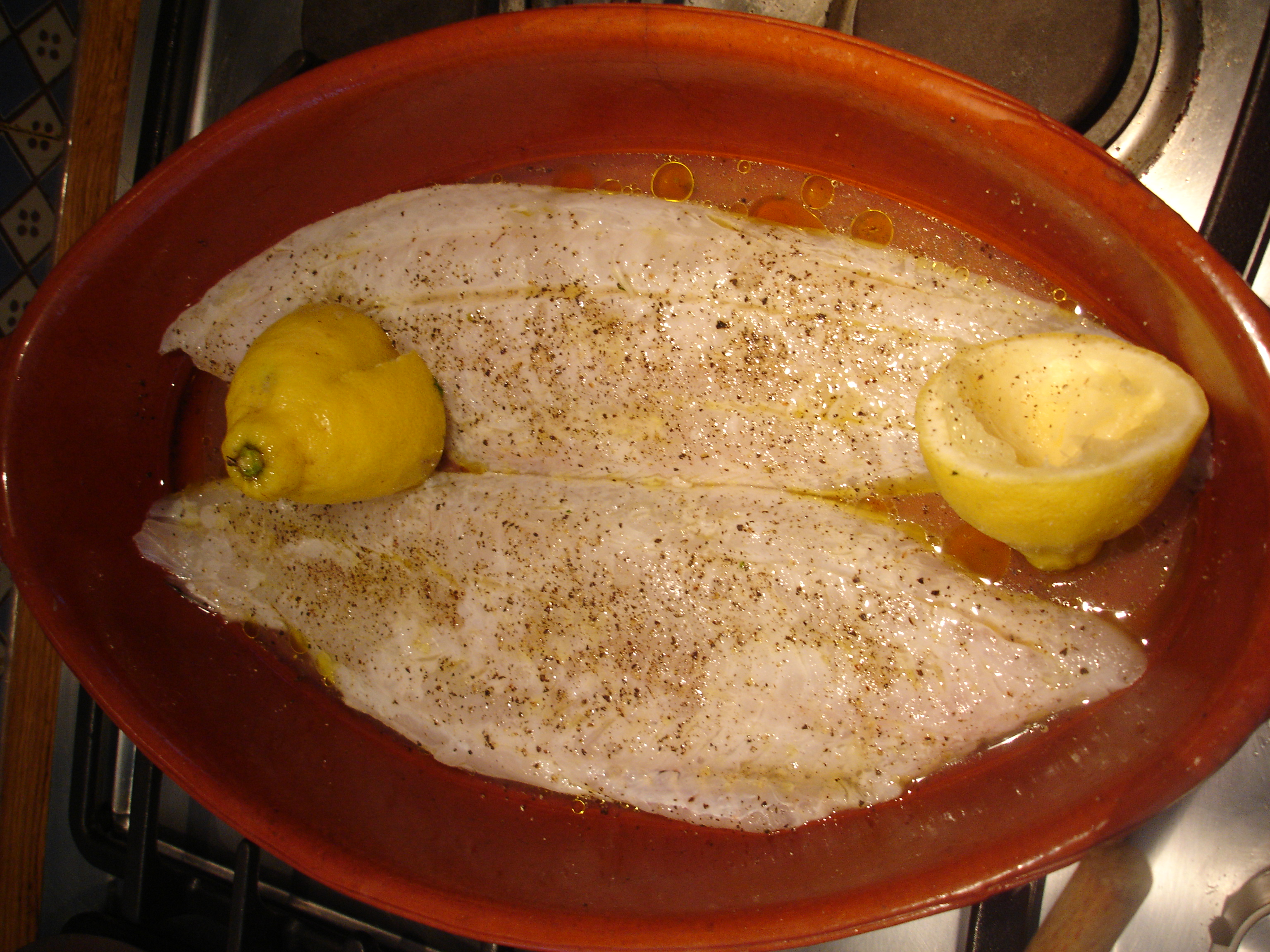
Oil a baking dish that will hold the fillets with a tablespoon of the oil.


Lay the fillets–cut into pieces or whole–in the dish.

Pour over the lemon juice and season with salt and pepper.

Leave to marinate for about an hour.

Heat the oven to 180C/350F.

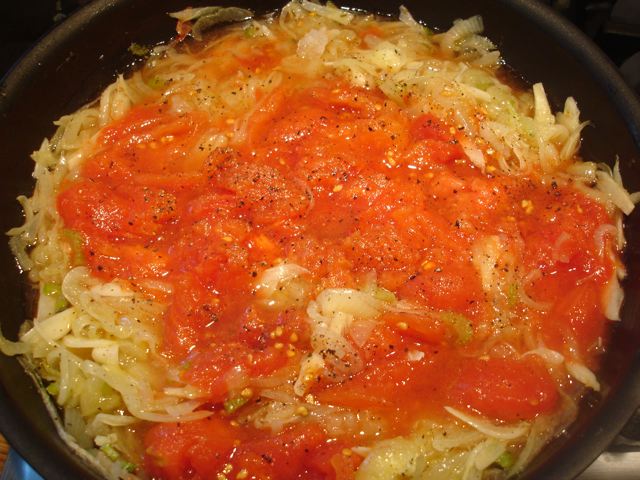
Gently sauté the onions, garlic and celery  until they collapse–being careful not to brown them.

Add the tomatoes and the wine to the onions, garlic and celery.

Mix and season well.

Cook this gently for 15-20 minutes.

Add the parsley and cook for a further few minutes.

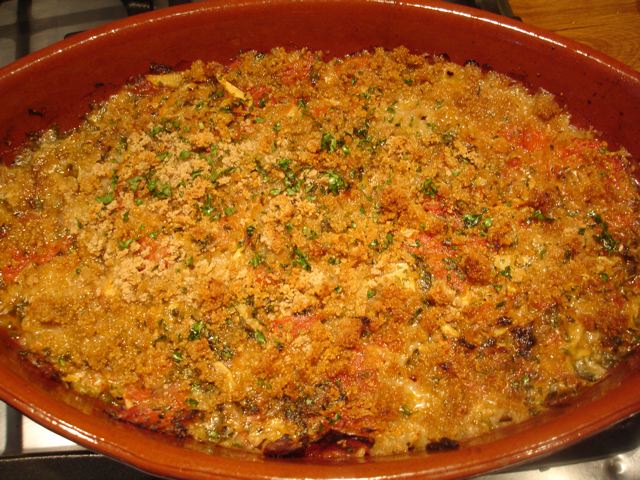
Spoon this mixture over the fish and sprinkle with breadcrumbs.

Bake in the centre of the oven for 30-40 minutes.

Read Full Post »

Home again in France and happy to be so.

In spite of being bleary-eyed from the journey  yesterday, I don’t miss another sign of the change of seasons: an asparagus stall at the Realmont market this morning.

At the bigger Castres market on Saturday there’ll be several, piled high with the new green and white  asparagus spears. I much prefer the green–a matter of taste and habit.

It may be a little early for this superfood, but I buy 500 grams/1ib, a generous serving for two–about 7 spears each, plus a few for testing.

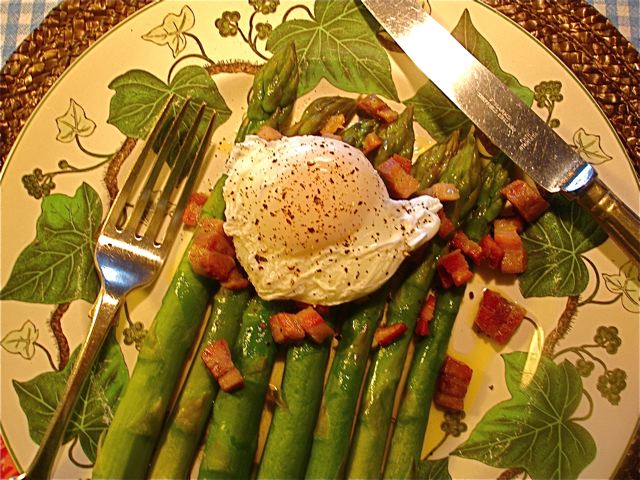
I know there’s a piece of bacon in the fridge–about 4oz/100gms– which I will dice small, gently sauté to a crispy finish.

I’ll dress the asparagus with 3 tablespoons olive oil, 1/2 teaspoon Dijon mustard, 1 tablespoon of lemon juice and a pinch of salt–whisked together; sprinkle over the bacon bits and top it off with a carefully placed poached egg.

An easy lunch for two weary people.

For the asparagus:

Trim the rough base of the spears, making them all about the same length.

Choose a saucepan or sauté pan that will take them all lying horizontally, and that’s wide enough to take a steamer basket/tray.

Fill the pan with water to the depth of the basket.

Place the asparagus horizontally in the basket and cover the pan.

It’s handy to cook an extra spear that you can use to test for doneness.

6–8 minutes should do it, depending on the thickness of the spears.

Pierce a spear with the tip of a knife to test for doneness–or better still, use your teeth!

When they are tender, divide them between two plates.

Spoon over a little dressing and share out the bacon dice.

Carefully place a poached egg on top.

Wrapping the ends of the asparagus in a damp paper or cloth towel, helps preserve the freshness of the  asparagus in the refrigerator. Best to eat asparagus within 48 hours of purchase–but why wait anyway!

Read Full Post »

« Newer Posts - Older Posts »