Feeds:
Posts
Comments

Archive for the ‘Diabetes’ Category

This seed is a useful alternative to rice. It is grown high up in the Andes–and no one seems to agree on how to pronounce it!

It serves as a plain canvas on which you can paint what you like.

It takes less time to cook than rice and is delicious in its own right or, as below, mixed with  sautéed vegetables.

It takes well to steamed  green vegetables, like broccoli dressed with good olive oil or sprinkled with crunchy nuts such as dry-roasted walnuts.

Crumbled feta or goats cheese is good too.

Here you can learn more about the benefits of Quinoa–perhaps more than you want to know!

Quinoa with sautéed vegetables

for 4

8oz/250gms quinoa

1 pint/2 cups/16floz of vegetable stock–I use organic stock cubes.

Cook this gently, covered, until you can fluff it up with a big fork–about 15-20 minutes.

quinoa cooking in stock

Meanwhile…

Gently sauté together:

4 tblsp olive oil

1 medium onion (red or yellow)–chopped fine

1 clove garlic–chopped

small red pepper–seeded and chopped into small dice

1 small chilli–chopped

1 small courgette–chopped into small dice

1 medium ripe tomato–peeled, seeded and chopped into small dice

Sauté them until soft.

vegetables gently sautéed

Add this mix to the cooked quinoa.

Add salt and pepper to taste–though be careful with salt, as the stock may be salty.

Allow the flavours meld.

cooked quinoa with veg mixed in

If you have some, sprinkle with a tablespoon of chopped parsley.

Mix all together carefully and eat it hot or tepid.

(You can steam the quinoa for a couple of minutes to re-heat.)

Read Full Post »

Michel Montignac
Michel Montignac in the kitchen of La Tour d’Argent restaurant in Paris (1993)
Photograph: Ian Cook/Getty Images

Shortly after being diagnosed with Type 2 diabetes, my friend David Clifford recommended Michel Montignac’s book, Dine Out and Lose Weight, now retitled  Eat Yourself  Slim and Stay Slim!

I read it and  found it helpful. Montignac emphasises the importance of changing one’s “way of eating” rather than dieting.

His theory is that it’s high sugar content in some carbohydrate foods that encourages the body to store unwanted fat that increases weight, rather than a high calorie intake.

He was a pioneer in using the glycemic index of foods–which measures the effect of carbohydrates on blood sugar levels (how quickly carbohydrates turn into glucose in the blood) to help people lose weight. Controlling excess weight is important for people with diabetes.

One day last September I read that Michel Montignac had died at the relatively young age of 65.

I emailed The Guardian newspaper to ask if they were planning an obituary. They replied, asking if I knew him. Though he came from southwestern France, I didn’t know him personally but  explained that I knew his work. The Guardian obit editor then invited me to write Montignac’s obituary.

It was an offer I couldn’t refuse.

Read Full Post »

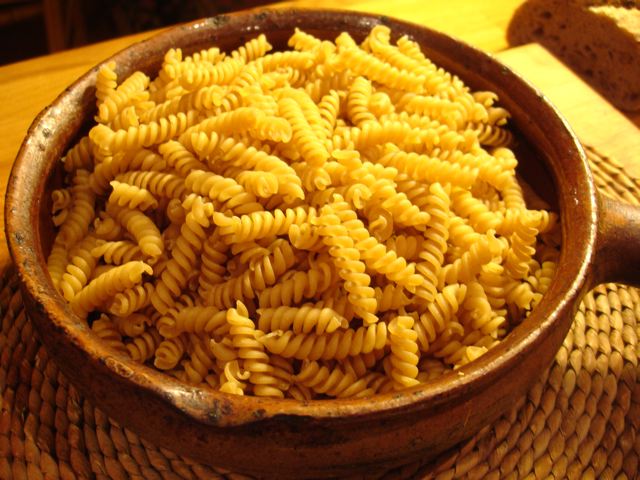
wholewheat spirrals

Our friend Rosemary Beau*, has pointed out in a comment, that I had not specified whether I use whole wheat pasta in the post for Penne in a tomato, rosemary and balsamic vinegar sauce.

She was right to mention it.

After my diagnosis of Type 2 Diabetes, we changed from eating white to whole wheat pasta. Although of course we noticed the difference in texture, we quickly came to prefer whole wheat pasta. We like the taste.

It favours strong sauces, like the one mentioned above.
Many supermarkets stock it these days–I just bought some at  the Holloway Road branch of Waitrose in London–but the shapes available in whole wheat are more limited than for regular pasta–so far.
From a health perspective, I feel more comfortable eating the whole wheat variety.
Research shows that the Glycemic Index [GI] of unrefined pasta is lower than refined–which is no surprise . What is surprising is that the difference is not as great as one might imagine.
Anyway, a moderate helping of pasta a week is a delight that I’m not giving up–for the moment at least!

How “al dente” it’s cooked is a matter of taste.

In Italy you’d think it an arrestable offence to overcook pasta–they cook it very al dente.  It does make for agreeably slower eating and as it takes longer to digest, it’s considered healthier.

Dishes made with the whole wheat variety are still a rarity in restaurants–though I was brought out of a jet lag daze last year when I spotted one at the end of the pasta offerings on a menu in New York City.

*We got to know Rosemary many years ago when we stayed at her warmly elegant B&B in the La Sologne area, south of Orleans in central France.

Read Full Post »

Peckishness can present problems for people with diabetes.

To snack or not to snack–that is the question!

One reason to eat a good breakfast is not to feel that nagging hunger mid-morning.

I have a bowl of oats, with walnuts, a teaspoon of linseeds, a prune, a dried apricot chopped, half a tub of low/no fat yoghurt, cinnamon sprinkled over and oatmilk, every morning and it’s sometimes my favourite meal of the day!

That and the two pieces of rye bread toasted and a cup of coffee take me happily through to lunch.

For me it is in the gap between lunch and dinner that peckishness kicks in–usually between 5pm-6pm.

What to do about it?

Ideally nothing–but then when dinner time comes the temptation to scoff is hard to resist.

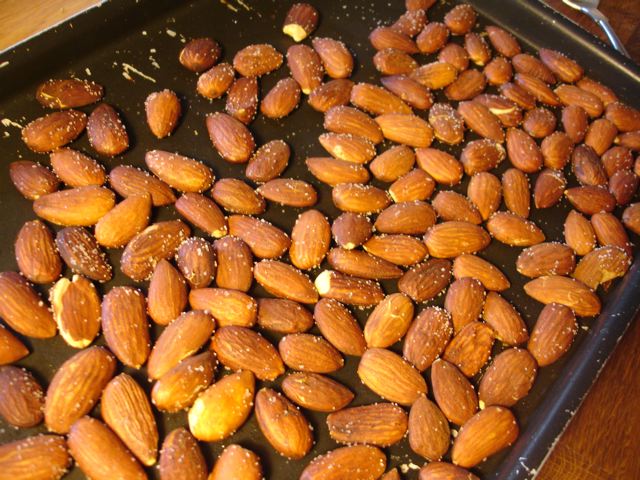
I ease the pain with nuts. Almonds are my prefered nut at the moment–roasted with a little salt. Pistachios preceded them until my nails started to split with opening them. Both have good health properties. Eaten in moderation, one doesn’t have to feel guilty about snacking.


Home-roasted almonds


8oz/250gm almonds

1 teaspoon olive oil

fine salt

heat the oven to 180c/375f

Put the almonds in a bowl and tip the teaspoon of oil over them.

Turn them over in the oil until they are well covered.

Add a couple of sprinkling of salt and flip them over and over until the salt is well distributed.

Spread  the nuts on a shallow baking tray and roast in the middle of the oven for about 10 minutes.

Read Full Post »

Jack posed this question yesterday in a comment and it is not an unreasonable one. It made me think about the new language of the internet, which sometimes seems like webspeak gobbledigook!

I put the above question into Google and found this on one site:

Any user-posted root node is subject to moderation.

Moderation refers to two possible changes in a node’s status:

  1. Approval of a node into the selected section of the site;
  2. Front-Paging a node, i.e. allowing it to be listed on the main page.
  3. Note that a node cannot be “front-paged but unapproved”.

Silly me I should have knowd!

I think I understand what is meant but wouldn’t plain english explain it better?!

Moderation has other meanings and there are  jollier definitions:

“Moderation is a fatal thing. Nothing succeeds like excess.”

Oscar Wilde

“Moderation in temper is always a virtue; but moderation in principle is always a vice”

Thomas Paine

Moderation is the inseparable companion of wisdom, but with it genius has not even a nodding acquaintance”–[Oh dear!]

Charles Caleb Colton: (English sportsman and writer, 1780-1832)

“Throw moderation to the winds, and the greatest pleasures bring the greatest pains”

Democritus

This definition is from wikipedia:

Moderation is a principle of life. In ancient Greece, the temple of Apollo at Delphi bore the inscription Meden Agan (μηδεν ἀγαν) – ‘Nothing in excess’. Doing something “in moderation” means not doing it excessively. For instance, someone who moderates their food consumption, tries to eat all food groups, but limits their intake of those that may cause deleterious effects to harmless levels.

This I can understand!


Read Full Post »

Even if you know what Diabetes is–others–perhaps some close to you–may not have a firm grip on what it is and what causes it. There’s a lot of unhelpful ignorance about. Family and friends may not take it seriously, since there may be no obvious symptoms.

I often find it hard to explain–and I’m always on the lookout for clear definitions.

Here are a couple that have helped me…(with apologies to those who are already well-briefed!).

From Diabetes UK:

“Diabetes is a condition in which the glucose (sugar) in the blood is higher than normal.

Insulin, a substance produced by the pancreas, helps to control the blood glucose level.

In diabetes there is a problem with the production of insulin.

There are two main types of diabetes:

1). Type 1 diabetes which occurs when the pancreas stops producing insulin. This usually develops quickly and before the age of 40. It is always treated with diet and insulin.

2). Type 2 diabetes occurs when the pancreas does not produce enough insulin or the insulin it does produce does not work properly. It usually develops gradually in middle and later life and is treated by diet alone, diet and tablets or diet and insulin. The majority of people with Type 2 diabetes are overweight. Losing weight and maintaining the weight loss is a major part of treatment as it helps insulin work more effectively.

Eating a healthy diet is an essential part of the treatment for diabetes and will help to control your blood glucose levels, blood cholesterol and blood pressure.

Eat regular meals and do not miss meals.”

The above says it all–an excellent summation–but I also like the metaphor of fueling the car in the following explanation:

“Normally, the cells of the body use the simple sugar glucose as fuel, the way a car uses gasoline. Glucose comes from starchy or sweet foods we eat, and the hormone insulin escorts it into the muscle cells to power our movements. Glucose also passes into our brain cells to power our thoughts. In type 2 diabetes, the cells resist insulin’s action, so glucose has trouble getting into the cells.”

“If glucose can’t get into the cells, it builds up in the blood. It is as if gasoline coming out of a gas pump somehow can’t get into your gas tank, and it ends up spilling over the side of your car, coming in through your car windows, and dribbling all over the pavement. It is a dangerous situation.”

“The abnormally high levels of glucose circulating in the bloodstream are toxic to the blood vessels, especially the tiny blood vessels of the eyes, the kidneys, the extremities, and the heart.”

My mother, who developed Type 1 diabetes in her thirties, died of a sudden heart attack at the age of 68.

Which is why, when I was diagnosed with type 2 diabetes– with no symptoms, I took it seriously.


Read Full Post »

Good article by Tracey Neithercott published in Diabetes Forecast that I spotted on  Diabetes Daily:

Are Carbs the Enemy?


Worth reading the whole piece, but the opening paragraph sets up the debate:

When it comes to diabetes, there may be no topic more fraught with controversy than carbohydrates. Sure, everyone agrees that the body uses carbs for energy in the form of glucose. But how much carbohydrate should people with diabetes really eat?”

It pits the “Moderate-Carb” approach  against the Low-Carb” approachboth represented by respected medical experts.

It also addresses what it calls the “Fat Question” before asking which what is the “Right Way”?

For me the final sentence says it all:

In the end, the best diet is the healthy one you’re able to follow.”

What do YOU think?

Read Full Post »

Testing time

Sophie arrived at 8.15 this morning to give me a blood test (prise de sang). She is one of the 5 nurses working from Lautrec. I’d rung yesterday afternoon to arrange the home visit–such is the convenience of living under the French system and in the countryside. I was the last stop on her morning round, which began in darkness at 6.45am.

She’ll return to the office in time to catch the 10am dispatch from the pharmarcie to the laboratory in Castres who analyse the sample later this morning. I will receive the result tomorrow by post–or at the latest on Friday.

Sophie didn’t charge for the visit this morning–usually about 9 euros. She said, with a smile, “Non, non, you gave me a bottle of olive oil last time–that’ll cover a second visit.”

It’s true that I’d given her a small bottle from our November trip to Tuscany to help harvest olives at a friend’s farm (more on that later).  It was only a quarter litre–pas grandes choses–but that’s Sophie!

Today it was the quarterly test for glycemie, which indicates the average level of sugar in the blood over a three month period–giving an overview of how successful I have been in controlling it.

When I was diagnosed 12 years ago, I went out and bought a testing unit–but never used it–nor the second one purchased a few years later!

Michel Woitiez, our doctor, who from the start impressed on me the importance of taking the condition seriously, has never asked me if I test daily. He never mentions it.

My book, Delicious Dishes for Diabetics, attempts to illustrate how a person with Type Two Diabetes, while changing some habits of a lifetime, can still cook and eat enjoyably, without feeling deprived.

Read Full Post »

I bought a couple of chicken breasts for lunch in Castres market this morning.

The recipe below is adapted from the late Ismail Merchant’s excellent book, Indian Cuisine.

Ismail Merchant

Ismail, who died too soon six years ago aged 68, was the producer half of the enormously successful film production team Merchant Ivory. I filmed The Europeans with them in New England in the autumn of 1978, with lovely Lee Remick.

Food played an important part in the ebullient Ismail’s modus operandi.

In earlier days he would do the rounds of the established film companies looking for backing, with a homemade apple pie in his bag.  Slices would be produced in exchange for the use of the telephone!

Money was never NOT a problem for them in those days and it was clear, deep into the filming in New Hampshire, that things were tight. Anxious creditors hovered and it was uncertain whether we’d be able to complete the filming.

About five o’clock one Saturday afternoon, I spotted Ismail coming in from the car park laden down with several grocery bags. “What’s up, Ismail?”

“Curry for dinner–everyone’s invited!”

He disappeared into the hotel’s kitchen which he had commandeered for the night.

At eight that evening, the whole company (at least 80 people) plus a few unfamiliar faces entered the dining room where  a wonderful Indian feast was laid out–a fantastic sight!

We finished the film on time, with no further rumours of money worries.

His simple recipe makes the rather bland chicken breasts more interesting with chili and cinnamon.

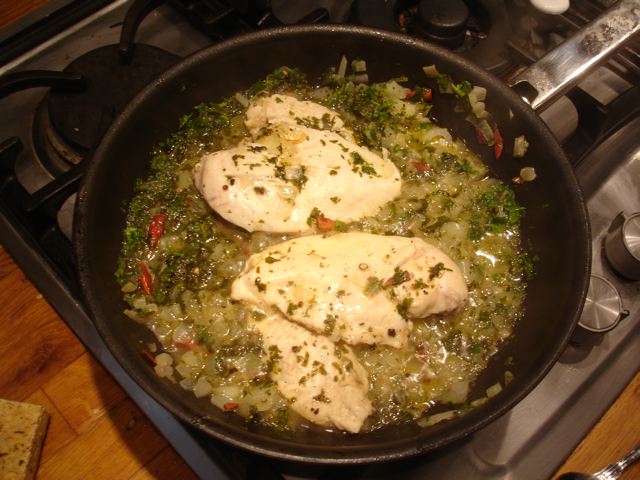
Chicken breasts sautéed with cinnamon, onions, and parsley

for 4

4 boned chicken breasts (without the skin)– sliced in half, lengthwise

4 tblsps olive oil

1 cinnamon stick– broken up

1 largish onion– chopped

2 to 3 small red chillies

juice of two lemons

Cook the onions gently in the oil with the cinnamon until soft.

Add the chicken breasts with the lemon juice.

Season with salt and pepper.

Turn them over after three minutes and cook for a further three minutes; then add the parsley and chillies.

Turn the breasts in the sauce and continue cooking for a further 5 minutes–the exact cooking time depends on the thickness of the chicken breasts.

In the pan...

(I just cooked two today.)

Cut into the thickest part of one to check. If it is still very pink, continue to cook another couple of minutes.

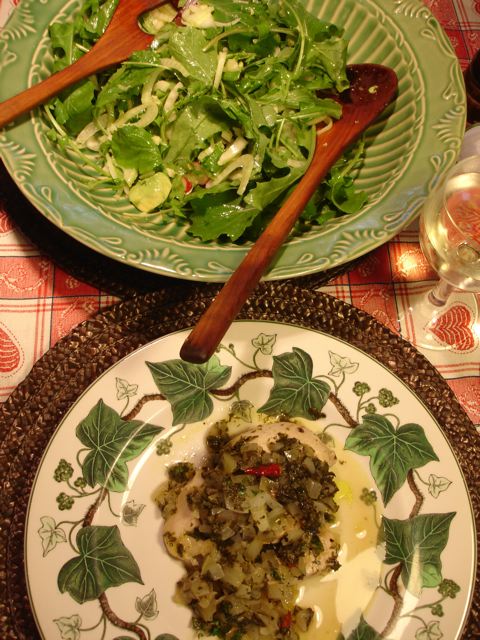
I served it with a salad of  raw fennel, radish, avocado and rocket  dressed with 3 tablespoons of extra virgin olive oil, a tablespoon of freshly-squeezed lemon juice, half a teaspoon of Dijon mustard,  salt and pepper,  whisked together.

On the plate....

A healthy & delicious dish for diabetics–and everyone else….

Read Full Post »

From the mid-September to the middle of November I combine my walks with a quest for walnuts.

I call it walnutting, and I’m nutty about it. It has become a little obsessional.

I know every walnut tree within 5 kilometres, and roughly when the nuts will mature and drop.

A night of high winds and torrential rain during this period can bring unexpected blessings, because there could be rich pickin’s, as they say in Cornwall, in the morning. You have to tread carefully or you’ll crush them, but a slight roll under your foot can mean treasure beneath!

When they fall on public paths or on the  roadside verges, anyone can harvest them.

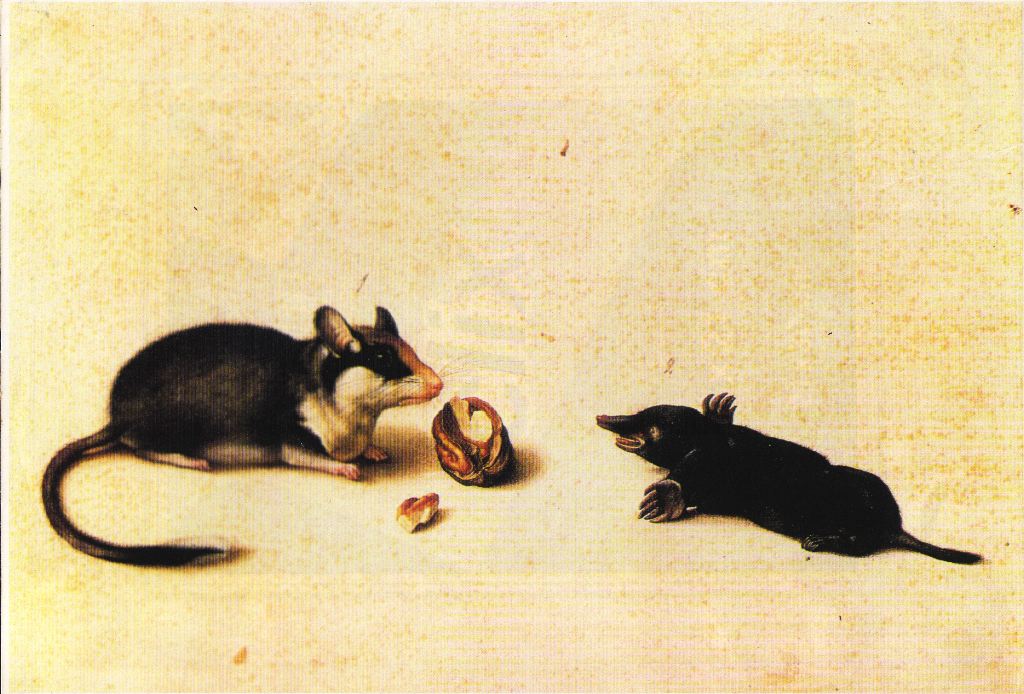
Walnuts are a super food— even the two little critters pictured below, painted over four hundred years ago, knew they were worth fighting for.


Dormouse & Mole with walnut

(By Jacopo Ligozzi in the Uffizzi Gallery, Florence)

Walnuts are full of omega 3’s–the good fats–and rich in proteins, potassium (good for the heart), zinc and iron.

They are delicious in salads and in sauces.

Dry roast them in a small pan and they taste even better.

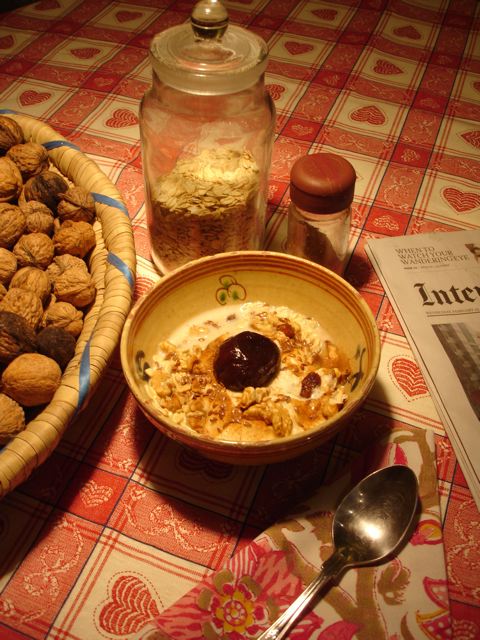
I crack five of them every morning onto my oats as part of the fresh breakfast mix pictured below, which consists of:

Three tablespoons of large oat flakes, an untreated dried apricot–chopped, a teaspoon of linseeds, an Agen prune, half a tub of no- fat organic yoghurt, a sprinkling of cinnamon and unsweetened oat milk.

Breakfast with walnuts and oat flakes

Read Full Post »

« Newer Posts - Older Posts »