Feeds:
Posts
Comments

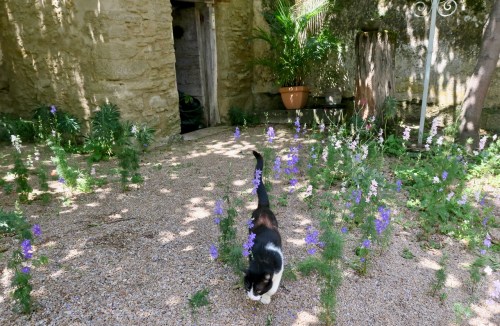
And Shadow makes six!

It is becoming a regular thing.

Between seven and eight in the evening the little black flash with white hairs in his ears trots in to the kitchen and after a quick munch, heads for the chair by the fire–which I happen to be occupying.

He nuzzles his way up between my left trousered leg and the arm of the chair, tries out various positions located in or around my lap, and finally settles himself.

It’s impossible not to stroke this beautiful ball of shining black fur that’s snuggling down so close and contentedly. Gentle stroking elicits a deafening purr.

The kitten has landed and expanded.
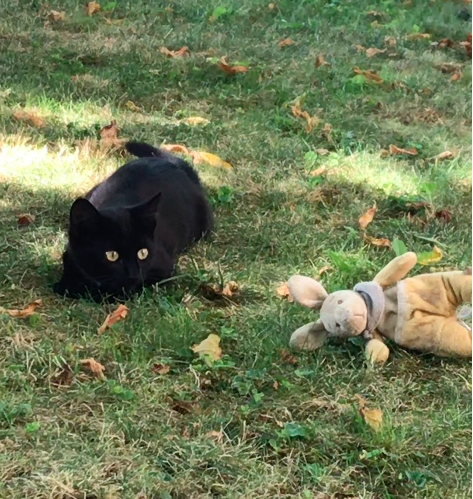
Shadow–the name bestowed on him by brother, Jack, who spotted how he would “shadow” the older cats–has filled out. Kitten–no longer!

He turned up one evening last August. We were alerted to a faint high-pitched mewing.

It seemed to be coming from the edge of the field that runs down to the road that passes by our driveway.

We waited and watched.

A little face peeked through the undergrowth.
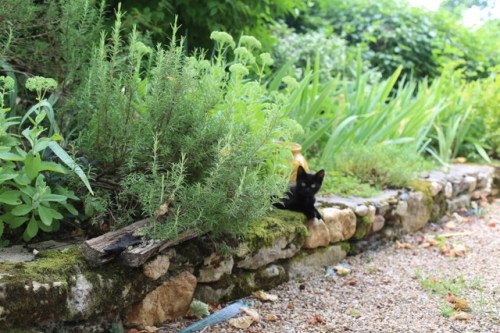
Meredith called him and left food–but he retreated when she approached.

Clearly abandoned by someone who knows this to be a cat friendly house–it is not the first time this has happened–they left him with nothing but an instinct for survival and a spirit strong enough to take two steps forward, one back if necessary.

He playied grandmother’s footsteps without knowing it for days. Something told him to press on, persevere. His stomach most like.

Even as he crept closer, the pitiful mewing continued.

The other cats were in the picture and tolerant; he showed no fear of them–it was us he wasn’t sure of; one of our kind abandoned him, after all.
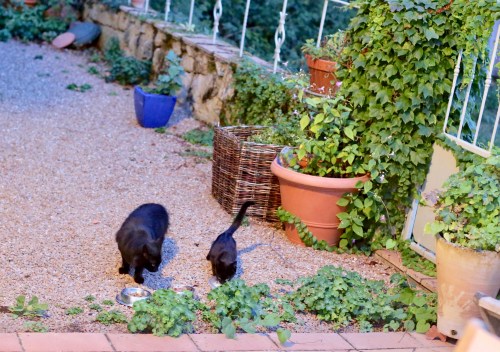
Midnight shows Shadow the perks of life at St Martin

It took weeks for him to accept the outstretched hand.

That early caution is gone now.

“For the birds,” he cries as he stalks them–showing a less agreeable instinct to be alive and active. So now wears a red collar with a little warning bell attached.

Now It’s more like: “Here I am! What’s for supper?”

He’s the lowest on a totem of six so has no shortage of examples to follow.

That’s the new kid up in the right hand corner while the elders dominate the chairs.

Our cats are some of the best fed on the planet and have developed a certain air of entitlement –which he has had no trouble adopting.

He is a curious youngster–cats have that reputation. Usually their fabled nine lives allows them to survive any unwise delvings.

Meredith tells me he is intrigued by the cat videos that are legion on the Internet.

I was watching TV the other night with him beside me when he jumped up on the arm of the sofa beside the TV set and began a forensic examination of the moving image. Puzzled by the glass barrier that was preventing him touching the seal that he was seeing.

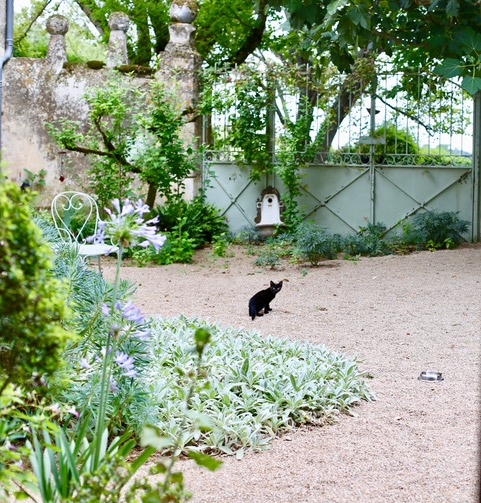
Last night on our way to bed Meredith opens the front door to corral the cats indoors and finds a black cat convention in full swing.

Midnight, Blackie and Ben are sitting around in the courtyard, no doubt discussing how Brexit will impact their lives.

A heavy padding down the stairs announces Shadow. Keen not to miss out, he heads for the front door lengthening his body in a stretching movement to pass through the door and insinuate himself into the group, in one remarkable movement.

He “fell into the butterdish” here.

We feel happy that he’s joined our group–no insinuating movement needed.

We love him.

❤️❤️Screenshot 2019-12-29 at 20.05.22


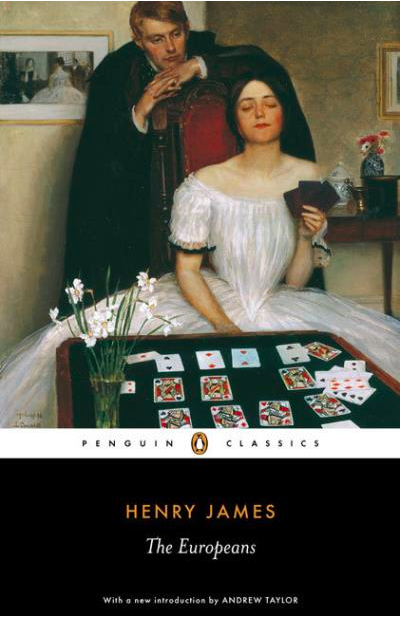
The Europeans


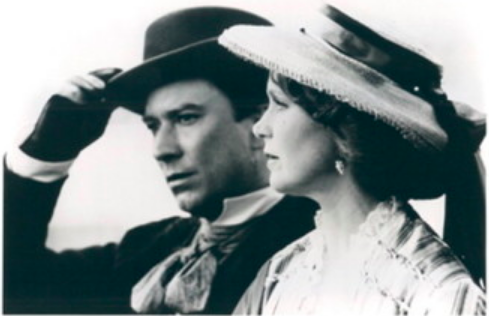
The title of a Henry James novella set in mid-19th century New England, filmed in a barely-changed New Ipswich by Merchant/Ivory productions in the fall of 1978.

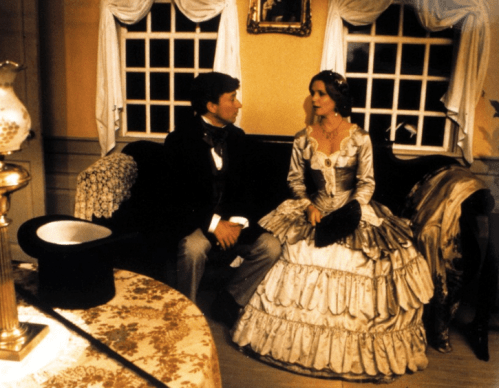
The setting was authentic–a New Hampshire village; the season–a blazing autumn, gold fading into silver; the story–Old Europe on the make in New England; my part–a Boston nabob unable to make up his mind.

Stark contrast with impulsive Ross Poldark for me–and one I found difficult. 

And I was playing with an impressionistic “American” accent opposite the real thing–Boston Brahmin daughter par excellence, and Oscar nominee, Lee Remick–herself playing with her best cut-glass English accent.

Poor stuck-in-the-mud Robert Acton was too rich, too comfortable and too complacent to contemplate the upheaval a life with a gold-digging, not-yet-divorced, European princess would put him through. 

Years later Ruth Prawer Jabhvala, Merchant/Ivory’s perennial screenwriter apologized for writing me such a dull part.

In truth, the fault was not hers.

No matter. I have good memories of fellow actors–in particular, Kristin Griffith who played my sister, and Tim Choate–plus one extraordinary feast.  And I loved spending weeks watching nature reflect the story, as the foliage changed colour and with it, the Princess’s prospects.

Tim Choate played Clifford.

That feast…

Independent film production is a hazardous business, and three-quarter’s way through the filming it became clear that the film was in financial difficulties (a scenario not unfamiliar to Merchant/Ivory productions). 

I heard that in earlier days, producer Ismail Merchant would visit American film company offices in London (he lived in New York) offering a slice of freshly-baked apple pie–in exchange for the use of the telephone.

Around 5pm one Saturday afternoon, I returned to the unit base after filming, to find irrepressible Ismail unloading a number of large brown supermarket bags brimming with produce from his car.

“Hi Ismail–how’s it going?–can I carry something?”

“Very kind–perhaps a couple of these bags–to the kitchen….”

“What’s happening?”

“Indian feast. Eight o’clock this evening. Everyone is invited!”

“That’s in barely three hours time, Ismail!”

“You’ll see!”

I guessed that cast and crew were not to be the only guests at the table.

Other interested parties attended too–perhaps worried about their investments in the film.

On the dot of 8pm, the dining room doors of the unprepossessing Holiday Inn Leominster, Massachusetts (only Holiday Inn in the world without a swimming pool?) were flung open by Ismail, dressed like a maharaja–in his full Indian finery–not a bead of kitchen sweat visible–to reveal tables groaning under the weight of his sumptuous Indian feast.

After weeks of location catering and fast food suppers, we gulped it all down.

The film wrapped without further rumours–and ran for nine months at the Curzon Cinema in London.

It’s the 40th anniversary of the release–and the film has been restored and is being re-released.

James Ivory, the director and the other half of Merchant/Ivory recently won an Oscar for best-adapted screenplay and is working on another. He’s 91! 

Ismail Merchant–whose refrain was always “Everybody loves our films!”–died in 2005. (And incidentally, he wrote several cookbooks too!)

Their partnership was the longest in the history of independent film production–44 years.


A Soup for the Speaker

The newly-elected Speaker of the House of Commons–Sir Lindsay Hoyle–has revealed that he’s recently been diagnosed with Type 1 Diabetes.

Photo by Jessica Taylor

He had been losing weight at what his wife thought was an alarming rate. She persuaded him to see his doctor–who sent him to A&E.

I’m going to cope with it. I’m going to manage it. I’m going to get through this. The fact is I feel really well. We know what it is – that’s the good news – and of course, I have got to get over it and get on with my job.

The House of Commons elected me to be the Speaker and there’s nothing that’s going to stop me from doing that.”

Theresa May made a similar announcement some years ago– a courageous step for a person with such a prominent profile.

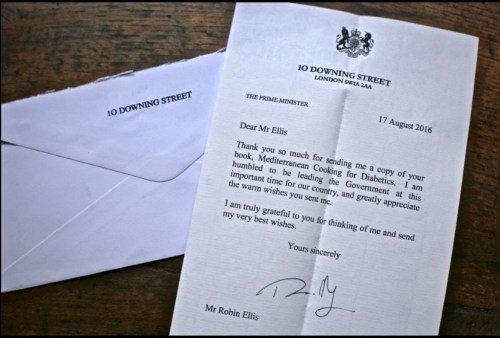
I’d read somewhere that she enjoyed cooking, so I sent her my book Mediterranean Cooking for Diabetics and received a gracious reply in a 10 Downing Street envelope:

I plan to do the same for The Speaker. 

In the meantime, Sir Lindsay, here is a warming winter vegetable soup that features in my new (fourth!) cookbook, to be published in the UK on June 4th, 2020– and available for pre-order now on Amazon.

Vegetable soup

Simply that—a soup with vegetables

1 medium onion—in small dice

1 leek—finely sliced

3 garlic cloves—pulped

1 carrot—in small dice

1 stick celery

2 tbs olive oil

1 fennel bulb– bite size dice

2 carrots– chopped to bite-size

2 sticks celery–bite-size dice

1 medium turnip–bite-size dice

8oz butternut squash–bite-size dice

1 tin/can tomatoes broken up with its juice

s&p

a bouquet of bay leaf, sprigs parsley and thyme

2 pints stock (I use organic vegetable stock cubes.)

  • Heat the oil in a large saucepan and add the smaller diced vegetables.
  • Turn over in the oil and cook gently until tender.
  • This is the taste “engine” of the soup that will slowly deepen its flavours.
  • Add the larger dice vegetables and turn them in.
  • Add the tomatoes and turn them in.
  • Lay in the herb bouquet and add the stock and lightly season with salt and pepper to taste.
  • Bring up to the boil and cover.
  • Turn the heat to low and simmer for a half-hour or until the larger diced veg are tender.
  • Remove the bouquet of herbs and add a swirl of your best olive oil.


I’m making this soup today!

A visitor

We have a visitor. As before with Beau and Midnight–out of the blue. Just turned up mewing sadly, not knowing that as an old friend once said it had fallen into the butter dish by stopping by.

He/she-we don’t know the gender yet–advances a little further down the path each visit, encouraged, by the food laid out, to be courageous.

Last night I noticed it managed to lower its eyes while lapping up the milk.

No sign of it this morning when Meredith called out. She worries the house cats have shooed it away during the night.

They have treated it as a curiosity so far and offered little hostility. Could mean it’s female –which would be good in a household of three big males but the name that came into Meredith’s mind –Archimedes– would not suit the little mite!

It rained in the night–perhaps it’s sleeping off a disturbed night.

Watch this space for updates on this happy event…

Meanwhile here’s a link to Meredith’s beautiful footage in the courtyard…

Ben seems cool about the watching figure!

STOP PRESS:  Sighting at noon–all’s well!


Megan Rapinoe celebrates scoring another goal for the USA and is about to be congratulated by her teammates


Meredith and I sat beside each other on the sofa and watched the game together–but our loyalties were divided.

We were watching the semi-final of the Women’s World Cup–football/soccer, (depending which side of the sofa you were sitting on) between England and USA.

Whatever you choose to call it lived up to its sobriquet last night– The Beautiful Game.

Loyalties lie deep in the gut–something that catches me by surprise.

I live in France; I’m upset about Brexit, but roots kick in when the chips are down.

The game was played with a passion and politesse–not always on view in the men’s tournaments.

The skill on show was phenomenal and added to the pleasure.

Watching such breathtaking expertise is a joy–it lifts the spirit and can bring a tear to the eye.

The women’s game has struggled everywhere but the States to catch the imagination of Joe Public–not enough macho on display?

But this competition, played out in France, featured at prime time on terrestrial television, has changed things forever.

Along with Meredith and me in France, eleven million fans in the UK were watching.

The penny has dropped, the scales have fallen. The women’s game has come into its own.

Tonight Gianni Infantino, the president of FIFA (world governing body of football) recognised this by proposing expanding the event to 32 teams from 24 and doubling the prize money and financial support. 

Full time–USA 2 England1

I conceded–through gritted teeth.


Early birds

Suddenly summer!

Bursts in the fields, on the stands;

Yellow, red, golden.

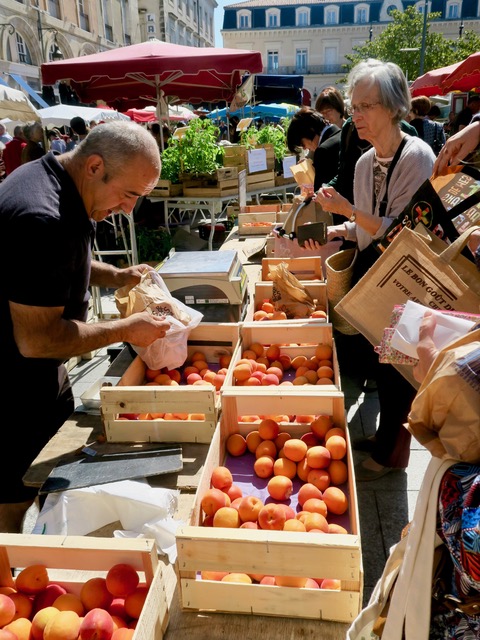
Place Jean Jaures on a fine Saturday morning in the first days of summer is slowly coming alive as the stall holders–chatty and enthusiastic–finish setting up.

Meredith and I drive down the road beside the market at seven minutes past seven–and look at each other in astonishment–we made it! And it’s registering a mere 20C/ 68F.

The forecast is 38C/100F later in the day.

By 9am it will be hotter and more crowded; by 11am, a sweltering throng and much of the new summer fare, bought and carried off.

It pays to be early birds as summer starts to deliver.

Sunday morning 6.30am and our resident golden oriole is warbling a modest ‘good morning’ as I step unsteadily into the road to begin my first early morning walk of the summer.

It’s a surprise to feel a pleasant misty spray on my face after the intense heat of Saturday. Slowly the pistons and crankshaft start to loosen up and the old engine begins to move up the hill.

Thoughts unbidden pop into mind.

One of the joys of walking–unbidden thoughts. Couldn’t see the wood for the trees–my mother would say–last night, but the old computer left to its own devices has sorted things out overnight and gently suggests a solution to a problem.

Of course–why didn’t I think of that?!

I stop, half-turn–doing my best not to fall over– and give a desultory wave to whoever it is in the large white van looming up behind me. Could be Lionel, our plumber,  going to work on the house he’s building; could be Serge on his way to pick up his son for the weekend.

I walk on past a field of wheat that has turned golden in the heat of the last few days.

As I crest the hill I see in the distance the white van returning and think, “ah yes, Serge and son”. Then a ways behind the van, a lumbering noise with two headlights, descending. The mind, clearer now from the climb, twigs. Not Serge, but Celine in the van and Pierre driving the monster which is a garlic harvester* –and they are heading for their vast field of pink garlic to begin the annual harvest.

I barely survive as Pierre–looking anxious–edges past me and heads on for a long day mining his and Celine’s fortune.

Garlic gath’rers pass,

Leaving the scent in the air;

It’s that time again.

Life is far from dull for early birds.

*Meredith captured Pierre and Celine harvesting a few years ago.

Today–30th June 2019–Winston Graham would have been 111!

I’m re-reading the Poldark saga books at the moment and being reminded of why this story still resonates.

WBGH Boston–home of Masterpiece, showcase for the majority of British TV drama in the States–is producing a series of podcasts to run with the showing of the fifth and final series of Poldark, stateside.

Mining Poldark is an epic undertaking–40 half-hour segments.  I’m co-hosting with Barrett Brountas.

It involves watching each episode–old and new– and re-reading the original books.

Barrett and I then spend  a half-hour dissecting each episode–agreeing and disagreeing in an agreeable fashion.

Coming Soon from MASTERPIECE – Mining Poldark

The team: Susanne Simpson (Exec Producer), me, Barrett (co-host), Nick Andersen (Producer)

We are nearly half-way through–and it’s a pleasure!

His wonderful writing lives on and is again a source of joy as well as–in this case–employment!

He wrote Ross Poldark, the first in the saga, in 1945 when he was 37 and bringing up a family of his own with his beloved wife–Jean at their home in Cornwall.

He finished the twelfth and last book, Bella Poldark, in 2002 at the age of 92!

This last tells the story of Ross and Demelza’s youngest child who becomes an actress–and with whom I’m sure Winston fell in love, as he’d done with Demelza–11 books earlier!

There’s as much PASSION in the last of the saga as there is in Ross Poldark.

He felt a loyalty to his characters–and this he passed on to his readers.

He was a supremely talented story teller.

Bonne Anniversaire, Winston!


“They’re essentially volunteers” Meredith says this morning as she waters our visitors.

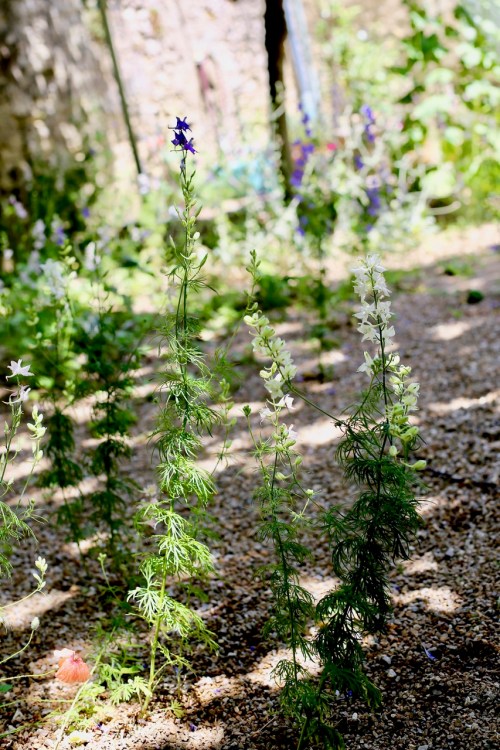
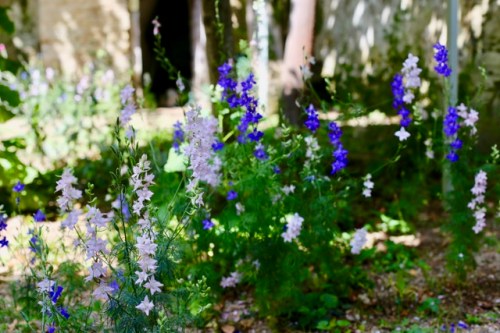
Whitey-pink and bluey-mauve; they arrived, it seemed, overnight; all of a sudden–there they were.

This morning they are enjoying the shifting light–a static ballet–barely responding to the whisper of a breeze; stick figures in an orchid conversation.

It’s mercifully cooler than yesterday–better for humans, cats and stick-people alike.

Beau likes to walk in the orchid forest early before the sun comes round to the courtyard;

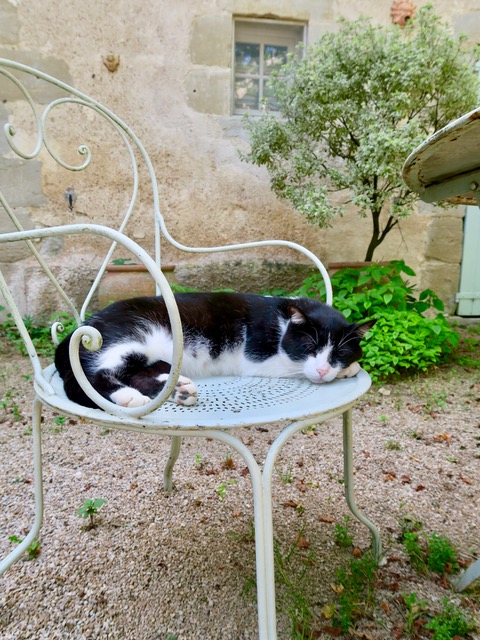
…then rest in the shade on the cool metal seat of the wrought iron garden chair.

Behind my ear a small bumble bee is enjoying bounty from our extended orchid family, buzzing between mauve and pink, making them sway a little as he lands..

Three white butterflies swoop in–fighting among themselves; clearly two’s company three’s a crowd.

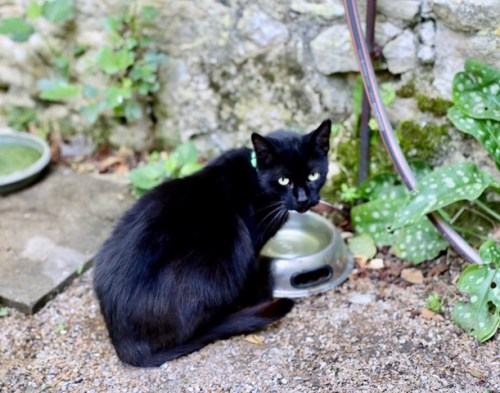
Ben rushes in–he never saunters–and settles at the dry food plate, before heading for the water bowl. It’s tough for sleek black cats in the near midday sun.

For a little longer we’re all happy to be in the courtyard–but the heat is rising–the skin starting to prickle–and soon we’ll make a dive indoors.

Stay awhile-stick people. We think you’re beautiful!


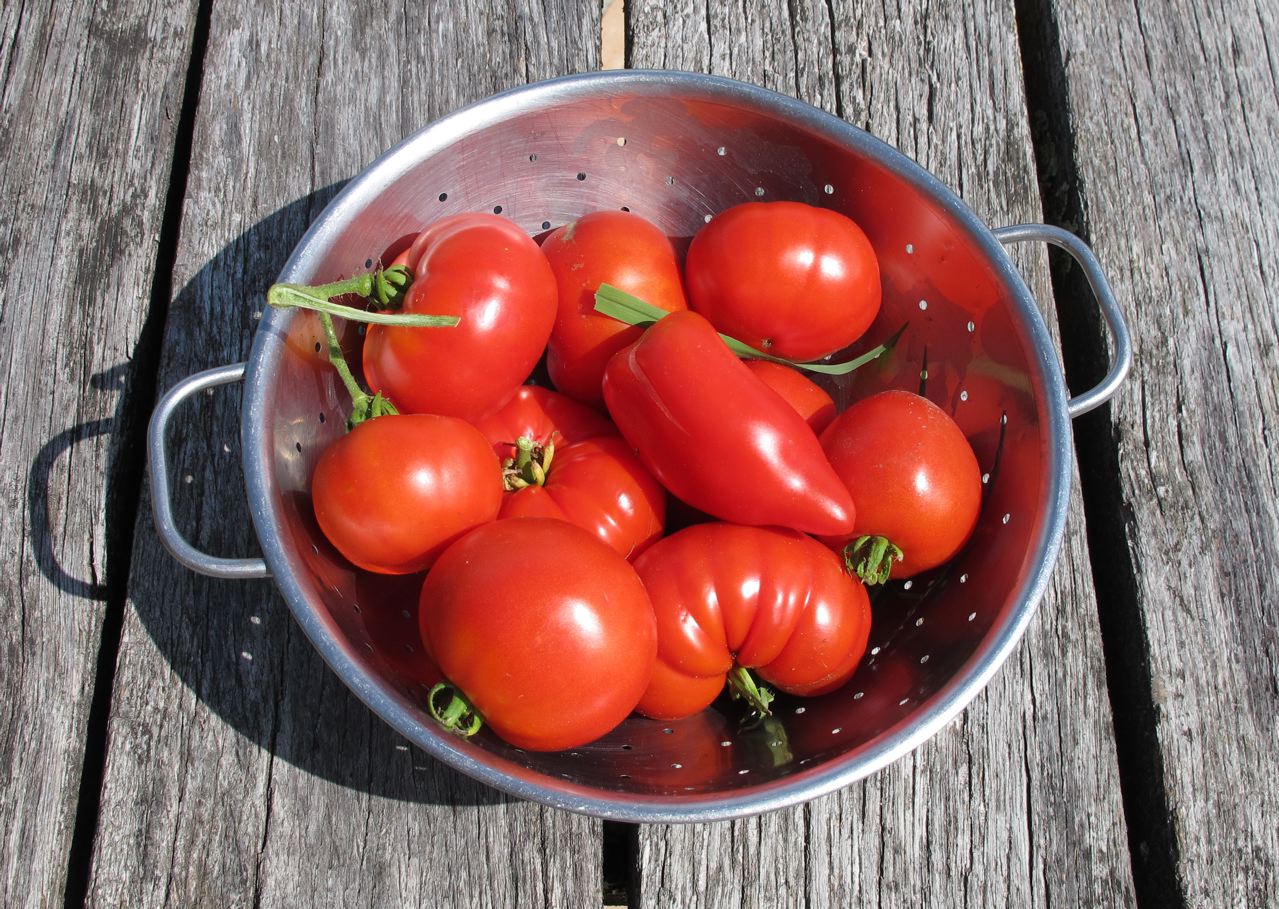
It’s currently 94F degrees in Lautrec and set to go to 103F this afternoon–so I’ve made Ma’s Gazpacho this morning with the first of summer’s tomatoes, peppers, spring onions and cucumber.

It is ridiculously simple.

I wasn’t sure it would be worth it with the vegetables available–not enough sun in them yet.

First taste after the food processor–just the pulverised vegetables–encouraging!

I stirred in the vinegar and oil, seasoned and popped the big bowl in the fridge.

Four hours will be enough–though overnight is better.

Thanks again, dear Molly!

Her recipe features in my second cookbook–Healthy Eating for Life and–as tribute to Molly in my upcoming book: Robin Ellis’s Mediterranean Vegetarian Cooking (which is with the publisher, and due out next year).

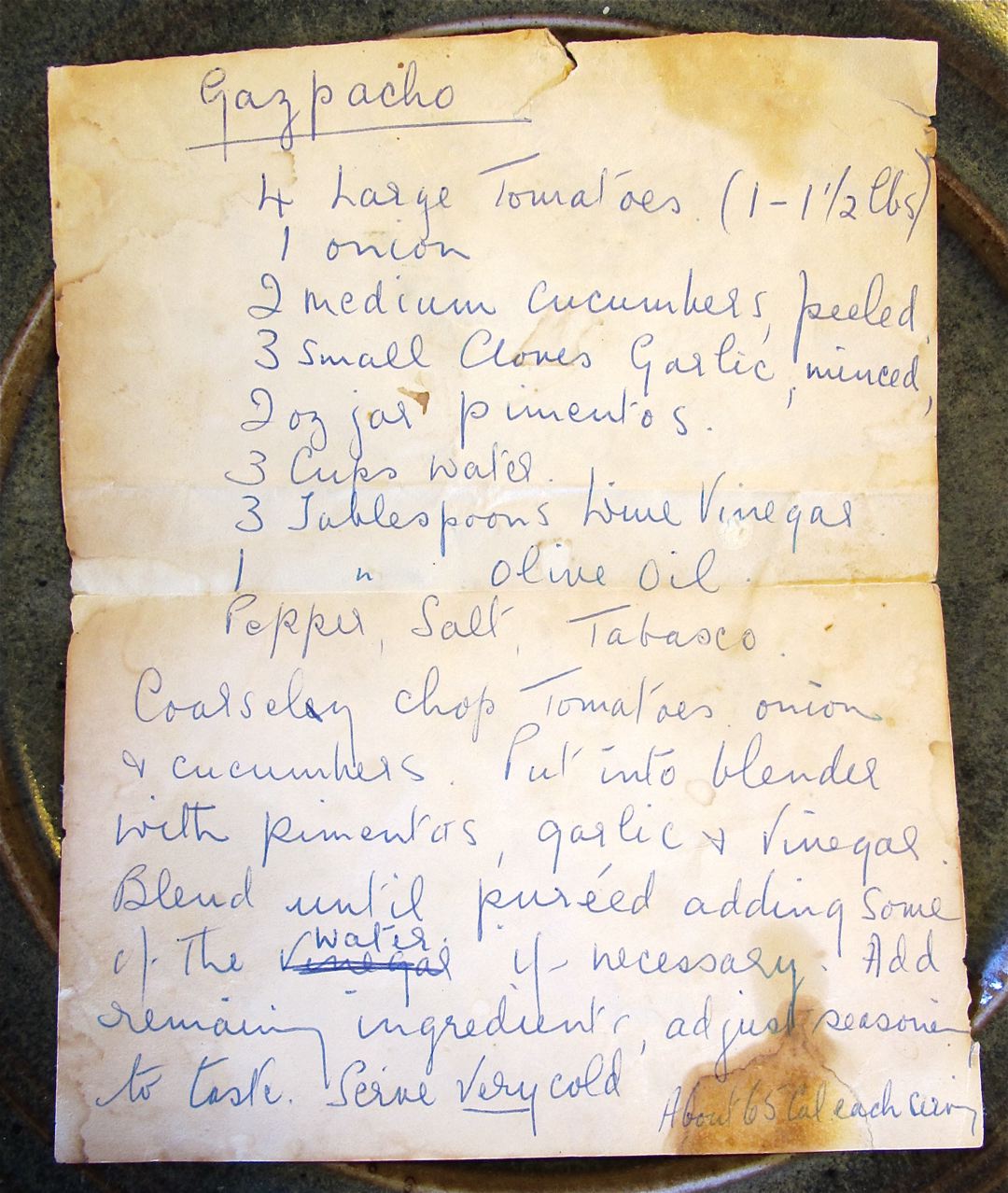
Here’s my original posting from July 2011 with the recipe written out on a yellowing envelope in my mother’s handwriting:

It’s a fair bet my Mother first tasted this traditional summer soup from Andalusia in 1953–when my parents took brother Peter and me to the Costa Brava for a two week holiday. (Dad worked for British Railways and got a certain amount of concessionary travel in Europe.)

There were five hotels at that time in Lloret del Mar. Five hundred plus now!

We stayed in one with a pretty courtyard–yards from the beach.

I don’t remember the gazpacho–but the egg fried in olive oil I can taste to this day!

Franco’s military police, patrolling the beach in funny hats and holding not-so-funny machine guns, also made an impression. No such thing at on the sands at Woolacombe!

About a kilo collected this morning–a little more than the recipe.

Molly Ellis’ Recipe (slightly adapted!)

Chop the tomatoes roughly–and put them in the food processor.

Chop up half a large, peeled cucumber and half a large,  red pepper–seeded–(she calls them pimentoes) and add them to the processor.

I add a couple of spring onions (scallions)–chopped. (Ma adds a yellow onion–which I’ll try next time).

Mash up 3 cloves of garlic, as she does, with a little salt–and add them to the processor.

Pulse the contents–not too smooth a finish.

Empty this already tasty mix into a bowl and adjust the seasoning with salt and pepper.

Stir in 3 tablespoons of red wine vinegar and two tablespoons of olive oil.

A few drops of Tabasco–as she suggests–a matter of taste.

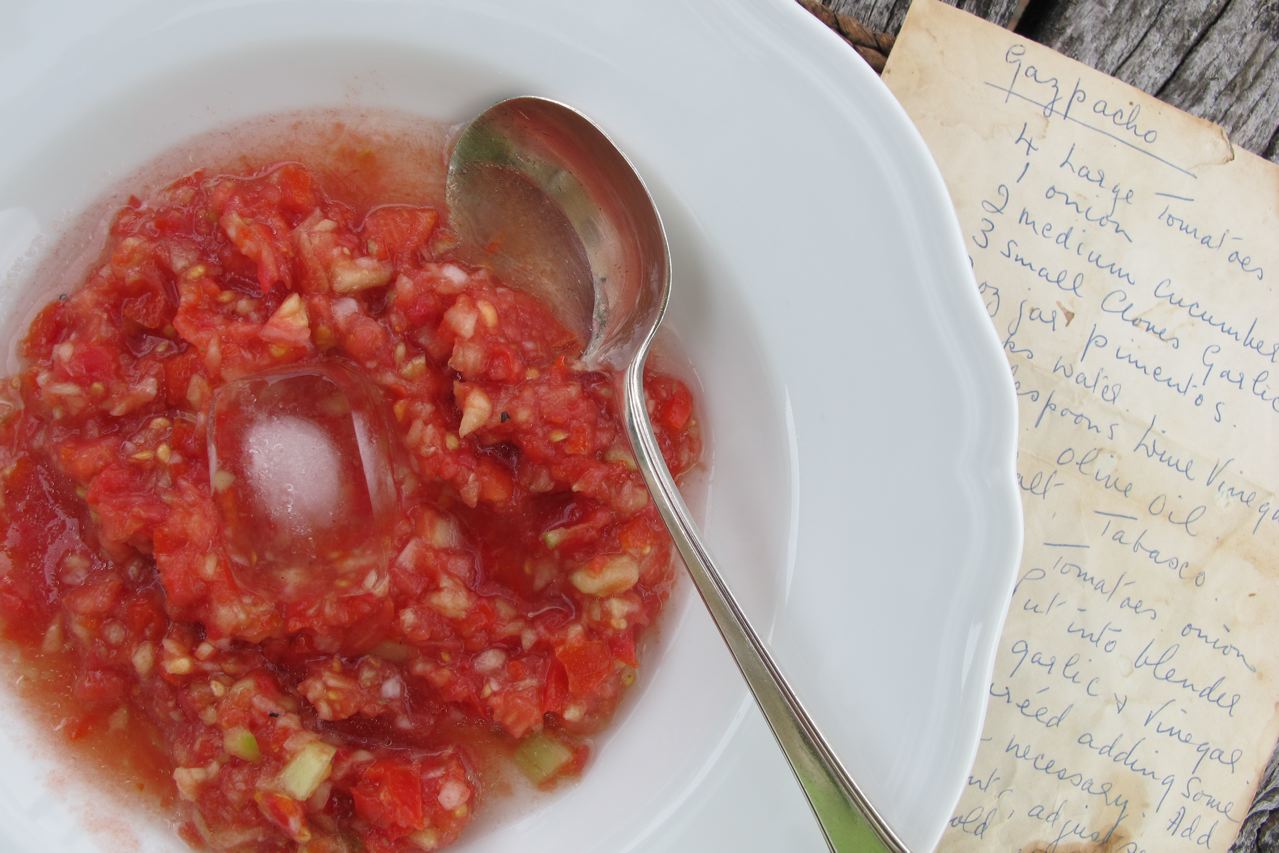
(At lunch today I added an ice cube to each served bowl.)

Chill for a couple or more hours.

We found one ladleful each is enough–with a whirl of olive oil to finish.

They came down out of a brilliant blue sky in almost perfect order–lining up to land within feet of each other–on an isolated hilltop north of Brassac in the alpine part of our department–the Tarn.

They were greeted by a group of Resistance re-enacters–young men and women  in authentic wartime garb and equipment, who hurried forward to help gather up the parachutes–as actually occured in 1944 by moonlight.

The jumpers–a Frenchman and five Americans flown in expressly for the occasion–all Special Forces–played the game and patted their greeters warmly on the back–relieved to see a friendly face after their hazardous flight into occupied France from the American base in Algeria!

The large crowd of onlookers, after readjusting their necks, showed their appreciation with applause and whistles.

Speeches were made and thanks given.

We all sang or hummed La Marseillaise and the Star Spangled Banner and a thousand photographs were taken.

It was a memorable moment–and a fitting tribute to an act of derring-do, 75 years ago.

On August 6th, 1944 a US Special Forces team (OSS–Office of Strategic Services, precursor of the CIA) consisting of 15 men parachuted onto this same dropzone around midnight. One broke his leg in the low altitude drop and was spirited away by the maquis de Vabre to a safe house where he was hidden and received treatment.

Two of the remaining fourteen were shot dead five days later by a German patrol they had ambushed.

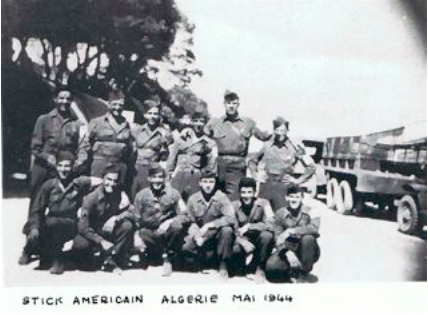
Robert Spaur, on the left, was one the two who lost his life on a remote and heavily wooded French hillside. His PAT comrades in this photo survived.

Twelve remained to fulfill their mission, which was to work with the local Resistance and prevent the Nazi occupying forces from sending reinforcements to fight the Allies after the Southern D-Day landings on August 15th, close to St Tropez.

Their perilous task was a success. They blew up a key strategic train bridge. Our local town Castres was liberated fourteen days after their landing. The Nazi occupying force–4,500 troops–surrendered. The Allied landings in Provence went ahead smoothly and the end of the war moved closer.

We followed the OSS men’s route from the dropzone back down into Brassac–in our case to enjoy an impeccably-cooked traditional lunch at a local restaurant of salade de gesiers and Joue de boeuf aux carrottes et vin rouge. 

It kept us in the bubble of history for a little while longer, savouring not only the food and company–but the whole remarkable and sobering story of OG Pat*.

Norma LaGueux Hamilton, widow of the Captain of OG PAT, Conrad LaGueux–raises the toast to honor and celebrate those who served.

People came from around the world to attend this 75th commemoration–from California, Florida, Washington D.C., Kabul, Paris and England.

Two of the original PAT team, Bernard Gautier and Robert Spaur, were killed in action and are buried in France–but not forgotten.