Feeds:
Posts
Comments

Archive for the ‘other sides to this life’ Category

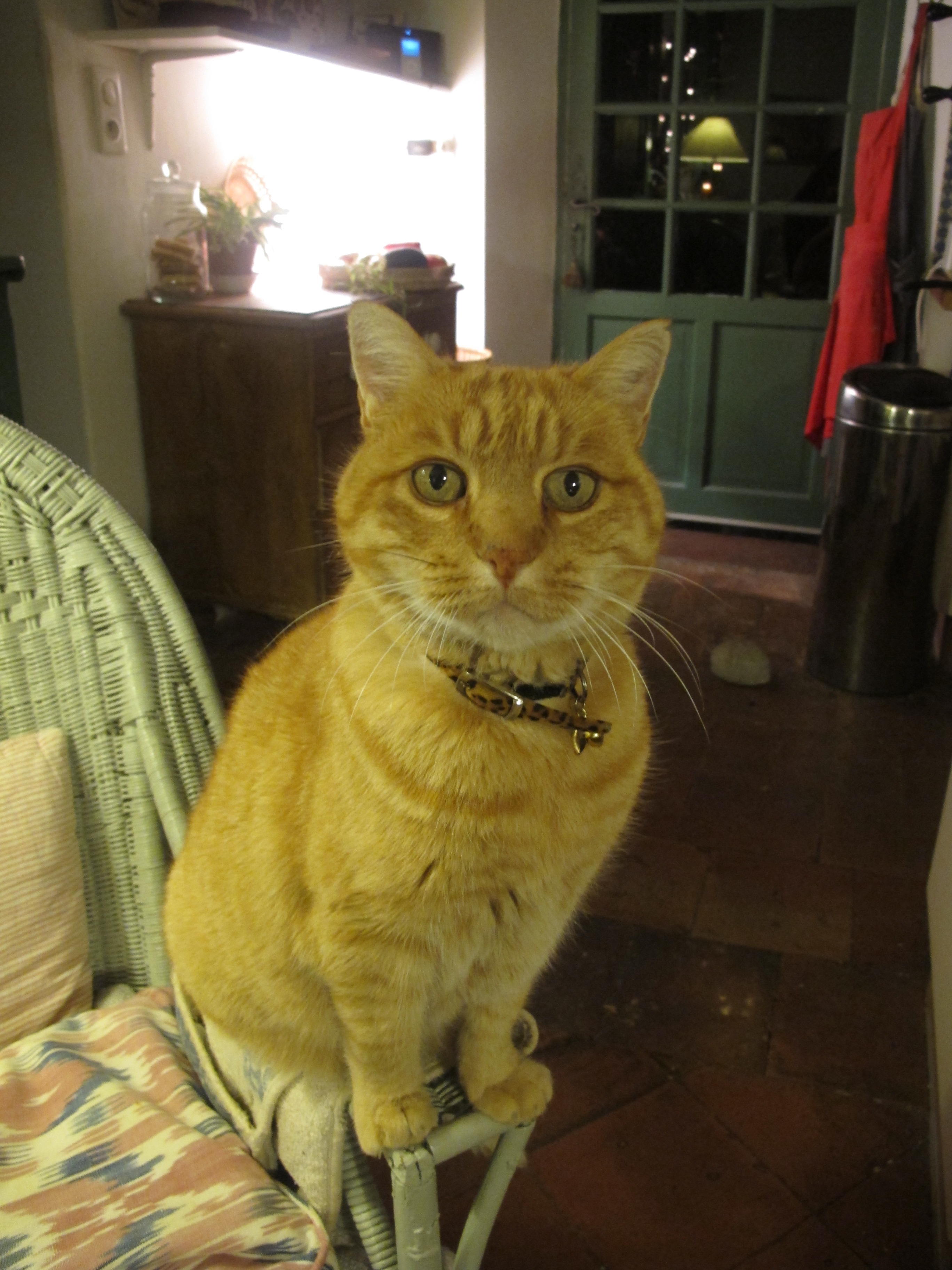
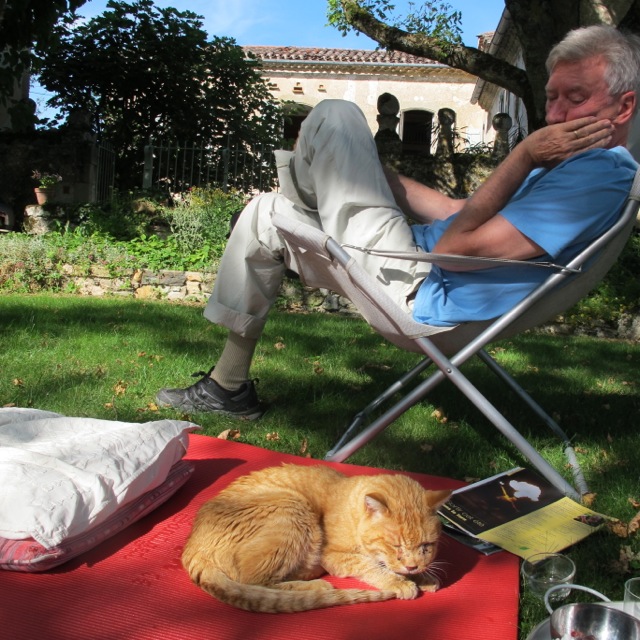
Beau takes his first post-prandial summer walk with us–out into a brave new world.

Tentative and doubtful at first, he adopts a deep crouch position in the short grass, watching us set off, reluctant to respond to our calls of encouragement.

Come on, Beau!”

Then when we turn our backs he begins to walk gingerly down the road behind us, his tail trailing behind him, not in its customary erect position, sniffing at the verges, not sure he wants to be this brave.

Pippa–head cat and veteran hiker–is, as always, reluctant–not from fear but from a deep sense of “why bother?“.

She makes a show of “here I am and here I’m staying” before moving sideways a few steps in a downhill direction; more from a desire to keep our interest than a decision to follow us down the road.

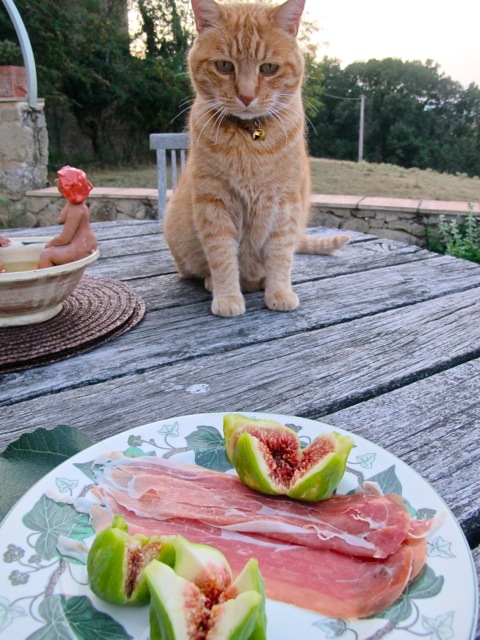
Seeing Pippa go through her you go on without me, I’m not coming with you this time routine, reminds us of the evenings when we’d have five cats in tow (a full house)–Pippa, Lucien, Marmalade, Butterscotch and Beauty–the newcomer.

By and large they were friendly walks, though with touches of attitude creeping in–Beauty was  never really accepted by Pippa.

Beau has the same experience as we come back up the hill.

He stalks her for a few paces then tries a playful leap–he’s got his confidence back and we’re heading towards more familiar ground.

Pippa surprised by his cheek wheels round and hisses her disapproval.

Too old for that my boy–watch it!

In the distance we hear the whine of a motor scooter and Beau looks round anxiously.

The noise gets louder as the rider heads in our direction.

Beau takes off up the hill, stretching his young legs,  followed by Pippa–managing a scamper.

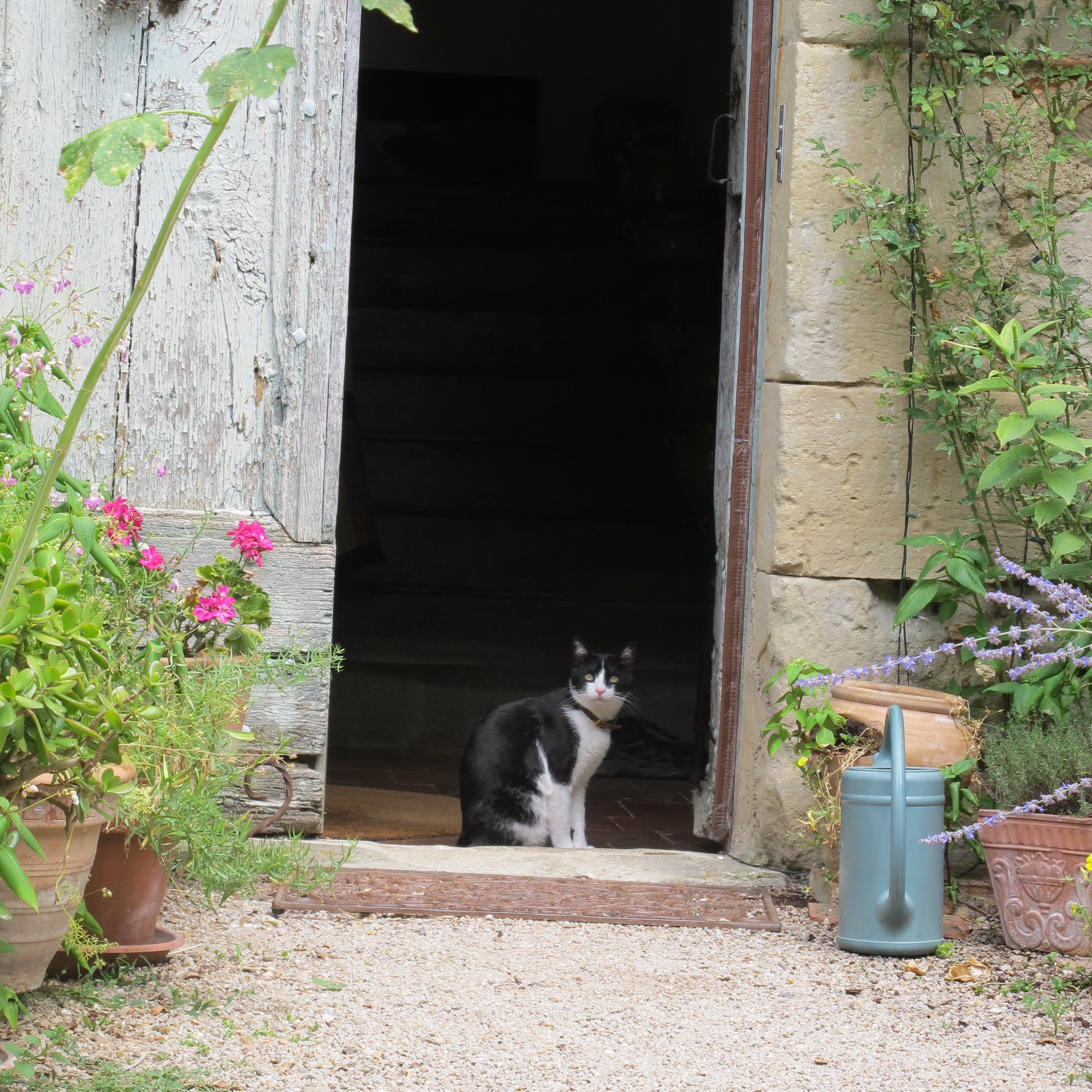
Safely back home Beau looks out at the big new world he’s just experienced for the first time.

WOW!

Read Full Post »

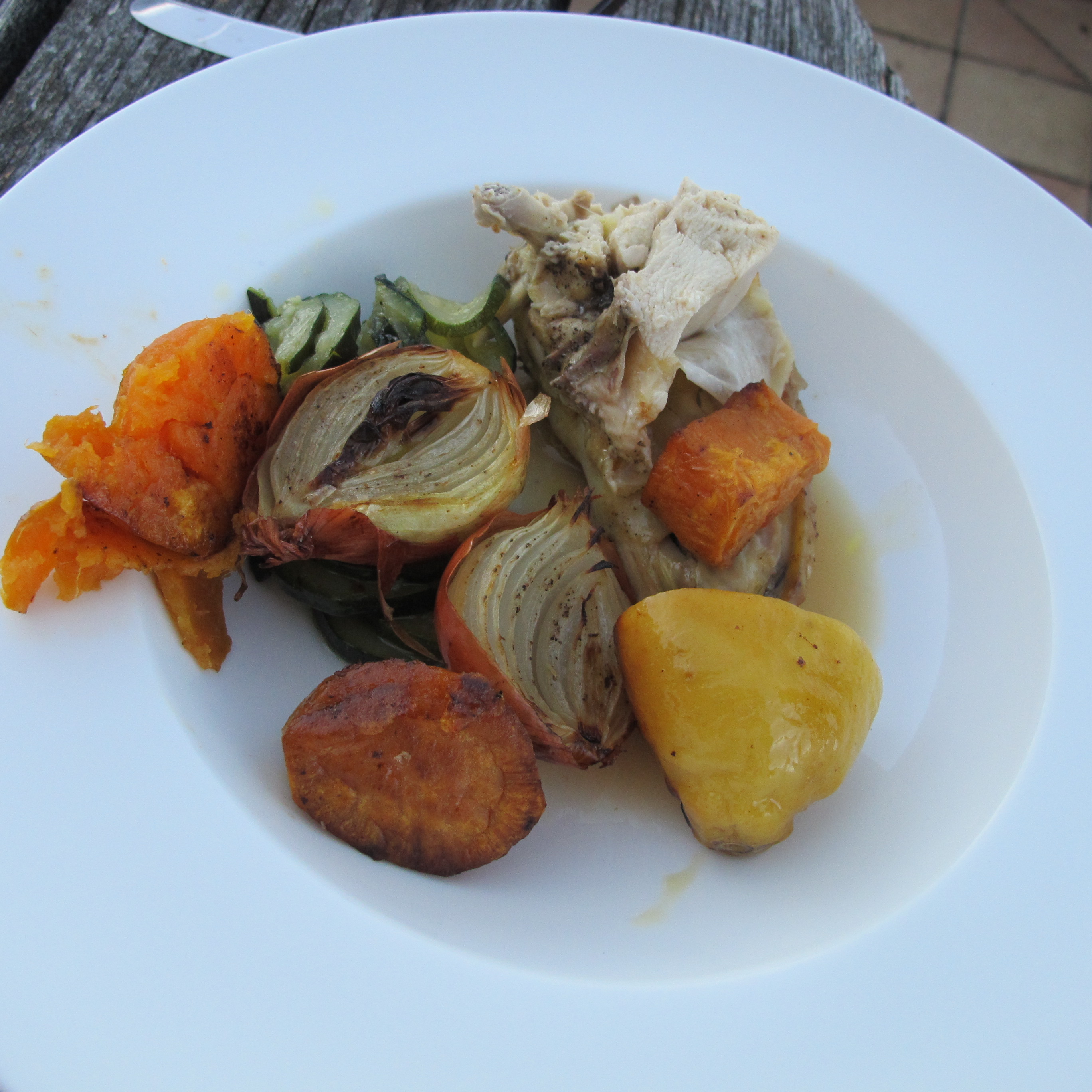
Spatchcocked chicken, roasted onion and sweet potato and a new courgette/zucchini dish

Joy!

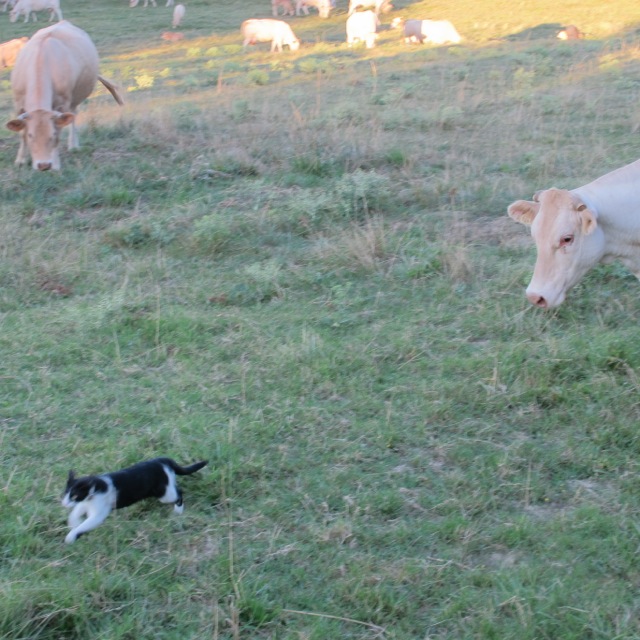
We sat on the terrace last night and ate this simple meal, while Beau played tag with the cows…

and the harvesters were hard at it in the field beyond the road.

Just the three of us–our friend Romaine came back with us from London.

The chicken she and Meredith bought would serve six and there were more onions and an extra sweet potato in the basket for unexpected guests.

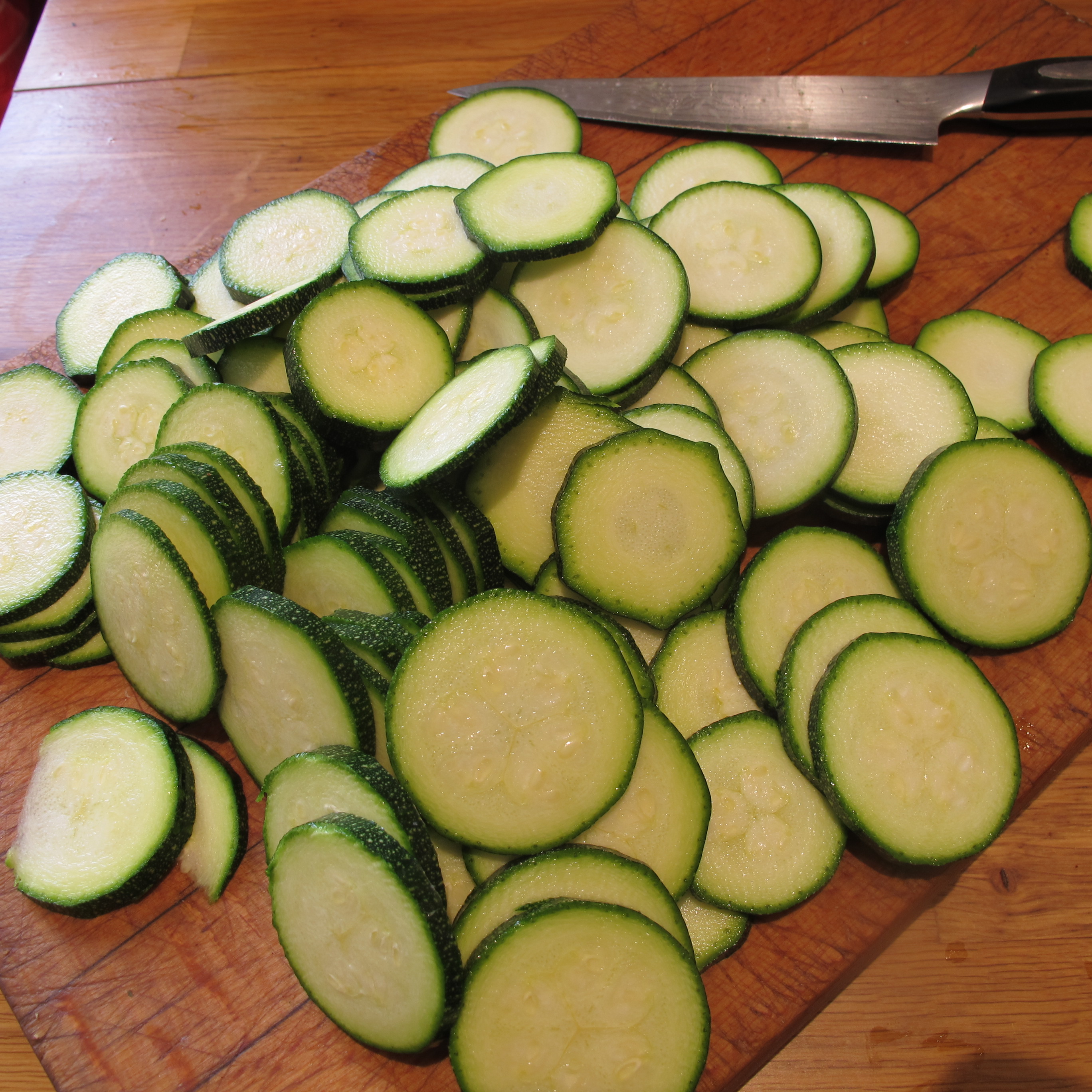
The kilo of courgettes–slow cooked and melting–would easily stretch to six.

Happy to be home–we tucked in.

The courgettes/zucchini recipe is from Skye Gyngell’s version in her book  How I Cook.

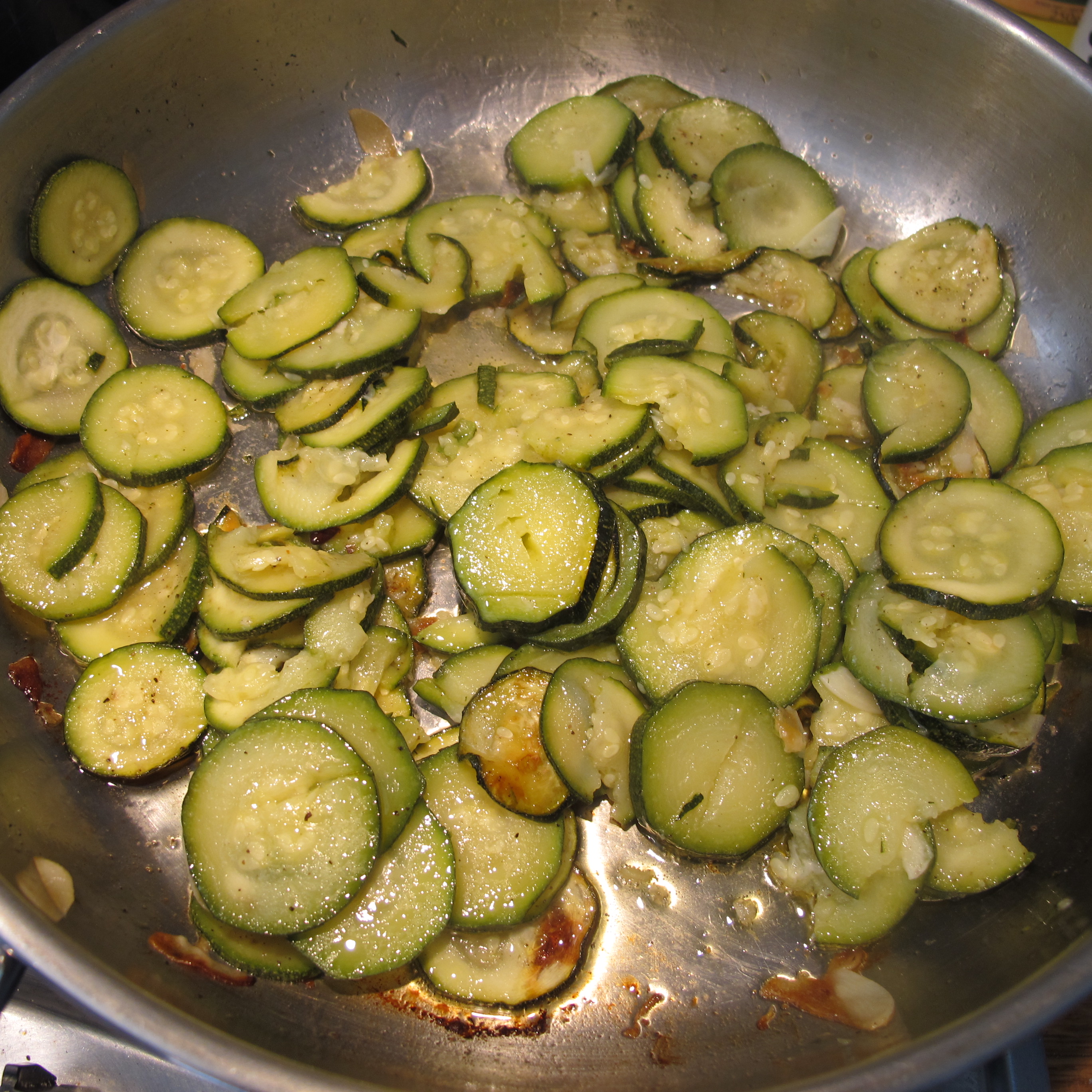
It is cooked slow and is mushily delicious with a little kick from the chili.

 Slow cooked courgettes/zucchini with garlic and mint.

for 4 

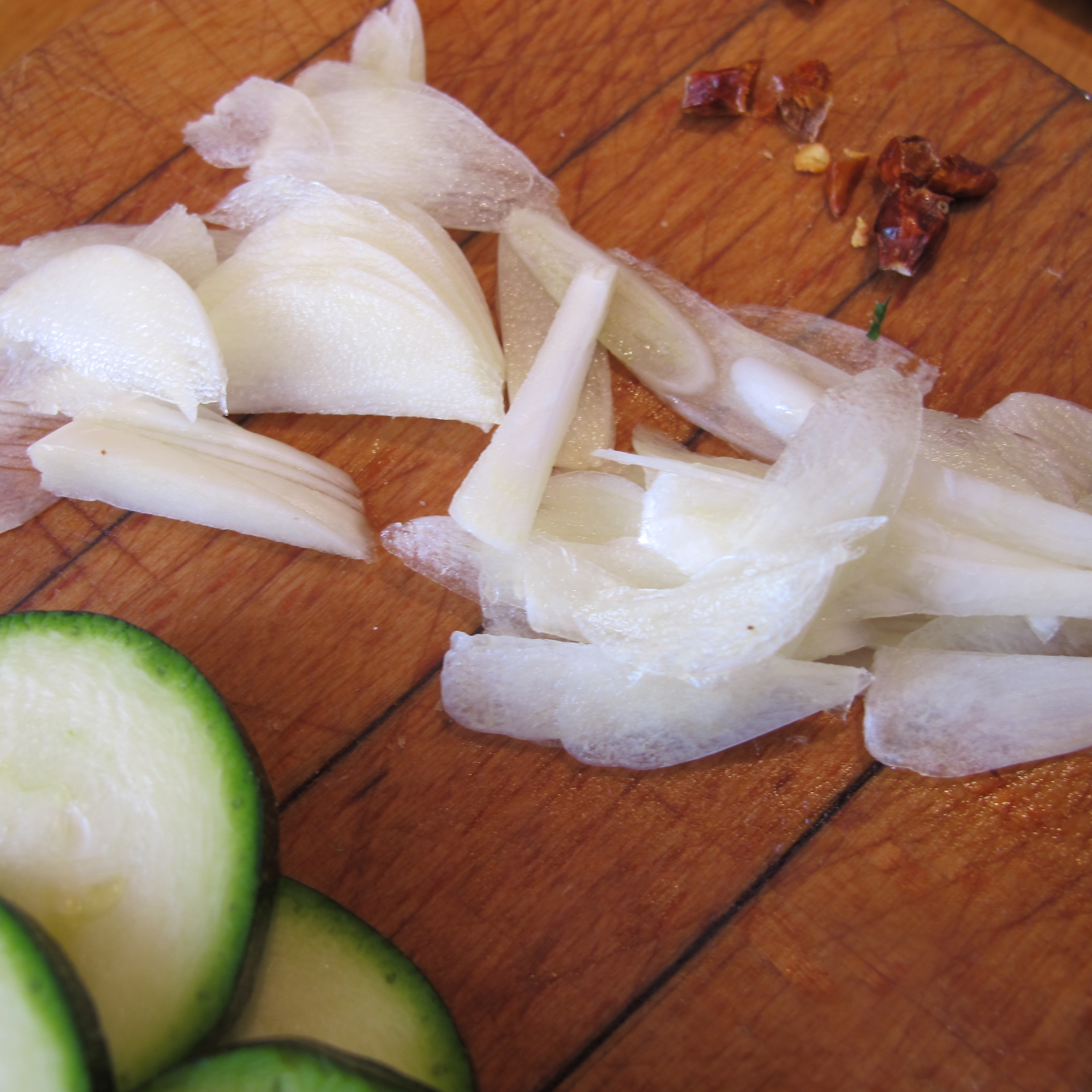
1 lb courgettes/zucchini--sliced thin

2 garlic cloves–sliced thin

1 small dried red chili–chopped

a handful of mint (if you have it)-chopped

salt and pepper

1 tblsp olive oil

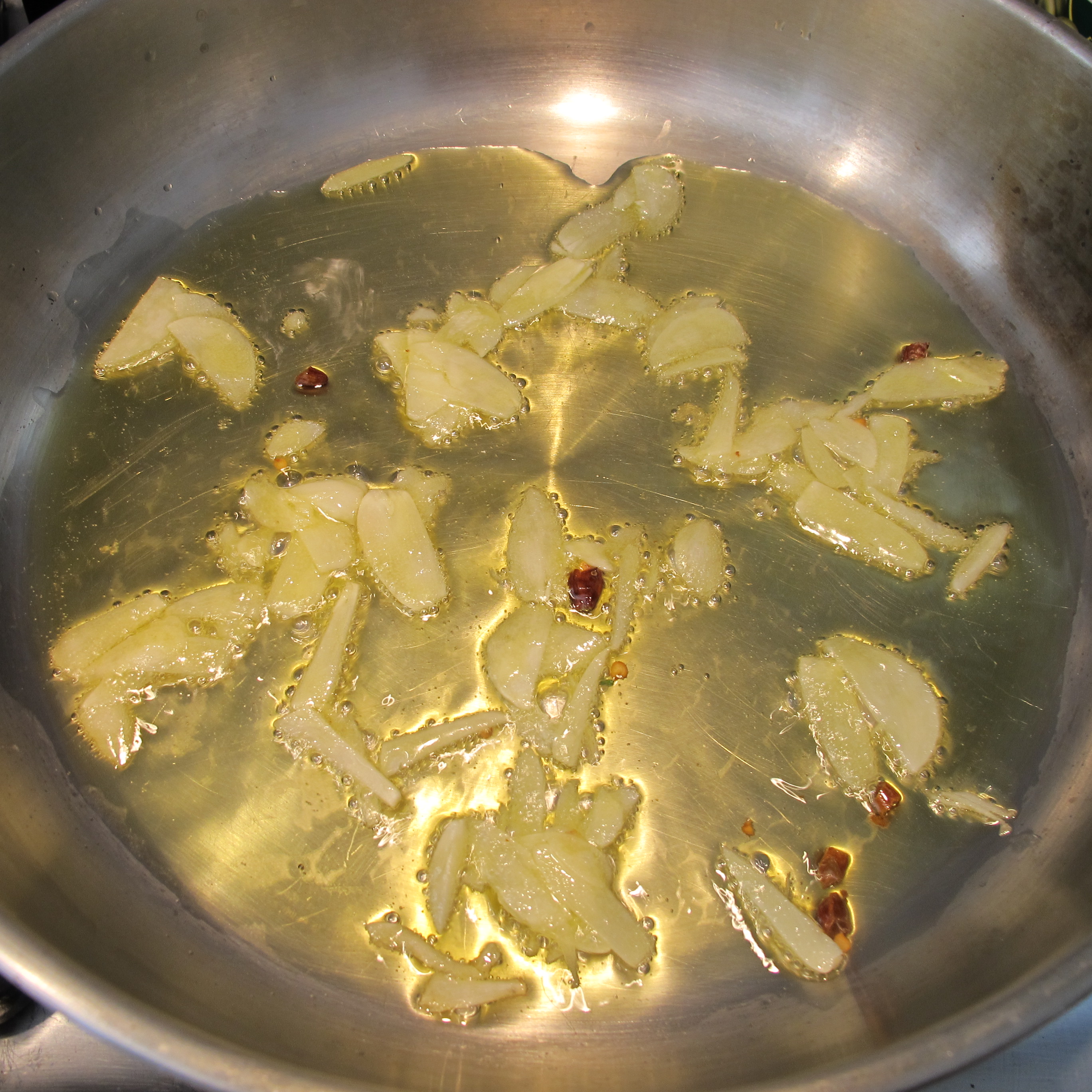
  • In a medium pan,  gently soften the garlic and chili in the oil.

  • Add the sliced courgettes/zucchini and turn them over in the oil to coat them thoroughly.
  • Season generously with salt and pepper.
  • Turn again to distribute the seasoning.
  • Cover the pan and cook for forty minutes on a very low heat.
  • Uncover and fold in the mint, if you have it–which we have, but I forgot it!

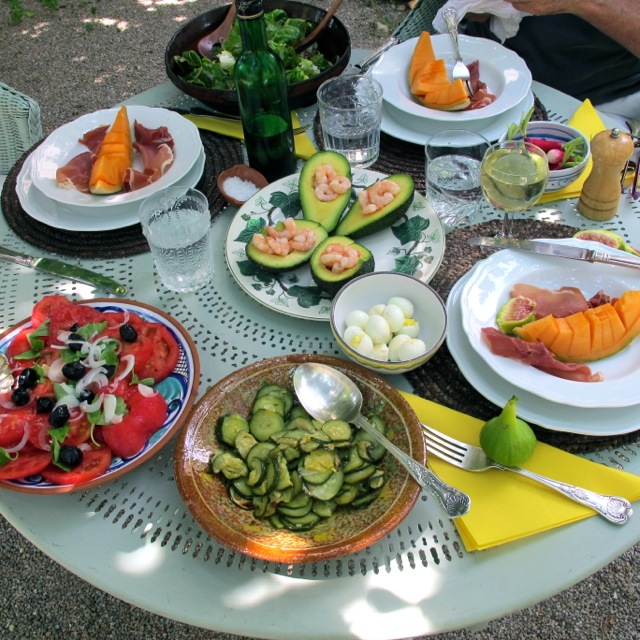
I made it again today with a pound (500 grams) of the courgettes and we enjoyed it tepid as a salad.

Read Full Post »

Thank you for all the heartfelt and very moving comments that were posted after Marmalade-adieu.

Quite remarkable.

They were helpful and touching.

 His journey clearly brought back memories.

We are on a short break in the UK for a double celebration–(hence the two glasses!)

A wedding in a rainy Malvern and a 60th wedding anniversary in a sunny (we’re hoping) Cambridge.

A bientôt, alors!

Read Full Post »

Julie our travelling vet came in the late afternoon and confirmed what we sensed.

Marmalade’s cancer had grown in his mouth and he was having difficulty breathing.

His quality of life had diminished significantly.

He would arrive at meal times as usual, showing initial interest but quickly change his mind.

We spent the afternoon with him in the garden. He’d responded, as he always did, to a call–

Mar! Marmalade! Marmadukey!–emerging from the shade and joining Meredith on the grass.

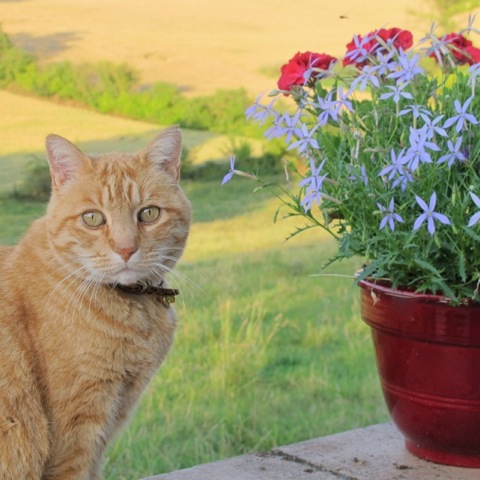
He was a companionable soul.

When we were still living in London in the nineties, he and sister–much missed Butterscotch–were boarded at a place nearby between our visits. We would arrive to reclaim them and it only took a couple of calls for him to come trotting keenly out of the bushes to greet his people!

He was a head nudger: Bonjour! Good to see you.

(It runs in the family. Mother of all cats Pippa says thank you for food with a nudge.)

Stretching by the cemetery wall after my early morning walk, I’d suddenly become aware of a presence.

Looking up I’d find Marmalade looking down at me from just above head height.
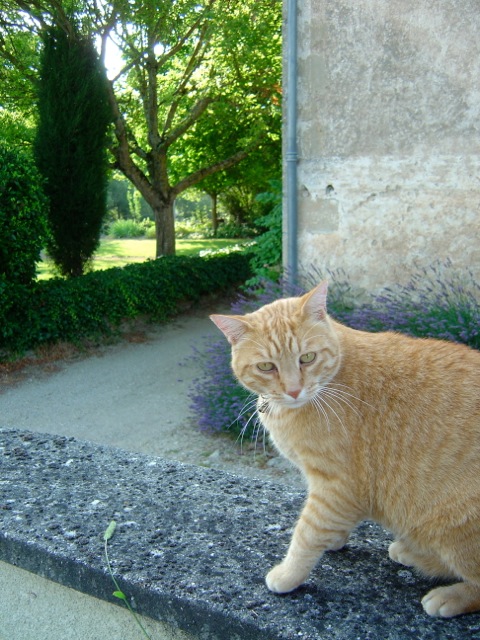
As I pulled myself level with his head he’d nudge my cap: Bonjour! Good to see you.

I’d be foolish not to think there was a touch of cupboard love involved as he eagerly followed me into the courtyard heading for the kitchen–but the greeting was genuine!

Marmalade liked his food…

–and not only his.

Before setting out on my morning walk, I’d feed all the cats.
Ev’rybody’s here-
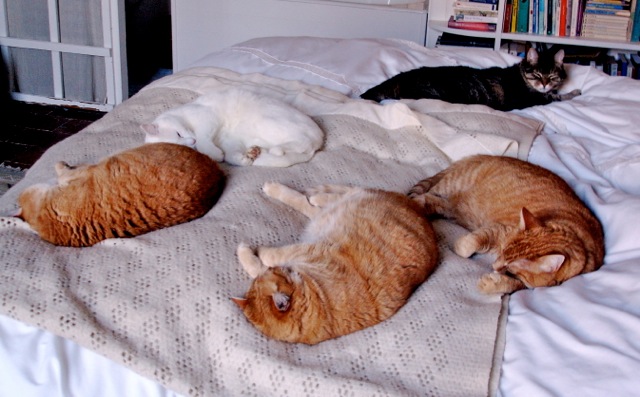
White, ginger, tabby–all five;
Sunny morning queue!
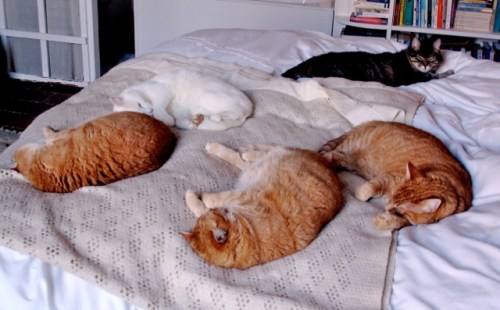
post prandial snooze

Working on the principle that the grass is always greener on the other cat’s plate…Marmalade would leave his bowl untouched and nudge in on his sister’s.
Often he’d join us at lunch–sitting up on the arm of a chair, apparently happy just to be present at the table.
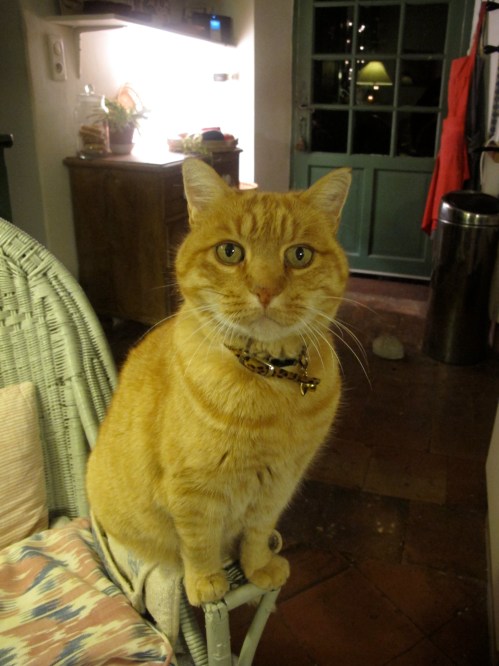
No pressure you understand! I’m not really hungry–but if there should be any leftovers, I wouldn’t say no.

There was a bit of the cuckoo in him too.

Orphaned Lucien–the tabby–a lone spirit, has a talent for finding comfortable places to park himself.

Marmalade would see a snoozing Lucien, check out the spot and decide that his “brother” needed a friendly lick-bath.

He’d judge it perfectly and move in on the nicely-warmed space when Lucien had had enough attention.

Mar has not been himself since snow white Beauty died prematurely aged 4, two years ago, followed last year by beloved sister Butterscotch.

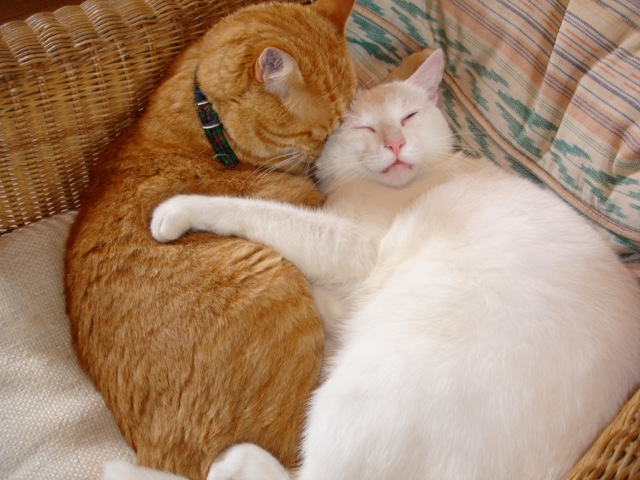
Beauty hero-worshipped Mar (eight years his senior) from the moment he arrived. Marmalade was happy to give in and accept he was adored.

It was a touching sight to see them cuddled up together in apparent mutual admiration.
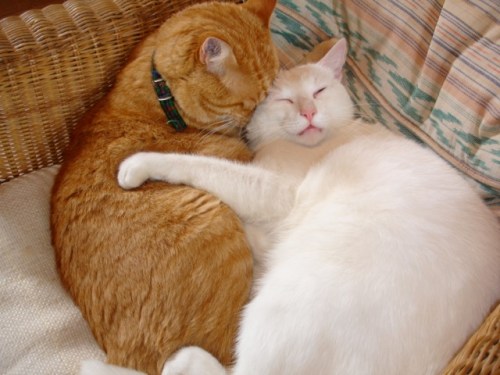
Since losing those two close companions, Marmalade seemed lost.

Young Beau–full of beans–tried to jolly him out of the dumps with his gleeful leaps and japes but dear, tolerant long- suffering Marmalade found it all too much.

Leave me alone old boy, I need a bit of a rest you know.

He lost weight and started getting ill.

His face became distorted, his breathing heavy and his left eye wept.

He was losing his magnificence.

He could still respond to a call and enjoy a moment with his people.

This week he took a turn for the worse and we called Julie–not wanting to prolong his ordeal.

So hard to judge the moment….

We kept our arms around him as he faded, lying full length on the kitchen table.

We buried him under the trees in the garden–beside Butterscotch and Beauty.

It’s the dailyness of domestic animals that makes their passing so difficult.

We miss his nudges, his quirks and the unqualified love he gave his people–for fourteen years.

Adieu! Nous te remercions–Big Mar.
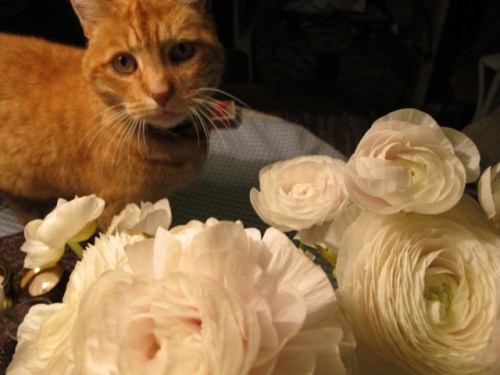
Click below for Meredith’s touching tribute to a great cat.

http://youtu.be/Iq0xmg-l1gg

Read Full Post »

I couldn’t think of the French word for “butterfly” at Monsieur Fraise’s, our Lautrec butcher, the other day.  The word was as elusive as the insect. Pamplemousse kept fluttering around my mind, which means grapefruit!

Papillon is the word!

When I tried to demonstrate with my hands, starting them in the praying position then opening out like a butterfly, the butcher looked flummoxed.

I don’t blame him.

The idea of slicing a pork chop almost in half horizontally was new to me when I read about it recently in the Food Section of The New York Times.

After more elaborate miming, he understood–and was game to have a go.

  • He carefully cut round the bone, freeing up the meat.

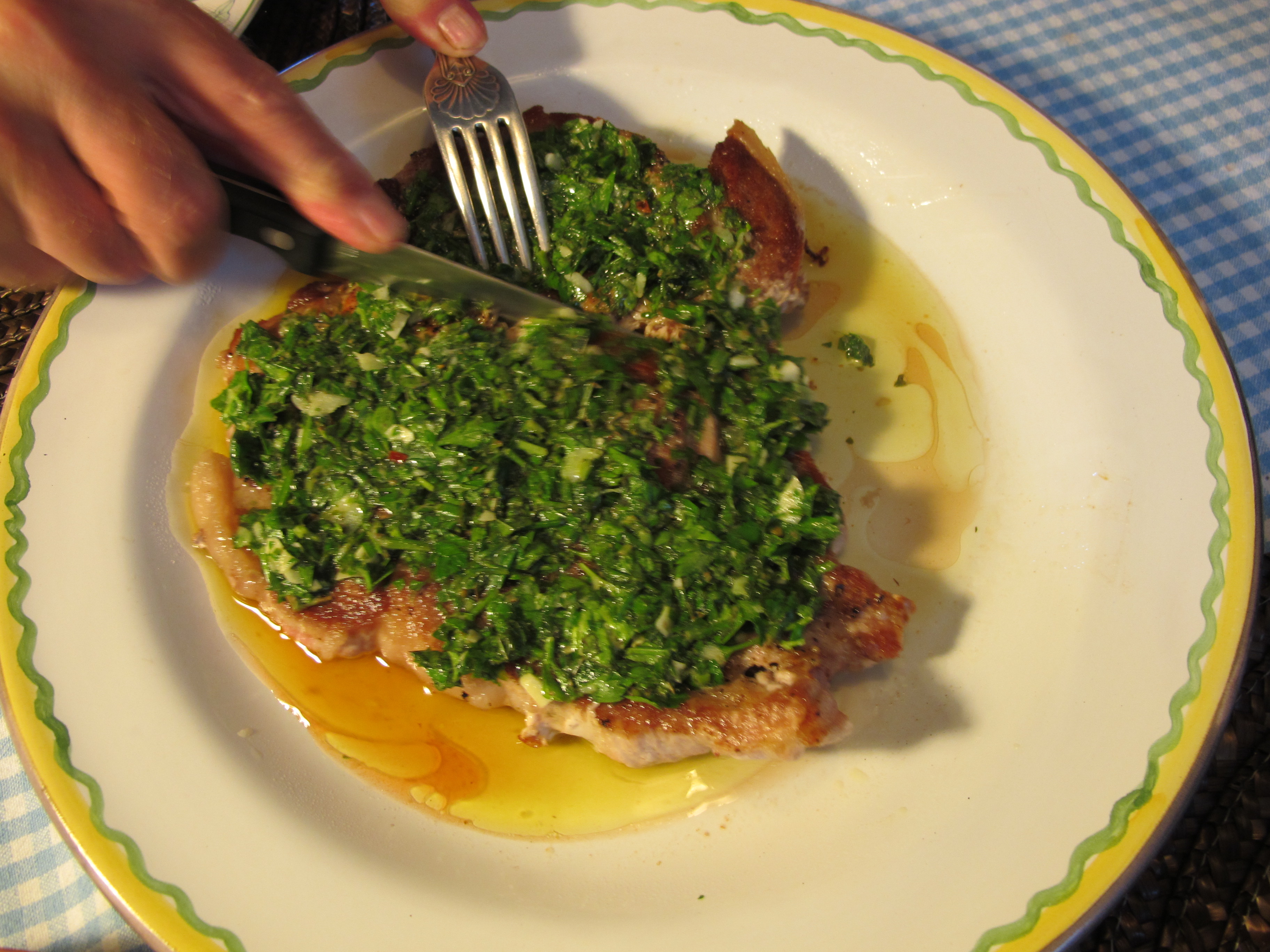
(Meredith’s photos below show me having a go….)

  • With his left hand holding the boneless fillet down, he sliced into the meat with a sharp knife working it through to leave a quarter of an inch uncut.
  • He folded back the two halves–still connected–to reveal the “butterfly”.
Below is the professional’s effort.  (Monsieur Fraise gets the Gold Medal I’d say!)
The advantage–apart from making a single chop go further–is that it cooks quickly–three minutes each side–retaining a juiciness that sometimes escapes when cooking pork longer.

Meredith and I tried out the herb topping (suggested by The New York Times). It looks good and is tasty–but leave it off if you like.

I enjoyed a piece of the chop–plain–the other evening with some slices of tomato dressed with olive oil and salt. I didn’t miss the topping.

for 2

1 thickly cut pork loin chop–butterflied

1 tblsp olive oil

salt and pepper

for the herb sauce

3 tblsps parsley

2 tblsps mint

1 tblsp chives

1 clove of garlic–sliced finely

1 tblsp–lemon juice

4 tblsps–olive oil

salt and pepper

  • Pile the herbs together and chop them finely.
  • Season to taste.
  • Add the lemon juice.
  • Stir in the olive oil.

for the pork

  • Season the chop well with salt and pepper.
  • Heat the tablespoon of oil in a sauté pan to hot and slip in the chop.
  • Turn the heat down to medium and leave the chop to cook for 3 minutes.
  • Turn it over and cook for a further 3 minutes–(the cooking time depends on the thickness of the butterflied chop. The juices should not run pink.)
  • (If you are using the topping, spread some over the chop at this point).

  • Let it rest on a serving plate–covered with foil–for 5 minutes before slicing and sharing it.

Read Full Post »

Our friends Irv and Iris from Washington D.C. stayed over the weekend en route to Paris.

Ex-history teacher Iris kindly tore herself away from reading Hilary Mantel’s second installment of the Thomas Cromwell saga long enough to show me that Delicious Dishes for Diabetics is now available as a Kindle download– an ebook–for £4.93 from Amazon.co.uk/.

She’s thinking of downloading it for their time in Paris.
I’m thrilled!
(* ee by gum!– English expression of surprise and amazement!)

Read Full Post »

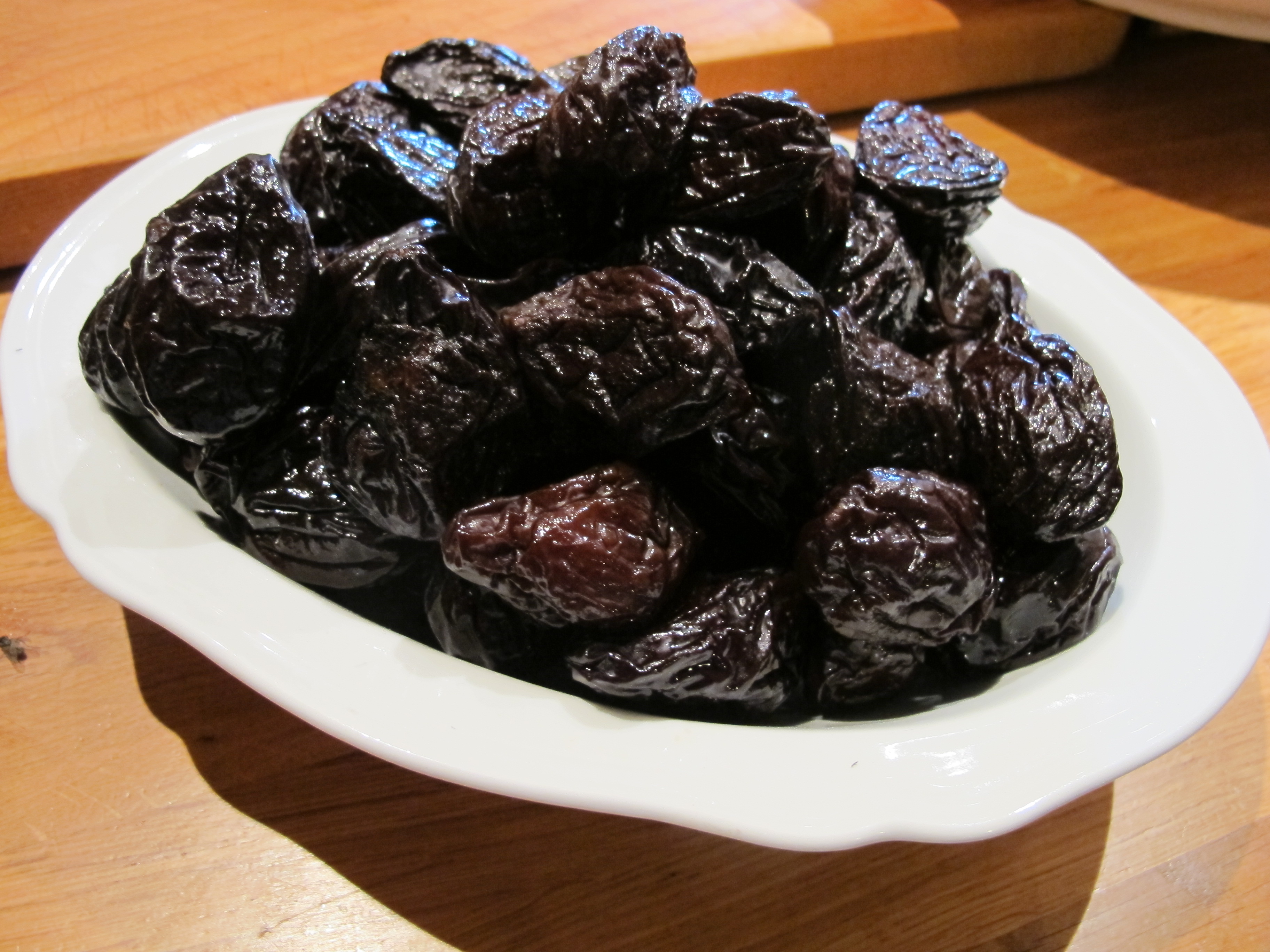
Pile of uncooked prunes

I like my daily prune.

I took a jar of cooked prunes to Corfu.

Seems eccentric–my mother must have had a hand in establishing the habit.

“Keeps you regular, Robin!”

There’s a funny side to prunes–mention of them can make people smile.

(Anything to do with body functions tends to bring a smile to English faces.)

The word itself has a comic sound– PROONE and it’s wrinkled appearance is not beautiful.

BUT they are delicious when soaked first and then gently stewed and allowed to cool.

The prunes here are from Agen–a couple of hours to the north west of us and they are extra as the French say of something special.

Some people eat them dried.

I prefer them after they’ve been through the Method–soft and melting in the mouth–as an essential part of breakfast.

The Method (for a pound of prunes):

  • Empty the prunes into a saucepan.
  • Cover them with boiling water.
  • Let them stand for a half hour.
  • Gently bring them up to the boil.
  • Cover them and let them simmer for another half hour–covered.
  • Leave them to cool then store them in the fridge.

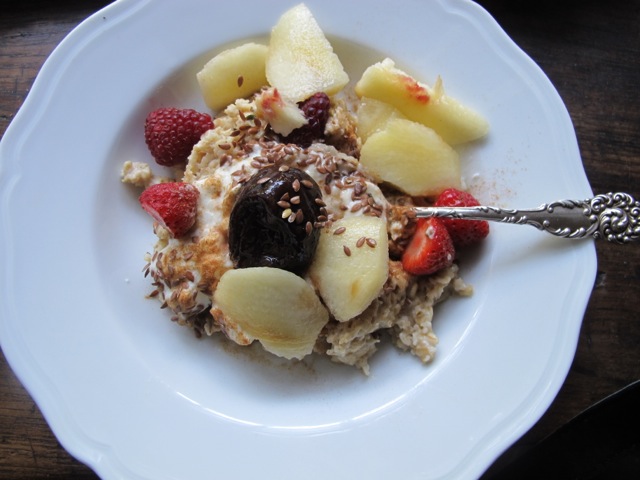
Here’s one in Meredith’s breakfast bowl–heaven she says!

“There’s no more faith in thee than in a stewed prune….”–                                                                                                          ~Jack Falstaff to Mistress Quickly in Shakespeare’s Henry the Fourth Part One.

I couldn’t possibly comment on that–but I have enough faith in prunes to take a jar of them to Corfu.

Read Full Post »

Winston as a Cornish gent, eagerly awaiting his debut as an extra in the second series of Poldark!

Today would have been Winston Graham’s 104th birthday!

He was born in 1908 in Manchester. His family moved to Perranporth in Cornwall in 1925 after his father died prematurely at 53.

There he married Jean Williamson–whom he’d first met when she was 13 (Demelza’s age when she first met Ross at the fair). He was just 18. They lived there for the next 25 years, bringing up their two children, Andrew and Rosamund.

Winston–a meticulous researcher as well as a great storyteller–steeped himself in Cornish history and customs. He wrote the first book of the saga–Ross Poldark--in 1945.

Eleven more books followed. The last in the saga– Bella Poldark–written when he was 92!

A month ago I checked out the Desert Island Discs archive ( a popular BBC radio series where guests choose eight recordings to comfort them after supposedly being shipwrecked on a desert island) . I remembered vaguely that Winston had been the subject some time around the screening of the series.

I found it and enjoyed listening to his choice and being reminded of his voice.

Last week when sitting with my back to his son Andrew–whose 70th birthday we had gone to Corfu to celebrate–I heard a voice say–“and what are you going to do this afternoon?”.

It was uncanny–the voice and the intonation were Winston’s!

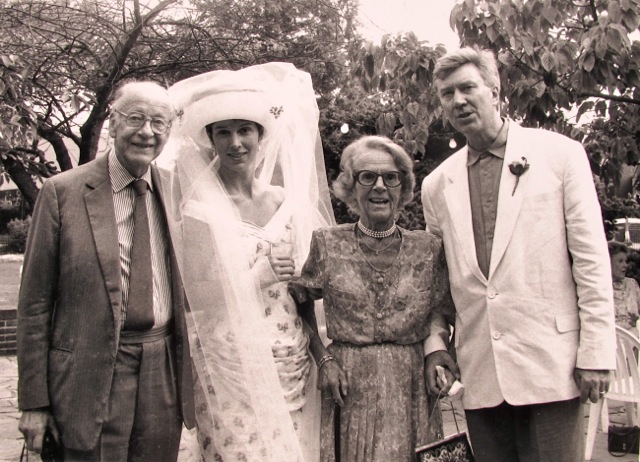
Winston and Jean at our wedding in 1990.

I will always feel appreciative of Winston for writing such a wonderful tale that has meant so much in my own life.

Read Full Post »

The Supreme Court Of America confirms the legality of the Affordable Care Act.

The American Diabetic Association just issued this statement on the Supreme Court Ruling on the Affordable Care Act.

Why was the law needed?

Under the old health care system, it was legal to deny health insurance to people with diabetes or force them to pay more for insurance coverage simply because they had diabetes.

Even for people who had insurance coverage, their plans sometimes didn’t cover the most basic diabetes needs, leaving them with large expenses in addition to the cost for insurance.

This lack of affordable access to care led many people to forgo the care they needed to prevent, delay or slow the progression of diabetes.

That meant cutting back on – or even going without – the doctor visits, insulin, medicines and test strips necessary to managing diabetes.

As a result, many people ended up suffering needlessly from diabetes complications that might have been prevented had medical care been available to them earlier. 

 I have diabetes. What does the ACA mean for me?

The ACA has many important provisions that impact people with diabetes, including rules about pre‐existing conditions, lifetime limits on benefits, drug costs, and programs aimed at preventing type 2 diabetes. 

In 2014, insurance companies will no longer be allowed to deny coverage because a person has a pre‐existing condition such as diabetes.

Will I have to pay more for my insurance coverage because of my diabetes?

Once the ACA is fully implemented in 2014, insurers will no longer be allowed to charge higher rates because you have diabetes. 

The statement goes into more detail about the effects the ruling will have in the lives of those adults and children already diagnosed  with diabetes and those who are yet to find out.

http://www.diabetes.org/assets/pdfs/advocacy/health-reform-qa.pdf?utm_source=Facebook&utm_medium=Post&utm_content=062812-SCOTUS-decision&utm_campaign=AHEALTH

There are 80 million undiagnosed diabetics in the USA and 26 million who have diagnosed.

This is an historic day for them.

Read Full Post »

Where am I?, I wondered, waking this morning.

Still in Corfu? It was hot enough at 7 am.

I quickly established that I was in France by looking out of the window.

No sign of the Albanian hills or the infinity pool.

Back to earth! But hot! hot! hot!

At the end of the garden though it was cool enough to tie up the tomato plants that had grown as much as the chickens in our week away.

The bees were still snoozing so it was safe to sit on a stool and talk to the plants!

Then off to Réalmont and its Wednesday market.

I’d missed the markets–they are rare in Corfu.

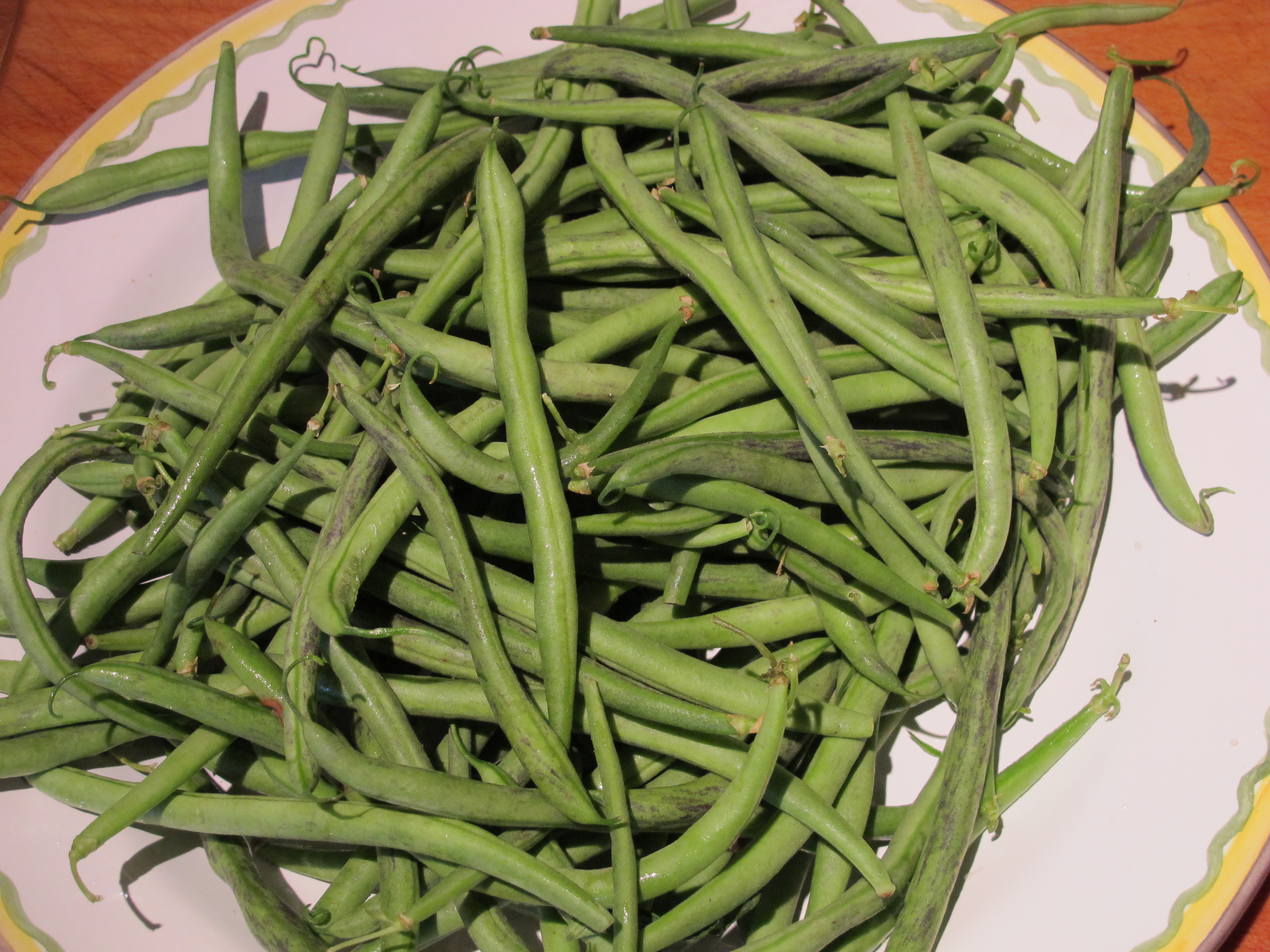
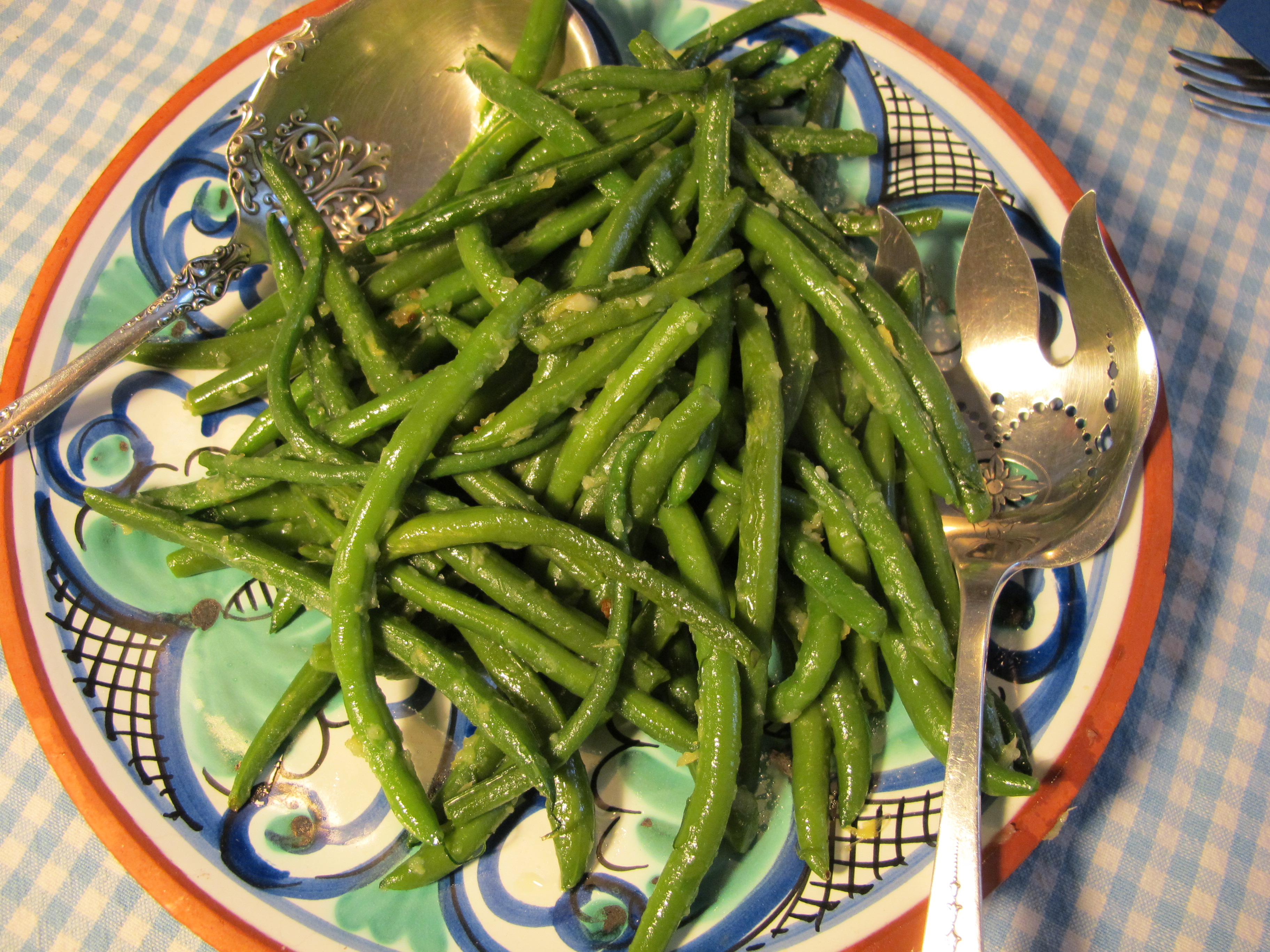
This is green bean time and here on the stalls they are piled high–picked last night I am assured.

a pile of beans

Joy!

Cooked enough to be tender,  yet still a vibrant green–but not too much so that they become flabby and dull in color. It’s hard to tire of them.

It’s always good to discover new ways to cook them.

I spotted this simple recipe in The New York Times a few weeks back. As I’d bought half a kilo of new season garlic and ginger this morning, Give it a go!, I thought.

My slightly adapted version

for 4

1lb green beans— topped, (no need to tail)

1 teaspoon of salt

2 cloves of new garlic-– (or the best looking you can find)

a large thumbnail size piece of ginger–peeled and chopped small

1 teaspoon salt

2 tablespoons of olive oil

  • Have a bowl of cold water ready to plunge the cooked beans into.
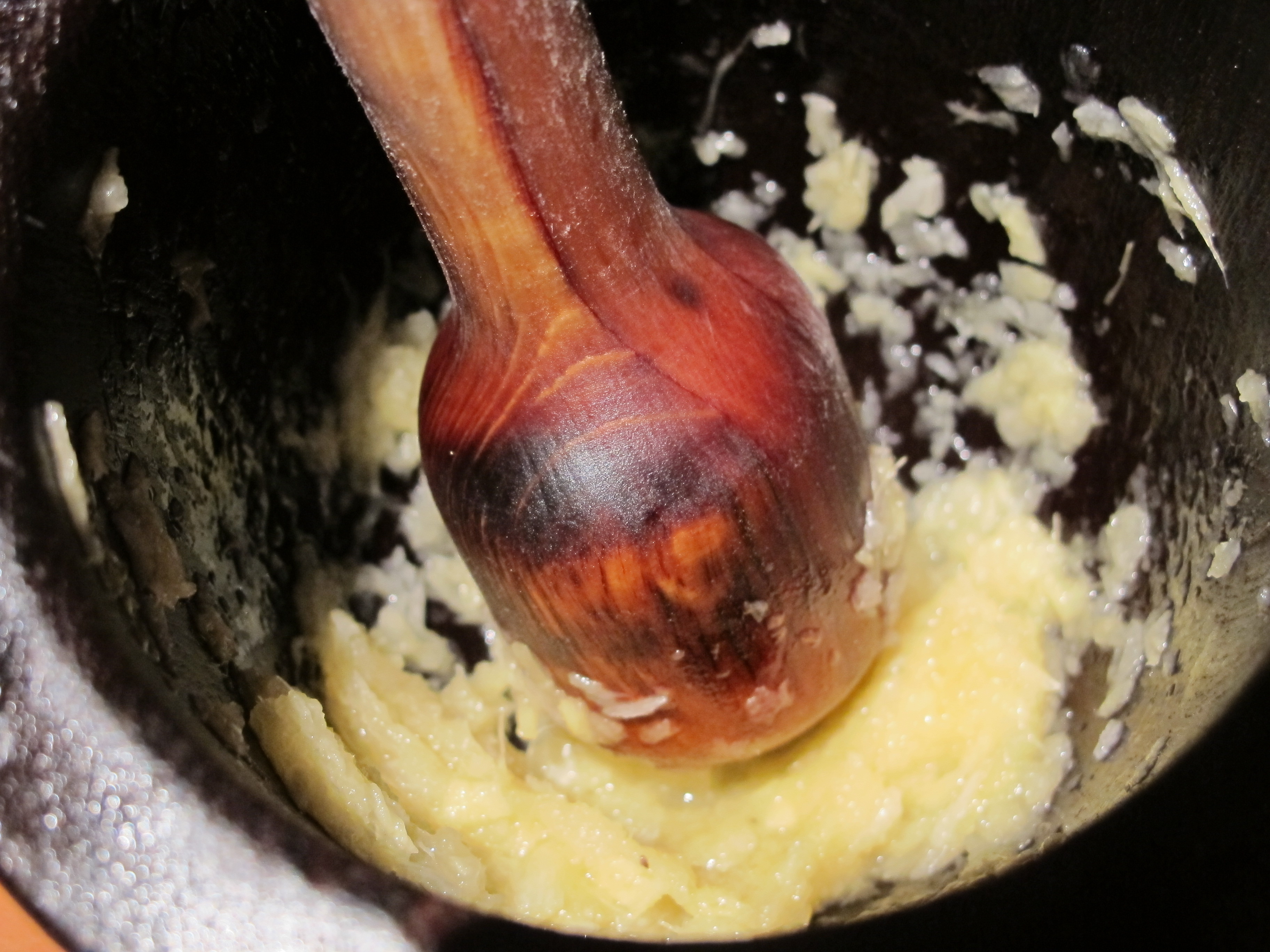
  • Pound the garlic, ginger and a teaspoon of salt into a pulp.
  • Bring a large saucepan of water to the boil.
  • Add the beans and cook them until almost tender to the bite–(a pair of cooking tongs comes in handy here to whip a bean out for a bite test).
  • When you judge they’re ready, transfer them quickly into the bowl with the cold water–to stop them cooking further.
  • Drain them and leave to dry a little.
  • Heat the olive oil in a large sauté pan.
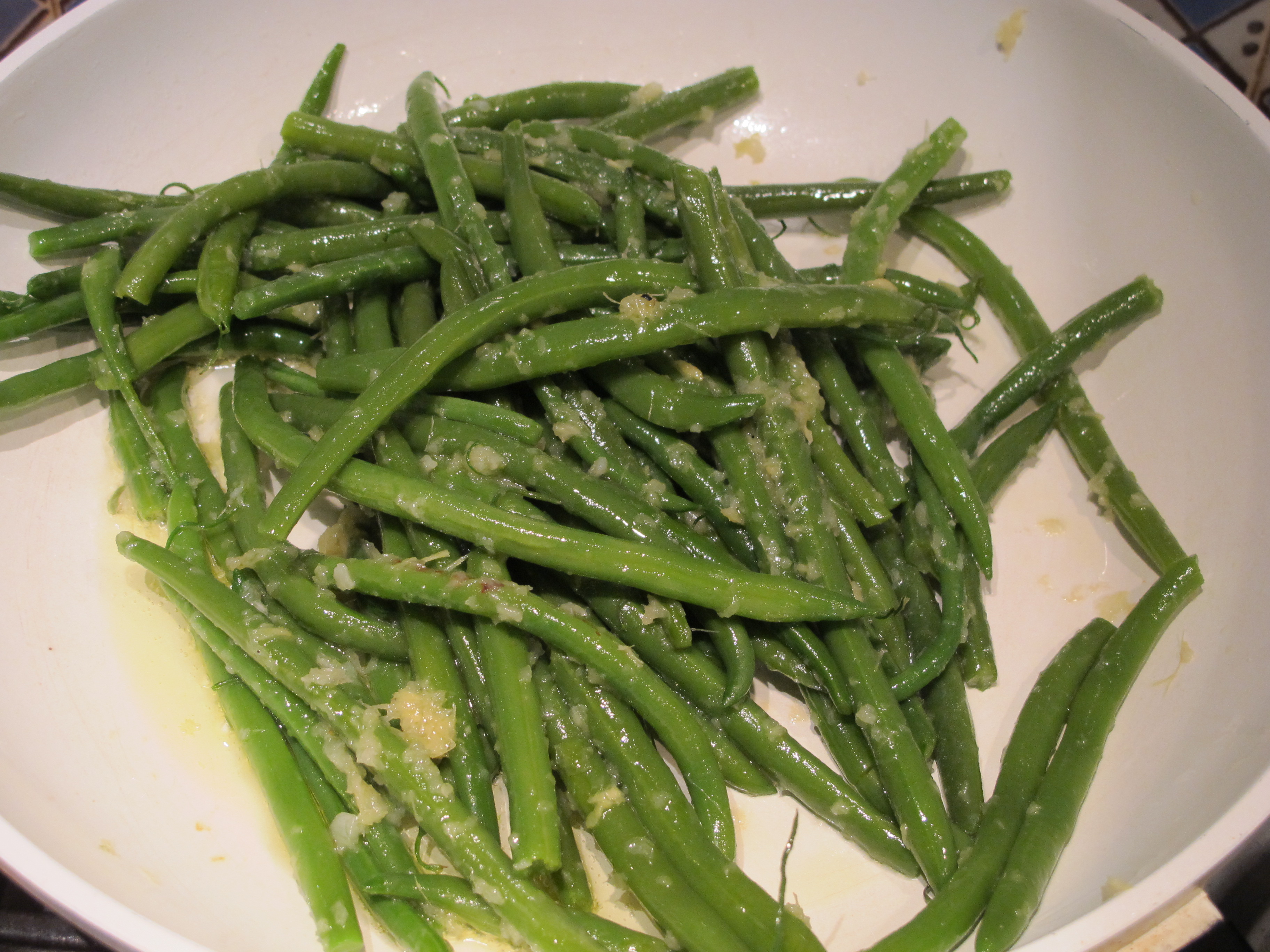
  • Add the beans and the gorgeous garlic and ginger gunge.
  • Over a gentle heat turn the beans in the mixture until they are nicely heated through.
  • Taste them and add more salt if needed.

We had them for lunch today…

with a butterflied pork chop–of which more later….

Read Full Post »
« Newer Posts - Older Posts »