I finish my walk this morning and begin stretching against the cemetery wall.
I see Hervé our neighbor in the cemetery with a hoe in his hand.
“Just attending to my ancestors before the rain,” he says.
By November 1st–All Saints Day–the cemetery will be covered in flowers both artificial and fresh.
Chrysanthemums are prominently on display.

Hervé is turning over the earth of the smaller of two plots–a narrow rectangle with a stone cross at its head.
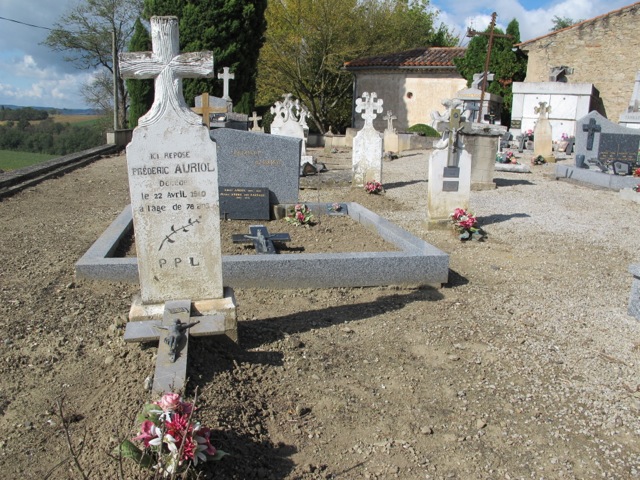
“My Grandfather,” he says “died in 1941. I was one year old.”
“And your father?”
He points to the adjacent plot which is twice the size and relatively more recent and has a granite tombstone at its head with clearly visible gold embossed lettering.
“Died 1941–I was two years old.”
“I seem to remember you telling me that he died in an accident…?”
“Yes–hit by a cow.”
“In those days,” he says, “people would go to market in Realmont [a distance of 12 kilometers] or even Albi–[25 kilometers] to buy their cow(s) and walk them back home. Took them the best part of a day.”
“My father had bought his cow for a daily supply of fresh milk–it was the second year of the war in France– and was walking it back to the hammeau [hamlet] when a lorry passed by too close, hurling the cow into my father and killing him. The cow survived. ” Hervé says.
His mother was left with seven children to bring up on her own.
“It was hard.”
Hervé is retired now from the bank in Castres where he spent his working life. He and his wife Maité, live in the house opposite the one in which he and his six siblings grew up.
“Strange isn’t it,” he says “So much less traffic on the roads those days than now and my father died in a traffic accident.”
“Ironique…” I say.
“Bonne continuation et dit “bonjour” a Maité.”
“Le meme a Meredith.”
He was right about the rain–coming down in sheets just before lunchtime.


 Robin Ellis