Feeds:
Posts
Comments

Archive for the ‘Poldark’ Category

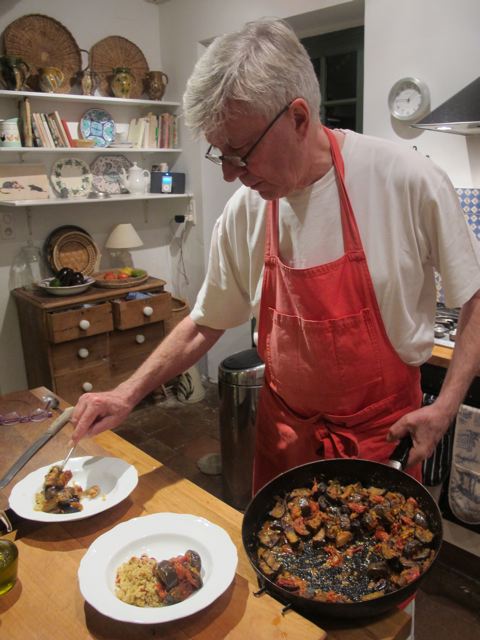
We had these last night with quinoa, plain green beans, and garlicky yogurt sauce.
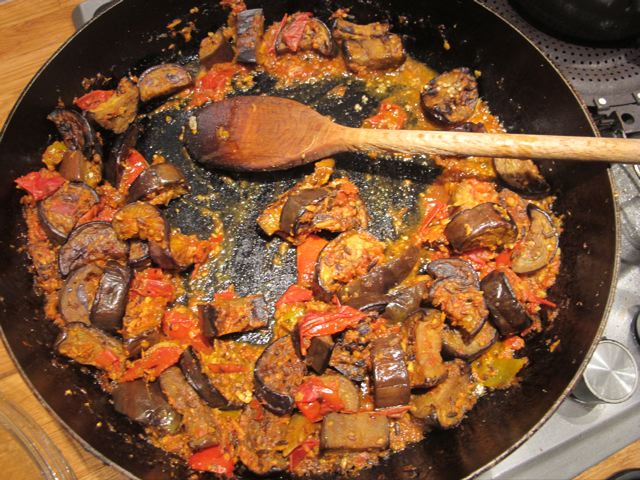
It’s adapted from a recipe by Rick Stein–known as the uncrowned king of Cornwall.

When we were filming Poldark in Cornwall 35 years ago, eating out in the county was very different from what we experienced last weekend and Rick Stein has a lot to do with it.  His fish restaurants in Padstow have set a benchmark. Things have improved!

We tried to reserve a table at one of Rick’s places a couple of weeks before our trip but they were all booked–sad for us but “Hooray” for Cornwall!

for 2+

500gms/1lb aubergines–cut up into smallish pieces (quicker to sauté), lightly salted and left in a sieve or colander for an hour to drain off their liquid, then dried ready for the pan. (This seems tedious to do but they absorb less oil this way.)

4 tablespoons olive oil

1” square piece of fresh ginger--chopped fine

3 garlic cloves–pulped with half a teaspoon of salt

1 tablespoon of water

2 tablespoons whole fennel seeds

1 tablespoon whole cumin seeds

1 tablespoon whole coriander seeds–crushed

1 teaspoon turmeric powder

1 teaspoon chili powder

500gms/1lb tomatoes–chopped with their juice (or use tinned)

3 more tablespoons of water

  • whizz the ginger and garlic in a tablespoon of water to form a loose paste.
  • heat a tablespoon of olive oil in a large sauté pan that you can cover.
  • when hot, add a single layer of  the dry aubergine pieces.
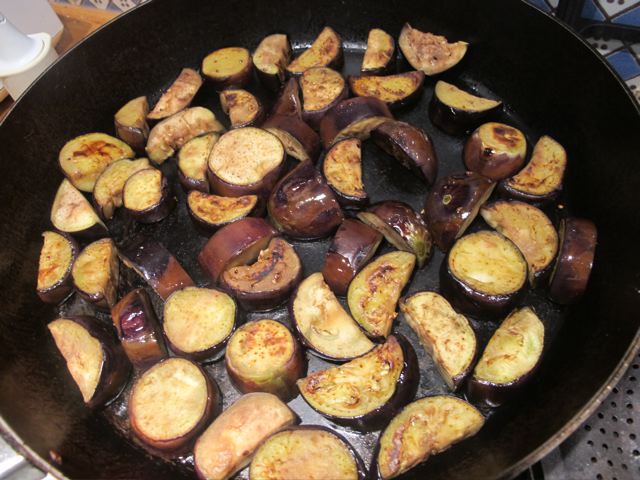
  • turn them in the oil and sauté on all sides until nicely browned–a pair of cooking tongs comes in handy here–then set aside. (It’s worth taking your time to make sure the aubergine is cooked through.)
  • continue the process until all the aubergine pieces are cooked, adding more oil as needed.
  • let the pan cool a little before heating two tablespoons of oil and adding the fennel and cumin seeds.
  • let them colour for a few seconds before adding the ginger and garlic paste.
  • cook this gently for a minute or two before adding the coriander, turmeric and chili powder.
  • cook this gently for a minute before adding the tomatoes and the extra water.
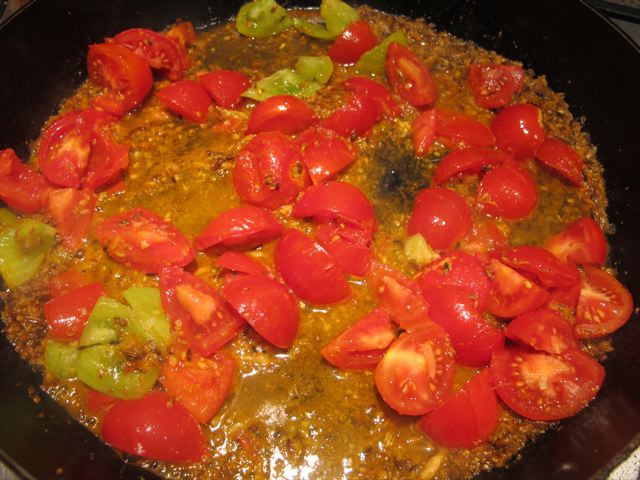
  • turn the lovely looking mix over and cook on a low heat for ten minutes to form a sauce.
  • add the aubergine pieces turning everything over thoroughly before covering the pan and cooking for a further 5 to 10 minutes.
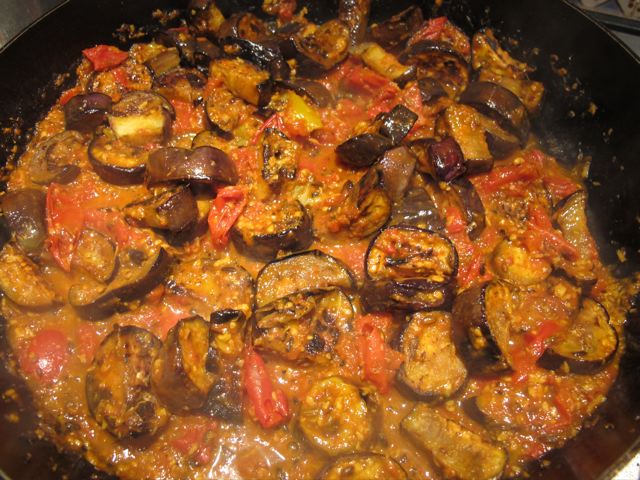
  • test the doneness of the aubergines, cooking them a little more if necessary, adding a little more water if  needed.
  • check the seasoning and sprinkle some chopped mint, fresh coriander, or parsley over the dish before serving.
Read Full Post »

I was back in Cornwall last weekend for the first book signing session at Waterstone’s in Truro.

The county is in fine form and this cathedral town was buzzing on Saturday morning.

Bev–who with her husband had driven all the way from Nottingham–made me feel a little underdressed!

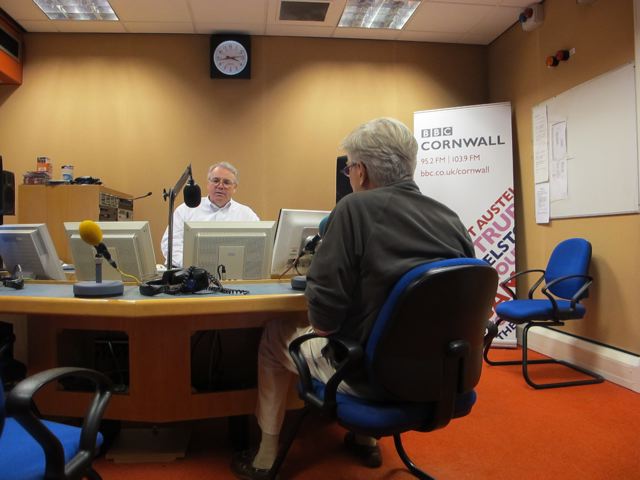
Here’s my interview with the excellent and sympathetic Martin Bailie at BBC Radio Cornwall last Friday–me trying to avoid the “errs” and “ums”!.

"On the spot" at BBC Radio Cornwall!

PS–according to an email received today from the US publisher (Skyhorse)–the book is now available in the States…!

Read Full Post »

A Hundred and Fifty Two posts and…

…I’m going to have a few days off.

Partly to finish the update of a book I wrote years ago called Making Poldarkand partly to have a few days off!

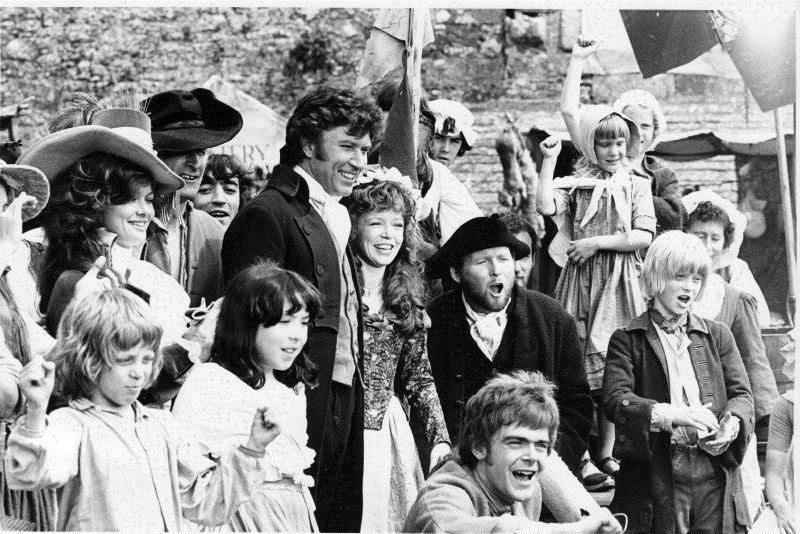
Back in 1978 I was commissioned by Bossiney Books (a small publisher in Cornwall)  to write an account of the filming of the two series. I updated it in 1987 and it had a life with the issue of the videos and the DVDs (only recently released in the United States).

Acorn Media are issuing a box set of both series in the USA soon and are including, as a special “extra”, the first chapter of my original memoir. That inspired me to begin work on a further update.

Here’s a “sneak preview” of the draft of the new chapter:

Making PoldarkPART 3

Twenty five years on and I’m living in a Presbytère—(priest’s house– the last priest moved out 90 years ago)—deep in the countryside of SW France with an American wife, Meredith, six cats and a hen.

I shop in the local markets and cook for the two of us twice a day. I’ve written a cookbook for Type Two diabetics and blog most days about that, cooking and the life here.

 What happened to the actor who for years feared the day he discovered he didn’t need to act anymore?

What happened to the townie who found the countryside beautiful–but dull–and couldn’t wait to get back to the city on a Sunday night?

 Well—“life moves on” is the easy answer, but that won’t do.

 When we reissued Making Poldark in the late 80s, Meredith and I were living in a Victorian house in north London, not far from where I grew up around Hampstead.

London is blessed with large parks and Hampstead Heath was a brisk walk away—you can lose yourself in the woods there and make believe you are in the countryside and still be a 15 minute walk from the local movie house.

 I had never thought of owning a second home in the sticks—let alone in France. (I knew Italy better and went to Florence regularly—I love the Italian kitchen.)

It was a shock then to hear myself asking the friends of Hughes Rudd—Meredith’s colleague and friend from ABC News in New York, who had retired down here–if they knew of anyone selling a house. 

More shocking still—having visited the house Hughes’ friends came up with—to find myself offering the owner the asking price five hours later! Not exactly businesslike, but the truth was I’d fallen in love (coup de foudre)—again.

 Meredith, coup de foudre no. 1 (lightning strike) in 1986, and I were getting married in the summer and though she thought the house was a gem—she must have been asking herself : “Do I need this and a wedding to see to?”

 We were married at the Rosslyn Hill Chapel in Hampstead in August and had our reception at the London Zoo.

We honeymooned at the empty house in the Tarn—empty apart from a couple of large beds a friend had made and some cardboard furniture.

The year was 1990.

To be continued…!

Thanks everyone for your continuing support–I am getting a big kick from doing it–and from reading your comments.

A trés bientôt…

rxx

Read Full Post »

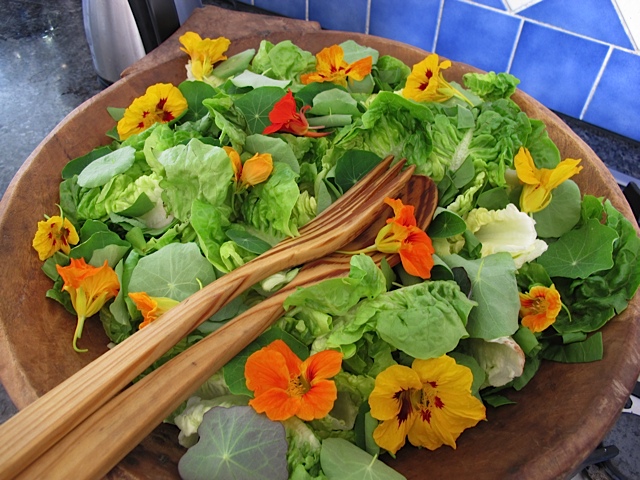
Still life--salad bowl

We were invited for lunch at our friends Donald and Emma’s yesterday.

Donald Douglas of that ilk!

He who gave up chasing me over the Cornish cliffs dressed as Captain McNeil years ago (sensible fellow) and settled down a few miles from us here in France.

I’m always slightly wary of visits to Donald–never sure he hasn’t a troop of redcoats hidden in the stable–just kidding!

Donald, apart from being a fine actor, is a talented gardener and an artist–happy experimenting in any medium.

Even food.

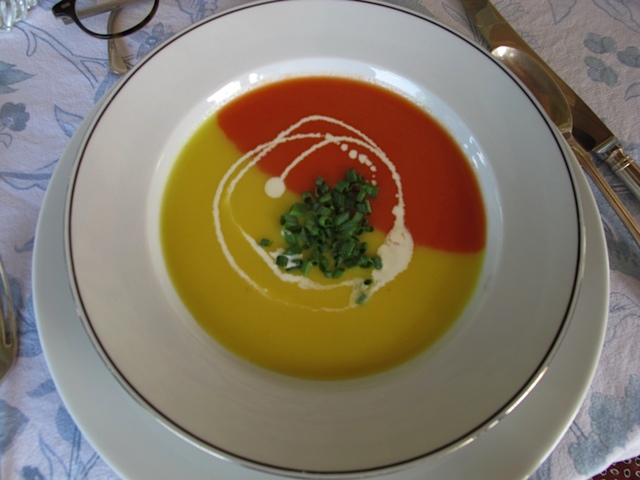
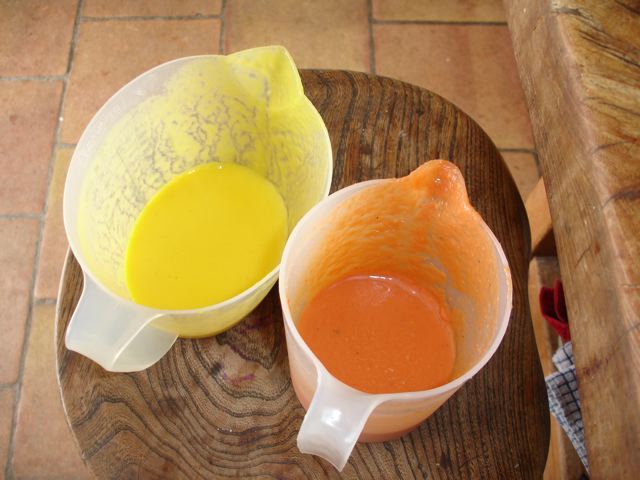
This is chilled Red and Yellow Pepper Soup with chives.

Or is it a painting?

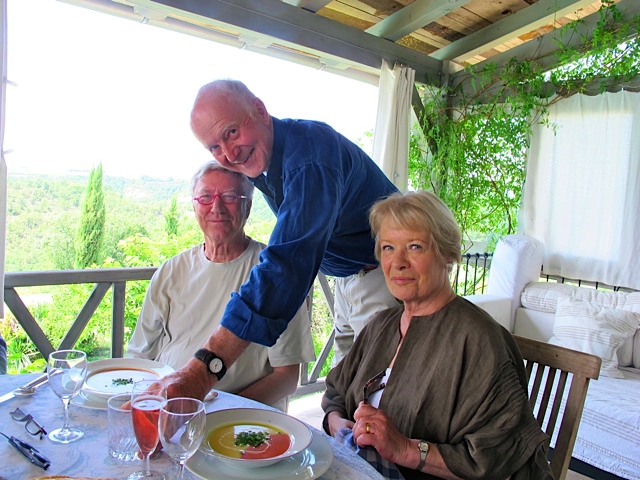
Three (Robin, Donald, and friend Miranda) about to eat the painting...

No–it’s lunch.

In fact–it’s an edible action painting.

He makes the two soups–being careful they are of the same consistency–and fills two jugs.

He chills them and when the guests are seated he starts to “paint”–pouring from both jugs at the same time.

He adds a swirl of cream and a large pinch of chives to each bowl and hey presto–

ART you could EAT!!

Read Full Post »

I am just about to spread the “no-added-sugar fruit paste” on my regular 2 pieces of 100% rye this morning with a bone-handled dessert knife, when I’m minded to look more closely at the blade.

This prompts a memory surge going back 60 years.

The knife has seen better days; the bone handle is split, but still feels comfortable in the hand.

The name of the shop it came from–Bravingtons–is clearly visible on the small broad blade–which spreads the fruit paste nicely.

I always liked the knives from this set–probably a wedding present for my parents from Ma’s uncle Harry, back in April 1938.

They were in everyday use when I was a boy–perhaps helping to establish my pernickity taste in cutlery. My enjoyment of food is always affected by what I am eating it with.

Great Uncle Harry Weakford, worked at the Bravingtons in Knightsbridge, selling silver to the posh.

He was my mother’s father’s brother.

This branch–just down from Harrods–had the familiar black-marbled, silver-lettered banner front–favoured by pre-war jewellery shops.

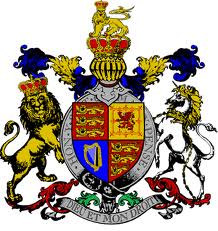
The Bravingtons shops proudly displayed the Royal Coat of Arms–as the official supplier of cutlery to the Queen.

Uncle Harry was a jovial cove who lived with his wife in Norbury, south London, where my mother was born & raised.

Once we visited for tea in the Fifties. I remember watching Leslie Howard in The Scarlet Pimpernel (1934) on their telly. We didn’t have a set at home, and I recall being swept up in the brave romance of it all. (Little did I know that years later I’d be rescuing French aristos in the guise of Ross Poldark!)

Uncle Harry, like my mother, had diabetes–and these thoughts about the knife make me want to know more about him and

remind me how “family inheritance” can be a mixed blessing!

Read Full Post »

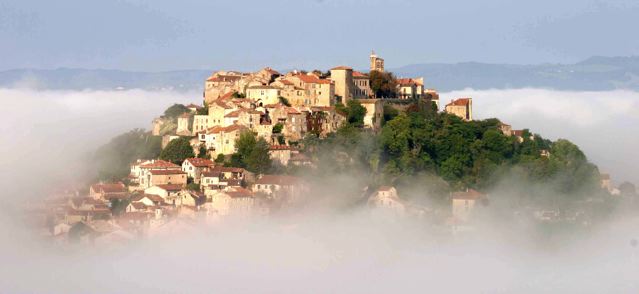
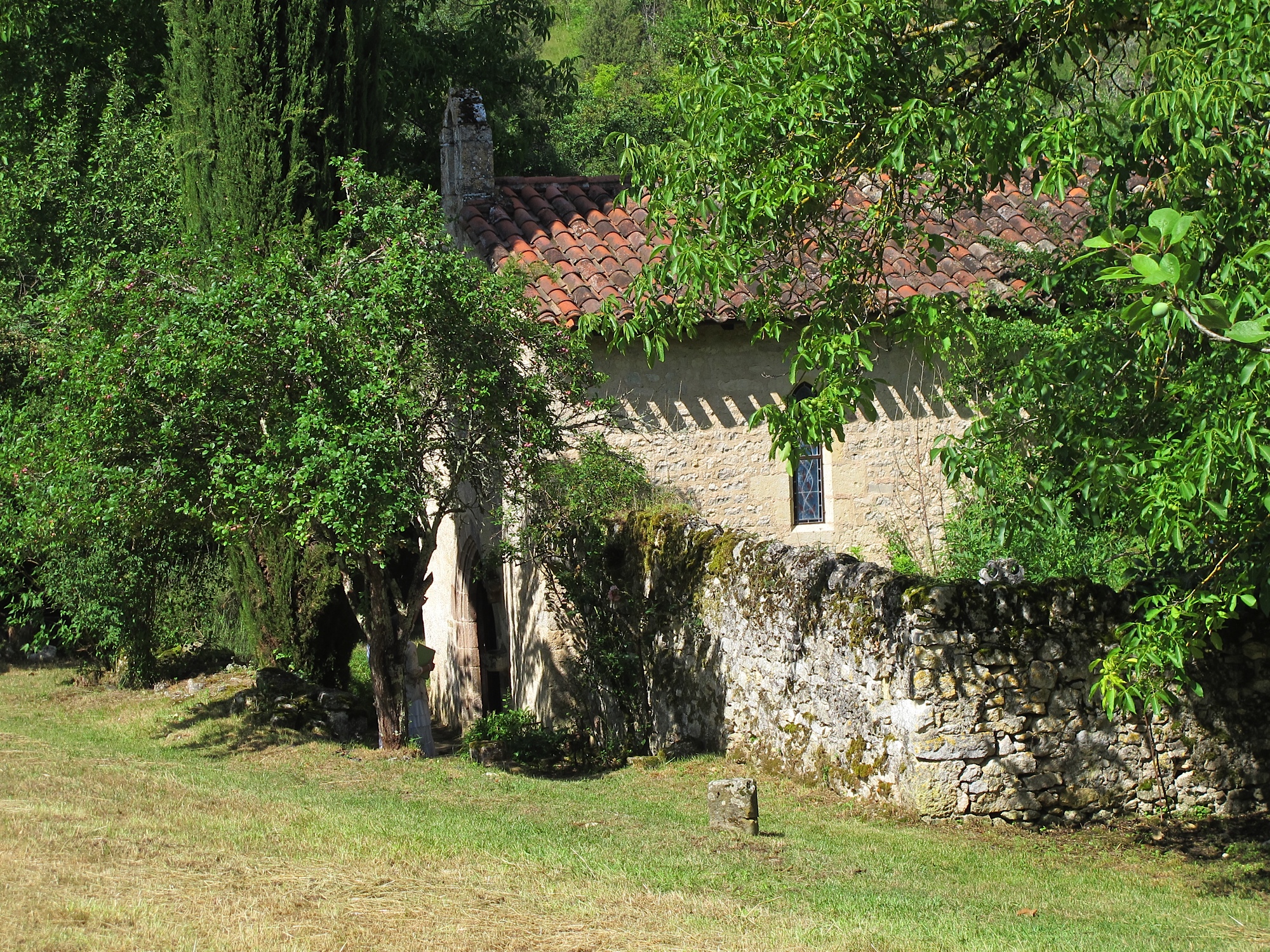
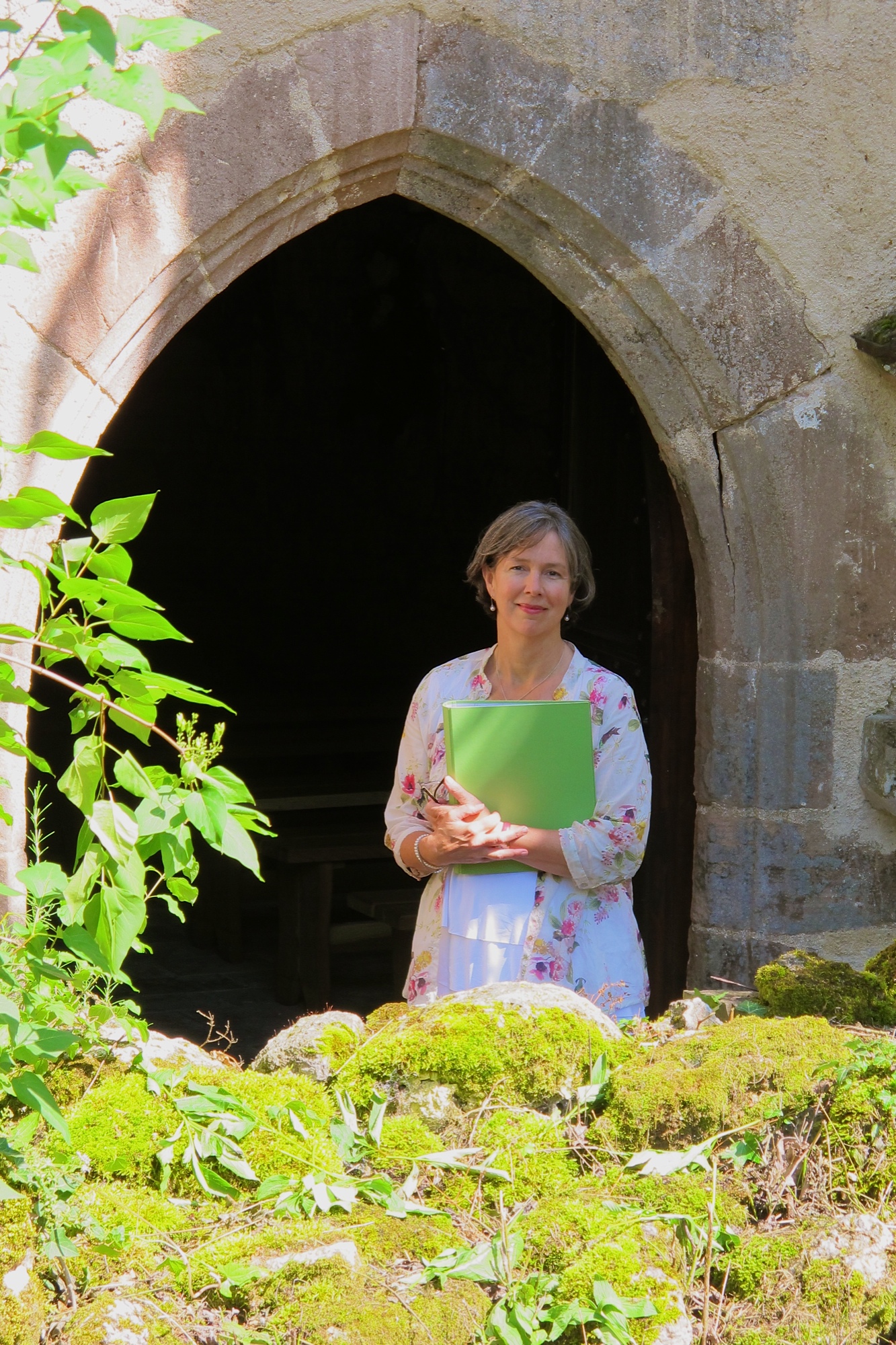
A Blessing Ceremony in the tiny chapel of  St. Jean in the valley beneath the medieval hill town of Cordes sur Ciel….

Donald Douglas’* daughter Eliza’s marriage to James in Michigan, is being blessed here–for friends and family this side of the Atlantic.

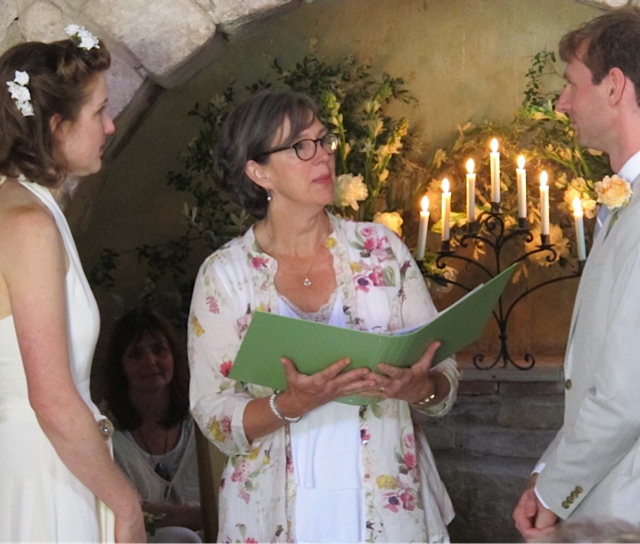
Eliza has asked Meredith to be the “Celebrant“.

Meedith is nervous–it’s yet another “first” for her and there has been no rehearsal.

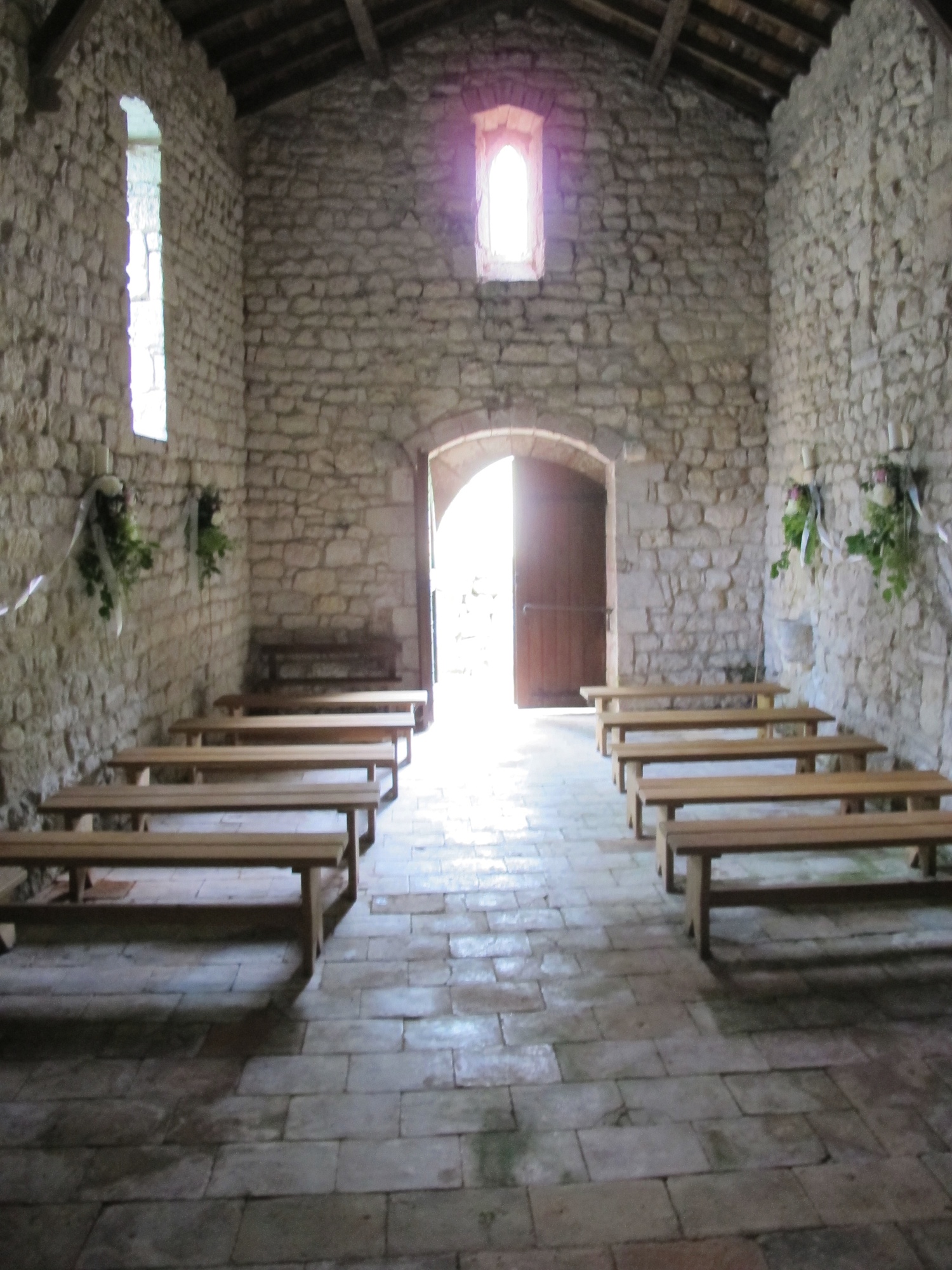
We arrive early at the chapel–founded in 1224 near a place of safety from the plagues that hit the unhealthy walled Cité high above it.

There is minimal light for reading, which adds to the anxiety and the hour approaches.

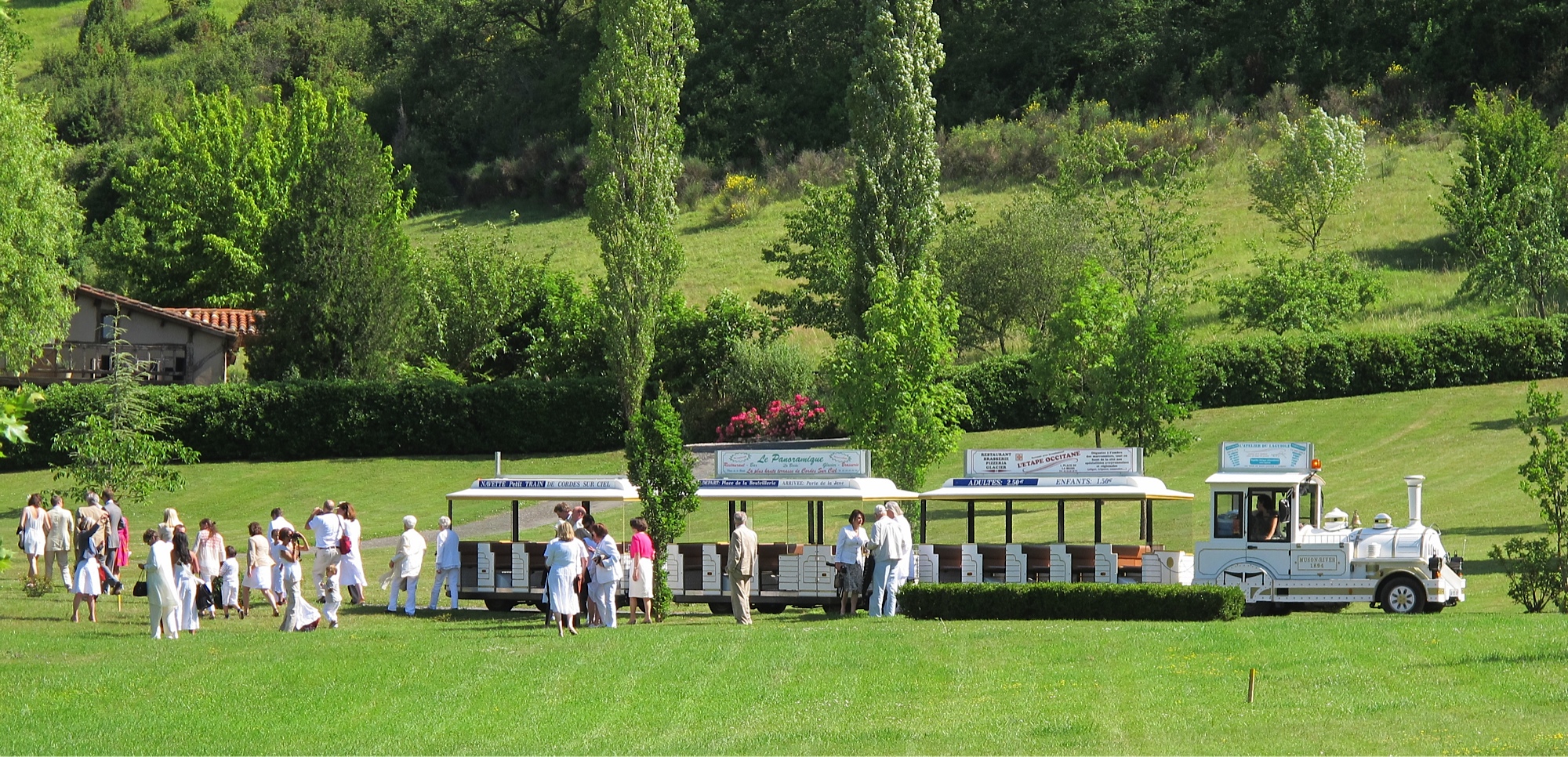
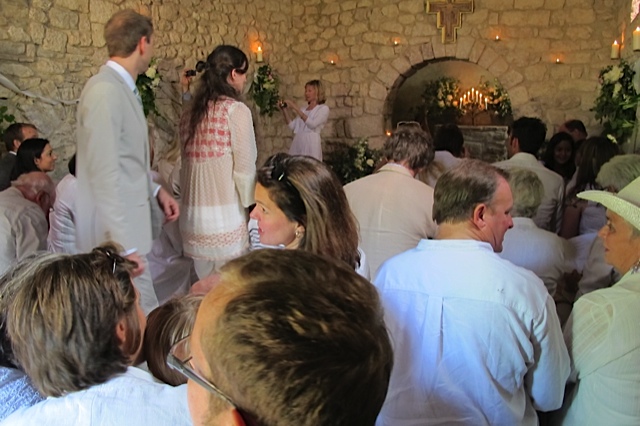
But by the time the guests arrive–all decked out in white (the couple’s request)–by “Le Petit Train”  from Cordes…

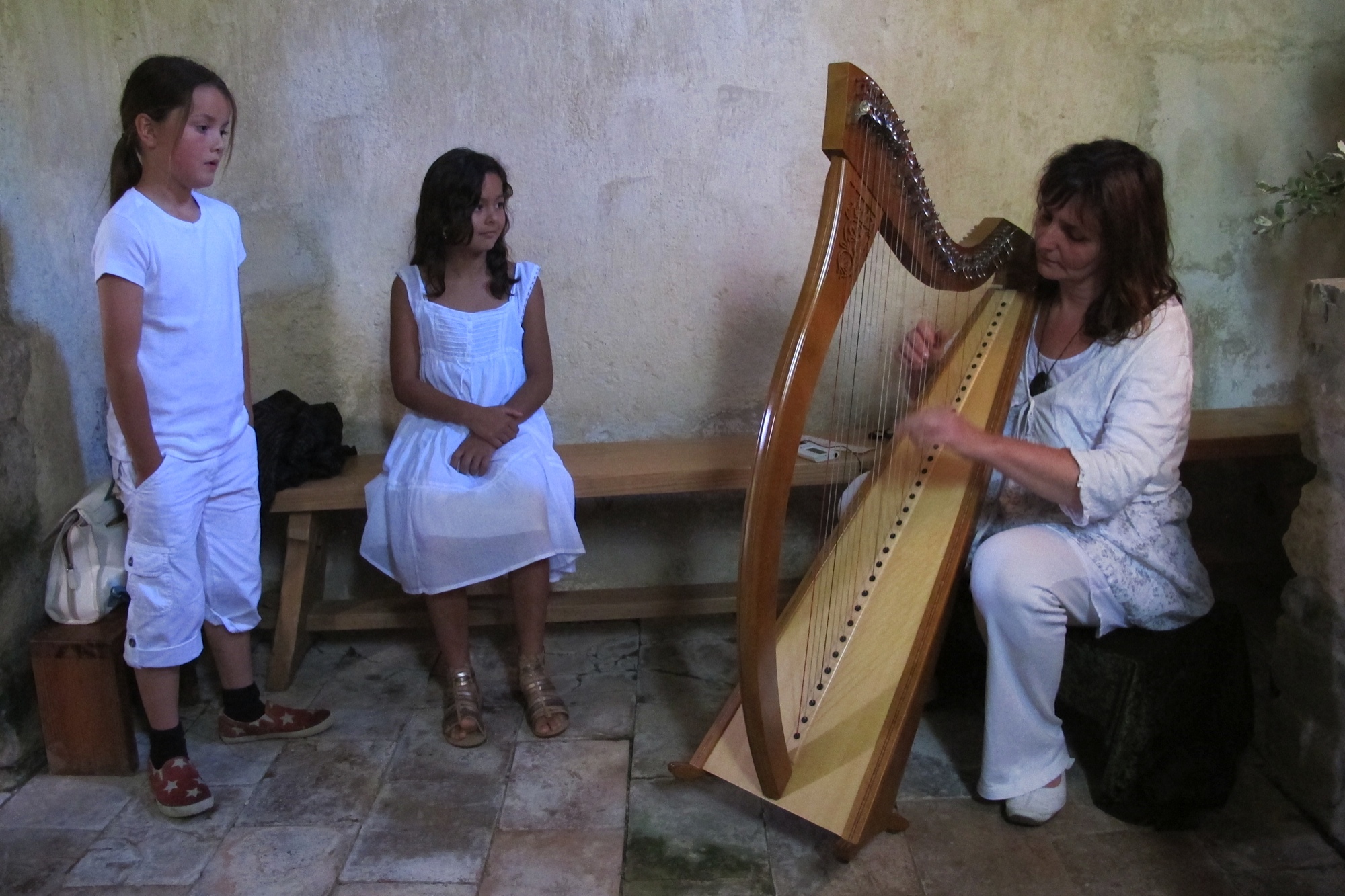
–more light has been shed inside (candles lit) and on the words (a few run-throughs) and Veronique is spreading calm from the strings of her celtic harp.

The chapel–decked out with white flowers–and  Meredith, are ready to welcome the buzzing crowd–about fifty adults and children–to this ancient site.

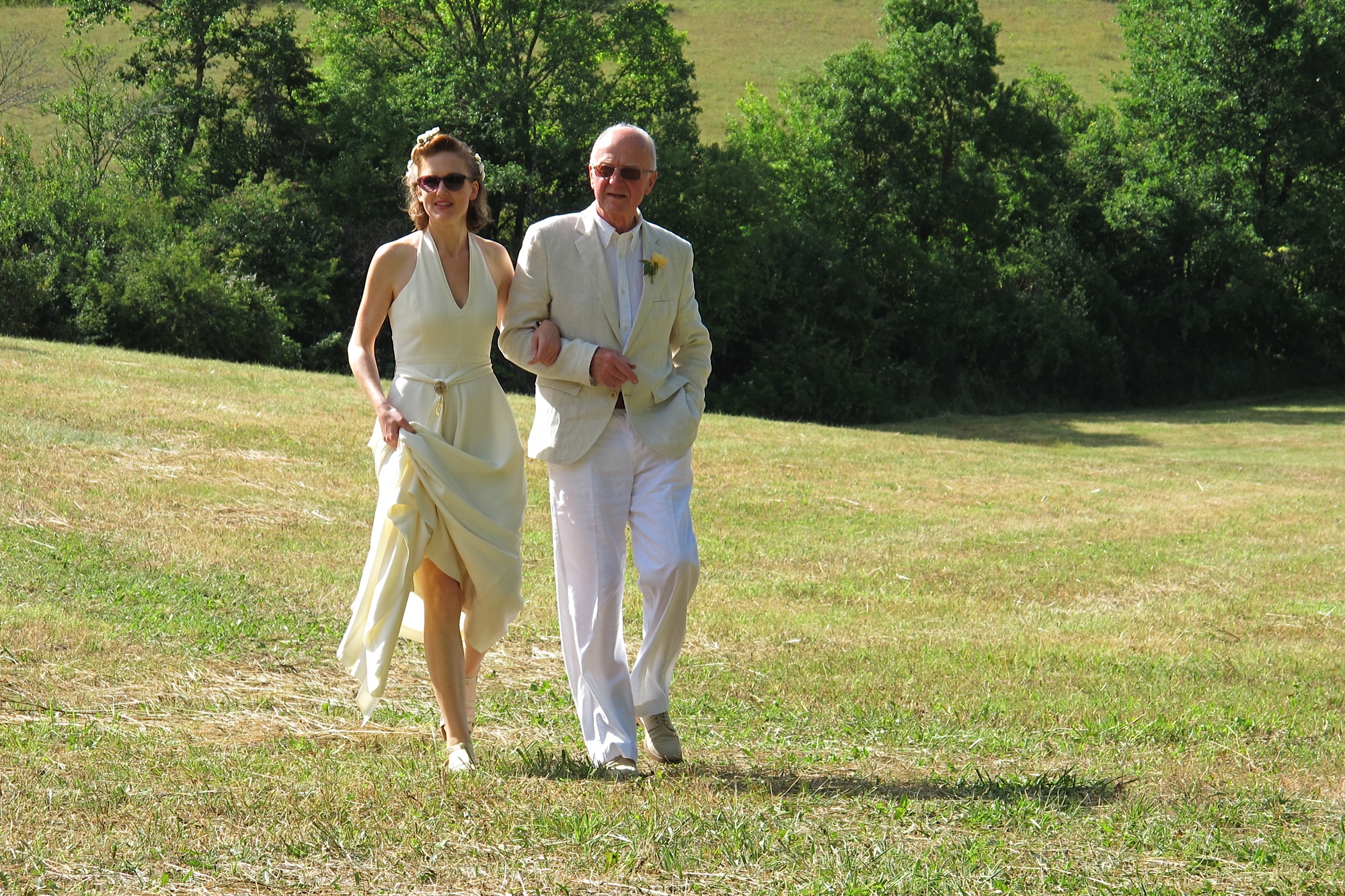
The bride approaches on her father’s arm and the ceremony begins.

It goes off beautifully, of course–Meredith performing her priestess-like duties perfectly with clear-voiced sincerity.

Poems–chosen by the couple–including Shakespeare’s 116th Sonnet (“Let me not to the marriage of true minds…”) are thoughtfully read.

Donald sings in his broadest Scots brogue, “The Braes O’ Birniebouzle“, so splendidly, we all burst into spontaneous applause.

As everyone files out our aptly named friend, Puck, whispers in my ear: “You know that from now on you’ll be known as the Vicar’s wife!”

*(Captain McNeil in Poldark)

Read Full Post »

In the middle of filming the second series of Poldark, Angharad and I went on a PBS (Public Broadcasting Service)  promotional tour of the States. The first series had just started to play there. It was late spring 1977.

Boston, New York, Washington, and Dallas.

Five days–four cities; crazy, glamorous and fun.

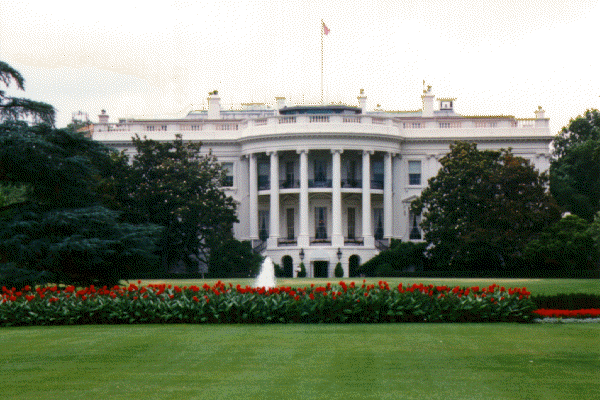
At nine o’clock, the morning after arriving in Washington, we were given a private tour of Jimmy Carter’s White House–including the Oval Office.

Bleary-eyed and jet-lagged at the time, I recall very little.

Did  “Ross Poldark”–veteran of the losing side in the War of Independence–back in enemy territory, cheekily sit–momentarily–in the seat of power behind the desk?

I sincerely hope not!

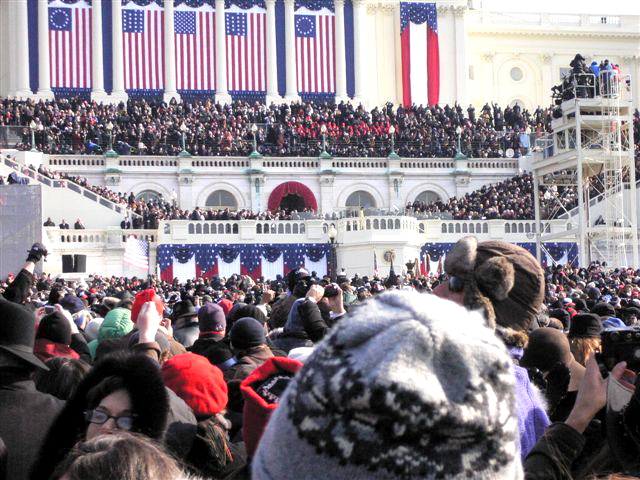
Fast forward forty two and half years and I was in Washington again–with Meredith this time, to witness the inauguration of Barack Obama as President.

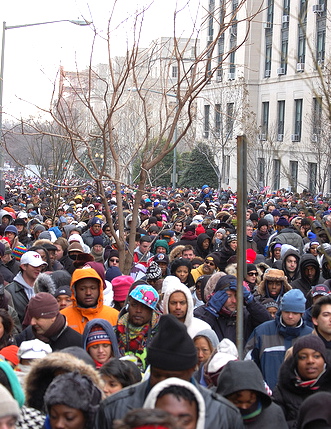
It was a bitter cold day with a brilliant blue sky and in the streets a solid mass of people were proceeding slowly towards the Mall to hear the new President speak.

There was a palpable feeling of hope and expectation in the air–of healing and renewal.

Meredith was elated–she had a ticket for the enclosure in front of the Capitol.

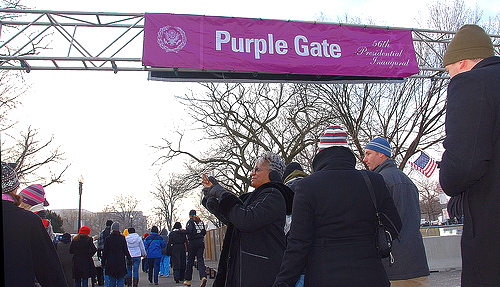
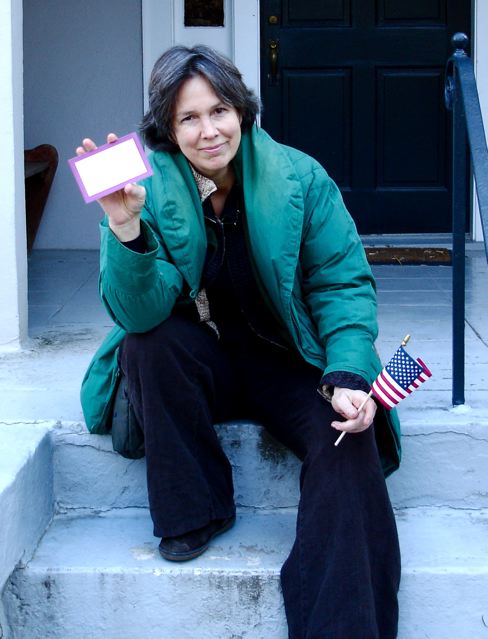
When I dropped her off at the subway at six a.m., she was clutching her purple ticket in her hand.

Four hours later she called me on the cell phone–in tears–to say there was a problem at the purple gate and it wasn’t looking good.

In the end 10,000 people failed to get through the purple gate!

Poor Meredith joined us at our friend’s club close by, to watch it all on television.

She calls it an inexplicable “snafu”–nobody ever found out exactly what went wrong.

Snafu!

A couple of glasses of champagne and the sight of history being made helped to restore her spirits.

A little over two hundred years after Captain Ross Poldark limped home to Cornwall and  General George Washington became the first President of the then thirteen United States of America, an African American was entering the White House as President–which black slaves had helped to build.

It was a momentous day.

Fast forward againWashington to London yesterday–Stansted to Carcassonne this morning and whoosh–we’re home!

President Obama and the First Lady– forced to curtail their Irish visit by the ash cloud–flew into Stansted last night on their first State visit to the UK.

This morning they met with the present incumbent of “Buck House”, with whom–we’re told–they have very friendly relations.

Buckingham Palace

(George III bought Buckingham House in 1761 for his wife Queen Charlotte–before going on to lose “the Colonies”.)

The world goes around…!

Read Full Post »

We were filming the second series of Poldark in spring 1977 and were based for a while near the seaside town of Padstow on Cornwall’s north coast.
On May 1st the town is taken over by the ‘Obby ‘Oss (Hobby Horse) Festival–an excuse for a day of communal good natured madness and merriment, with obvious origins in traditional fertility festivals that pop up everywhere at this time of year.
This is the account of it I wrote in my book Making Poldark .
 We’d finished filming the expedition to France,

"Operation Rescue"!

 and it was May Day;  a group of us decided to go to Padstow for the Festival.
We arrived at about 7 pm, and from far away we could hear the beat of the drum and the music.It had been going on for at least twelve hours and the atmosphere was “jolly” –you might say. We rounded the bend and came into a square and there it was! The umpteenth parade of the hobbyhorse in full swing.
The drumbeat was mesmeric and the man inside the hobbyhorse never stopped moving–round and round he went, tempting and teasing the circle of young maidens. A pagan ritual full of fun and danger. Not English at all.


Someone in the crowd recognised me and although George Collins, my dresser, insisted I was his cousin Fred, and not Poldark,  they weren’t convinced!  So we moved on quickly to a pub down the hill.
The beer and the cider were flowing freely, and it happened again and again.
I was bought pasties and pints everywhere. 
A man in one of the pubs came up and said, “You’ve put Cornwall on the map. Thank you.” I was amazed and flattered, a  little embarrassed and by this time somewhat stewed.
We settled down in a corner to listen to the accordionist. We sang and we danced and everyone forgot about Poldark. It was a great night.
I suppose I was naive to think I could go to a big Cornish festival like this and remain anonymous–television is a powerful and popular medium–but as for “putting Cornwall on the map”– on the evidence of this particular evening–it later occurred to me that it might be the other way around.

The Poldarks enjoying a previous 'Obby 'Oss fayre?

Read Full Post »

Lunch in a UFO today.

It’s sitting in a French field,  looking spectacularly out of place–as any self-respecting UFO would.

The owner tells us it’s coming up to two years now since they landed.

He built it himself, from packs–“like Ikea! he says. Packs or no packs, it’s a piece of work and it revolves 360 degrees–as any self-respecting UFO would.

It’s beautiful inside with many  features that are familiar to us: a high-tech kitchen, a dining area and toilets.

It has living quarters too and there are children’s toys lying around. This is obviously both a home and a work place.

The owners call it Dôme de Montmiral.


It is a couple of miles from the Castelnau of that name, though there’s about a thousand years of history separating them. We ask if there were any problems getting permission to build it there–sorry, to land it? “No, everyone was for it–but we had to go to the highest level.” Well, you would for a UFO…..

Enough of that!

The Dôme is an unusual restaurant, set in the middle of  beautiful countryside in the north Tarn, here in southwestern France. Its shape resembles a flying saucer and it serves vegetarian food. A bioclimatic house, made from wood–it is self-sufficient in many ways.

This is the fantastic project of Valérie and Raymond Moncan. She is the cook and she’s passionate about it; quite a change, as she used to be a professor of  Latin and Greek!

She serves a fixed menu–though you  can have input when booking and she is sensitive to special needs.

I notice the shelves are full of cookbooks which I can’t resist investigating. The first one I pull out is titled: “Mal de Sucre” [the evil/curse of sugar]. I feel I’m in good hands!

Today we’re having lunch with Donald Douglas –aka “Captain McNeil”–my old enemy in Poldark.                      

Old rivals call it a day!

It’s his birthday and we are celebrating with his partner and other friends.

There are three courses for 25 euros with wine on top.

The food is different–more delicate than the usual restaurant vegetarian. In fact it is vegan–no dairy products. It’s tasty and lightly-spiced and  perhaps a little other worldly…?

Shredded patés of beetroot, apple and mushroom with seasonings

Kitcheri of basmati rice & red lentils with vegetables

The sort of fare one might imagine being served in a UFO….!

Read Full Post »

This cherished treasure of the far west of England has achieved special status.

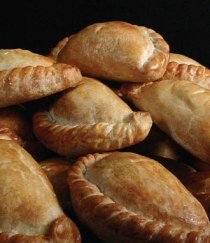
The European commission ruled yesterday that the Cornish Pasty has won Protected Geographical Status or PGS; in other words, it’s officially  Pretty Good Stuff!

The EU ruling states that a genuine Cornish pasty has to have a distinctive “D” shape, and be crimped on one side, not on the top.

“The texture of the filling is chunky, made up of uncooked minced or roughly cut chunks of beef (not less than 12.5%), swede, potato, and onion with a light seasoning.” Not good for type two-ers!

I know something about this great local delicacy. I spent an entire morning’s filming inside the coach that completed Ross Poldark’s return from the American War, the first scene of the series, having the intricacies of pasty making explained to me, between takes, by a delightful lady extra called Elizabeth Coad.

I also learned from a former miner the reason these beauties have an indented ridge over the top. Apparently during a day’s work at the tin or copper face, often two to three thousand feet below the surface, a miner’s fingers would become impregnated with poison from the metal and the ridge of pastry was what he held  the pasty by, to be discarded afterwards. The pasties often contained a two course meal–the meat and potato in one half and apple in the other! Miners used to leave a small portion of their pasties down the mine after their shift for the ghosts of old miners, the Knockers they called them.

Real Cornish miners having a pasty break.

"Miners" in costume.

Read Full Post »

« Newer Posts