Feeds:
Posts
Comments

Archive for the ‘Food’ Category

A month to go to the publication of  “Delicious Dishes for Diabetics–a Mediterranean Way of Eating“.

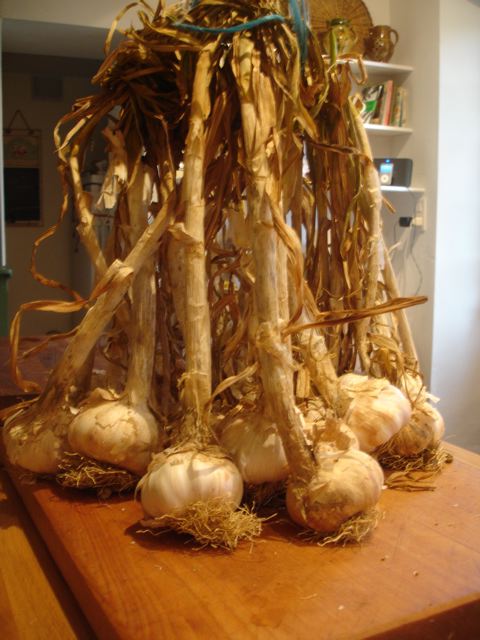
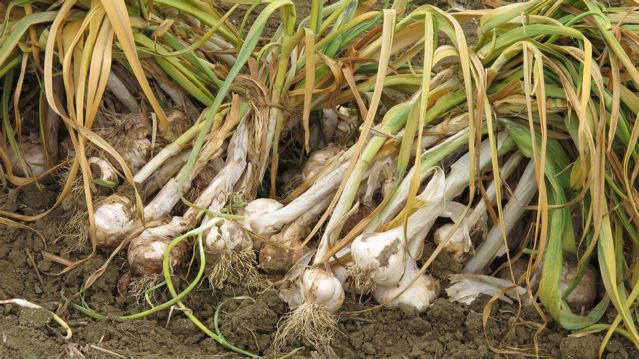
Our local garlic [l’ail rose, pink! ] harvest is almost over and the fields are stacked with tresses waiting to go to the barns for drying.

It’s a longer lasting garlic than the violet or white–that’s what Alice (maker of the garlic soup) says and adds “it’s Lautrec’s fortune.”

The air smells garlicky–pleasantly so–and it reminds me of this dish: Chicken with 40 cloves of Garlic.

The recipe is reproduced from the coming book.

This is a traditional recipe from southwest France, and particularly good with the pink-sheathed garlic grown all round us.

The bird sits on the garlic for a couple of hours and hatches a beautiful dish. It also can’t fail to be a conversation piece – as people may feel nervous about those 40 cloves of garlic!

They have little to fear; it is soft and sweet after the cooking.

Serve with some brown basmati rice perhaps, a salad or green vegetable.

1 chicken – washed and thoroughly dried

salt and pepper

3 tbsp olive oil

about 40 large garlic cloves (new season garlic is best) – left unpeeled

2 fennel bulbs – outer leaves removed and halved

sprigs of rosemary, sage, parsley, thyme and a couple of bay leaves

½ small wine glass of white wine [don’t be tempted ;-)]

1 tbsp chickpea flour

Serves 4

Heat the oven at 190°C/375°F/Gas Mark 5.

  • Season the chicken well with salt and pepper.
  • Gently brown it in a tablespoon of olive oil in a large sauté pan.
  • Remove the chicken to a plate.
  • Put the garlic and all the remaining ingredients except the wine and the flour in a casserole, add two tablespoons of olive oil and turn everything thoroughly in it
  • Place the chicken on top and dribble over it some more olive oil and an extra sprinkling of salt.
  • Make a paste with a spoonful of flour and some water.
  • Carefully spread the paste round the rim of the lid of the casserole – this seals it.
  • After 2 hours’ cooking, gingerly lift the lid and remove the chicken and the meltingly soft garlic to a serving platter.
  • Spoon off all but a tablespoon of the oil and deglaze the casserole with the white wine.
  • Reduce this sauce a little and transfer it to a small jug.

Yes, do eat the garlic too!

Read Full Post »

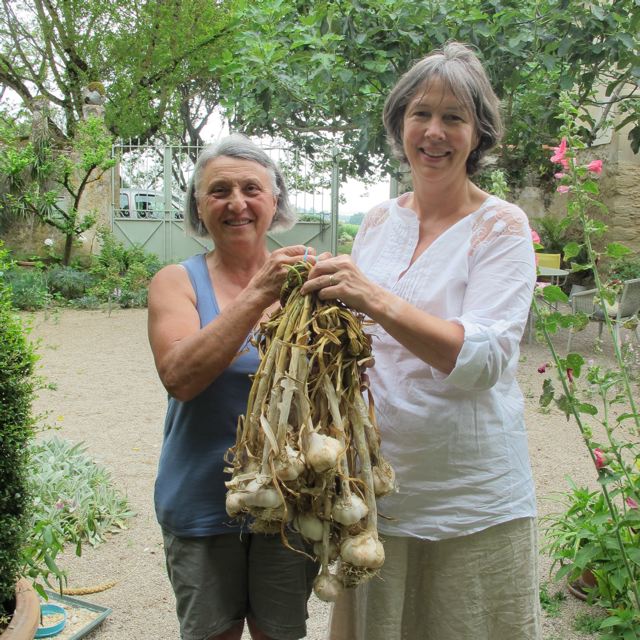
I ring our neighbour Alice, who delivered the magnificent tresses of garlic yesterday, thank her for the thrilling present, and ask if she’d be willing to show me how she makes her version of garlic soup.

She says she’d be delighted and we fix for us to go over to the farm at 3pm.

In her kitchen she’s put out the ingredients ready on the counter.

I thank her for agreeing to this and she says the pleasure is all hers.

Garlic, eggswater— the simple ingredients for this traditional peasant soup– “La recette de Maman”–says Alice.

She prefers bread–a day or two old [rassi-stale]–to go into the cooked soup; some people put pasta like vermicelli in it, she says, but her brother René doesn’t like it.

The pain de campagne comes from the oldest boulangerie in Castres.

She’s sad because it’s closing–the owners couldn’t find anyone to take it over.

The same thing happened to my favourite fish shop–I say.

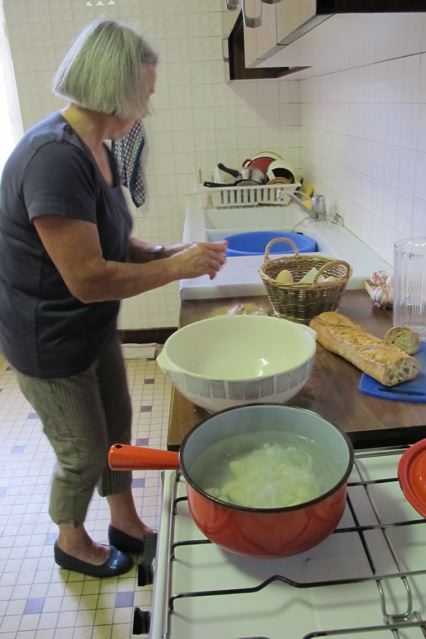
She fills a saucepan with about 700 ml of cold water, puts the lid on and lights the flame.

While the water is heating she peels 8 to 10 cloves of garlic.

Through the window of the kitchen across the courtyard there’s a young woman working upstairs in the barn.

She is preparing the tresses of garlic for drying out in one of the barns.

Celine and her husband have rented the farm for 25 years from Alice and her brother–who retired a couple of years ago.

Later I ask Alice if she misses this labour intensive working of the garlic.

“Pas de tout” she says emphatically–smiling.

The water boils and Alice puts in a large teaspoon of salt and the garlic.

She carefully cracks an egg and juggles the white into the pan,

depositing the yoke in the  bowl in which she’ll later make the mayonnaise. She repeats this with a second egg.

While the garlic is softening, she makes the mayonnaise and talks.

In the Gers–the other side of Toulouse–they brown the garlic in a little oil and add it to stock rather than water, she says.

She and her brother have a vegetable soup at midday with a little meat and a salad. Soup again in the evening–and salad.

I ask about cheese. Only at breakfast, she says.

She makes the mayonnaise by first adding a big pinch of pepper to the egg yokes in the bowl.

Then she whisks a teaspoon of Dijon mustard into the yolks.

She favours peanut oil but opens a bottle of olive oil when I say I prefer it.

She pours the oil–very slowly to start–into the mixture, whisking steadily to avoid it separating.

The steadiness of the whisking process helps her sustain it

.

It’s hard to tell how much oil she uses–she just knows when it’s ready.

Now she makes the soup. She ladles the garlicky water carefully into the mayonnaise– stirring with each ladle and adding the cloves of garlic and egg white bits at the end.

Finally she slices some stale country bread and adds it to the runny soup.

Voilà la soupe a L’ail!”– she announces with a theatrical flourish!
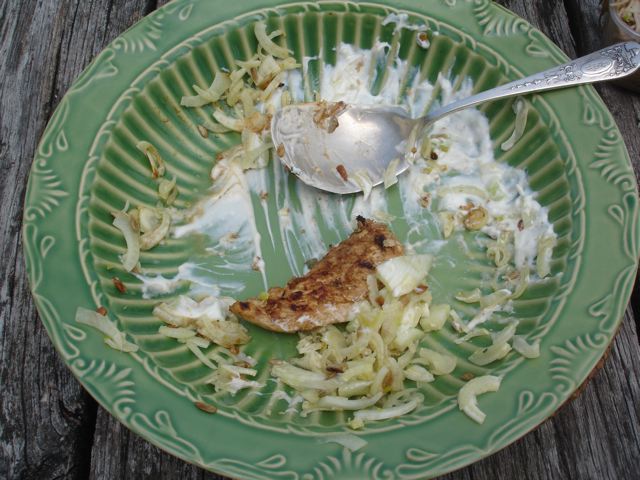
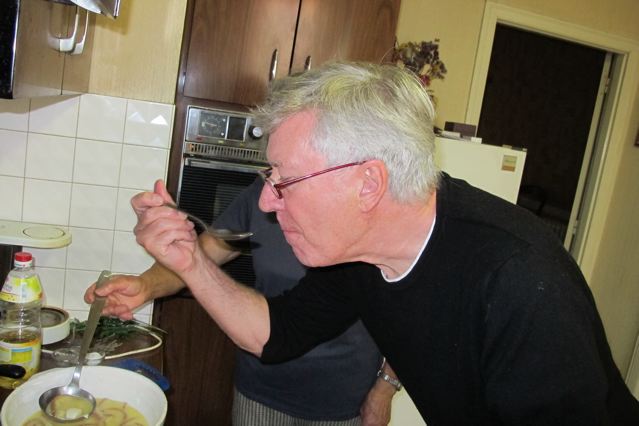
The tasting:

and approving….”

–though when I try it at home, a little less salt and some small wholewheat pasta in place of the bread, will be my choice.

Thank you, Alice!

Read Full Post »

Sometimes it pays to take a siesta.

Blissfully unaware of visitations–even deaf to the invasive sound of the garlic drying fans at work day and night,
in our neighbour, Pierre-Louis’ vast new barn–I slept in the cool, behind closed shutters, sheltered from the  afternoon heat.

When I awoke–Meredith–who got up a little earlier–told me there was a gift waiting downstairs.

Alice, our neighbour, who earlier this year was the bearer of much sought after morels–had brought another seasonal gift.

I was still half asleep and didn’t immediately twig what it might be.

In fact I found myself showing scant interest.

Alice had already departed, so there seemed to be no rudeness involved in staying upstairs and wrestling with an idea for a blog post.

Eventually thirst got the better of me (not curiosity) and I came downstairs for a glass of cool water.

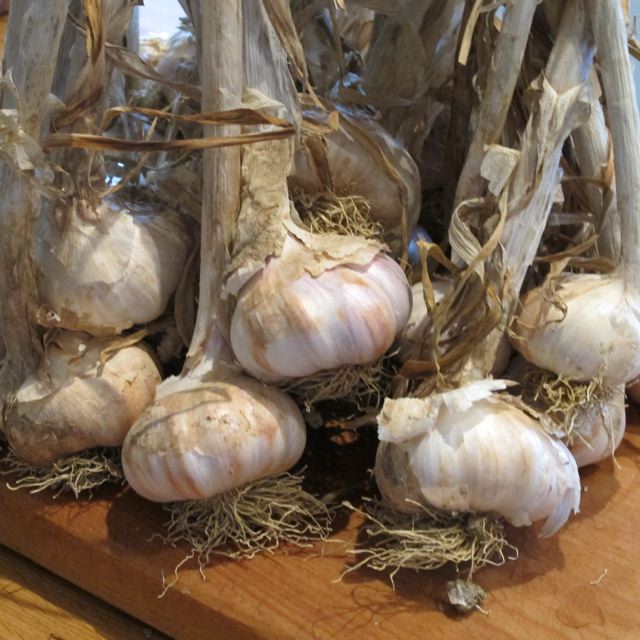
There it was on the counter in all its rough beauty–a stack of new garlic–pulled from the earth a couple of days ago, now offering itself for use in the kitchen.

What a thrill for someone who cooks!

Read Full Post »

CORRECTION!!–stop press

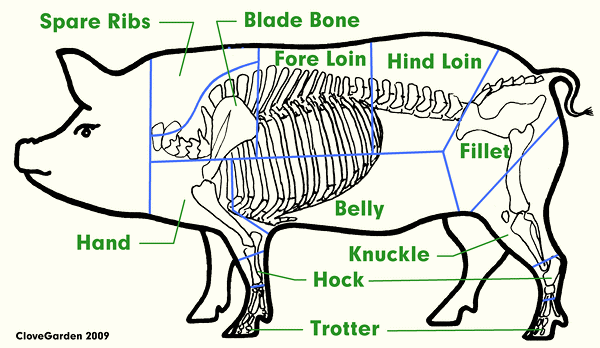
Our friend Hilton just rang to say according to his research Le Jarret de Porc — the part of the pig I cooked and posted on today– is not Hand of pig; it is Knuckle or Hock of pig!

He said he enjoyed eating it nevertheless!

And added for good measure that the French expression jarrets d’acier meant strong legs [legs of steel].

Knuckles/Hocks!

Apologies for that.

Read Full Post »

This is adapted from a recipe by Matthew Fort (food columnist for The Guardian) that I spotted recently.

Cooked long in a low oven, it’s simple and straightforward–requiring minimal effort on a hot day.

Hand of pork [jarret in French] is located below the shoulder and on the bone . It’s a tasty but less expensive cut–and stays moist through the long-ish braise.
Four of us just had it for lunch.

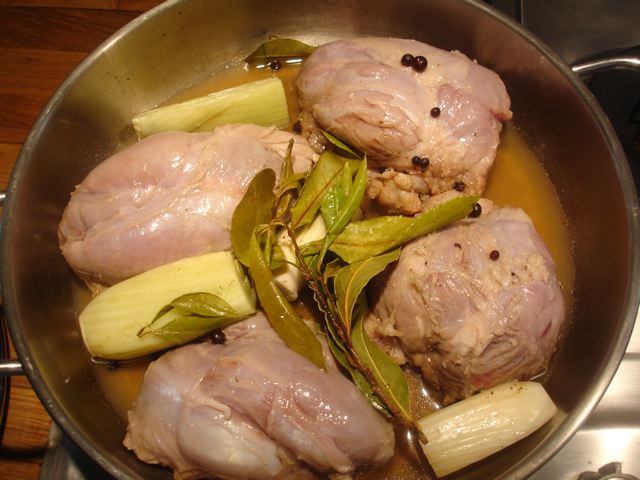
Two hands of pork–deboned and skinned (the butcher will do this when he’s not busy) or leave the bone in–just makes it harder to carve, but the meat should fall off the bone anyway.

1 teaspoon of juniper berries

6/7 bay leaves

1 teaspoon of black peppercorns

150 ml cider vinegar

100 ml water

pinch of salt

I added a couple of small fennel bulbs I had in the fridgecleaned & halved (optional)

Preheat the oven to 150C/300F

  • With a sharp knife carefully strip off as much as you can of the fat layer left on the pork.
  • Put the bay leaves, juniper berries and peppercorns and fennel pieces in a casserole.
  • Lay the pork hands on top–(ours had separated into 4 largish pieces after boning)–and lightly salt them.
  • Pour over the vinegar and water.
  • Bring this gently up to a simmer.
  • Cook in the low oven for 2 hours.
  • Take the dish out of the oven.
  • Leave aside the pork pieces in the warm casserole–but ladle or spoon the liquid–which will be too tart– into small saucepan and reduce it by half.
  • Taste it–and when it tastes like a sauce you like, pour it into a warmed gravy jug.
  • The pork pieces don’t carve easily.
  • We served the pork in tasty looking chunks with a little of the gravy poured over them.

Read Full Post »

Experiment–cooking something for the first time “before your very eyes“– as the Music Hall magician’s would shout…

This recipe sounds promising–I found it buried deep in an old file–and I have the ingredients to hand.

(Apologies to the original author should they come across it.)

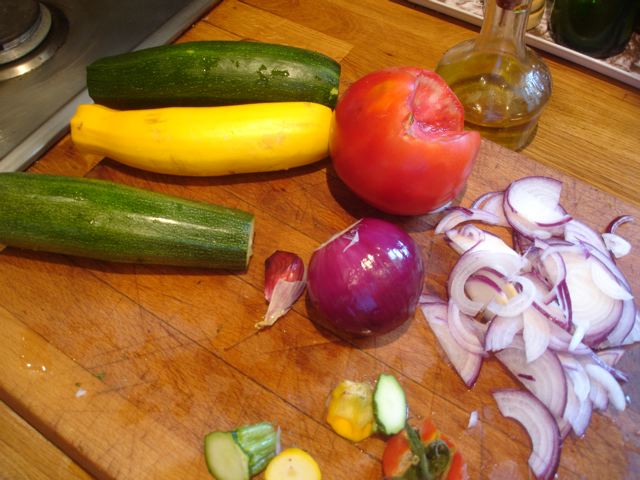
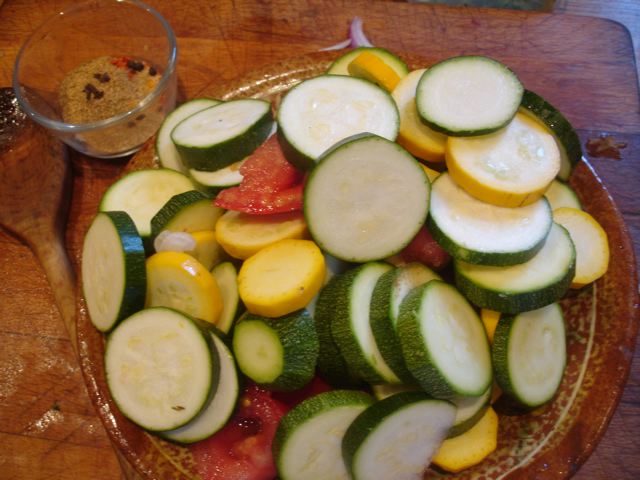
I picked one of the courgettes/zucchini from our garden early this morning!

Not overwhelmed with the supply yet–but it’s early days.

It’s going to be spicy hot with that much cayenne.

If that is not to your taste, you can either half the quantity of cayenne or add more yogurt .

Eight fluid ounces of water seems a lot; but the 25 minutes or so of simmering will concentrate the taste I hope.

Here goes!

"under starter's orders"

3 tablespoons olive oil
1 onion–thinly sliced
3 medium zucchini/courgettes [a yellow one for the look– if available]- sliced
a clove garlic–finely chopped
1/2 teaspoon salt
225ml (8 fl oz) hot water
1 small *dessertspoon [warning–see below] cayenne powder
1/2 teaspoon ground turmeric
1 teaspoon ground coriander
3 whole cloves
7 whole peppercorns
1 large/2 medium tomatoes–chopped
2 tablespoons low/no fat  yoghurt

  • Heat the oil in a medium frying pan.
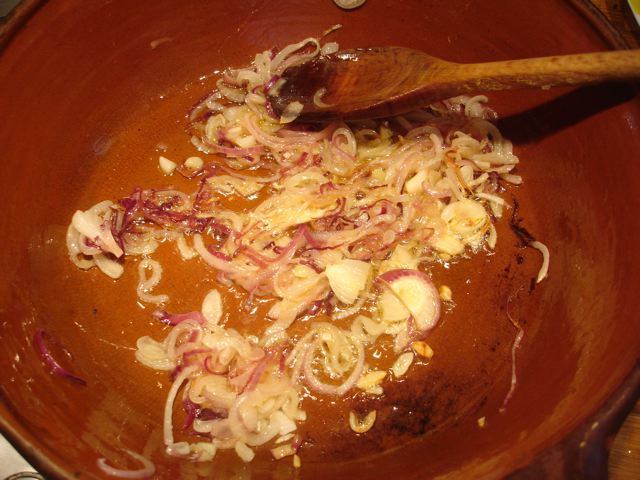
  • Sauté the onion and the garlic over a medium heat until golden (about 5 minutes).

onions and garlic on the go

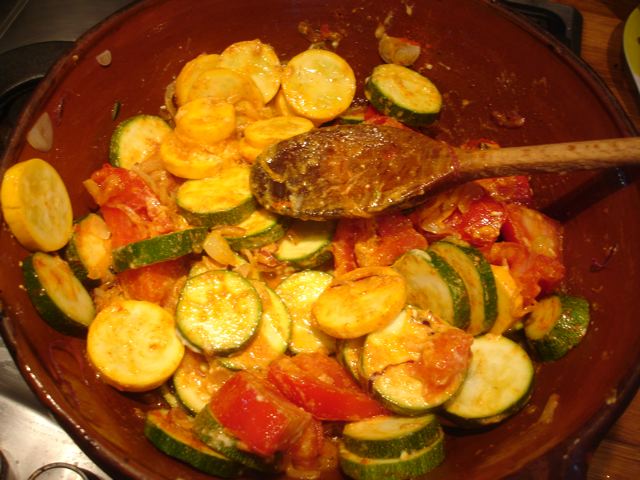
  • Add the courgettes, salt, chilli powder, turmeric, coriander, cloves, peppercorns, tomatoes and yoghurt and turn everything over several times.

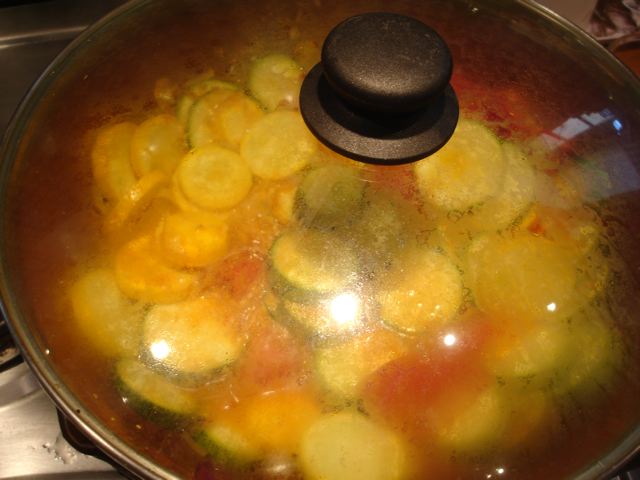
ready for the water...

  • Add the water and cover to bring up to a simmer.
  • Leave the mix covered, to bubble contentedly over a low heat for 10 minutes.
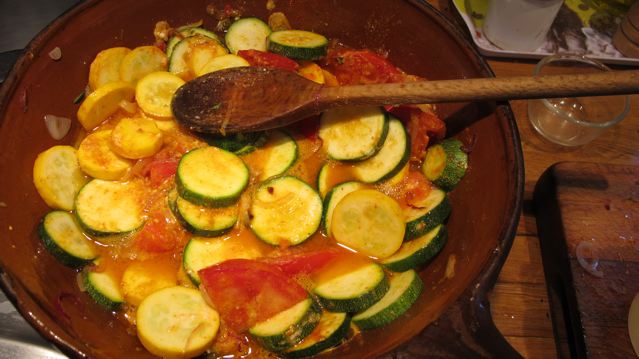
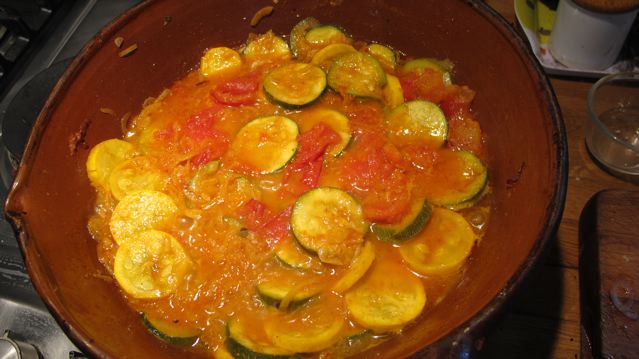
  • Uncover and let it continue to chugger gently until the courgettes are tender.

chuggering contentedly

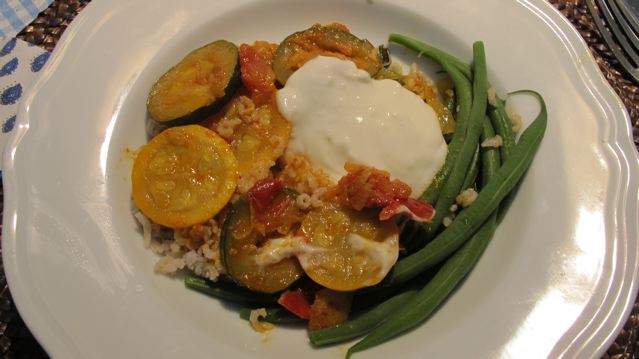
Serve over Basmati brown rice with green beans and some garlicky yogurt on the side–lunch on a sunny Sunday.

We’ll see…

Post lunch report:

Tasty–a little overcooked–and  toooooo  hot!

*The original recipe above called for a dessert spoon [roughly 2 teaspoons] of cayenne powder–which I included.

Meredith’s eyes watered and there were choking noises from the other side of the table, as I reached for the water jug.

The cooling yogurt was there one moment and gone the next!

So next time a teaspoon or less depending on your preference of cayenne powder and the courgette slices could have more bite, i.e. cooked a little less.

A standby for the coming zucchini glut.

Read Full Post »

This morning our friend, Jane, alerted me to the early lead article in today’s Guardian newspaper: [http://www.guardian.co.uk/society/2011/jun/24/low-calorie-diet-hope-cure-diabetes].

It reports on the eye-catching (though hardly mouthwatering) results of a study carried out recently at Newcastle University, England,  involving type 2 diabetics.

The participants were put on “an extreme diet” for two months.

*The title of the post refers to a documentary [http://topdocumentaryfilms.com/simply-raw-reversing-diabetes-in-30-days/] which another friend, Denise in London, sent me some months ago. I was reminded of it while reading The Guardian this morning.

In this 90-minute film (free to watch online) the six participants in the program are:

challenged to give up meat, dairy, sugar, alcohol, nicotine, caffeine, soda, junk food, fast food, processed food, packaged food, and even cooked food for 30 days. The film chronicles moments of “struggle, support and hope as what is revealed, with startling clarity, is that diet can reverse disease and change lives”.

The immediate results were stunning in some cases, like the study reported in The Guardian. The effect on participants was moving.

Nevertheless the challenge overwhelmed a couple of the participants and one dropped out. I remember being left feeling a little uneasy about the claims made in the film about the possibility of curing  diabetes.

Reversing the condition was clearly achieved by following the regimes shown.

However Professor Roy Taylor, the leader of the Newcastle experiment  acknowledges that, “we need to examine further why some people are more susceptible to developing diabetes than others”.

Meanwhile–in the everyday world, food philosopher Michael Pollen’s simple mantra is worth keeping in mind.

Eat food. Not too much. Mainly plants.

Read Full Post »

our neighbours go about it...

On my morning walk and heading home, I spot a  group of people gathered at the edge of a field of garlic.

It is 8 o’clock and the sun is already promising a hot day–time to start lifting the garlic.

In the beginning...

L’ail rose de Lautrec.

(The pink garlic of Lautrec  [http://www.ailrosedelautrec.com/en_growing-lautrec-s-pink-garlic_13.php].)

The harvest happens in two stages.

In late May I noticed similar groups of people early one morning–more warmly dressed–who spent the day slowly making their way through the field, painstakingly snipping off the scapes of the plants.

(Scapes are flowering stems that grow out of the plant; these must be cut off so that the plant uses its energy to make a bigger bulb instead of making a bigger plant.)

They make good eating–if you can find them–in a salad or an omelette.

The plants are then left a month to allow the bulbs to swell before the harvest.

Our friend, Sophie, tells me the white is lifted [arraché] first, then the violet and last the pink–which is the best she says (she would, she’s a Lautrecoise!).

Some years ago l’ail rose de Lautrec achieved Label Rouge status, which officially  guarantees a level of excellence.

Not long after buying the house–we took some to California, where Meredith’s green fingered brother-in-law planted it and latr won first prize in the Marin County Fair!

[The sheaths were white not pink–it’s the local earth that turns it pink.]

We told the story to the farmer in the next hamlet, thinking he might be amused.

After a long pause and looking like thunder, he growled—“C’est interdit!”[It’s forbidden!].

Don’t mention the garlic!”–[apologies to Fawlty Towers].

In sleepy Lautrec, on the first Friday in August–the annual Garlic Festival–ten thousand people teem slowly through the narrow streets heading for the main square and a bowl of delicious garlic soup [soupe à  l’ail]–ladled out FREE at noon.

and--the end result...

Stop Press: Our French friend, Myriam, calls by.  Her mother she says buys l’ail forain or l’ail bio [organic]–and it tastes better.

I shall enjoy the research!

Read Full Post »

Here’s a recipe to celebrate the first day of summer.


SOL–sun    STICE--still

The day the sun is so high it appears to stand still; the longest day in the Northern Hemisphere.

And a song to hum while preparing the vegetable salad–(watch out for the end of the seventh line though, if you’re singing the words with company!)

Inspired by and adapted from a book with an unusual title and many wonderful recipes:

Crazy Water Pickled Lemons  by Diana Henry

Roasted Aubergine [eggplant] slices with Feta and a mint vinaigrette.

for 4

2 large aubergines [eggplant]

I used the purple speckledy ones this time.

–cut crosswise or lengthwise into thickish slices (2cm/3/4″), lightly salted and left for an hour or so to drain through a sieve or collander

olive oil for brushing the foil and the aubergines

salt and pepper

a small slab of feta cheese to crumble on the top of the salad (optional)

The Vinaigrette

1 teaspoon white wine or cider vinegar

1 tablespoon balsamic vinegar

2 garlic cloves pulped with a little salt

2 fl oz olive oil

a large handful of mint leaves–roughly chopped

  • Heat the oven to hot–240C/450F.
  • Lightly brush the aubergines slices with olive oil.
  • Cover shallow oven trays (you may need two or to repeat the process) with foil.
  • Brush the foil with oil to prevent the slices sticking.
  • Spread the slices on the trays.
  • Place the trays in the upper part of the oven for 10 minutes–
  • then take the tray(s) out of the oven and turn the slices over–
  • return them to the oven for a further 10 minutes.*
  • Make sure the aubergine is done by piercing the thickest part with the tip of a knife–
  • Underdone aubergine is uneatable.
  • Take them out of the oven and spread them on a serving plate.
  • Whisk the vinaigrette ingredients together and pour it over the slices while they are still warm.
  • Flake the feta–if you are using it– over the top.
  • Serve at room temperature–leaving a little time for the flavours to meld.

* alternatively, you could griddle the slices–which gives them a slightly smoky taste.

Read Full Post »

This is adapted from the Indian actress and cookery write Madhur Jaffrey again, whose spicy green beans from a recent post, would be a good accompaniment.

I’ve cooked from her BBC series cookbook-“Indian Cookery” for many years–it may be out of print now but is worth seeking out. She says in the introduction,
that her mother once told her, her passion for food dates back to “the hour of my birth, when my Grandmother wrote the sacred syllable”Om” (I am”) on my tongue with a finger dipped in honey. I was apparently observed smacking my lips rather loudly.” Something we do regularly after eating from one her recipes!

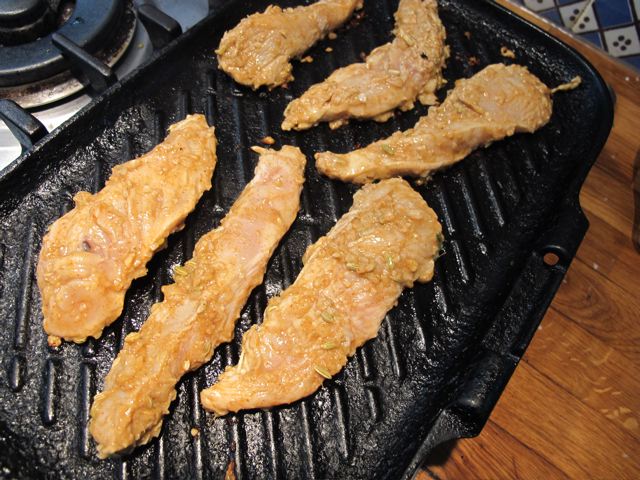
An overnight marinade in this delicious blend of familiar spices and a quick turn on a griddle* make these strips of chicken breast a handy lunch option.

for 4/6

2lb/1k free range boneless chicken breast— skin removed, washed, patted dry
and cut into 1″/2cm strips

the marinade:

5 tablespoons olive oil

4 tablespoons red wine vinegar

1 medium onion–roughly chopped

1 head of garlic–peeled and roughly chopped

1” nob of ginger–peeled and roughly chopped

2 tablespoons each of fennel seeds and ground cumin

2 teaspoons ground coriander seeds

8 cardoman pods and 8 whole cloves

1 teaspoon ground cinnamon

20 black peppercorns

1/2 teaspoon cayenne pepper

2 teaspoons salt–sea salt for preference and “Malden” if you can find it

  • Liquidise the marinade ingredients.
  • Add the resulting mush to the bowl in which you have put the strips of chicken.
  • Turn it all over–making sure the chicken is well covered by the marinade.
  • Cover the bowl and leave it in the fridge overnight.
  • Heat a griddle to hot and cook the strips in batches.
  • Depending on the thickness allow them a couple of minutes a side. Cut into one to test for doneness–if it looks too pink let it cook on a few seconds more.
*You could also cook these in a hot oven (220c/425f  for 10 to 15 minutes depending on their thickness).

Read Full Post »

« Newer Posts - Older Posts »