Feeds:
Posts
Comments

Archive for the ‘Diabetes’ Category

Glycemic Load–What is it? 

The Glycemic Index measures how carbohydrate rich foods affect blood sugar levels in the body.

It is an important tool for diabetics, whose ability to process glucose (sugar) is impaired.

The Glycemic Load (or density of carbohydrate )is a useful extension of the Glycemic Index.

The Glycemic Foundation explains:

The glycemic load (GL) of a specific food portion is an expression of how much impact (“oomph”)  the food will have in affecting blood glucose levels.

Here’s an example:

The G.I.of watermelon is high (G.I. = 72), but its glycemic load, the oomph factor, is relatively low  (G.L. = 7), because the quantity of carbohydrate in a serving of watermelon (150 g or a 5 mm thick slice) is minimal since it’s mainly water.

The G.I. of a potato is also high (GI=80), but unlike the watery melon, it has a high density of carbohydrates, a high Glycemic Load, so even a small portion will have a high impact  or  “oomph”.


The more carbohydrate density that there is in a food, the higher its G.L. or oomph factor.

The Glycemic Load of a food is the glycemic index of a portion or serving of that food.

The G.I. per serving of the watermelon is much lower than the potato.

Phew–it’s enough to give you indigestion!




Read Full Post »

Walking

The sovereign invigorator of the body is exercise, and of all the exercises walking is the best.
Thomas Jefferson

I used to think walking was pedestrian!

I ran—or jogged, or bicycled. Walking took so long.

But then we moved here, where it’s a bit hilly and I was getting older, so I started walking and liked it.

All truly great thoughts are conceived by walking.
– Friedrich Nietzsche

I was walking six times a week, usually for about 40 minutes. I tried to do a circular route, which suited me better.

I am a slow walker, but I never walk backwards.
–   Abraham Lincoln

I liked the freedom of it, and starting from home–no time spent travelling to exercise. And there was no equipment needed—just a good pair of shoes and warm clothing. I usually took the same route–which never felt the same two days running–so to speak!– varying with the day’s weather and the changing  seasons.

To find new things, take the path you took yesterday.
–   John Burroughs

Then one day I overdid it and my left knee felt bad.

I had to stop for a while and was missing it. I used an exercise bike but it wasn’t the same.

Gradually my knee healed and I started walking again, but less. Now it’s 3 or 4 times a week– preserving old knees.

If one keeps on walking everything will be alright.
–   Soren Kierkegaard


Thoughts come clearly while one walks.
Thomas Mann

It is not talking but walking that will bring us to heaven.
–   Matthew Henry

Straw men don't walk....

Caloric Expenditures Per Mile for Different Bodyweights by Walking at Various Speeds

Read Full Post »

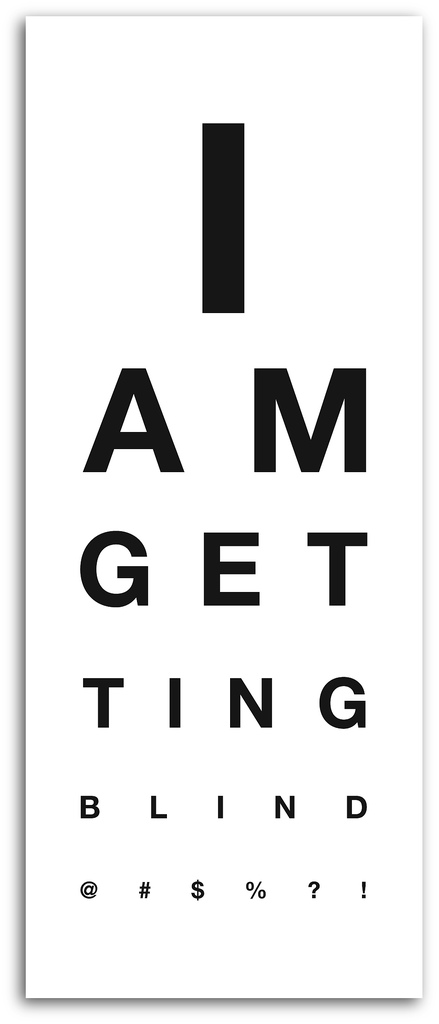
Eye Test

Eye Test

I learned early on, that managing Type 2 Diabetes involves more than watching what you eat—it’s really a head to toe job!

The villain sugar is a ruthless foe. It will take advantage of any weaknesses with alacrity, and insinuate itself into those vulnerable spots like eyes and feet if you drop your guard, causing damage that cannot be reversed.

This is the reason for my visit today to Dr Nguyen’s eye clinic–my annual check-up.

“Put your chin on the strap please and place your forehead against the bar—look straight ahead and don’t move”.

The forced intimacy of doctor and patient is strange. As he leans forward and shines his special torch deep into my eyes, we are eyeball to eyeball. For a moment I feel like the Man in the Iron Mask, receiving a visit.

The short pause before he says “no sign of damage”, is a bit nerve wracking; on occasion I’ve caught myself crossing my fingers under the table—though I forgot this morning!

Phew-another year gone!–it only remains to make an appointment for the same time next year.

Being tested has become part of life again. Just like schooldays.

I see Cyril for feet every three months and have a blood test to check cholesterol and glucose levels as often. No big deal really—when your life depends on it.

Read Full Post »

Frittata

Frittata

Frittata is an egg tart without the pastry—a handy dish for diabetics, that everyone can enjoy.

It’s an Italian omelette for four to share and, unlike the French version, is cooked slowly. We had it for lunch today, just the two of us– a Valentine’s Day offering.  It went down well with the Taster in Chief!

I was a little nervous because the filling was left-over Swiss chard and onions, based on an Indian recipe, and mildly spicy, not Italian; but then you can add whatever you like to the basic cheese frittata or just enjoy as it stands. Here’s it is.

Cheese Frittata

For 4

7 eggs

100gms/3.5 parmesan cheese—grated.  This could be a mix–parmesan and swiss gruyere, for a little richer taste.

2 tblsp olive oil

salt and pepper

1. beat the eggs in a bowl, add salt, pepper and the cheese.

2. heat the oil in a 30cm/12” sauté pan.

3. add the egg and cheese mix.

4. turn the heat down to the lowest level.

5. cook until only the surface of the frittata is liquid– about 15 minutes.

6. place the pan under a hot grill for a minute or so, or just slide it carefully onto a plate, place a second plate over the top and turn them over, then slide it back into the pan for a minute or so.

7. The surface should be golden not brown, and the frittata moist.

8. serve with some steamed broccoli –green with the yellow–and your best olive oil sprinkled over it.

I sometimes cut the frittata in strips and serve them over the salad

Read Full Post »

G.I.–what is it?

GI—what is it?

Well it has nothing to do with the American army, where it stands for “Government Issue” apparently, and not “General Infantry” as often claimed.

The Glycemic Index measures how carbohydrate rich foods effect blood sugar levels in the body.

The GI Foundation neatly sum it up thus:

Not all carbohydrate foods are created equal, in fact they behave quite differently in our bodies. The glycemic index or GI describes this difference by ranking carbohydrates according to their effect on our blood glucose levels. Choosing low GI carbs – the ones that produce only small fluctuations in our blood glucose and insulin levels – is the secret to long-term health, reducing your risk of heart disease and diabetes and is the key to sustainable weight loss.

The GI ranks food from 0 to 100, using glucose, with a GI value of 100, as the reference.

The GI has three categories—high (70 to 100), medium (56 to 69) and low (55 and less); these are intended to indicate the speed at which the glucose(sugar) content in the food enters the bloodstream.

So it makes sense for type two-ers, who have less than efficient insulin function, to favour carbohydrates that are in the low to medium bands of GI.

For more information:

Glycemic Index Table

www.glycemicindex.com

Read Full Post »

Just no desserts…!

There are no desserts in my cook book, Delicious Dishes for Diabetics–A Mediterranean Way of Eating.

This is because I don’t eat desserts.

Well not the whole truth—Meredith sometimes makes a dessert for company that is so good, that not to try it would be churlish—so I have a sliver.

I’m lucky, I don’t have a sweet tooth and have never had a craving for large portions of exotic “afters”—though I do remember the wonderful tall glassed “Knickerbocker Glories” (ice cream sundaes in the U.S.) at the lunch counter on the top floor of Marshall and Snelgroves, once a famous department store on Oxford Street. One of my grandmother’s regular treats in the early 1950s!

For others it‘s a sacrifice to forgo the third course. It’s true that a good meal needs a grace note at the end, something that rounds it off–a contrast to the savory tastes of the main dish–something to complement the coffee or tea to come. Well, all is not lost…!

The answer, surprisingly, is CHOCOLATE–with a high proportion of cacao.

One square eaten with a good cup of coffee is the perfect end to a meal for me.

I have got used to 90%  and find anything lower than 85% too sweet.

The idea has caught on. There often seems to be a choice these days from 70% and upwards in most supermarkets.

This site positively encourages the consumption of high cacao chocolate:

10 Reasons to Eat High Cocoa Content Chocolate


Read Full Post »

A piece by AFP (Agence France Presse) notes a disturbing recent report, from the prestigious Centre for Disease Control in the USA.

Diabetes cases climb to nearly 26 million in US

Friday, 28 January 2011

As reported by the CDC, the number of diabetics in the United States has grown to nearly 26 million, a 10 percent increase over 2008

“These distressing numbers show how important it is to prevent type 2 diabetes and to help those who have diabetes,” said Ann Albright, director of the CDC’s diabetes translation division.

‘We know that a structured lifestyle program that includes losing weight and increasing physical activity can prevent or delay type 2 diabetes.’

Type 2 diabetes accounts for 90 to 95 percent of the cases. The condition arises when the body gradually loses its capacity to produce and use insulin to regulate sugar levels in the blood.

In 2008, 7.8 percent of the US population, or 23.6 million people, had diabetes and 57 million adults were classified as pre-diabetic with higher than normal blood sugar levels, according to a study by the Centers for Disease Control.

The CDC found that the number with diabetes has since climbed to 26 million people and 79 million more are now considered to be pre-diabetic, which increases their risk of heart disease and stroke.

The CDC estimates that around 27 percent of Americans with diabetes, or around seven million, are not aware of it.

Last year, the CDC warned that one in three American adults could be diabetic by 2050 if the current trends persist.

As a postscript—I would add to paragraph three that, in my experience, changes in the way you eat also play a role in controlling the condition.


Read Full Post »

« Newer Posts