Eagle-eyed for fishcakes made without potatoes (which I prefer to avoid)–I spotted these a few years back in an article by Gordon Ramsay.
I’ve added an egg to the original recipe to lighten them a little.
A garlicky yogurt sauce goes well with them–Tzatziki (see next post)
for 2–or 4 as a starter
200 gms salmon fillet–skinned and checked for bones
200 gms smoked haddock–undyed if possible, and skinned
2 small shallots–chopped small
an egg–lightly beaten
salt and pepper
olive oil for sautéeing
- Cut the fish into chunks and put into a food processor.
- Pulse to a coarse mince–too much and it will be a slurry.
The "mix"
- In a bowl, mix the fish with the shallot, the egg, salt and pepper.
- Check the seasoning.
- Form into little patties or “cakes”.
- Chill them for an hour if possible–it just helps to bind them.
- Heat a tablespoon of oil in a large pan.
- When it’s hot slip the “cakes” into the pan and gently flatten them a little.
- Sauté them on each side to a light brown finish–2/3 minutes a side.
- They should still be moist inside.
"Prêt à manger" fishcakes
We have just had these for lunch on a rainy day–with a simple green salad and tzatziki.
Archive for the ‘Diabetes’ Category
“No potato” Fishcakes
Posted in Diabetes, Food, Recipes, tagged fishcakes, no potato fishcakes, salmon fishcakes on June 7, 2011| 3 Comments »



Only 150 minutes a week…!
Posted in Diabetes, other sides to this life, tagged exercise & diabetes, exercise & health, healthy living habits on June 2, 2011| 1 Comment »

Sir John Falstaff--see below!
An actor friend–who has type two diabetes and had a tendency to be overweight–told me a couple of days ago that he had taken up walking with hiking poles. He’d lost 10lbs and was feeling all the better for it.
(Meredith bought me a pair a couple of years back but I was too self conscious to use them for long!)
Professor Steven Blair (Arnold School of Public Health, University of South Carolina) writes
in this month’s GI news, that there is now overwhelming evidence that regular physical activity has important and wide-ranging health benefits, including reduced risk of chronic diseases such as heart disease, type 2 diabetes and some cancers.
Fit people come in all shapes and sizes the professor says:
“I often tell people that I was short, fat and bald when I started running, but that after running nearly every day for more than 40 years and covering about 70,000 miles … I am still short, fat, and bald. But I suspect I’m in much better shape than I’d be if I didn’t run.”
Being fit, he believes, means accumulating 150 minutes of moderate intensity exercise, such as walking, each week–a brisk walk of about 40 minutes 4 times a week.
Overall, his data showed about a 50% lower mortality rate in the moderately fit as compared with the unfit.
Professor Blair believes that weight isn’t everything (he would wouldn’t he!) and recommends focusing on good health habits, no matter what number you see on the scales.
- Give fruits, vegetables and whole grains a major place in your daily diet.
- Be moderate about fat and alcohol.
- Don’t smoke.
- Work on managing stress.
- Perhaps most important, get out of your chair and start moving for at least 150 minutes/week.
His studies show that a normal weight person who is unfit is twice as likely to die in the next decade as a person who is overweight and fit.
Nevertheless, next time my friend plays Sir John Falstaff--which he has done several times–he’ll have to use artificial padding–and good for him I say!

Prof. Steven Blair–who believes that physical inactivity is the biggest public health problem of the 21st century.
There’s no escape!
Posted in Diabetes, other sides to this life, tagged diabetes, director of the National Institutes of Health, Dr. Francis Collins, exercise & diabetes, National Institute of Health, NIH, physical activity and diabetes, train travel, Washington D.C. on May 19, 2011| Leave a Comment »
“Good afternoon Ladies and Gentlemen, this is train 127 to Waahshington–train 127 to Waahshington”
En route to Washington from NYC by Amtrak–a three hour journey.
We find the “Quiet Coach” (no loud voices–no cell phone use)–perfect.
Meredith starts to read the in-house magazine, which has a photo of Michelle Obama on the cover looking in radiant health. Her mission is to stem the rise in juvenile obesity.
The theme this month is Health and Wellness–no escape.
Inside Meredith finds a short article written by Dr. Francis Collins, the director of the NIH–the National Institutes of Health–entitled: “Change your life style and save your life”–no escape.
These days you can’t even take a trip in the “quiet coach” without being exhorted to examine your lifestyle!
Dr. Collins writes that shortly before taking up his post, he took advantage of one of the programmes funded by the NIH and had a DNA scan designed to look at the hereditory risks of disease.
To his surprise the scan revealed he had a risk of Type 2 diabetes.
“The strategy that caught my eye,” he writes, “was an NIH funded Diabetes Prevention Program which found the the combination of increased physical activity and modest weight loss is a highly effective way to lower the risk of Type 2 Diabetes. When trial participants–all with elevated levels of glucose–exercised 2.5 hours a week and lost 7% of their weight on avereage, many were protected from developing diabetes, with preventive benefits lasting at least a decade.”
He decided to act and started working out. In the first six months of his new routine he lost 25 pounds.
“I’ve never felt fitter, ” he says.
“Taking charge of your health by choosing the right foods and the right exercise programme is among the most important investments you can make in your future”–no escape!!
“Ladies and Gentlemen–15 minutes to New Carrolt’n– New Carrolt’n 15 minutes. Twenty-five minutes to Waahshington, 25 minutes to Waahshington–New Carrolt’n, Maryland is next”.
My Mother and Diabetes
Posted in Diabetes, other sides to this life, tagged diabetes, Drs. Banting and Best, family history, insulin, insulin shock, Jack Ellis, Molly Ellis, reactions on May 7, 2011| 15 Comments »
Diabetes is in my family.

My mother, Molly–who’d be 96 today–died of a diabetes-related heart attack at 9 a.m. on December 2nd 1982, while dressing to go shopping. Perhaps a good way to go–but hard for the rest of us. She was 68.
She developed Type 1 diabetes in the early fifties–the result, we were told, of shock at the sudden death of her own mother at our home in north London. Molly was in her mid-thirties. Diabetes was in her family–her Uncle Harry had it.
Enough was known about the disease by then to allow her another thirty years of life–she would often cite Drs. Banting and Best (http://nobelprize.org/educational/medicine/insulin/discovery-insulin.html ) as her saviours, for their ground breaking work on insulin (http://en.wikipedia.org/wiki/Insulin).
When she was pregnant with my youngest brother Jack, the doctors at St. Thomas’ Hospital over the Thames from the Houses of Parliament, were uncertain whether to allow the pregnancy to continue. They went ahead–praise the Lord!–and Jack Ellis (http://en.wikipedia.org/wiki/Jack_Ellis_%28actor%29) thrives to this day!
She injected insulin twice a day for the rest of her life without any song and dance. I was in awe.
From time to time she would have what she called a”reaction“.
http://www.emedicinehealth.com/wilderness_diabetic_reaction/article_em.htm
This usually happened as result of a low blood sugar level.
If she hadn’t got her insulin balance quite right–at a cocktail party perhaps (this was the fifties!), she’d start acting strangely, sometimes appearing to be the worse for drink. My father would delve into her handbag for the lump of sugar he knew was there and with some difficulty persuade her to swallow it.
At first it struck us ignorant kids as odd that a person whose body couldn’t absorb sugar normally would swallow some to save her from a coma or worse!
These “reactions” would occasionally occur in the middle of the night–a real danger. Miraculously my father always woke up in time to administer the sugar lump–though a couple of times I remember Ma being taken by ambulance to St. Thomas’ in a comatose state.
Witnessing first hand the damage diabetes could inflict, I needed no persuading to take it seriously when my diagnosis came a dozen years ago.
Ma set a great example. She was steadfast, brave and determined to enjoy life–despite her difficulties.

Molly
Here’s a Quiz (Diabetic) to be getting on with….
Posted in Diabetes, tagged diabetes, quizz on May 4, 2011| 1 Comment »
I found this (http://www.diabetes.co.il/) yesterday.
It’s quick, fun and informative.
Excuse me while I get back to the kitchen…!
Early, Middle and Old Age Spread!
Posted in Diabetes, tagged belly fat, diabetes, Diabetes Institute at Beth Israel Medical Center, insulin, middle-age spread, visceral fat on April 26, 2011| Leave a Comment »

I came across this comment today from Gerald Bernstein, MD, director of the diabetes management program at the Diabetes Institute at Beth Israel Medical Center in New York City, explaining why”belly fat” is bad:
“When those fat cells around the belly swamp the organs that play a key role in regulating blood sugar, that fat works to block the action of insulin, which is necessary to lower the blood sugar.
Insulin normally triggers the liver to take up extra blood glucose and store the energy for future use.
But when the liver is submerged in this fat tissue, insulin can’t get it to respond. As a result, blood sugar can accumulate in the bloodstream, where it can damage organs all over your body.”
It reminded me of what Jill Littrell, in a comment a few days ago, said–in scientific terms– about the link between this visceral fat that lies deep inside the abdomen, surrounding the abdominal organs– the liver, kidneys, the pancreas– and the development of Type Two diabetes.
I’m beginning to understand this better.
Whether you are young, middle or–more middle aged (!)–no fat is your friend.
Diabetes–a coincidence…
Posted in Diabetes, tagged coincidences, diabetes, surgery & diabetes on April 13, 2011| 1 Comment »

I like coincidence–the apparent chance conjunction of happenings.
Last night in a long comment on my blog, Jill Littrel, a clinical psychologist at Georgia State University in Atlanta, talks about the root causes of Type Two Diabetes.
This morning’s Guardian newspaper carries an article (http://www.guardian.co.uk/society/2011/apr/13/obesity-surgery-treats-diabetes) about a study of people who have undergone surgery to remove excess body fat–and how this procedure has stopped the developement of the diabetes in a significant number of cases.
I am still digesting Jill’s piece (so to speak!), which is rich and written in scientific terms that are sometimes a little opaque for the layperson…. (I am going to ask Jill for a less technical version.)
The overall message is clear though: Type-two-ers have an insulin ‘delivery system’ that is faulty–the ‘goods’ (i.e. insulin) are not arriving where they are needed to do the job–to distribute glucose efficiently to the body’s cell system.
In the comment, she explains that there are a number of explanations.
One reason is the effect of excess fat round people’s middles on the body’s ability to self-regulate.
Which takes us to the article in The Guardian….
The theme here is getting rid of fat that is contributing to the breakdown of a healthy ‘delivery’ system.
According to the study, surgery to remove or reduce the fat can be effective in re-tuning the body and stopping the disease in its tracks.
It is easy to see the attraction of such a move.
Problem solved with a quick slice of the knife!
But doesn’t this conveniently sidestep the vexed question of why the person is overweight in the first place? Isn’t this just another ‘band-aid’ solution. How long will it take before the person puts it all back on?
For Jill Littrel the answer is to make lifestyle adjustments–e.g. more exercise, meditation to reduce stress, the use of certain spices like turmeric in cooking (I could add–a little cinnamon sprinkled on your breakfast choice!) which over time will help the body to readjust.
A British Department of Health spokesperson quoted in The Guardian agrees, saying in response to the findings of the study that surgery should only be considered as a last resort once weight-loss schemes and exercise programmes have been tried.
————————————————————————————
Presidents John Adams and Thomas Jefferson both died on the same day (as far as we know, NOT of diabetes!)– July 4th, 1826 – 50 years to the day after they both signed of the Declaration of Independence.
I like coincidences!
Bee Happy!
Posted in Diabetes, Food, other sides to this life, Recipes, tagged bee-keeping, bees, meredith, morel mushrooms on April 7, 2011| Leave a Comment »
Alice–our mushroom supplier earlier this week–just arrived with a hive full of displaced bees.

“You’d better stay inside, Robin, you might get stung!”
I’m happy to continue having my honey-free breakfast in the kitchen.
Meredith and Alice, dressed in their protective costumes, carry the box of bees out to the end of the garden.


!
Alice seems confident they will be happy in their new setting–and she is often right about things.
Yesterday she’d brought round another bag of morel mushrooms–‘miffed’ perhaps that I had not followed her advice about using creme fraiche in the cooking of the first lot. (I didn’t have any.)
“Has he bought creme fraiche?” she asked. Meredith nodded in the affirmative.”Eh voila!” and left the second bag for supper last night. She was right–they taste good with a tablespoon of cream amd a twist of fresh ground black pepper added to the pan.
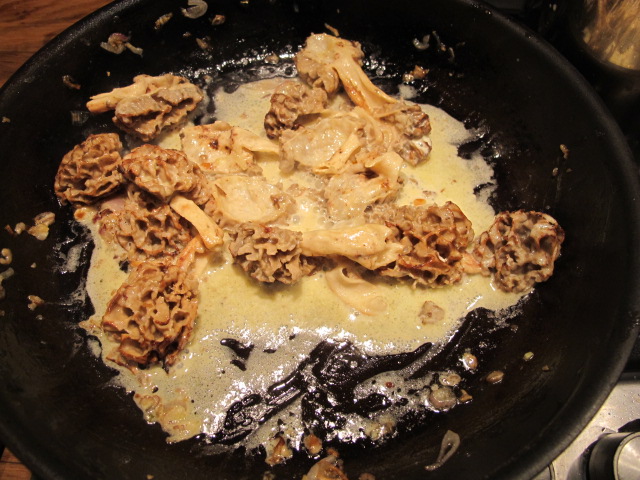
morels with cream
She thinks the field across the road will be a rich source of nectar for them this year, with much buzzing contentment.
“The fascinating process of making honey begins when the bees feast on flowers, collecting the flower nectar in their mouths. This nectar then mixes with special enzymes in the bees’ saliva, an alchemical process that turns it into honey. The bees carry the honey back to the hive where they deposit it into the cells of the hive’s walls. The fluttering of their wings provides the necessary ventilation to reduce the moisture’s content making it ready for consumption.”*
Happy bees would be better than discontented bees when I’m working in the tomato patch close by, in a month or two.

The danger zone?
“The vexed question”
Honey promoting web sites are keen to be positive about the vexed question of honey and diabetes, pointing out that it is a better option than sugar and sugar substitutes.
Because honey is generally thought to be health promoting, a little everyday is a good idea–even for people with diabetes, they argue.
* more than you need to know perhaps about HONEY–but useful nonetheless.
Molly’s smoked mackerel paté
Posted in Diabetes, Food, Recipes, tagged fish paté, mackerel, mackerel paté, Molly Ellis, paté on March 31, 2011| 13 Comments »
This is my 50th post and it’s dedicated to my mother Molly [Weakford] Ellis–whose cooking on a small budget in the late forties and fifties was resourceful and inventive. From her I learned that it was worth spending a little time in the kitchen–not least because I got to lick the bowls!

The Ellis Family under the flowering cherry 1955
Her smoked mackerel paté has a fair amount of melted butter in it, but the oily mackerel is a healthy counter to it.
I like it best served on toasted rye bread.
She wrote the recipe out for me on the back of an envelope and miraculously I still have it.
Her flowing round hand is unmistakeable to me. Few of her written recipes survive, so I treasure this one.

It is very simple.
I made it this morning with the 8oz/250gms of mackerel bought last Saturday at the London Farmers’ market and reduced the other ingredient quantities accordingly….

(Tasting it for balance is a legitimate perk of the cook!)
The apple slices cut the richness of the paté.
Watch out though–it is more-ish!
Serve with lemon wedges.

It’s Mother’s Day this weekend–so “Thanks Ma!”
Asparagus arrival—and an easy lunch…
Posted in Diabetes, Food, other sides to this life, Recipes, tagged asparagus on March 30, 2011| 2 Comments »
Home again in France and happy to be so.
In spite of being bleary-eyed from the journey yesterday, I don’t miss another sign of the change of seasons: an asparagus stall at the Realmont market this morning.
At the bigger Castres market on Saturday there’ll be several, piled high with the new green and white asparagus spears. I much prefer the green–a matter of taste and habit.
It may be a little early for this superfood, but I buy 500 grams/1ib, a generous serving for two–about 7 spears each, plus a few for testing.
I know there’s a piece of bacon in the fridge–about 4oz/100gms– which I will dice small, gently sauté to a crispy finish.
I’ll dress the asparagus with 3 tablespoons olive oil, 1/2 teaspoon Dijon mustard, 1 tablespoon of lemon juice and a pinch of salt–whisked together; sprinkle over the bacon bits and top it off with a carefully placed poached egg.
An easy lunch for two weary people.
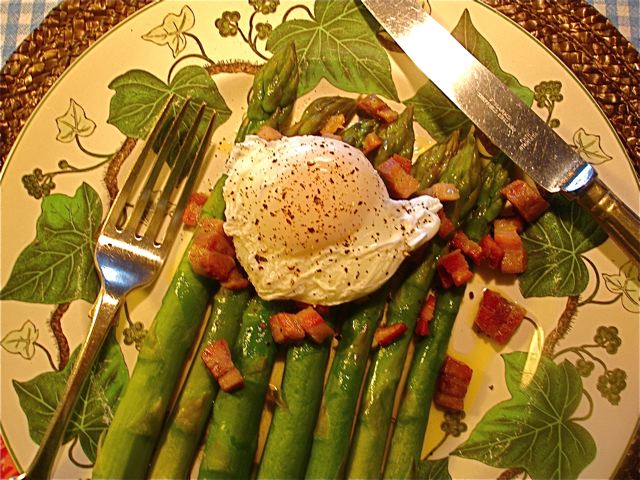
For the asparagus:
Trim the rough base of the spears, making them all about the same length.
Choose a saucepan or sauté pan that will take them all lying horizontally, and that’s wide enough to take a steamer basket/tray.
Fill the pan with water to the depth of the basket.
Place the asparagus horizontally in the basket and cover the pan.
It’s handy to cook an extra spear that you can use to test for doneness.
6–8 minutes should do it, depending on the thickness of the spears.
Pierce a spear with the tip of a knife to test for doneness–or better still, use your teeth!
When they are tender, divide them between two plates.
Spoon over a little dressing and share out the bacon dice.
Carefully place a poached egg on top.

Wrapping the ends of the asparagus in a damp paper or cloth towel, helps preserve the freshness of the asparagus in the refrigerator. Best to eat asparagus within 48 hours of purchase–but why wait anyway!
Making Poldark: Memoir
Includes photo from the NEW Poldark series!
Mediterranean Cooking for Diabetics
Healthy Eating for Life
Delicious Dishes for Diabetics: Eating Well With Type-2 Diabetes
Follow Robin on Facebook…
-
Join 1,671 other subscribers
-
Recent Posts
Tag Cloud
anchovies angharad rees asparagus broccoli cabbage cats cauliflower celery chicken chickpea chickpeas corfu coriander courgettes cumin Dal Delicious Dishes for Diabetics diabetes Donald Douglas eggs fennel food frittata garlic ginger green beans Healthy Eating for Life honey Ismail Merchant l'ail rose de lautrec Lautrec leeks madhur jaffrey Making Poldark Marcella Hazan Mediterranean Cooking for Diabetics meredith Nigel Slater no potato fishcakes nutmeg olive harvest olive oil onion Ottolenghi parsley Poldark recipe recipes red cabbage red lentils red onion red peppers roast chicken robin ellis rosemary salmon salmon fishcakes socca soup spicy spring summer sweet potato. thyme tomatoes tour de france turmeric Type 2 diabetes vegetarian Walking walnuts white beans winston graham yogurt sauce zucchiniCategories
Twitter Updates
Tweets by RobinPoldarkMeta


 Robin Ellis