Feeds:
Posts
Comments

Guests are arriving for lunch.

We are hoping to eat outside shaded from the May sunshine (ha! ha!) by the new parasol.

No chance!

However…

Yesterday I made a soup from half a kilo of asparagus, as an experiment–keen to find something different to do with it during the season.

It is raining today and cold–time for soup?

Meredith tasted it this morning–

Just enough for five–she said–it’ll warm everyone up on a chilly day!

We could have some roasted spears on the side–I said.

YES!– she said

and no need for a sauce!–I said, always looking to cut down the workload!

2 leeks–cleaned and chopped roughly

1tbsp olive oil

1lb/450gm asparagus–the tough ends removed, chopped roughly

1 litre/2 pints stock–I use organic vegetable stock cubes

1 tbsp fresh tarragon–chopped fine

salt and pepper

1 tbsp creme fraiche

  • Sweat the leeks in the olive oil over a gentle heat, in a covered saucepan–five minutes.
  • Add the asparagus and stock.
  • Bring to a simmer and cook until the asparagus is just tender.

  • Season carefully.
  • Liquidize–best done with a hand held stick liquidizer (if you have one).
  • Fold in the creme fraiche and tarragon.
  • Gently reheat to serve–with roasted spears on the side if you like.

ps–off to Italy tomorrow for a short break, a change of scenery and a recharging of the culinary batteries?

IMG_6355

Ciao!!

14333412-italian-vintage-car

IMG_6269

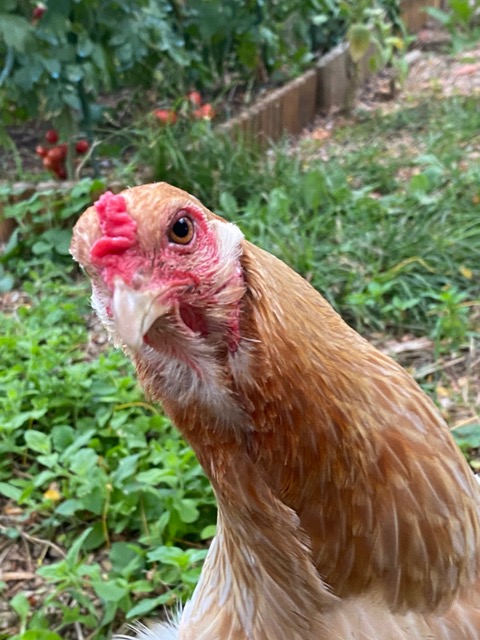
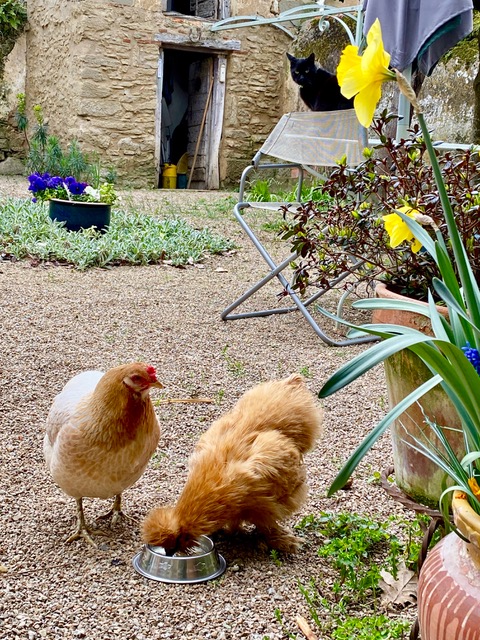
These fluffy chicks, with unusual sticky-out plumage, arrived last week–the gift of our friend and neighbor Flo.

Four of them–five weeks old; a possible cockerel (the little red cockscomb is the give away, it seems) which we’d return if confirmed–and three females. They busied themselves immediately–casing the joint; in and out of the abundant foliage which is growing like mad–there’s been so much rain.

Chuck-chucking round the courtyard they went, checking for bugs and other goodies in this new environment–content to forage and let the morrow look after itself.

Oh dear..!

We had a job herding them into the little hen house for the night–why don’t they know it’s for their own good!

Chased them round and round the courtyard–a comic carousel–until the bright idea of backing them into little hall area of the dependence (side building) occurred.

One by one, we cornered them–me holding out the light long handled fishing net used to catch mice and relocate them! Meredith grabbing them and after much squeaking–poor terrified creatures–folding them gently but firmly through the door of the henhouse–why don’t they know it’s for their own good!

Down went the flap on the last one and we sighed with relief. Safe for the night.

Oh dear..!

An appointment in Toulouse means an early departure the next morning.

Meredith takes out a bowl of food just before we leave.

Silence…

I follow her out to see how the little chickadees are doing.

They’re dead! 

Dead?

All four!

And indeed there they were lying inert in the fresh hay.

We had the whole day in Toulouse to wonder how in the world..!?

Meredith started itching. Little mites had colonized her since she handled the chicks. Could they have done for them? Were they fatally  traumatised by our efforts to coral them into the henhouse? Had they eaten something poisonous in the courtyard? Was the henhouse itself infected with a virus? Seemed unlikely.

By the time we arrived home, Flo’s husband Thierry had come by to take them away.

Flo came up with the more convincing answer the next day.

fouine (stone marten) attack.

images

a pretty little stone marten–pretty but lethal!

Our friend Jean-Phillippe–here for seasonal box hedge clipping–confirmed this theory.

Dramatically he held up his pen, saying the little predator is able to get through a hole as small as the circumference of a pen.

The marten then goes for the jugular and turns into Dracula!

This explains the almost unharmed look of the chicks as they lay dead on the floor of their short lived new home.

Oh dear

A sad tale from the Tarn.

Does it mean perhaps that no more little hens can safely inhabit the courtyard of Saint Martin for fear of the deadly night rambler–the unseen Stone Marten?

Rachel Lucas just left a comment following the post on Keith Richmond’s olive oil:

I prefer olive oil to butter on everything…currently on steamed English asparagus at almost every meal!….

It inspires me to reproduce the recipe for Roast Asparagus from Delicious Dishes for Diabetics.

IMG_7838

We are eating a lot of asparagus at the moment; it’s hard not to–it’s the season and the poor weather has meant the changes that should be happening now are unusually slow in arriving.
Roasting it for a short time at a high temperature makes for a different taste and texture.
We just had some for lunch with a simple new fish recipe for plaice which I’ll post soon.

Asparagus is wonderful, but even in its short season it can get a bit repetitive! This is a handy alternative way; quick and easy with the thinner type.The addition of thyme comes from the River Café.

2 tbsp olive oil
500 g/1 lb asparagus

2 tbsp fresh thyme leaves

salt

1. Heat the oven at 220°C/425°F/Gas Mark 7.
2. Heat the oil in a shallow baking tray.
3. Turn the asparagus in it and sprinkle over the thyme and

some salt. The roasting time depends on the thickness of the asparagus: about 5 or 6 minutes for thin and a bit longer for the fatter size. It should crisp up a bit.


logo-Boggioli
slide-1

Our friend Keith Richmond has a thousand olive trees in the Tuscan hills, south east of Florence.

IMG_3130

Keith shows off tomato bruscetta at a local restaurant in Radda in Chianti.

Every November he harvests his olives and wins prizes with the rich green oil they produce.

new olive oilMG_4997

He recently picked up a gold medal in Los Angeles and another important prize in Germany.

We first met him at an olive oil tasting demo in Florence and were smitten with his passion for this miraculous product and his beguiling way of expressing it.

He knows his subject.

I thought I’d ask him to write a brief note about the tricky task of choosing a good olive oil.

He obliged with this:

It occurs to me that, since you mention extra virgin olive oil so often in your recipes and recently extolled the virtues of the Mediterranean diet in your blog, some of your readers may like to have some pointers on how to select an olive oil of good quality.

IMG_5320

The supermarket shelves are loaded with olive oils of questionable quality, many of which may be suitable, I imagine, for frying or cooking in general. Price is certainly an important first indicator: cheap oil is, well, cheap oil – and you get what you pay for!

When taste and flavour are indispensable you have to go to the top of the range. Ideally you should know the grower and how the olives are processed. Obviously that is seldom possible, so the best alternative is to head for the more expensive olive oils on the shelf. You are more likely to find an olive oil of good or even exceptional quality in that way, especially if the label indicates that the olive oil is organic (‘biologico’ in Italian, for example) and that it is (for Italian olive oils at least) IGP or DOP, a sort of appellation controllée. This means that the olive oil has passed rigorous olfactory and chemical tests and is reliable.

Pay attention to the ‘best by’ date. This should never exceed 18-24 months after the year of production. Oils can still taste good after that date but will have gradually lost most of the characteristics beneficial to health. Also, you have no idea how the olive oil has been stored, so keep your distance from ‘old’ olive oils.

Your readers in North America would do well to consult a web site and blog run by Tom Mueller (www.truthinoliveoil.com). He gives a lot of sensible advice on a variety of oils that are available in the US especially.

I’ll be happy to answer any queries. Keep cookin’, best, Keith

This is meant as an introduction to his excellent site–which is worth a visit.

http://www.boggioli.com/

IMG_3506

Keith and Helen Richmond also offer excellent holiday accommodation on the farm.

http://www.boggioli.com/the-farm/hospitality/


IMG_3123

Consulting the oracle…

Chickpea bread

IMG_6259

This goes by a number of names and several shapes–socca, farinata di ceci, foccacia di ceci–depending where you eat it.

It’s street food eaten on the move.

There’s a recipe for it in my book, Delicious Dishes for Diabetics.

But here is a slightly different version–I’ll call it chickpea bread.

I’m going to buy some spring onions in the market tomorrow–well it is Spring though it’s difficult to credit–grill them as in A lovely mess of spring onions and spread them over the bread.

The sun is forecast tomorrow and we’ll eat it sitting down!

Joy!

1 pint/580ml sparkling water

8oz chickpea flour–(aka gram, garbonzo flour and gluten and wheat free)

1 tsp baking powder

2 tbsp olive oil

half a small red onion–sliced fine

1 tbsp rosemary spears or more

salt and pepper

  • Pour the water into a large glass bowl.
  • Shake the flour and baking powder into the bowl through a sieve and stir it in.
  • Add the salt.
  • Add the olive oil and stir thoroughly.

IMG_6244

  • Cover the bowl and leave it to settle for a couple of hours.
  • When you are ready to bake the “bread”, stir in the onion and the rosemary.

IMG_6256

  • Heat the oven to 200C/400F.
  • Oil an oven tray and pour in the contents of the bowl, taking care it doesn’t slop over the sides.

IMG_6254

  • Gingerly lift it onto the top shelf of the oven and let it cook for 35 to 40 minutes.
  • It should have browned some.

IMG_6261Ease it out of the tray onto a serving board for easier slicing

IMG_6262

and grind some pepper over it.

(Good sautéed in olive oil the next day and eaten with a simple salad or try it topped with a fried or poached egg.)

It’s unseasonably chilly outside–the northwest wind at my back lending me a helping hand on the return part of my walk today.

Meredith just checked the diary and this day last year–the 12th of May– she and our neighbor Alice collected the first honey from our hive. The bees enjoyed a couple of days working the Judas tree last week–but they’ve retreated again and who knows when they’ll be honey again for tea!

Sunday is pasta night and I feel in need of strong flavours.

Anchovy and tomato–an old favorite comes to mind.

This was first published in October 2011–but it doesn’t feel inappropriate to rerun it this May evening!

Meredith and I have eaten this a thousand times.

It is from the matchless Marcella Hazan and is probably my favourite pasta dish of all time–comfort food par excellence!

What makes it so delicious is the anchovies–controversial little fish–not to everyone’s taste.

Here they deepen the taste without dominating.

Those preserved in salt are best–they dissolve more readily than those preserved in oil–but it’s a business preparing them for cooking.

Since I was diagnosed with type 2 diabetes we have eaten wholewheat pasta and now we prefer it. It’s available on the shelves of most supermarkets these days.

How al dente it’s cooked is a matter of taste.

In Italy you’d think it was an arrestable offence to overcook pasta–they cook it very al dente and it makes for agreeably slower eating.

for 4

2 medium cloves garlic–chopped

6 tablespoons olive oil

anchovy fillets–chopped fine and pounded into a paste (with a mortar with a pestle if you have one)

2 good tablespoons parsley–chopped

400gm tin [can] of tomatoes–chopped with their juice

salt & pepper 

400gms wholewheat spaghettini

  • Lightly sauté the garlic in small saucepan until it colours.
  • Take the pan off the heat and add the anchovies and parsley– stirring well to dissolve them into the oil.
  • Add the tomatoes, salt and pepper.
  • Cook at a steady simmer for about 25 minutes, stirring regularly.
  • When ready, the sauce will have an unctious consistency and a little pool of oil on top.

Cook the spaghettini in plenty of well-salted boiling water.

  • Test for your preferred “doneness”.
  • Drain, put in a heated bowl and add the sauce.
  • Mix well and serve.
RobAnghorses_2

With fond memories of the late Angharad Rees

The BBC announced yesterday that Poldark is to be remade and will hit the screens in 2015–the 40th anniversary of the original showing.

Amazing news for everyone who loves a good story, for fans of the original, for Cornwall and for a whole new generation who are unaware of the rich pickin’s in Winston Graham’s saga.

His stories and characters are still being enjoyed 70 years after he wrote the first book in 1945. They still stand up–as many who contribute to this blog bear witness.

Our Winston was a master storyteller and we, the original cast, were lucky to be involved.

Mammoth Screen is the company producing the new version.

They have recently been responsible for Parade’s End and Endeavour (the prequel to Morse). Both period pieces done with a care and attention to detail that bodes well for the remake of Poldark.

Richard Morant, the first Dr. Enys, who died too young at 65 in 2011 was asked in a TV programme what made Poldark a success. He replied:

It’s about love—it’s about betrayal—the things that hurt us– the things that give us joy….Where people you know are going through their emotions, expressing their feelings of love, life and death–it evokes strong attachments, strong passion–and you love it! You love them, you love the people, you cherish them, you honour them, you respect them!”

Winston would have liked this explanation and I’m sure would have joined me in wishing Good luck to everyone involved in the new project.

Follow

Get every new post delivered to your Inbox.

Join 687 other followers